Daily insights for city builders, delivered every morning at 6 AM ET. I’m Brandon Donnelly — a Toronto-based real estate developer and founder of Globizen. I’ve been writing here since 2013.

Tag: fashion

  • Fashion nothingness

    Fashion, like architecture, says a lot. It is, according to Wikipedia, an “aesthetic expression at a particular time, place and in a specific context.” So it’s interesting to consider how fashion might translate, and not translate, around the world. This recent article by The Economist, called “The United Nations of Uniqlo,” offers up one comparison, albeit a generalized one, between Japanese and American clothing preferences. (It’s an article about the Japanese fashion label Uniqlo.)

    Japan:

    At first glance there seems nothing obviously Japanese about Uniqlo’s wares. But a strong strain of minimalism pervades Japanese culture. Buddhism remains an important influence on Japanese society even in an increasingly secular age, and among its core tenets are renunciation and detachment – concepts that mean being able to suppress one’s lust for the material elements of daily life. Mario Praz, an Italian critic, contrasts the Japanese style with the suffocating abundance of Victorian interiors in Europe and America which, he says, stemmed from horror vacui (fear of emptiness). More recently, young people in the West have also grown less enamoured with acquiring stuff, hence the widespread popularity of another Japanese export: Marie Kondo, a professional declutterer.

    America:

    The American market has proved harder to crack. The 56 Uniqlo stores in America fall far short of Yanai’s plan, in 2012, to open 200 there. They still operate at a loss. “When you think about the American market, you don’t always think of subtlety,” said Steve Rowen of Retail Systems Research, a consultancy. “This is a social-climber society. Even if you want to fly under the radar, there still has to be some indication that you’re fashion forward.” Once that urban millennial with a starter job begins to make real money, Rowen postulated, “they move past a brand like Uniqlo pretty quickly.” Americans are perhaps willing to embrace invisibility only until they are rich enough to want to be seen.

    You could probably also fashion a similar argument around housing preferences. The Japanese are known for their minimalist houses, as well for completely different views on housing in general. But we shouldn’t forget that good minimalism is expensive. Remember: “Only the rich can afford this much nothing.” Maybe that’s what Uniqlo needs to do in America. The problem is that its nothingness isn’t expensive enough.

  • Project Profile: Hotel Emiliano, Rio de Janeiro

    image

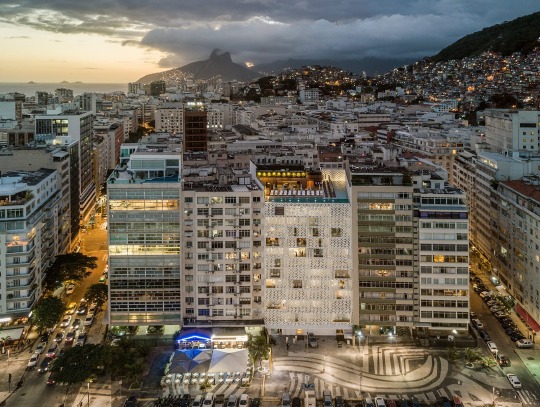
    This is not exactly a new project. The hotel, pictured above, opened in 2016 and was the brand’s second location (their first opened in São Paulo in 2001). But I like the story and how it was executed.

    Hotel Emiliano is the work of husband and wife team Gustavo Filgueiras and Andrea Colli Filgueiras. He is a hotelier. And she is a jewelry designer. Both wanted to pay homage to the glory days of Rio’s Copacabana Beach.

    Designed by Arthus Casas and Chad Oppenheim – who, by the way, recently built himself a stunning home in the Bahamas – the 90-room hotel is clad in white shutters that can be used to modulate the Brazilian sun. 

    image

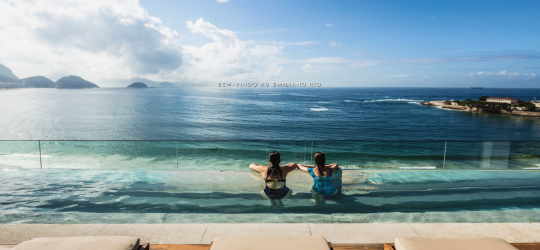
    On the roof is an infinity pool with a glazed side. Here is a screen grab from the hotel’s website:

    image

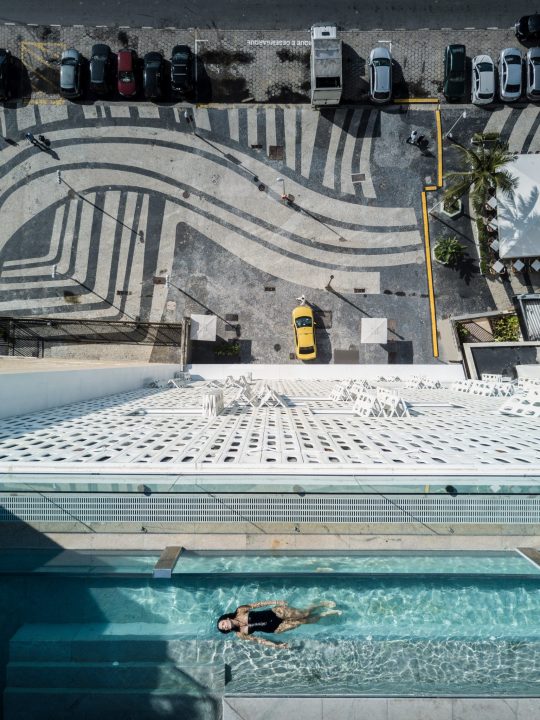
    And here is an aerial view of the pool taken from Dezeen:

    image

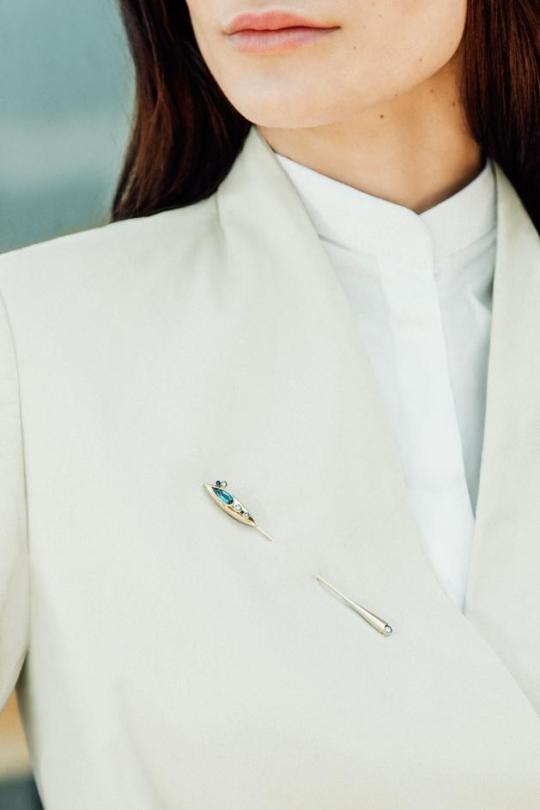
    The uniforms for the hotel were designed by Barbara Casasola and a custom jewelry collection was created by Andrea Colli. 

    image

    For more photos, check out Dezeen and Wallpaper.

    Architectural photography: Fernando Guerra

  • “BRAND”

    image

    For a number of reasons, I am fascinated by the streetwear label, Off-White

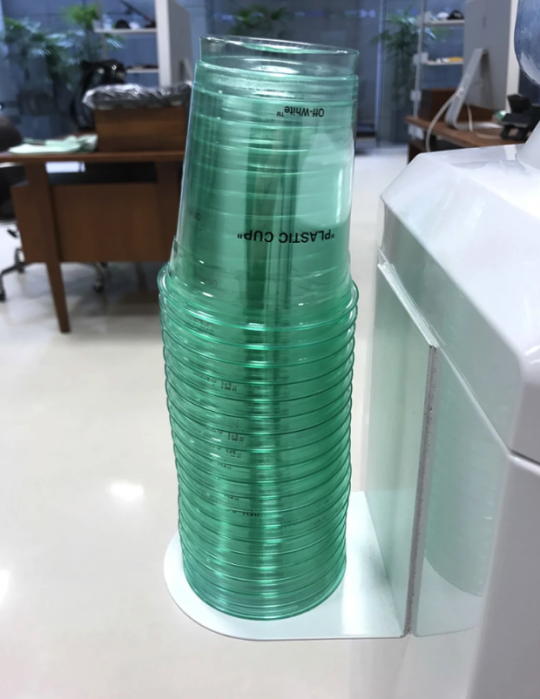
    It is one of the hottest labels in fashion, and yet there’s a part of me that doesn’t really get it. It’s mostly bold text, usually in quotations, on various apparel items. A set of Wellington boots might be plastered with “FOR RIDING.” A winter coat might be plastered with “DOWN JACKET.” And when they collaborate with Nike, the shoes might be tagged with “AIR.” Quotations included. Is that fashion?

    But then you hear Virgil Abloh – the founder of Off-White, who by the way was also trained as an architect before becoming creative director for Kanye West – talk about his brand and it starts to make more sense. The quotation marks are supposed to signal “ironic detachment and a comment on the idea of originality.” Okay, so a little more sense.

    Part of his inspiration comes from the work of Marcel Duchamp. In 1917, Duchamp shocked the art world with, Fountain. Some would consider this to be the most pivotal art piece of the 20th century. It was an off the shelf urinal that he simply signed, dated, and placed on a pedestal. Though initially rejected as art, it eventually redefined what art could be, shifting it from, “new physical creations to [the] moulding [of] ideas.”

    The corollary to this was that anything could be art, even something as utilitarian as the catch basin that you pee into. And this insight is something that Abloh has used to fuel his label. But he has taken it a step further. He has leveraged the ubiquity of these everyday-items-elevated-to-art as a way to elevate his own brand. Here’s a quote by Abloh from the Guardian:

    “The idea [that] an everyday object is art. Branding is generic and if I adopt the generic, then it becomes my branding, but it normally occurs in life.”

    In other words, he is co-opting generic and ubiquitous items – like, for instance, the patterning on caution tape – for his Off-White designs. And if you believe that a bit of brand equity is at least partially driven by brand ubiquity, well then you might start to see the value in this approach. He is simply assigning authorship to things that are already omnipresent.

    But, is that fashion? I guess that depends on whether you consider Duchamp’s Fountain to be art.

    Image: SSENSE

  • A demand-driven apparel world

    Here is an interesting article from Loose Threads that talks about the profound impact that data and fast fashion are having on apparel brands, transforming them from supply-driven businesses to demand-driven ones. It adds a bit more nuance to the trope that tech is disrupting retail simply because people are choosing to buy online.

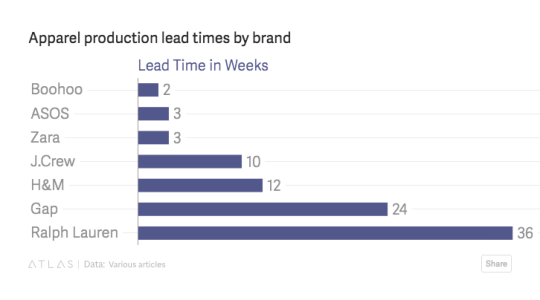
    The argument, here, is about a more fundamental shift in commerce. Brands are now forced to move faster than ever before. Product lead times are dropping (see below via LT). Customer feedback loops are almost instantaneous because of social. And the result is that customers are now the driver: Figure out what people want right now and then create that supply as quickly as possible.

    image

    Fast fashion certainly isn’t a new concept, but the data, algorithms and demand planning systems are only becoming more robust. Merchandise buying – historically the work intuitionists trying to predict what customers will want seasons into the future – is now an automated process that optimizes itself following every click, abandoned shopping cart, and social media like. 

  • Experiences over fashion — or is that really the case?

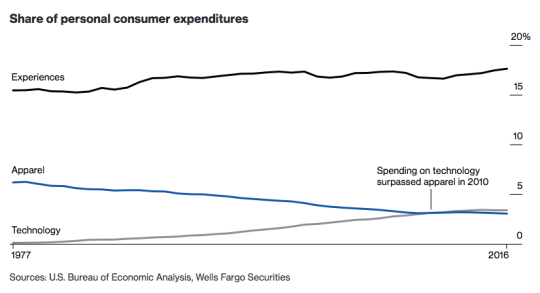
    Bloomberg recently published this interesting piece talking about the death of clothing. The reasons are as follows: we’re spending more on experiences, as well as technology (tech spending surpassed apparel spending in 2010); casual dress in the workplace has become more widely accepted; fast fashion companies like H&M and Zara are putting downward pressure on prices; and social media influencers – instead of big companies – are now the ones showing us what to buy and wear.

    Here is a graph from the article comparing experiences, apparel, and technology expenditures: 

    image

    The first thing I noticed is that experiences, while still increasing, haven’t really spiked since 1977, even though everybody seems to be talking about how social media-fueled Millennials are all about experiences. I was also surprised to see that the share of US employers that allow casual dress every day seems to be closing in on 50%. (Informal survey for the comments and for Twitter: Do you wear casual clothes to work? I’m a no.)

    But perhaps the biggest contributors to this decline are fast fashion and low-cost manufacturing. Stanley Pignal – South Asia business and finance correspondent for the Economist – pointed out on Twitter that since 1982 inflation in US apparel was only 123% compared to 248% for overall CPI. So maybe a lot of the above reasoning is just a distraction.

  • “Liberate these objects from their containment”

    Architect Rem Koolhaas recently unveiled a backpack that he designed for Prada’s autumn winter 2018 menswear collection

    It looks like this: 

    image

    It’s more of a frontpack. Actually, maybe the right name is chestpack.

    What stood out for me, though – perhaps more than its frontality – was the way that Rem Koolhaas described his reasoning behind the design.

    Here is an excerpt from Dezeen:

    “Today, waiting in line for a typical airport check of carry-on luggage, it is surprising to note how the shapeless container of the backpack, is inhabited by strict, orthogonal devices like the laptop, the charger, books, toilet bag, and how awkward it is to liberate these objects from their containment in the backpack,” he said.

    “This project proposes a reinterpretation of the backpack, more suitable to the contemporary urban citizen,” he continued. “The frontal position gives a more intimate sense of ownership – a better control of movement, avoiding the chain of oblivious collisions that the backpack inadvertently generates.”

    Leave it to an architect to talk about a backpack like the wearer is about to go to war.

    P.S. I’m a fan of Koolhaas. I just found this funny.

    Image: Prada

  • Saks x Dim Mak

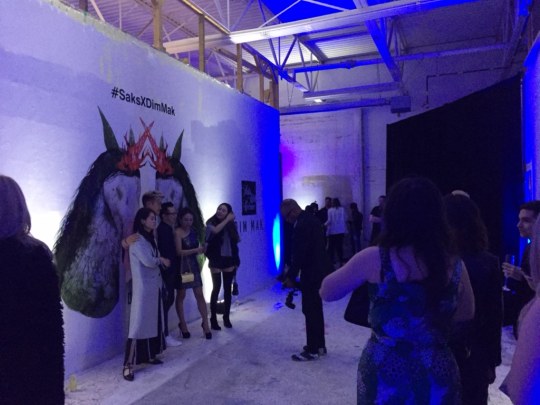
    Steve Aoki was in Toronto today for a collaboration with Saks Fifth Avenue – namely the launch of his fall/winter Dim Mak Collection

    The after party was at Junction House (the pre-development version). Here is a photo:

    I actually wasn’t there (because I’m fighting off some sort of cold), but a friend sent me this photo. 

    It’s such a great space for events and production. It used to be an artist studio, but they moved out because they outgrew the space.

    If you have a need for a large warehouse space, you can actually rent it by visiting here.

  • The value in small retail spaces

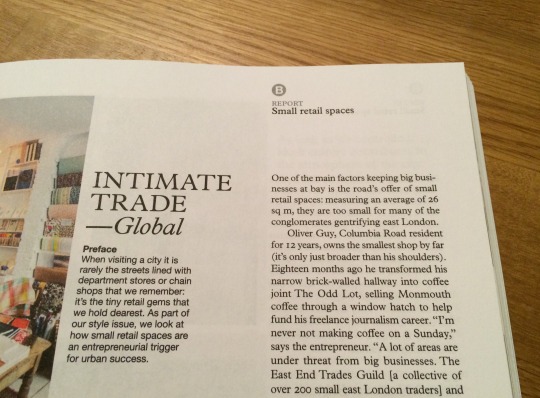
    image

    This month’s issue of Monocle is centered around fashion, style, and retail. And one of the most interesting pieces is a report on small retail spaces. 

    The argument (which you can read in the preface shown above) is that micro retail spaces are incredibly important for entrepreneurship and urban vitality. Because if all a city has is large retail spaces, then you’re creating impossible barriers for new retail startups. The rents simply become too high.

    It’s on page 79 in case you have this month’s issue or want to go pick it up.

    After reading the article, I immediately thought of 2 posts that I recently wrote on related topics. The first is “Incubating new ideas in cities” and the second is “The hard things about retail.”

    In the first post, I questioned how cities might be able to encourage and incubate new ideas alongside new development and buck the Jane Jacobian truism that new ideas require old buildings. And in the second post, I expressed my concern for a micro retail condo complex here in Toronto that appears to be struggling.

    But maybe that micro retail complex is on to something (just with the wrong tenure: condo instead of rental). Maybe it’s as simple as starting with great urban design and small (affordable) retail spaces. 

    It seems to be working for Columbia Road in London, Knez Mihailova in Belgrade, and Tower Theater in Los Angeles (the 3 examples that Monocle gives).

  • Spring forward with Apple’s new watch

    image

    Today was Apple’s big “Spring Forward” event. We already knew the Watch was coming, but now we know that it’ll be available for sale on April 24, 2015 and that their high-end “Edition” line will start at just $10,000.

    Within the tech community, there are mixed opinions when it comes to the Apple Watch. Some think it’ll be a total flop. Some think it’ll be the next iPhone. And some think it’ll do reasonably well, but that it just won’t be the next category killer for Apple.

    I personally think it will do really well. 

    I think there are enough use cases for which looking at your wrist is a better experience than pulling out your phone – particularly for quick glance activities. Think payments, transit fares, airline tickets, location-based notifications, and so on. 

    However, one of the big challenges for Apple Watch will be that they’re trying to replace an entrenched fashion piece. So not only is Apple trying to solve a problem that most people didn’t know they had, but they’re also trying to get people to give up their Movado or Patek Philippe – which is why they created a super high-end line.

    Whatever the case may be, I plan to pre-order a Watch next month (just the regular one, not the $10,000 one).

    I’m excited to try the health features (it’s a passion of mine). I’m excited to see what kind of data this new device generates both for me personally and in aggregate. And I’m excited to see what clever software developers end up creating for this new platform. Because that’s where the real potential lies.

    It might not seem like a big deal to move a computer from your pocket to your wrist (assuming people are willing to do that). But I think we’ll all be surprised at what kind of new ideas that generates.

    Hopefully I’ll soon be able to board a Toronto streetcar and tap my wrist to pay the fare. That would certainly be a civilized way to travel.

    What about you? Do you plan on buying an Apple Watch?

  • A brief history of T. Eaton Co.

    image

    I was out last night near Yonge and College for a friend’s going away party and the topic of the College Park building came up (originally an Eaton’s department store). We talked about how in the 1920s it was planned as a 38-storey Art Deco tower (see above photo), but that the Great Depression forced Eaton’s to scale back their plans. They ended up building a 7-storey building, albeit an impressive one.

    Then today, thinking about that discussion, I became curious about the story of Eaton’s. Where exactly did it start and how did they get to a point where they were planning the largest retail and office complex in the world?

    Well, as many of you probably know or can guess, the first Eaton’s store was opened where the Toronto Eaton Centre mall currently sits today. The exact address was 178 Yonge Street, which is just north of Queen Street. But what was interesting about this location is that, at the time, it was considered to be far removed from Toronto’s center of fashion and retail. That was King Street East. Below is a map from 1842.

    image

    In 1869 when Timothy Eaton opened his first store, the heart of Toronto was what is today known as Old Town (although most people would probably just refer to it either as King East or as the St. Lawrence Market). People shopped along King Street between Yonge and Jarvis, and Queen Street probably would have felt out of the way.

    image

    But Eaton’s succeeded at Yonge & Queen, along with rival store Simpson’s, and retailing shifted northward. With Eaton’s College Street, the company was once again looking north. In fact, they wanted to move their entire operation from Queen Street up to College Street, and they even tried to get Simpson’s department store to do the same (somebody clearly understood agglomeration economies).

    But since the full build out of Eaton’s College Street never actually happened, both stores were kept in operation and a customer shuttle bus was run between the two of them (until the Yonge subway line opened up in the 1950s). With the opening of the Toronto Eaton Centre mall in the 1970s, Eaton’s closed both Queen and College Street locations, and consolidated operations near Dundas Street.

    In 1999, after 130 years of operation, the company went bankrupt.

    What I find interesting about this story is that it speaks to how dominant the department store business model was at the time and how it was shaping the city around it. If Eaton’s had achieved its vision for the corner of Yonge & College, Toronto might look a lot different today. Perhaps we’d all be shopping for fashion along College Street.