Daily insights for city builders. Published since 2013 by Toronto-based real estate developer Brandon Donnelly.

Tag: european cities

  • Living vs. just visiting — do these two things require different built environments?

    Many years ago I was in a community meeting talking about a proposal we had to add retail uses adjacent to a park. Residential was the highest and best use, but we were excited by what retail could do for the project and area. We were imagining something like a Parisian cafe where everyone would sit facing outward toward the park.

    Much to our surprise, the community was vehemently opposed. And when we eventually asked who had been to Europe and sat outside in a nice cafe, the response we generally got was, “yeah, we have, and it’s obviously nice there, when on vacation. But that’s Europe. It won’t work here and it’s not appropriate for the area.”

    Hmm. This raises all sorts of interesting questions. But for today, let’s ask this one here: Why is it that some people choose to live in places that are so different than the ones they visit when on vacation?

    Is it because we, as humans, want fundamentally different experiences when we travel? i.e. We want to escape from our current reality. “Oh look how novel this is.” In this case, I guess you could say that our markets are fairly efficient and people are getting the kind of lifestyles that they truly want, both at home and abroad.

    Or, is it because, for a variety of reasons, we’ve created rules and obstacles that force certain built form outcomes? We think the other ways won’t work. I often find myself in this latter camp, meaning that when I travel, I at some point end up thinking: “This is a good idea. I want to both move here immediately, and steal this idea and bring it back to Toronto.”

    How about you?

    Photo by DAT VO on Unsplash

  • Canal houses and rental barracks

    Feargus O’Sullivan’s CityLab series on European housing typologies started in London, but has since gone on to cover Berlin’s mid-rise tenements — called Mietskasernen — and Amsterdam’s canal houses. The series is exactly the sort of thing that I like to geek out about. In fact, I can see a book on this topic staring at me from my bookshelf.

    If you end up taking the time to read the articles, you’ll be reminded of a couple of things about the way cities work. One, the way we use buildings changes over time. Two, the kind of architecture we pursue is always a reflection of the socioeconomic milieu at that particular moment in time. And three, the way we perceive buildings also changes over time.

    In the case of Amsterdam’s canal houses, their original function was live/work. They were residences, but they were also warehouses. Amsterdam’s maritime dominance meant that it was more profitable to store things, instead of just house people. (Sometimes as much as half of the house was dedicated to storage.) Trade patterns had moved from the Mediterranean up to the North Atlantic, and that worked out pretty well for the Dutch in the 17th century.

    In the case of Berlin, their typical mid-rise “rental barracks” went from reviled to coveted as the buildings aged, elevators made the penthouses desirable, and people started to appreciate some of their idiosyncrasies. It’s an example of what I was getting at when I spoke to the CBC for this article about Toronto’s skyscraper boom. Some things, including buildings, take time. They need to settle in.

  • The first North American night mayor

    With Mirik Milan (Night Mayor of Amsterdam) speaking at the upcoming NXT City Symposium here in Toronto, I figured it was time to revisit the topic of night mayors. If you’re new to this topic and/or the blog, you can get yourself up to speed here (scroll down).

    Firstly, this idea is clearly spreading and it just crossed the pond. Last month on August 24, 2017, New York City Council voted to create the “Office of Nightlife.” It’s a small start. The office will have an annual budget of $300,000. But that’s okay.

    As far as I know, NYC is now the first major North American city with government humans focused on leveraging the benefits of the nightlife industry.

    For the record, my post “Why Toronto needs a night mayor” was published in March 2016. It was obvious that the idea was already spreading throughout Europe and I was hoping that this city (Toronto) take notice and decide to lead within North America. New York City decided to do that instead.

    Secondly, CityLab published an article today called how to be a good night mayor. It is about what NYC can learn from the European cities who are already experimenting with this kind of office. Perhaps my favorite is the recommendation to “reflect your own city’s DNA.”

    Of course, having a night mayor is one thing. Making it highly effective is another. In that regard, it is still early days for North American night mayors, and night mayors in general. Who will truly lead?

    Photo by Alina Grubnyak on Unsplash

  • European cities by rail connectivity

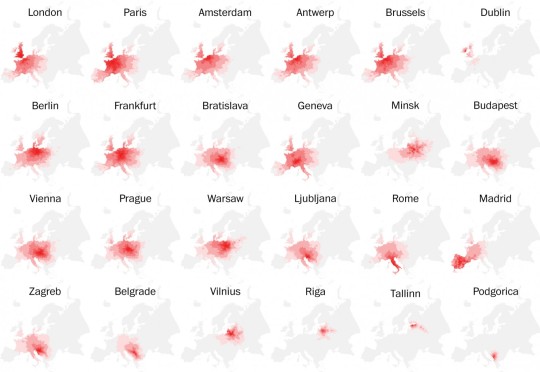
    This is a terrific set of maps published by The Washington Post (2015) using data originally collected and published by Peter Kerpedjiev:

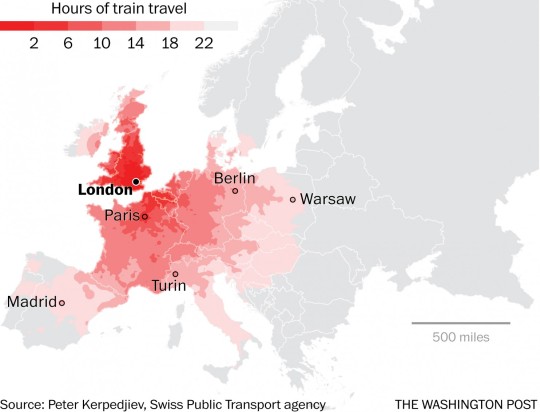
    What they show is how far you can travel in a 24 hour period using only trains and brisk walking from a collection of 28 European cities. In a few cases, such as from London to Dublin, a ferry ride is also included.

    Here’s a zoom in on London:

    The obvious takeaway is that Western Europe is very well connected, whereas many parts of Eastern Europe are not. Some cities, such as Tallinn (Estonia) and Podgorica (Montenegro) are almost completely disconnected.

    Of course today there’s stiff competition from air travel.

  • Lisbon creates 24-hour district

    About a year ago I wrote a post called, Lisbon is the new Berlin. The timing of the post happened to coincide with Monocle’s first ever Quality of Life Conference, which was held in the city.

    Since then, I’ve been keeping an eye out for all things Lisbon and the city has quickly jumped to the top of my list of places I want to visit. I am obsessed with understanding the triggers that catalyze change within a community and/or city.

    On a related note, Lisbon has recently put in place new regulations to control nightlife in the city. Bars in certain areas must now close at 2am on the weekdays and 3am on the weekends. Outdoor patios must close at midnight. If you have the right kind of soundproofing though, your bar can remain open until 4am. The impetus for these changes was to address nightlife noise complaints – a perennial problem in many cities.

    However, Lisbon has also created a 24-hour district along a supposedly underdeveloped area of the waterfront. This means that bars and clubs in this area will have the option of staying open 24/7. At the same time though, investments are being made (Portuguese article) to transform the area into something more than just a place for drinking and dancing.

    I am noticing a real trend in European cities around using nightlife as a strategic lever to attract talent and revitalize neighborhoods. Oftentimes the knee jerk reaction is to simply focus on the negative externalities associated with nightlife. But there are strategic benefits. Many cities today recognize that.

    Image: Mhx on Flickr