Daily insights for city builders, delivered every morning at 6 AM ET. I’m Brandon Donnelly — a Toronto-based real estate developer and founder of Globizen. I’ve been writing here since 2013.

Tag: ed glaeser

  • Consumer city and playground city — are they any different?

    One conventional way to think about cities is that people migrate to urban areas in order to make more money. This remains true today and the data is pretty clear that, if you live in an urban area, you’re likely to make more money than if you didn’t — even if you’re just as educated. You’re also likely to make even more money if the city is really big (there’s a correlation between income and city size). And you probably also walk a little faster given that, you know, time equals money.

    But there are other reasons for wanting to live in a city. And probably the biggest is that they can bring us pleasure. Back in 2001, Edward Glaeser, Jed Kook, and Albert Saiz published this paper called, “Consumer City”, where they showed that high amenity cities have tended to grow faster than low amenity cities. They also went on to demonstrate that, in high amenity cities, urban rents have tended to increase faster than urban wages, suggesting that there are other reasons for wanting to live in a city beyond simply wage growth.

    Fast forward to today and Ed Glaeser has a new opinion piece in the New York Times arguing the following:

    New York is undergoing a metamorphosis from a city dedicated to productivity to one built around pleasure. . . The economic future of the city that never sleeps depends on embracing this shift from vocation to recreation and ensuring that New Yorkers with a wide range of talents want to spend their nights downtown, even if they are spending their days on Zoom. We are witnessing the dawn of a new kind of urban area: the Playground City.

    I saw City Observatory comment that they thought it was odd Glaeser didn’t mention his previous work on the Consumer City. But I wonder if this is him not wanting to suggest that this was a trend decades in the making. Maybe instead, he wanted to position it as a dramatic and profound shift brought about by a pandemic. But how can you not ask this question: Is the Playground City truly something novel, or are we just following a trend line?

    In my view, they’re not all that different. The basic idea is that people like cities that are cool and fun, and so they will pay a premium to be in those kinds of places. This was true in 2001 and it’s still true in 2023. The only difference today is that we now believe we have too much office space in some markets, and so we’re trying to recalibrate around work vs. pleasure. But even with this, the work component of our cities isn’t going to zero.

    Photo by Jan Folwarczny on Unsplash
  • Urbanization since the 14th century

    This morning I stumbled up on this conversation between Richard Florida and Ed Glaeser about the post-pandemic city. It’s from September 2020 and that is obvious in some of the comments. Richard Florida (who was in Toronto) remarked that it felt like the pandemic was mostly over at that time and that Canada had seemingly done a much better job than the US at tackling it. That no longer feels right. But I did find myself agreeing with some of their other points.

    Here’s one from Ed Glaeser that looks back to previous health crises:

    But pretty much since the 14th century, urbanization proceeded despite the reappearance of the Black Death in the 1350s. Urbanization proceeded despite the Great Plague of London in the 1660s. All of the great diseases that spread in 19th-century America, cholera, yellow fever, the urbanization just chugged along. Even the influenza pandemic of 1919-1920 was followed by a tremendous decade of city building. So, I think our cities have proven to be remarkably resilient.

    For the full conversation, click here.

  • The fall of the Roman Empire and the future of cities

    Harvard economist Ed Glaeser and former New York City Health Commissioner Mary Bassett were recently interviewed on national radio about COVID-19 and the future of our cities. What both of them touch on is the long history that cities and pandemics have had together, which is something that Glaeser also wrote about over here in City Journal. This pandemic isn’t the first and it won’t be the last.

    Using history as an example, Glaeser makes the argument all of this can go one of two ways. After the influenza epidemic of 1919, cities rebounded quickly. The roaring twenties were one of “the great city-building decades in American history.” But on the other hand, there’s the Justinian Plague (circa 541 to 750 CE), which is thought to have played an important role in the fall of the Roman Empire. Glaeser argues that this plague, which took over 200 years to extinguish, is responsible for 800 years of de-urbanization across the Mediterranean. Is that so?

    A quick search reveals that the impacts of the Justinian Plague are, of course, greatly contested. Some scholars have questioned whether it was actually an “inconsequential pandemic.” Whatever the case may be, it doesn’t change the fact that the modern world has been built around density and proximity. We are social beings and we are smarter and more productive when we are able to cluster together. That was the case in 750 CE and it remains the case today.

  • Thoughts on California’s wildfires

    What is happening in California right now is both sad and scary. I woke up to these photos in the New York Times. So I spent the morning reading up on wildfires and what causes them. 

    I am sure many of you are thinking: Is climate change doing this?

    It’s important to note that California is designed to burn. The characteristics that make the state a highly desirable place to live – mild winters and hot and dry summers – also make it a highly flammable place.

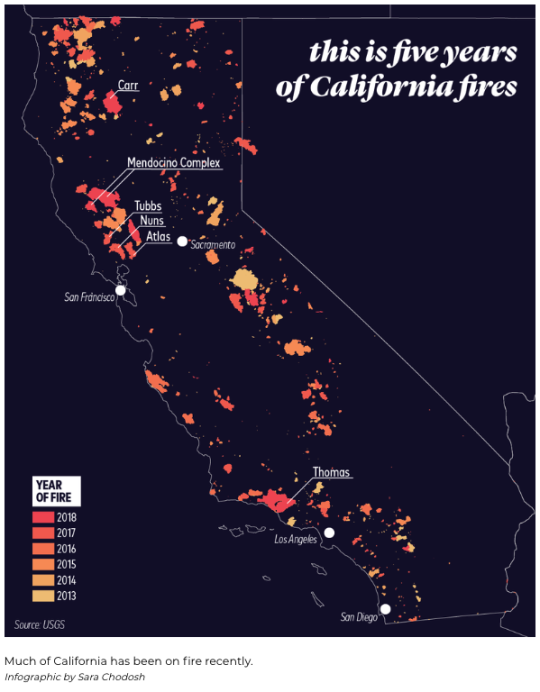
    Below is a map from Popular Science showing how much of California has burned over the last 5 years. Most of California’s hottest fires (13 of the top 20) have occurred since 2000.

    image

    But these naturally occurring fires are actually important for the regeneration of its forests. So one argument is that the current policy of “total fire suppression” is actually partially responsible for this increase in severe wildfires.

    Low-intensity forests aren’t burning like they used to and it is creating more densely packed forests for even larger wildfires. In other words, through our actions we could be exchanging smaller and more frequent fires for bigger and more severe ones.

    The other concern is development. 

    California had a population of about 24 million people in 1980. Today it is closer to 40 million. And much of that growth has occurred outside of existing urban areas (too hard to build). This has meant more people living in suburban and rural areas – adjacent to wildlands.

    Ed Glaeser has repeatedly argued that the best way to respect nature is to actually stay as far away from it as possible. Humans are a destructive species. Living in a dense city is good for the planet.

    Now let’s address the climate change issue.

    Daniel Swain, who is a climate scientist and author of the Weather West blog, published this popular thread on Twitter about a day ago. At the time of writing this post, it had been retweeted and liked over 10,000 times.

    From his perspective as a climate scientist, this is not all about climate change. That’s the wrong question to ask. It’s more complicated and nuanced than that. But climate does indeed act as a “threat multiplier” to the other factors we’ve already discussed.

    Fire season typically begins and ends with rain. When the fall rainy season starts, the fire season ends. One of the biggest risk factors is a dry fall, particularly after a hot and dry summer (or after multiple hot and dry summers, as has been the case in California). 

    Because according to Swain, fall means the start of “offshore wind” season, which can help to stoke these wildfires. 

    Unfortunately, one of the projected outcomes of climate change for California is more precipitation concentrated in the “winter” months, at the expense of precipitation in the shoulder seasons (spring and fall). So that means a longer fire season.

    Swain believes that if Northern California had received close to its typical amount of rain this fall, it is almost certain that this tragedy would have been avoided. 

    That, however, makes me wonder about the relative importance of all the factors we have discussed today.

    For Daniel Swain’s full thread, click here.

  • How to revive the American Heartland

    “Every unemployed American is a failure of entrepreneurial imagination.” -Edward Glaeser

    At the end of September, economist Edward Glaeser returned to the Manhattan Institute to deliver the 2017 James Q. Wilson Lecture. If you’re a regular reader of this blog, you may remember that he was there in 2016 and delivered a presentation called “The End of Work.” 

    This year’s talk continues that theme, but focuses on joblessness and economic stagnation in the US Heartland. 

    The solutions he puts forward are based on a very simple economic model for growth that he refers to as “rules and schools.” Simply put: The rules of a place need to support business and entrepreneurship and the people need to be educated.

    One example he gives is of a woman in Detroit who was trying to start a food truck business but had to wait 18 months for a permit. There’s no reason that should happen. He blames the insider restaurant lobby for working to keep competition at bay. The rules are bad. We have similar problems here in Toronto with our food trucks. I think it’s wrong.

    He also pokes fun at the Bilbao effect. Yes, Frank Gehry created a beautiful piece of architecture. But did it lower the unemployment rate?

    The last thing I’ll mention are his comments regarding Amazon HQ2 because I like how he frames it. 

    Firstly, Amazon is going select a city that doesn’t need Amazon. It’s going to go where there’s already abundant human capital. 

    Secondly, “smokestack chasing” is not the right economic development strategy. The key questions should be: How will this benefit our human capital and how many new firms could it create?

    If you have an hour, check out Ed Glaeser’s talk. If you can’t see it below, click here.

    [youtube https://www.youtube.com/watch?v=e8LvHpRCUYk?rel=0&w=560&h=315]

  • Houston, the global city

    Houston doesn’t often get a lot of love in urbanist circles.

    Though since Ed Glaeser published Triumph of the City and declared Houston’s unfettered sprawl the secret sauce for housing affordability, it is now frequently held up as the shining example of why housing supply matters.

    But this is a hotly debated topic. 

    Ed Glaeser would argue that increased supply is the key to housing affordability. But Richard Florida would likely be quick to point out that Houston is also one of the most unequal and segregated cities in America. It is not the model we should be following.

    But let’s be positive today on the blog.

    At the bottom of this post is a great talk by Stephen Klineberg called: Houston, The Global City. Klineberg is a Professor of Sociology at Rice University and the founder of the Kinder Institute for Urban Research.

    In this hour long talk, he outlines, among other things, the remarkable transformation of Houston from a one-industry town (oil) comprised predominantly of white people to a mixed economy where every major ethnicity is now a minority.

    He also argues that Houston is at the forefront of the demographic shifts happening all across the country and that, without this inflow of immigrants over the past couple of decades, Houston today would probably look a lot like a decaying rustbelt city.

    It’s a good watch.

    If you can’t see the video below, click here.

    [youtube https://www.youtube.com/watch?v=SJdWYXIr_qE?rel=0&w=560&h=315]

  • Autonomous vehicles will strengthen the case for road pricing

    Joe Cortright of City Observatory recently published a post about the types of policies that cities should be looking to adopt in response to autonomous vehicles. It’s called: Pricing roads for autonomous vehicles.

    Many have argued, including urban economist Edward Glaeser, that autonomous vehicles are going to be positively disastrous for cities. Once you remove the labor costs associated with the driver and the overall price per kilometer plummets because of pooling/technological advances, we are going to see an huge surge in demand – well beyond the capacities of our roads.

    Of course, there are solutions. We can accurately price the roads, which is something that more cities should be doing today even before autonomous vehicles arrive. Here is an excerpt from Cortright’s article:

    “With modern electronics, and especially with autonomous vehicles, position and speed is monitored with great precision. There is no reason why they [drivers] should not pay for exactly the amount of roadway that they use. And we know that the cost of the city’s roadway varies substantially across space and over time. Use of road capacity in less dense neighborhoods at off-peak hours imposes nominal costs on the city’s road budget. In contrast, peak hour use of city streets and arterials, particularly in and near the city center, imposes huge costs on the city and its residents. Those who use the system at peak hours in congested locations should pay the costs associated with creating, maintaining, and where necessary expanding that infrastructure.”

    This isn’t a novel concept, which is why when Toronto was looking at a flat road toll I argued here on the blog that it was a step in the right direction but that it was too blunt a tool. 

    It’s a moot point now because sadly the province ended up pandering and rejecting the plan, but we should have been considering something that could achieve the above objectives. It needed more finesse.

    But in all likelihood our cities will have to face that reality sooner rather than later.

  • The war on work

    Air Canada bumped me from my flight this morning and so I am spending the day hanging out at Toronto Pearson Airport. I can think of more enjoyable ways to spend Canada Day, but at least there’s a nice seating area in Terminal 1 with free wifi and lots of plugs.

    I just finished watching the below talk by Harvard economist Ed Glaeser at the Manhattan Institute. His overall thesis is that unemployment is a far worse problem than income stagnation and that the US needs to stop creating incentives for people not to work. He refers to it as a war on work.

    He addresses a few topics that we’ve talked about here on this blog, such as guaranteed basic incomes, as well as others that we haven’t talked about, such as raising the minimum wage. To give you one spoiler: He argues that a higher minimum wage has been shown to cause an overall drop in employment, which he, again, believes is a deeper problem.

    Glaeser delivers a passionate performance. So if you have 30 minutes to spare – perhaps you’re stuck in an airport somewhere – I recommend you give it a watch. If you can’t see the video below, click here.

    [youtube https://www.youtube.com/watch?v=8xaNV_6wgak?rel=0&w=560&h=315]

  • Education and economic prosperity

    One of the things that I would like to do a bit more of in 2016 is coding. I used to a bit of it in high school and university, and I’ve taken some online classes since then, but I really feel like I should know more. I like making things and tech is clearly an important part of the world today.

    I mention this because I have signed myself up for an intro to web development class this evening at Brainstation. My plan is to do a few introductory web and mobile development courses and then figure out where and what I want to dive into further. I don’t plan on being a software developer – I’m happy being a developer of the real estate varietal – but I want to improve my literacy.

    I also mention this because I think it’s important to be reminded just how critical education is to urban economic success. Here’s an excerpt from Ed Glaeser’s book, Triumph of the City:

    “Human capital, far more than physical infrastructure, explains which cities succeed. Typically in the United States, the share of the population with a college degree is used to estimate the skill level of a place … Despite its coarseness, no other measure does better in explaining recent urban prosperity. A 10 percent increase in the percentage of an area’s adult population with a BA in 1980 predicts 6 percent more income growth between 1980 and 2000.”

    And if you plot education (people with four-year degrees) vs. per capita income levels for the major US metropolitan areas, which City Observatory did, you’ll see that nothing matters more. Here’s how City Observatory described it:

    “This chart is the first, most important thing to remember about urban economic development in the 21st century: if you want high incomes, you need to have a high level of skills. Cities with poorly educated populations will find it difficult to raise living standards in a world where productivity and pay depend increasingly on knowledge.”

    This, of course, isn’t new information. I’m sure I’ve written about it before. But it doesn’t hurt to be reminded.

  • The Next Urban Renaissance

    The Manhattan Institute for Policy Research has just published a free book called, The Next Urban Renaissance: How Public-Policy Innovation and Evaluation Can Improve Life in America’s Cities.

    Here’s an excerpt from the foreword:

    This collection of essays brings together the best ideas from scholars with expertise across a broad spectrum of urban issues. The common theme of the papers is to innovate, evaluate, and leverage the remarkable private talent that is so abundant in America’s great cities. Public capacity is sharply limited; the ingenuity of urban entrepreneurs seems practically boundless. Local governments should be more entrepreneurial and do more to use the talents of the entrepreneurs around them.

    As a further preview, two of the ideas suggested in the book include: 1) reducing or eliminating parking requirements for new developments (which is something I’ve written about before on ATC) and 2) implementing a split-rate property tax for land and its improvements.

    If you’d like to download the free PDF, click here.