Daily insights for city builders, delivered every morning at 6 AM ET. I’m Brandon Donnelly — a Toronto-based real estate developer and founder of Globizen. I’ve been writing here since 2013.

Tag: economics

  • Young, rich, childless, and white

    Whenever I’m not sure what to write about, I just read. That’s one of the big benefits of daily blogging – it forces me to do that.

    This morning I stumbled upon the blog of Jed Kolko. Jed is an economist and, up until 2015, he was Chief Economist and VP of Analytics at Trulia.

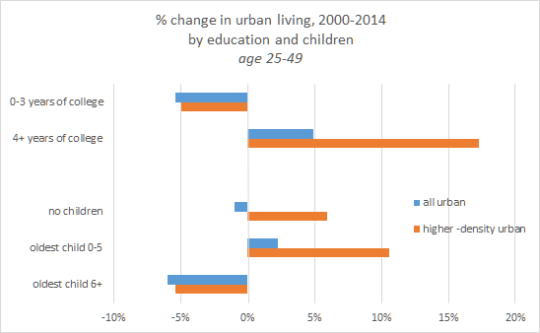
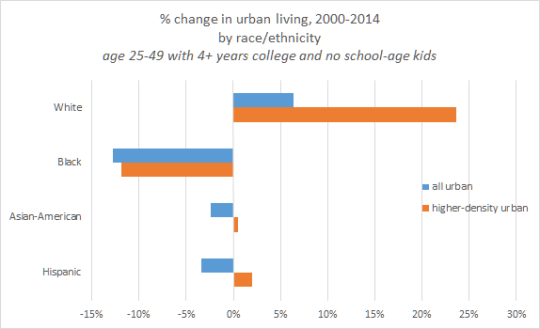
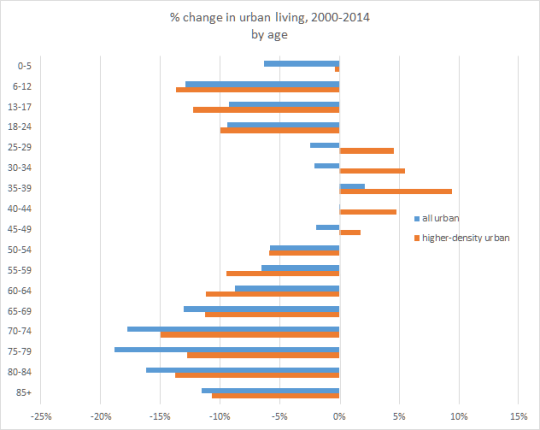
    His most recent post argues – naturally with lots of data and charts – that for all of our talk of (re)urbanization, it’s actually a specific subset of the population that is far more likely to be have urbanized between 2000 and 2014: the young, rich, childless, and white. (Note: His post is talking specifically about U.S. cities.) 

    Below are a few of his charts. 

    In all cases, the x-axis represents % change in urban living between 2000 and 2014. All of the data is from Public Use Microdata Samples (PUMS) – 2000 decennial Census and from the 2014 one-year American Community Survey (ACS).

    Here is age:

    image

    Household income:

    image

    Education and children:

    image

    And here is race/ethnicity:

    image

  • The economic benefits of a winning sports team

    Jays Game 2 by Charles Bodi on 500px.com

    https://500px.com/embed.js

    I was having round 1 of (Canadian) Thanksgiving dinner with my father on Saturday night and we inevitably started talking about the Blue Jays.

    As I write this post, the Blue Jays are down 2-0 in the ALDS, but by the time you read this email in your inbox (assuming you subscribe), game 3 will have already happened. Either the Jays will be on their way to a great comeback or the season will be over. I am remaining fiercely optimistic.

    But in addition to the regular sports chatter, we also started talking about the possible economic benefits of the Blue Jays winning and being in the playoffs for the first time in decades. 

    We assumed that 50,000 people buying tickets, heading downtown, and spending money on food, alcohol, parking, transit, taxis, and hotels, would be a great benefit to the local economy. And immediately I thought to myself: this would make a great blog post.

    But it turns out that the local benefits of professional sports aren’t so clear cut.

    There’s been a lot of research on public funding for sports stadiums and a lot of the research suggests that it may not be in the best interest of taxpayers. A considerable amount of the spending does not get retained by the local economy and instead gets siphoned off to the respective league and to concentrated private interests.

    But Toronto already has the SkyDome, I mean, Rogers Centre. It’s a sunk cost. So looking forward, there must be some incremental benefits.

    Well, a recent article in the Chicago Tribune asked this same question in light of the Cubs heading to the playoffs. And it turns out that it’s also not so clear cut.

    Part of the problem is something called the “substitution effect.” When a sports team starts winning (and people jump on the bandwagon), money is simply redirected away from other forms of entertainment towards sports entertainment. In other words, instead of going to see a movie or going to the museum, people go to the game.

    In fact, a 2001 study by Dennis Coates and Brad R. Humphreys called, “The Economic Consequences of Professional Sports Strikes and Lockouts”, found that during sports stoppages, 37 metro areas with professional sports franchises actually experienced no negative financial impact. And in many cases they performed better.

    Interesting.

    Having said all this, there’s a powerful sense of solidarity that takes over a city when everyone is rooting for the same team to win. And that’s hard to attach a value to.

  • Affordable housing and the economics behind developing new rental apartments

    light trail in concrete jungle by Tassapon Vongkittipong on 500px.com

    https://500px.com/embed.js

    In most big cities around the world, there is a pressing need for more affordable housing. We know that inclusive cities make for better cities. But from San Francisco to Hong Kong, you always hear people talking about how expensive housing is.

    So why is this such a difficult problem to solve?

    Part of the problem, I think, is that many people don’t understand the economics behind building a new building. Oftentimes I hear people say that because developers make so much money, they should just build more affordable housing. Done. Simple.

    But things are not that simple.

    To illustrate my point, let’s walk through the thought process for developing a new rental apartment building.

    In its simplest form, developers are concerned with: revenue – costs = profit. And since many of the costs associated with building a new building just are what they are, it all starts with revenue, which in our case would be rents.

    To build a new rental tower in Toronto, your rents typically need to be at least in the high $2′s per square foot per month. Otherwise the economics don’t work. But to make the math simple, let’s say you need $3 per square foot in rent. That means a 1,000 sf apartment would rent for $3,000 per month.

    That’s not cheap. There are only so many people who can afford these kinds of rents and only so many areas where you can command these kinds of rents, which means there are only so many areas in Toronto where new rental apartments will be built by the private sector.

    If the rents instead happen to be $2 psf – meaning that same 1,000 sf apartment now rents for $2,000 per month – then for-profit developers will not build (barring any unique deal circumstances). Even at $2.50 psf / $2,500 per month, it would be difficult to make the numbers work here.

    And by the numbers, I am talking about tight returns that really only start to make sense in our environment of record low interest rates. Which means that when interest rates start to rise (pushing cap rates up), it may not even make sense to build rental apartments when the rents are in the high $2′s per square foot. This is particularly true if you’re competing against condo developers to buy the land. They can afford to pay more. 

    In this scenario (of rising interest rates), many real estate firms might simply opt to buy existing assets instead of taking on the risk of building anything new. Now all of a sudden your supply of new market rate apartments (not to mention affordable apartments) has dried up. Remember, it’s been decades since Toronto built rental apartments at any sort of meaningful scale.

    It’s for reasons like this that Vancouver launched a program called Rental 100. In a nutshell, it helps to reduce the “costs” variable in the equation mentioned above so that developers are able to meet minimum project returns and build more rental buildings. They do that through things such as reduced parking requirements, additional density, development charge waivers, and so on.

    In some ways, these items are subsidies. The city is giving up revenue that it could have otherwise collected from a developer building, say, a condo. But in other ways, they are freebies. The city could be unlocking development sites that may have otherwise not been developed. In which case it’s not really forgone revenue.

    Vancouver’s Rental 100 program is a market rental housing policy. But there’s no reason that similar thinking couldn’t be applied to create an affordable rental housing policy. It has been done and is being done in many cities.

  • Are condos at a tipping point?

    I live in a condominium in the St. Lawrence Market neighborhood of Toronto. And recently, I’ve had a number of “empty nesters” ask me if they could come check out my condo and get a feel for what it’s like to live in a downtown neighborhood like the Market.

    And they’re asking because they’re contemplating something that has become quite common for folks whose kids have left the roost. They’re considering, for a number of reasons, selling their suburban home and right-sizing to a downtown condominium.

    Whether it’s because they want to free themselves of cutting grass and shoveling snow, they don’t like stairs anymore, they want to be able to lock the door and head to Florida for the winter, or they want an amenity rich urban lifestyle, the uptake on condos has been significant both in Toronto and other cities around the world.

    Indeed, the condo market has become great at serving “both ends” of the market: first time buyers/young professionals and empty nesters. But what I wonder is if we might be at a tipping point with respect to the middle segment of the market: families.

    The average new construction low-rise home in the Greater Toronto Area is roughly $650,000 right now. But this would be more for houses in the center of the city. There, you’re probably looking at anywhere from $650,000 to $1 million for a “typical” 3 bedroom Toronto house.

    By comparison, a new condominium might average somewhere between $550 and $600 per square foot in the city. So for a 3 bedroom condo at, say, 1,300 square feet, you’d be looking at somewhere between $715,000 and $780,000. Add in parking and you’re somewhere between the mid $700,000’s and just over $800,000.

    In all cases, we’re talking a lot of money. But the point I’m trying to make is that condominiums and houses are becoming cost competitive. There are obviously differences between both housing types, but if your goal is a 3 bedroom place to raise a family, that utility could be met in both cases.

    There may still be psychological/societal barriers to raising kids in a condo, but I wonder if we might be close to a tipping point now that the economics are starting to line up. What do you all think?

  • Competitiveness and currency

    The Globe and Mail published an article yesterday morning called, “Why a lower loonie is (mostly) good for Canada.” It talks about the recent decline of the Canadian dollar from parity last May to roughly USD $0.92 today. But that the drop is essentially because of a rising US dollar. 

    Irrespective of what’s causing the devaluation though, the article takes the tone that it’s generally good for the country:

    “On net, this could be seen as a good thing because it’s making Canadian goods and services more competitive,” said Michael Devereux, a professor at the University of British Columbia’s Vancouver School of Economics.

    But this viewpoint always gets me concerned. 

    Canadian goods and services shouldn’t be competitive because they’re cheaper; they should be competitive because they’re the best damn good and services in the world. And so my fear with statements, like the one above, is that it almost makes us believe that a weak dollar is a prerequisite for competitiveness. It’s not.

    In fact, research done by Professor Walid Hejazi at the Rotman School has shown that a weak Canadian dollar actually lowers productivity levels and creates a disincentive for innovation. Why bother to innovate when you can always get your goods and services to market at a lower cost than your competitors?

    Thankfully, the outgoing Senior Deputy Governor of the Bank of Canada (and upcoming Dean of the Rotman School), Tiff Macklem, has acknowledged this perspective. In a talk at Queen’s University last January, he said:

    “What should Canadian businesses do? First, don’t count on a weaker Canadian dollar. Hoping for a weaker Canadian dollar is not a business plan. A sustainable export strategy cannot rely on expectations of a more favourable exchange rate, since Canada is likely to remain an attractive investment destination.”

    That sounds like good advice to me.