Daily insights for city builders, delivered every morning at 6 AM ET. I’m Brandon Donnelly — a Toronto-based real estate developer and founder of Globizen. I’ve been writing here since 2013.

Tag: documentary

  • Barriers to entry: Salvador vs. Toronto

    Netflix has a new docuseries out about Latin American street food. I watched two episodes of it last night. The first was about a chef from Buenos Aires, Argentina and the second was about a chef — named Dona Suzana — from Salvador, Brazil. Even if you aren’t necessarily into food shows, it’s a good way to remind yourself just how much you probably miss traveling right now.

    The story of Dona Suzana is an interesting one. Before opening her restaurant, she was doing laundry in order to make ends meet. Then at one point, the City of Salvador came to her community in order to undertake a large construction project. They needed someone to cook food for the construction workers and so they asked her if she would do it.

    Since she had always dreamed of being a chef, she jumped at the opportunity and took out a loan to buy everything she needed in order to fit out her kitchen. She cooked for the workers and everyone loved the food. But she never ended up getting paid. They stiffed her.

    That turned her off cooking for a bit and it was not until a trio of graffiti artists were working in her community and looking for a place to eat that she tried her hand at it again. They offered to pay her in advance and persuaded her to make them something. She agreed and the food was a huge hit.

    In fact, the group of artists loved the food so much that they made her a sign with the name “RéRestaurante” (titled this way because Dona has a stutter) and began sharing photos of her dishes on social media. All of a sudden she had people showing up at her door. And today she has people from all around the world showing up at her door.

    This is a wonderful success story. But I think it also says something about land use policies. As far as I can tell from the episode, she setup her restaurant at her place of residence — a community along the waterfront where her husband fishes and where she uses his catches for her renowned dishes.

    Here in Toronto, we are operating in an environment where if you try and setup a coffee shop in a residential “Neighbourhood” — like, for example, Contra at 1028 Shaw Street — you might spend a few years fighting with your neighbors and battling it out at LPAT hearings in order to get the appropriate permissions.

    I’m not necessarily suggesting that we should do away with all zoning (or maybe I am). But I would like to draw your attention to this contrast. Because one has to wonder whether RéRestaurante Dona Suzana would exist today and be known around the world had the barriers to entry not been so low for her. Of course, had there been more rules, maybe she wouldn’t have gotten stiffed the first time around.

    Either way, I am currently in the market for some dende oil.

    Photo by Milo Miloezger on Unsplash
  • How drones will change cities

    Dezeen, the architecture and design magazine, has a documentary out called Elevation – How Drones Will Change Cities. It premiered in Hong Kong in March and is supposed to be widely available this month. I’m not exactly sure when that is happening, but below is a trailer. If you can’t see it below click here.

    [youtube https://www.youtube.com/watch?v=YSlep5XCpaw&w=560&h=315]

    Included in the trailer is footage of a delivery drone concept by design consultancy PriestmanGoode called Dragonfly. Norman Foster also talks about the development of “aerial highways.” It’s 2018 and we were promised flying cars by this point. But flying drones, similar to what’s in the above trailer, seem more probable right now.

  • My Piece of the City

    A friend of mine just sent out a group city builder email about My Piece of the City, which is a new documentary that is screening all weekend here in Toronto at the TIFF Bell Lightbox.

    The film is a critique on the revitalization of Regent Park, told through local residents and their efforts to stage a community musical (which happened in real life).

    The Daniels Corporation, in partnership with Toronto Community Housing, is the developer and builder for the entire 69 acre community. The Daniels Foundation also funded the musical and this documentary.

    But, despite this backing, the Globe and Mail has said that it remains a “healthy critique” of this entire process. And the trailer certainly gives you that impression.

    I am sure that this documentary will be of interest to many of you, so if you would like to grab tickets for this weekend, you can do that here.

  • REM

    image

    “A building has at least two lives – the one imagined by its maker and the life it lives afterward – and they are never the same.” -Rem Koolhaas

    Tonight I went with a developer friend to see the documentary REM at the Hot Docs Cinema on Bloor Street. It’s a documentary about the Dutch architect Rem Koolhaas, directed by his son Tomas Koolhaas. Trailer here.

    The film is essentially 75 minutes of introspection on the part of Rem. It’s him ruminating over a continuous piece by the American composer Murray Hidary. At times it was hard to hear what Rem was actually saying.

    If you’re looking to learn the specifics of his designs and process, then this movie is not for you. Though there’s lots of footage of his buildings. It also does not make clear just how much influence he has had professionally. I mean, everyone from Bjarke Ingels to Jeanne Gang once worked at his firm.

    The film is really about getting inside the mind of Rem as he travels the world. What struck me is Rem’s profound curiosity for seemingly everything. He really is obsessed with analyzing, documenting, and reporting. He refers to it as a compulsion.

    I also like the idea put forward that architecture represents a particular moment in time. If you’re precise about things, you may be right the moment the building is complete.

    But from that point onward, everything begins to change around it and you will be wrong. That’s what the quote at the top of this post is getting at.

    So I enjoyed it – but probably because I’m an architecture geek and Rem is arguably the most influential living architect today. But I’m not going to tell you that this film is a must-see.

    P.S. Who knew, Rem Koolhaas flies economy.

    Photo by Pavan Trikutam on Unsplash

  • Why you should sometimes ignore your customers

    In business we are told to listen to our customers. Be customer-centric. In city building we are told to listen to the community. Be community-focused. And there’s no question that these mantras exist for a reason. They are paramount.

    But when should you not listen?

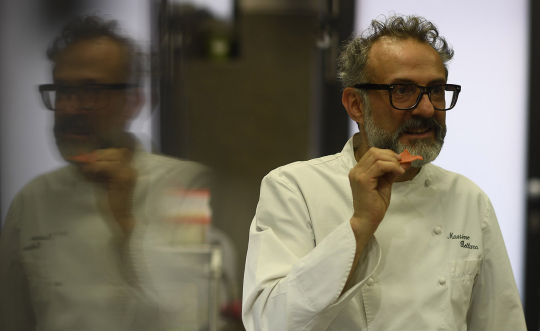
    I watched a Chef’s Table documentary last night on Massimo Bottura (pictured above), who is the owner and operator of Osteria Francescana in Modena, Italy. Osteria Francescana is a 3 star Michelin restaurant and widely ranked as one of the best restaurants in the world.

    But it wasn’t easy for Massimo at the beginning. His goal was to bring the Italian kitchen into the 21st century and so his plates are often creative takes on classic Italian dishes. His restaurant blends the old and new; food and contemporary art.

    This approach upset a lot of people at the outset. Massimo was seen almost as a traitor who was turning his back on traditional Italian cooking within provincial Modena. Don’t mess with centuries of tradition they would say. Grandma knew best, son.

    Because of this, his restaurant sat empty in the early years, to that point that he was ready to close its doors. The only reason he kept it open was because his wife encouraged him to give it one more year. She said: This is the kind of food you want to make. If you don’t try, you’ll regret it.

    So he gave it another year and luckily he got a few breaks, including a glowing review by a well known food critic from out of town. Once this hit, the Modenese started to quickly rethink their distaste for Massimo’s idiosyncratic dishes. Before long, his restaurant was full.

    So what changed? It wasn’t the dishes. It was perception. The out of town critics and positive reviews gave people permission to like the dishes. This is critical because nobody needs permission to like tradition. It’s tradition, after all. There’s little risk in that.

    But there’s risk in liking something new that hasn’t been done before. Change creates uncertainty. And if Massimo’s wife hadn’t encouraged him to stick with it just a bit longer and ignore the naysayers, the world may not have one of its top restaurants.

    Sometimes we don’t know what we like and want until we are shown.

    Image: Osteria Francescana 

  • The Millennial Dream [Documentary]

    Back in 2015, I was interviewed for a documentary called The Millennial Dream. I then completely forgot about it until somebody tweeted it at me yesterday. So the documentary is out – it was released last year – and you can rent it or buy it on iTunes.

    The documentary calls into question the [North] American Dream. This idea that you just have to work hard, save up, buy a house in the suburbs, pay off your debt, and then everything will be just fine. For many, that dream is quickly disappearing, if it hasn’t already.

    Enter the Millennial Dream. Our economy is changing. Our jobs are changing. Our cities are changing. And by 2020, the Millennial generation is expected to form 50% of the global workforce. What is this generation dreaming about? That is what this documentary is about.

    But I should probably stop here because I haven’t actually seen the film. I could be overselling it. I’ll watch it this weekend and then report back. If you can’t see the trailer embedded below, click here.

    [youtube https://www.youtube.com/watch?v=CVCNXJk2fT8&w=560&h=315]

  • The Art of Design

    I don’t actually have Netflix, but they have a new original documentary series out called, Abstract: The Art of Design. It’s a look at “eight of the most creative thinkers” working in art and design. It premiered at the Sundance Film Festival this year.

    Here are those 8 people:

    1. Es Devlin (stage designer)
    2. Ilse Crawford (interior designer)
    3. Ralph Gilles (Chrysler head of global design)
    4. Bjarke Ingels (architect)
    5. Platon (photographer)
    6. Christoph Niemann (New Yorker cover illustrator)
    7. Paula Scher (graphic designer)
    8. Tinker Hatfield (Nike sneaker designer)

    The trailer feels unnecessarily dramatic for a documentary, but I’d still like to watch it. The reviews also seem to suggest that it’s pretty good. Below is the trailer. If you can’t see it below, click here.

    [youtube https://www.youtube.com/watch?v=DYaq2sWTWAA?rel=0&w=560&h=315]

    If you’ve already seen it, what did you think?

  • Important things

    image

    Last weekend I watched Minimalism: A Documentary About The Important Things. I’ve been reading the blog for awhile now (I blogged about it) and so the movie has been on my to-do list since it came out.

    Now, I am not a minimalist to the same extent as Joshua and Ryan, and some of the people featured in the film. I have not reduced all of my personal belongings to 51 things and I have not renounced any sort of permanent residency. I own some stuff.

    But I am very much attracted to the philosophy that less can be more. That less can make us happier. That quality is more important than quantity. And that we actually need far less stuff than we think we do, especially in a consumerist society like ours.

    One word that comes up a lot in the documentary is: deliberate. In other words, we should be more deliberate about the choices we make, the things we buy, and so on. Will it create value in my life?

    And that’s one of the reasons I like this notion of minimalism: It’s a challenge. You have to think. Because if you don’t, you will be told what to do and what to buy, and you will accumulate things without even knowing. It’s essentially a constant battle against excess.

    Perhaps the biggest potential for excess happens with our choice of housing, which is why small homes feature so prominently in the film. A tiny house isn’t going to be for everyone, but many people have certainly come to the realization that square footage alone does not equate to more happiness.

  • The World in Ten Blocks

    “Toronto is probably the world’s most diverse city.”

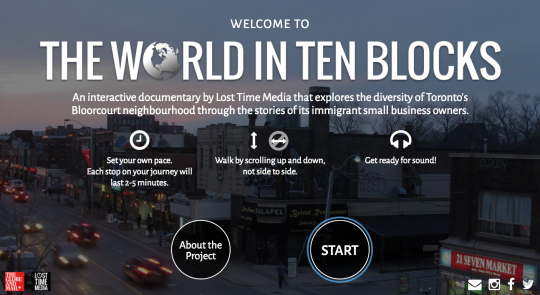
    That is how a new interactive documentary called The World in Ten Blocks starts. Produced by Lost Time Media and hosted at theglobeandmail.com, the documentary examines a ten block stretch of Toronto’s Bloorcourt neighborhood and tells the story of a diverse set of small-business owners who have moved to this city from all around the world. People from Guyana, Mexico, Nicaragua, Saudi Arabia, as well as many other places.

    It’s amazing to be reminded just how diverse ten small blocks of this city can be; especially at a time when immigration has become such a polarizing topic around the world. I sometimes take it for granted just how diverse this city is. I forget and assume that this is just how cities are. But of course that is not always the case. Toronto is an exceptional city.

    Click here for The World in Ten Blocks.

  • The Millennial Dream

    This evening I was interviewed for a documentary called The Millennial Dream. It’s all about how Millennials – people like me – are rethinking or even rejecting some of the traditional notions of The American Dream. It’s being produced by Hemmings House.

    My part was all about housing. 

    So a lot of it was about how housing preferences have (or have not) changed for Millennials. If you’re a regular reader of this blog, you’d already be familiar with many of the topics I covered.

    What’s most interesting to me though, is not what Millennials are doing today. We already know that there’s been a return to cities and that many young people prefer walkable and authentic communities. Everyone is talking about it and it’s no longer novel.

    What’s more interesting to me is what Millennials are going to do in the next 10 years when the majority of the cohort is in their 30′s. What percentage will be married? What percentage will have kids? And, where and how will they choose to live in cities?

    Because there are some structural changes happening. Marriage rates in the US have been declining since the 1960s (see New York Times).

    And fertility rates are at their the lowest in US history. So in theory, and unless things change, Millennials should on average demand different types of housing. Fewer of them are likely to marry and they’re having fewer kids.

    But at the same time, I also believe that there have been changes in consumer preference that are not going to completely reverse as Millennials age. So city builders will need to come up with new and creative forms of housing for families who want to stay in urban centers. And that’s an exciting challenge.

    I’d be curious to hear thoughts in the comment section below. The documentary won’t be out until the end of the year, so you still have a chance to influence its direction. More voices are better than one.