Daily insights for city builders, delivered every morning at 6 AM ET. I’m Brandon Donnelly — a Toronto-based real estate developer and founder of Globizen. I’ve been writing here since 2013.

Tag: digital art

  • CryptoParisian #112

    I have written about Bright Moments before. They are a digital art company exploring the intersection of NFTs and real-world experiences. It started as a popup gallery in Venice Beach California, where artists could show new work and where collectors could buy IRL. They then created their own pixel art collection called CryptoVenetians. It included 1,000 different people-centered NFTs by artist QianQian. Since then, they have gone on to host events and create new CryptoCitizen collections in New York, Berlin, London, Mexico City, Tokyo, and Buenos Aires. And this week they were in Paris.

    (I don’t know why they skipped over Toronto!)

    Their end goal is to create a complete collection of 10,000 NFTs, most of which are tied to a specific city. (The only one that isn’t is their CryptoGalacticans collection.) What’s obviously great about this approach is that it’s a way to promote digital art and onboard new users into the crypto space. They are literally going around the world, throwing parties, and saying “look how cool and fun this whole crypto thing is.” At the same time, it also links the digital and the physical, which I believe is fundamental. We’re social beings and web3 will never change that.

    The other interesting thing about Bright Moments is that they are structured as a decentralized autonomous organization (or DOA). That’s like a company, except that governance is distributed to its tokenholders and it’s all managed on a blockchain. But it still operates as a company and it can raise money like one too. In 2021, Union Square Ventures invested 500 ETH into the DOA through a blockchain transaction that would naturally be public if you cared to look it up. Based on today’s spot price of about CA$4k per ETH, that was a CA$2 million investment.

    In the case of Bright Moments, its tokenholders are the people who own a CryptoCitizen. These are the people who get to vote on how the organization is run. They can also earn money if they do things like host a community dinner or organize a local meetup, with the idea being that, as an organization, you want to encourage this sort of bottom-up participation and innovation. I find it fascinating to watch this new governance and entity structure emerge, and it will only continue to evolve.

    I’ve been following Bright Moments more or less since they dropped the CryptoVenetians. I thought about jumping in then, but I figured I would wait to see if there would be a CryptoTorontonian. That would obviously be my number one choice. But once they announced their final list of cities, and Toronto wasn’t on it, I grumpily decided I would instead wait for a CryptoParisian. And since this week was Paris, it was time.

    I now hold CryptoParisian #112:

    I like that it has the Pont Neuf and that the human is wearing sunglasses.

    This means that I now have a small ownership stake in the Bright Moments DOA. So presumably I’ll soon have a say in important and serious matters! It also means that when they launch their final CryptoCitizen collection in Venice, Italy this spring (nice work going full circle here), there is a chance I might get airdropped a CryptoVenetian. It’s a random process, so whatever. I also know that it’s easy to look at this pixelated Parisian and think, “WTF, Brandon.” But something new is building here. And I’m sure that all of the folks who were in Paris this week can testify to that.

  • How I’m displaying my NFT art

    I recently got a Samsung Frame TV to use as an NFT display at home. I had been looking for one for a while and I finally pulled the trigger last week. The way the Frame works is that it’s a TV when it’s on, and it’s an art display when it’s off. But I really don’t care about the TV part. I just wanted a good looking art display.

    There are a lots of purpose-built NFT displays on the market right now, including Tokenframe, Blackdove, Muse, and others. And I was very close to getting a Muse Frame.

    But ultimately I decided on the Samsung Frame because it was (1) cheaper for its size (50″), (2) it looks cool, and (3) I was fine with just a simple high-quality display. I think there will be lots more software and dongles created in the future for people who want to showcase their NFTs on whatever they happen to have at home.

    However, if you’re a crypto and NFT purist, this maybe isn’t the display for you — at least right now. Out of the box, it doesn’t connect with any crypto wallets. And so you’re not going to automatically see the provenance of each art piece (more on this below). Instead, the default method is to just upload JPEGs to the TV from Samsung’s SmartThings app (insert right-click-save-as jokes here).

    Overall, I’m really happy with the display. Here are my initial thoughts:

    • I have it set to randomly rotate through my art every 3 minutes. There’s also a motion detection feature that works reasonably well. If it doesn’t detect any motion, the display will go completely to sleep. But for some reason, it occasionally gets possessed and the TV will randomly turn on. Last week it kept turning on old Baywatch episodes. Possibly user error.
    • Samsung’s SmartThings app is bad. It’s buggy and a pain to use. For example, even though I’ve given it complete access to my phone’s photos, they never seem to show up. I have to limit access and then go and select the ones I want to use in my gallery.
    • I have found that I prefer when the art is full bleed versus within the Frame’s skeuomorphic picture mat. This is a new form of art and so I like the idea of breaking past traditions. But unless your images are 16×9 and a high enough resolution (I have generally found > 3000px wide to work), then you’re going to get prompted to insert and select a mat design.
    • I have solved this problem by manually cropping and editing the individual pieces. Some NFT collections, such as CyberBrokers, also give you vector files which allows you to play around as you see fit. Again, if you’re an NFT and/or art purist, you’re probably not going to like this. But I think of it as curating the pieces.
    • Most of my art is on Ethereum, Solana, and Tezos. Being able to upload whatever I want is helpful, because not all NFT displays support all of the chains. The Muse Frame, for instance, only supports Ethereum and Polygon right now.
    • PNG files and video files aren’t supported natively. This is a significant drawback and so eventually I know I’m going to have to change up the software that powers this display. And there are options. Bright Moments offers display software for holders of its NFTs. Fred Wilson’s venture firm USV created this setup. And I’m sure there are countless others. These can solve the provenance issue mentioned above by pulling directly from the various blockchains.

    In the end, I knew what I was getting into with the Frame. I knew it wasn’t a purpose-built NFT display and I was fine with that. It’s still early days in this space. But it sure is nice to finally see my NFT art in large format.

  • Virtual artists are now being signed to digital record labels

    One of the most interesting things about NFTs is that some, but not all, come with very permissive licensing. What this could mean is that, as a holder, you are free to do whatever you would like with your NFTs, including creating businesses on top of them or using them for other commercial purposes. This is fascinating to me and I like NFT projects that adopt this open approach.

    In the past, we have talked about Bored Ape Yacht Club owners creating things like restaurants on top of their NFTs. But here is another more recent example: An NFT from the CyberBrokers collection has just been signed to a Web3 record label called Player Zero. This is the company’s first “Animated Virtual Artist”, and her inaugural album is available for streaming here, as well as from places like Spotify.

    This might sound kind of crazy if you aren’t following the crypto space. But is it really? We already have virtual influencers with millions of followers, so why can’t we have virtual pop stars being signed to digital record labels?

    I don’t know what this will ultimately mean for the holder of the above NFT, but imagine a world where the owner automatically receives X% of all the proceeds produced by the virtual artist. Now all of a sudden you have a cash flow stream that can be evaluated using traditional finance methods and an asset that can be valued and traded.

    Full disclosure: I own multiple CyberBrokers.

  • There is no effort without error and shortcoming

    I had a blog post planned out in my mind for today. I was going to write about how the Penthouse Collection launch went this evening at One Delisle (our new website just went live), and the digital NFT art (by Petra Cortright) that we commissioned to accompany each of the 8 penthouse residences.

    But then my partner Lucas Manuel sent out the below quote by Theodore Roosevelt in one of our group chats and it derailed everything. I think it’s imperative that it gets reshared here immediately:

    It is not the critic who counts; not the man who points out how the strong man stumbles, or where the doer of deeds could have done them better. The credit belongs to the man who is actually in the arena, whose face is marred by dust and sweat and blood; who strives valiantly; who errs, who comes short again and again, because there is no effort without error and shortcoming; but who does actually strive to do the deeds; who knows great enthusiasms, the great devotions; who spends himself in a worthy cause; who at the best knows in the end the triumph of high achievement, and who at the worst, if he fails, at least fails while daring greatly, so that his place shall never be with those cold and timid souls who neither know victory nor defeat.

    There is no effort without error and shortcoming. But in the worst of cases, that means failing while daring greatly. Because failing while daring greatly is better than not daring at all. These are words to live by. And I would like to think that our team’s efforts to bring digital NFT art to Toronto’s condominium market is daring on some level.

    What is clear to me after speaking with a lot of people this evening is that most people don’t know what an NFT is and they don’t know how this all works. But at the same time, they recognize that real and meaningful change is underway. (I was on Global TV this evening trying to explain this stuff.)

    We may be the first (at least here in Toronto), but I would put money on the fact that we won’t be the last developer to incorporate NFTs into their projects. And that’s a good thing. We should all be building on top of each other’s work. Let’s dare greatly.

  • The Petra Cortright NFT Collection at One Delisle

    My two week photo blogging experiment has come to an end. We are now back in Toronto. France was incredible, and I thoroughly enjoyed practicing my French and messing up which nouns are masculine and feminine. Expect some follow-up posts in the coming week(s). I was jotting down notes throughout the trip.

    I must say that the experience of getting back to Canada was far easier than I was expecting. Besides having to run around to a few different places for our PCR tests (sante.fr gave us some addresses that wouldn’t take us), it was relatively painless.

    I am now swimming through my inbox (butterfly stroke kind of thing). There’s a lot to catch up on and a lot that I want to write about. But here’s something pretty special. Today I am excited to share that Slate Asset Management just announced an NFT digital art collection by Los Angeles-based artist Petra Cortright.

    The collection consists of 8 works of digital art that are exclusive to each of the 8 penthouse residences at One Delisle (1/1). We believe that this is one of if not the first example of this — NFTs being commissioned by a developer for future condominium residents.

    Since the beginning, we have wanted to make One Delisle a “project of firsts.” We wanted to create something remarkable and usually that means you have to do something for the first time. We are fortunate to have been able to partner with Studio Gang for both the architecture of the building and its interiors.

    The Petra Cortright NFT Collection is the next step in this commitment to new ideas. And on October 6th the team will be revealing both the One Delisle Penthouse Collection and hosting a one-time gallery viewing of the eight digital art pieces. If you would like to attend here in Toronto, please send an email to info@onedelisle.com.

    For more information about what all of this means (including a bit about NFTs), here’s the full press release from earlier today.

  • Meatspace vs. metaverse — what is the best way to flex?

    With every passing year, the Matrix feels less and less like science fiction. With the continued rise of the metaverse — Zuckerberg is betting all of Facebook on it — we are increasingly living our lives between two worlds: one is offline and one is online. What this will ultimately mean (for us and for our cities) is of course up for debate. But what is clear is that the traditional trappings of real life have quickly made their way online into the metaverse. Arthur Hayes recently penned this fantastic article about the future of the world (it’s the metaverse) and the role of art (including NFT art). In it, he makes the argument that to “flex” is integral to the human experience. Here’s what he means by that:

    As social beings, the sole purpose of many activities and purchases is to publicly display how much energy you can waste. The nightclub economy is extremely a propos to this concept. Individuals walk into a dark room, listen to loud music (art), dance (a waste of energy akin to a mating call), and pay exorbitant amounts of money to drink liquid. Everyone gets dressed up real nice in articles of clothing that serve no useful purpose other than to demonstrate that the wearer spent a lot of money to display their social status to the rest of the clubbers present.

    People go to clubs to flex. In the words of the late Clayton Christensen, that is the “job” to be done.

    Why this matters is that many of us are now doing the same kind of things online. Buying a CryptoPunk (an OG NFT) for a large sum of money and posting it as your social media profile pic is a flex. Is this rational or irrational behaviour? Whatever your answer, it is akin to paying several hundred dollars for a t-shirt from some cool streetwear brand. The real job to be done is not that you desperately need a t-shirt to cover your upper torso. It is the signalling that goes along with owning something scarce and valuable. One of the things that is so special about NFT-permissioned stuff is that there’s now a simple way to prove and enforce all of these things: ownership, scarcity, and so on.

    What’s equally fascinating to me is how offline and online will end up interacting with each other. (Arthur refers to our offline world as the meatspace. I don’t know if he coined the term, but I’m going to rolling with it for the purposes of this post.) If people end up preferring to flex online instead of offline (and I’m sure many already do), what does that do to our meatspace(s)? And what does it do to our cities and how we build? I have no doubt that these questions are coming.

    Photo by Richard Horvath on Unsplash

  • Rotterdam reinvents the urban food market

    image

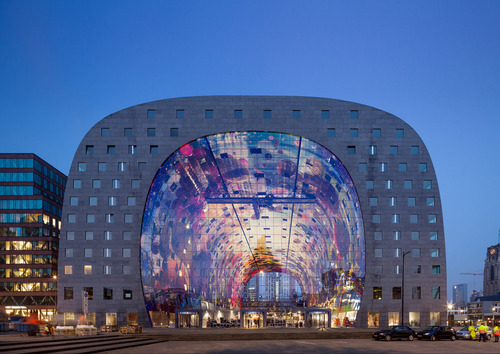
    Every now and then a piece of architecture comes along that makes you feel like your city should be more beautiful – or at least very least: bolder. In this case, it’s the new Market Hall in Rotterdam, which has been making the rounds on the internet since it opened last week. It may not be everyone’s cup of tea, but I find it really exciting.

    Designed by Dutch architecture firm MVRDV, the Market Hall is a 1.1 million square foot mixed-use building consisting of residences (102 rental apartments and 126 for sale apartments), a food market, a supermarket, a public space, and a 1,200 stall parking facility. But before I say anymore, here’s the money shot:

    image

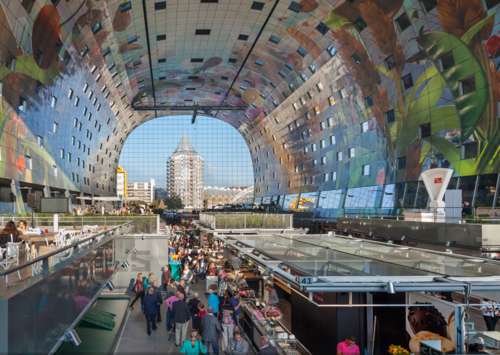
    And here’s what it looks like from the inside of the market:

    image

    In the middle of the building is the food market. At night when it closes up, it then becomes a well-lit public space. The entire central area is enclosed, but well connected visually to the outside through a big and fancy glass facade.

    The apartments wrap the central market and were constructed using standardized modules (despite the unique form). The spaces that require natural light face outward and all the spaces that do not require natural light (by Dutch law), such as the kitchens, face inward towards the market. 

    There’s a grocery store 1 level below grade (to help supplement the market) and all parking and loading is done underground. This means that the building itself has no real backside. Most buildings typically have an ugly loading and “back of house” area – the building’s ass if you will. In this case, the entire perimeter of the building is urban and accessible.

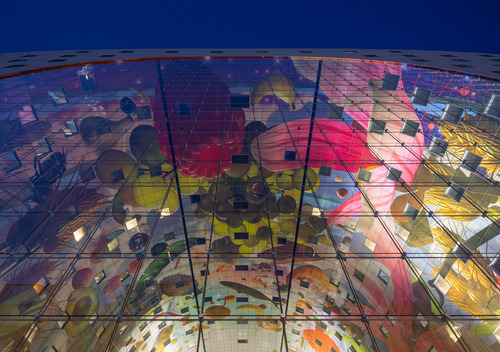
    Finally, on the ceiling of the market is a massive mega-mural designed by Dutch artists Arno Coenen and Iris Roskam. Click here for a 360 degree panorama. It’s wild. 

    So what do you think of this building? Would you like to have it in your city? And would you consider living in one of its apartments? I would.

    Images: MVRDV