Daily insights for city builders, delivered every morning at 6 AM ET. I’m Brandon Donnelly — a Toronto-based real estate developer and founder of Globizen. I’ve been writing here since 2013.

Tag: development

  • Japan’s disposable housing

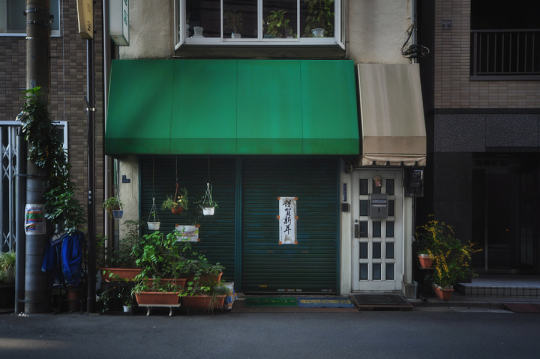
    緑 by Austin  Hou on 500px.com

    https://500px.com/embed.js

    As further evidence that real estate is a local business, let’s take a look at the housing market in Japan today. It’s a very unique market.

    According to this Freakonomics podcast, 50% of all single family houses in Japan are demolished by the time they reach 38 years old. That’s their half-life. By contrast, in the US, this number is 100 years.

    The reason for this is rapid depreciation. Real property typically consists of two things: land and the building. Land doesn’t depreciate. But the structure sitting on the land does.

    In Japan, the building or structure is thought to be fully depreciated (and therefore worth nothing) after about 30 years for a single-family home and after about 40 years for an apartment/condominium.

    The result is that there’s virtually no resale housing market. When somebody buys a house, it is usually torn down and completely rebuilt. It’s a uniquely Japanese phenomenon.

    So why does this happen?

    The Freakonomics podcast presents a couple of hypothesis. Some believe that it’s caused by a Japanese fixation with newness. New is seen as pure and clean. 

    Others believe that it has to do with a building code that is constantly changing due to the high frequency of earthquakes in Japan. 20% of the world’s earthquakes with a magnitude of 6.0 or greater happen in Japan. And so there appears to be a belief that newer homes – with the latest seismic technologies – are the safest.

    Whatever the case may be, the fact that there’s virtually no resale housing market in Japan, not surprisingly, produces some interesting outcomes. For one, maintenance and DIY home projects are uncommon. Why invest in your home when it’s not viewed as an asset, but as a disposable good?

    At the same time, people worry very little about marketability when they are building new. And this is a big reason why Japan is so famous for its radically designed homes. When you’re building only for yourself, you just do what you want.

    But most importantly, some (such as Richard Koo, who is interviewed in the podcast) believe that this approach to housing is a huge “obstacle to affluence.” Without a functioning resale market, the Japanese don’t get the opportunity to build wealth/equity in the same way that other countries do.

    Do you buy that?

  • Interview with Brad Keast of Osmington

    image

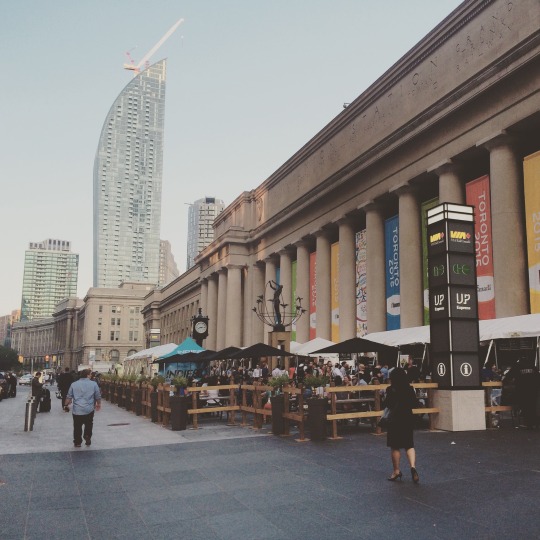
    Given yesterday’s post about Times Square in New York, the timing is perfect to talk about the revitalization of Union Station here in Toronto, its new public spaces, and the programming that’s now happening in and around the station.

    Perhaps the most noticeable is something called Front Street Foods @ Union Summer, which is an outdoor food market set up along Front Street. It’s on this summer from July 6th to September 27th, 2015. 

    However, Front Street Foods is only one part – the food part – of a larger events and programming strategy known as Union Summer. I recently had a quick chat with Brad Keast of Osmington, who is involved in a lot of what’s happening right now at Union Station.

    I found it interesting to learn about how organic the process was. And I thought you all might find it interesting as well.

    ————————————–

    Tell us a little bit about you and your company’s involvement with Union Station. 

    I’ve been with Osmington for over 4 years now and Union Station is a major focus of my waking life. 

    The company won a public RFP with the City of Toronto in 2009 to be the City’s retail partner in the redevelopment. What this means is that while the City owns the building and is doing base building construction, we are overseeing all the retail, advertising, and special events and programming. We are finding all the tenants, doing a bit of overshell work and then turning it over for fit-up.  

    We think the real special part of the project comes in through the special events and programming. We really want to make the station a destination in itself and you’re starting to see that with some of the programming we’ve done this year, be it a contemporary art event like Villa Toronto or something more community-focused like Union Summer – the current animation of the area in front of the station.

    How did the idea for Union Summer come about? 

    This really was a collaborative internal effort. We started by thinking ‘hey, let’s put a bunch of tables and chairs on the new plaza in front of the station and see what happens.’ Then we added in the idea of food. We knew it had to be accessible but didn’t want traditional food trucks, rather something less mobile but still not permanent. 

    That’s when we reached out to Toronto Market Company and they started rounding up the vendors. Then we layered on entertainment – daily music be it live or DJs, as well as a movie night with the Toronto International Film Festival (TIFF). We even have some kids programming on the weekends. Then we worked with the Farmers’ Market being displaced from Nathan Phillips Square due to Pan Am this year to have them here on Wednesdays.

    What was involved in making Union Summer a reality? What was the biggest surprise and/or hurdle that needed to be overcome? 

    There was a tremendous amount of coordination needed. First we weren’t sure when the construction was even going to be finished, all that was certain was it would be before Pan Am started. 

    Then the infrastructure required for the event itself was an exercise in creativity – power, water, and grey water disposal in particular. There was a lot of meetings with City officials for things like building permits, fire code, council approval to apply for a liquor permit, and health and food safety measures. Operationally things like loading in, coordinating with the installation of the Pan Am banners between the columns, interim furniture when our original order didn’t make it onto a ship in Antwerp, and then the first week was so busy that some vendors started losing staff because they were burnt out. 

    Like all things with this project we have to be mindful that this is an operating train station. In fact it’s the busiest building in the country with over 250,000 people per day passing through so we can’t impede those operations. We’ve done our best and have learned some lessons along the way and the reception has been overwhelming. 

    One of the best things about having that many entrepreneurs in close proximity is that some vendors have been pairing up to try experiments. Frozen custard-stuffed churro?

    Toronto is getting much better at designing and programming its public spaces. Given your experience with Union Summer, is there something the city could and should be doing to encourage more of these kinds of urban activations?

    Well, first of all, our contacts at the City, in particular Denise Gendron and Scott Barrett in Real Estate Services have been incredibly supportive of our efforts and we couldn’t have done it without them. If I could make one recommendation it would be to build in the supportive infrastructure for services. Of course that’s only beneficial if there is someone to take charge of the space and program it appropriately. It’s not a part time job.

    What’s next for Union Station?

    Right now the focus is on getting the first retailers open on GO’s new York Concourse. On the programming side we will host art for Nuit Blanche (October 3rd, 2015). That promises to be exciting. And then opening November 30th, 2015 is the Holiday Market. It was a huge success last year so we’re bringing it back for 3 weeks this time.

  • America really is building very few condominiums

    On my way back from Philadelphia
    this past weekend I wrote a post called, The
    Philadelphia (real estate) story
    . It was about how opposite the market is
    in Philly compared to Toronto.

    After writing that post and
    because of a discussion in the comment section, I started thinking about condo
    vs. rental apartment development across the US. Because unlike cities such as
    Toronto and Vancouver, it struck me that – outside of maybe New York and Miami
    – most U.S. cities are really not building a lot of for sale condos. And if
    you’re from Toronto or Vancouver, I bet that feels odd to you.

    But what exactly is that number?

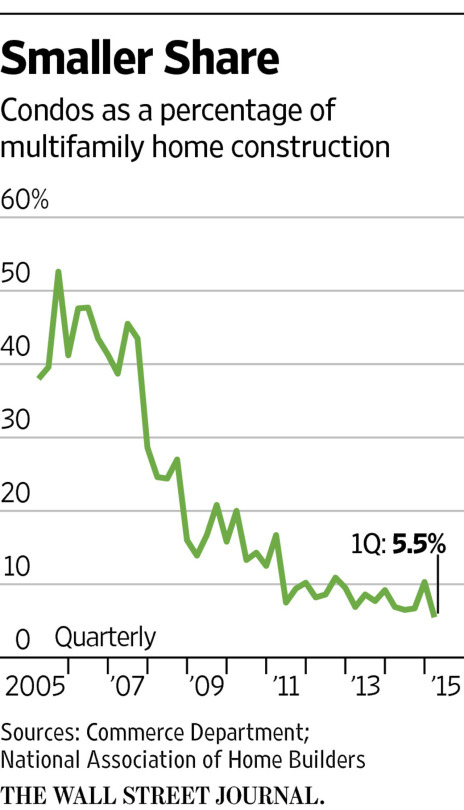
    As of the first quarter of 2015, condos as a percentage of all new
    multifamily (apartment) construction in the US was only 5.5%. That’s a tiny number and is down from
    over 50% before the Great Recession, which means most
    cities in the US really are building mostly rental. Last year the US built 264,000
    multifamily units across 11,000 buildings
    .

    So why is that happening?

    There appears to be a number of
    factors, according to a
    recent article in the Wall Street Journal
    .

    There’s a supply side
    constraint:

    Another obstacle cited by developers: construction loans. Matt
    Allen, chief
    operating officer of the Related Group, a developer based in Miami, said he can
    get a construction loan for roughly 75% of the cost of building an apartment
    complex. But lenders will cover only 50%, on average, of a condo complex’s cost
    because of the greater risk, he said.

    There’s a demand side
    constraint:

    As a result, the Federal Housing Administration, which
    backs mortgages made to low-wealth buyers, tightened its lending standards in a
    series of moves from 2008 to 2012. Under the new rules, in order for the FHA to
    insure mortgages in a given condo complex, at least half of the units must be
    owner-occupied and no more than half can be FHA-insured, among other
    requirements. For condo projects under development, at least 30% of units must
    be under contract for sale before the FHA will start backing mortgages there.
    Mortgage giants Fannie Mae and Freddie Mac tightened
    their standards as well.

    And there are macroeconomic
    factors:

    On the entry-level end, tepid job growth early in the
    recovery and the younger generation’s affinity for flexibility have fueled
    demand for rentals. Apartment rents are up nearly 16% since 2010, according to Reis Inc.

    Notwithstanding
    the above, could this be a post-recession policy pendulum that has swung
    too far in one direction?

  • BIG coming to Toronto’s King West

    Colourful architecture by Elka Nilsson on 500px.com

    https://500px.com/embed.js

    Earlier this week a press release went out announcing that Allied Properties REIT (TSX:AP.UN) had established a joint venture with Westbank to redevelop 489 – 539 King Street West here in Toronto.

    “What is so exciting here is that Allied has over time assembled 620 feet of frontage on what is fast becoming one of the most interesting streets in Toronto,” said Ian Gillespie of Westbank. “With this scale, we have a unique opportunity for world-class city building.”

    Westbank is relatively new to the Toronto market. Their first project was the Shangri-La Toronto in 2012. But since then they’ve entered the city in a big way with high profile projects like the redevelopment of Honest Ed’s at Bloor and Bathurst.

    But what excites me the most about this King Street project is that they’ve selected Bjarke Ingels Group as the design architect. I’ve written about BIG a few times before and I’m a huge fan of their/his work. So I’m pumped to see what gets proposed here. It will not be typical.

    There are a few heritage buildings on the site. And it looks like some (but not all?) will be preserved. 

    Based on this post and discussion on UrbanToronto.ca, it’s not clear whether 489 King Street West will be preserved and incorporated into the new build (as was the case with a previous design). I sure hope it is though.

  • Laneways and ravines

    Solitude by Lionel Linton on 500px.com

    https://500px.com/embed.js

    I have a new mission for this summer: To explore more of Toronto’s ravines.

    Last week I had a fascinating conversation with Steve Heuchert of the Toronto and Region Conservation Authority (TRCA). Most developers in this city would probably cringe when they hear those words. Because often when the TRCA gets involved it means your project is about to get more complicated.

    But if you take a step back and look at the larger city building equation, our ravines are a remarkable and unique feature of the Toronto area landscape.

    And unless you live near one or are fortunate enough to have a home that backs onto one, I suspect that for many of us this city’s ravines are a somewhat forgotten layer of the urban fabric. We drive by them. We pass through them on the subway. But they don’t really register in the way that they should.

    And so if you think about it, our ravines actually share many similarities with our laneways (alleys). We know they exist, but we could be doing a lot more to truly celebrate and integrate them into the rest of the city. They are missed opportunities.

    The challenge with our ravines though is finding the right balance between preservation and increased usage. But this isn’t something that a great landscape architect couldn’t help solve.

    So today’s thoughts are: How do we increase ravine awareness? How do we improve access and expand their uses? How might we craft our ravines to become an interconnected open, green, and cultural network within the city? And how do we better position the ravines as part of Toronto’s overall city brand?

    If you’re interested in this topic, check out this talk that Steve Heuchert did last year. It was part of an event that Megan Torza of DTAH organized called RavinePortal.

  • When everyone thinks you’re wrong

    Sunset by Paolo Mastrogiacomo on 500px.com

    https://500px.com/embed.js

    I was recently talking to my good friend Jeremiah Shamess about the current state of development land sales in Toronto (he does this for a living) and he said something to me that I found really interesting.

    He said that because the market is so competitive, you can really only win development sites in one of two ways. Either you’re willing to spend the most money or you see something and have a vision that nobody else sees.

    And it was this second piece that really stood out to me because it reminds me of one of my favorite investing frameworks.

    Warren Buffet is famous for saying that you should be fearful when others are greedy and you should be greedy when others are fearful. And what I’m about to talk about is really that same core philosophy.

    Here’s how venture capitalist Fred Wilson put it (reiterating something that Bill Gurley said):

    I saw Bill Gurley say that you can only make money by being right about something that most people think is wrong. His logic was that you can’t make money by being wrong. And you can’t make money by being right about something everyone else knows. So you have to be right about something that most people think is wrong. I really like that framework.

    But this doesn’t just apply to technology companies or stocks. It applies to city building, most industries, and probably most things in life if you think about it.

    If all you’re doing are things that everyone else is doing, then how can you expect to outperform? You’re going to revert to the mean.

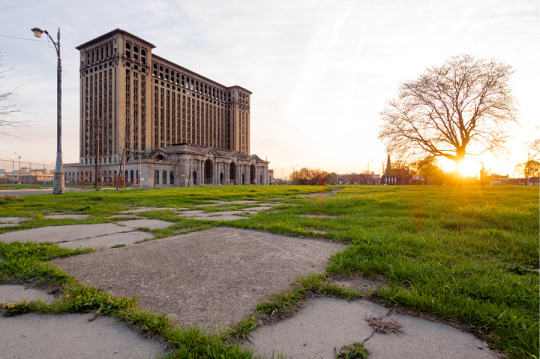
    Take, for example, billionaire Dan Gilbert and Detroit. Not everyone believes that Detroit will come back. In fact, I suspect there are probably more people who think it won’t come back, than people who think it will. Otherwise, it would already be back.

    But Gilbert is unquestionably long on Detroit (via Forbes):

    As you’ve likely heard, over the past four years Gilbert has become one of Detroit’s single-largest commercial landowners, renovating the city with the energy and impact of a modern-day Robert Moses, albeit bankrolled with his own money. He’s purchased and updated more than 60 properties downtown, at a total cost of $1.3 billion. He moved his own employees into many of them–12,000 in all, including 6,500 new hires–and cajoled other companies such as Chrysler, Microsoft and Twitter to follow.

    If/when Gilbert proves to be right about Detroit, then he will have been right about something that most people thought was wrong. And because of that, he will no doubt make a lot of money.

  • Project Profile: Cabin at 45 Dovercourt

    image

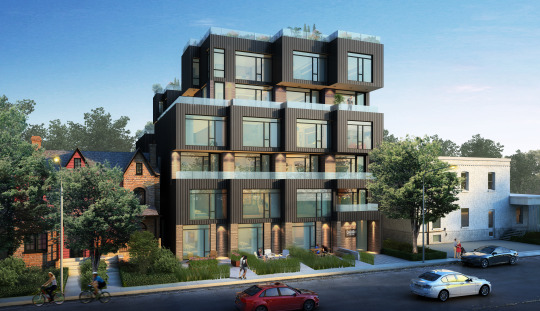
    Last month,
    Curated Properties submitted a
    rezoning and site plan application for a 6-storey, 25-unit building at 45
    Dovercourt Road in Toronto. The project is known to the market as Cabin and you
    can register for it now.

    The project
    immediately caught my attention (because of its design, because of its
    branding, and because I like the work of Curated), so I decided to dig in
    further and get a copy of their architectural drawings. Development
    applications and their supporting documents are all public. Anyone can request
    a copy. But the city isn’t great at making this known.

    Since I’m excited
    to see more of these small scale urban infill projects in the city, today I
    thought I would highlight some of its key features and some of the things that
    are being proposed in order to make a project like this work.

    The Homes

    First of
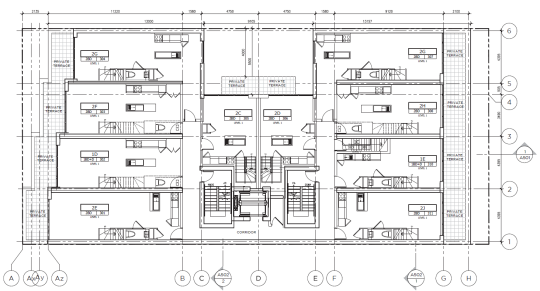
    all, 100% of the suites are 2-storey. 76% of the suites are also 2 bedroom or
    larger.

    The result
    is that the project is essentially a series of townhomes stacked on top of each
    other. I suspect that this will appeal to more end-users as opposed to
    investors. Hopefully, it will also attract more families to the area.

    Here’s the
    third floor plan:

    image

    You
    probably can’t see it, but all of the suites are marked as “Level 1”, obviously
    indicating that there’s more than one level.

    Also worth
    mentioning is the notch or cut out on the north side of the building. This is
    what makes the 2 suites in the middle of the floor plate possible. In order for
    them to have windows, they need to be setback from the (north) property line.
    It also means those suites get terraces.

    The Parking

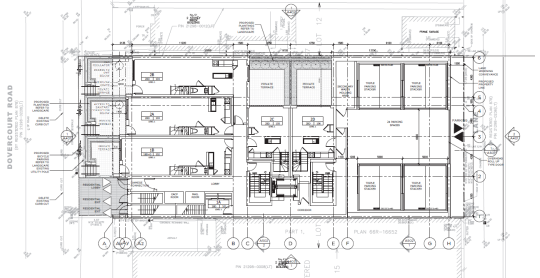
    Turning to
    the ground floor plan, it’s interesting to see that they are proposing 8 triple
    car stackers that will be accessible off the rear laneway (right side on the plan below). That equates to 24 parking spaces in the building (8 bays x 3
    cars per stacker).

    image

    On small
    urban sites like this one, it can be very difficult to accommodate parking. So
    it’s inevitable that we will see more parking stackers in the city and a continual
    reduction in parking minimums.

    The Construction

    Finally, I
    have been told that this project is expected to be framed in wood, as opposed
    to reinforced concrete, which is more typical of condominiums in Toronto.

    As of the
    beginning of this year (2015), the
    Ontario Building Code was modified to allow wood-frame buildings up to 6
    storeys
    . Before this change, the highest you could go was 4 storeys.

    This change
    was done with the intent of reducing construction costs so that it becomes more
    feasible to develop smaller infill sites such as this one. So expect to see
    more of this.

    I know that
    a lot of people would like to remain in the city even when they start having
    children. But it’s becoming increasingly difficult to find affordable low-rise
    homes. And not everyone wants to live in a high-rise tower. 

    That’s why I think
    we will see more, not less, low-rise and mid-rise infill projects like Cabin.
    If you’re interested in this topic, also check out a post I wrote called 3
    stages of intensification
    .

    The rendering at the top of this post is from Curated Properties and the
    drawings are by RAW Design.

  • The Beijing supercity

    image

    A few weeks ago I wrote a post talking about megalopolises and the importance of the Great Lakes region in North America. And I suggested that high speed rail could be one way to better stitch together the region.

    To some, I’m sure this sounded like a bit of a pipe dream. But thinking at the megalopolitan scale is something that I think we are going to need to do. Other parts of the world certainly are.

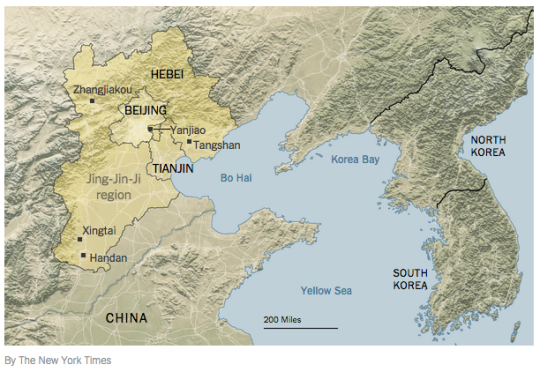
    The Chinese government is in the midst of developing a supercity around Beijing that is called Jing-Jin-Ji. It will span about 82,000 square miles and will house approximately 130 million people. 

    As part of the plan, a high-speed rail network is being built that will bring the region’s major cities within an hour’s commute. The objective is to compete with the Pearl River Delta and the Yangtze River Delta regions in the south.

    It’s a scale of planning and development that most people aren’t used to thinking about. But it’s happening right now.

    Image: New York Times

  • 10 reasons to visit Toronto right now

    https://500px.com/embed.js

    Next weekend a good friend of mine from architecture school will be visiting Toronto from Philadelphia. And I’m really excited to show him the city. (Next month it’s my turn to go to Philadelphia.)

    He’s a fellow city geek. He hasn’t been to Toronto in a number of years. And I haven’t seen him since our trip to Detroit 2 years ago.

    For those of us living and working in Toronto, there’s a lot to celebrate. Sure the Gardiner Expressway East decision didn’t go as I – as well as many other urbanists, including our Chief City Planner – had hoped. But there’s no shortage of other things to brag about.

    So here are 10 reasons to visit Toronto right now:

    1. We’ve created an entirely new business district south of Union Station called South Core. Now the region’s primary mobility hub is in the middle of the country’s most important business district, as opposed to on the edge of it. It’s a better use of infrastructure.

    2. We now have a dedicated train (the Union Pearson Express) that takes you from the country’s busiest airport directly to downtown in 25 minutes. You’ll find local retailers at the stations and a brand created by the brain behind Monocle Magazine. You can even use a smart card to ride it and our local transit system.

    3. We didn’t shut down Uber. Instead our mayor wants to create new policy that will allow these services to coexist with conventional taxi services. We don’t yet know how this will turn out, but I believe it’s a step in the right direction. It’s Toronto taking a leadership approach to innovation as opposed to trying to stomp it out.

    4. We are about to host the largest sporting event in Canadian history. The 17th Pan American Games will have double the number of athletes competing as the 2010 Winter Olympics in Vancouver.

    5. We created an entire neighborhood from scratch in order to house all of these athletes (Canary District). And I think it’s destined to become one of Toronto’s great neighborhoods. I’m saving my first visit for next weekend, so expect a follow-up post on this.

    6. We are dramatically rethinking this city’s public realm. From the plaza out front of Union Station to the new Queens Quay Boulevard along the waterfront, we are prioritizing people and creating more complete streets. It has given Toronto an entirely new urban feel.

    7. We are slowly starting to embrace our forgotten laneways and alleys through the help of organizations like The Laneway Project. And this is going to eventually lead to a further rethink of our pubic spaces and urban fabric.

    8. We continue to be one of the fastest growing cities in the world (certainly in the developed world). As a result, we are building some really exciting buildings by some of the top architects in the world. This includes everyone from Norman Foster to Frank Gehry.

    9. According to a recent report coming out of the Martin Prosperity Institute, Canada is one of the most creative and globally competitive countries in the world, as well as the most open to “ethnic and religious minorities and gay and lesbian people.”

    10. The ATC community is in the process of identifying a new, quintessentially Toronto food dish. But since we have every type of imaginable cuisine here, we’re struggling to pick just one. When you visit, you can help us identify the best and most Toronto dish.

    So there’s a lot to be excited about. I for one can’t wait for us to host the Pan Am Games, starting tomorrow. It’s a chance to show off this great city. 

    So if you’re also in town next weekend and want to geek out about cities, drop me a line.

  • Building on optimism

    To be a real estate developer, or at least to be a good real estate developer, I think you need to have a certain kind of personality. Specifically, I think you need to be an optimist.

    Because if you’re going to take big risks and deal with lots of uncertainty – which is how most development projects work – then you have to believe that you’re going to be able to figure it all out and make it happen.

    That is not to say that you’re not worried about risk and you’re not thinking critically about what you’re doing. Managing risk is a hugely important part of the business.

    Rather it’s accepting that unexpected things will come up, whether it’s a small construction hiccup or a huge black swan event. And knowing that if and when that happens, you’re going to do whatever it takes to get through it.

    As an example, I remember a developer telling me a story about one of his projects in South Florida. This was back when I was in grad school so some of the details are a bit fuzzy.

    But basically he had excavated a site for an underground parking garage and they had just finished pouring the foundations and first underground level. (Because of its high water table, underground parking garages are rare and expensive to build in South Florida.)

    It’s then 2 ’clock in the morning and he gets a call from his engineer telling him that a hurricane is coming through. And that once it comes through the water is going to lift up his foundation from below and basically destroy it.

    They immediately start brainstorming solutions and the engineer ultimately decides that if they fill up the hole with water before the hurricane comes through that it will weigh down the built structure and keep it intact.

    So in the middle of the night, before a storm was about to hit, they’re all on-site pumping water into a big hole.

    The storm eventually came and went and the engineer was right: the water-filled hole kept everything in place. So instead of spending what could have been millions, the developer probably spent tens of thousands on a water bill. That’s a much easier pill to swallow.

    This, of course, wasn’t in the development pro forma or in the construction schedule. But it happened, as stuff invariably does. And for future projects, I’m sure it’ll be something he thinks about it. 

    But it’s all part of the game. And to be good at the game, I believe you need to be an optimist.