Daily insights for city builders, delivered every morning at 6 AM ET. I’m Brandon Donnelly — a Toronto-based real estate developer and founder of Globizen. I’ve been writing here since 2013.

Tag: development

  • Thoughts on land-value taxation

    Yesterday I wrote about a new book that was just released called The Next Urban Renaissance

    The first essay in the book, written by Ingrid Gould Ellen of New York University, is centered around three ideas to help cities deal with the affordable housing problem. This is something that successful cities all around the world are grappling with.

    The first idea is land-value taxation, which is also known as a “split-rate” tax. I’ve touched on land-value taxation before on ATC, but I never really dug into it. So this was a good reminder to do that.

    The idea behind land-value taxation is to split property taxes into a land tax and an improvements tax (i.e. the building), and then shift more of the burden over to the land side. Economists tend to really like this model because taxing buildings/improvements can discourage property investment and development, whereas taxing land doesn’t impact supply. The supply of land is fixed.

    So in the context of affordable housing, land-value taxation is thought to be a way to encourage more development and to increase the supply of new housing – which is usually a good way to keep home prices in check.

    Here’s how Ingrid Gould Ellen described it:

    …a land tax would discourage speculators from hoarding
    undeveloped land and incentivize them to develop their parcels to the
    full extent allowable. Regardless of whether a parcel sits vacant, houses a
    partially occupied, one-story retail strip, or holds a 30-story apartment
    tower, the annual tax bill would be the same. By switching to a land tax,
    a city could therefore increase the supply of housing and, by doing so,
    reduce prices across the board.

    But I can’t help but wonder if this isn’t more applicable to cities or areas that are currently struggling to encourage development. For instance, would boom town Toronto really benefit (in terms of affordable housing) from a tax change that ends up encouraging more high-rise development?

    It also strikes me as being exceptionally difficult to implement, particularly in city like Toronto that is growing and changing so quickly. Is it reasonable to ask the owner of a small downtown parking lot to being paying property taxes as if a 90 storey supertall had been built on top of it? Because that is the reality in some parts of this city.

    And if we opted to phase in this new land tax, would it then become a game of arbitrage where developers look for properties with the lowest land taxes but the highest achievable densities?

    Finally, I wonder if it wouldn’t exacerbate some of the problems that already exist in rapidly growing cities, one of which is the preservation of smaller heritage buildings in centrally located neighborhoods:

    In the case of a split-rate tax,
    the losers will be owners of parcels with high land-to-building value
    ratios, or owners of small buildings on valuable, centrally located parcels,
    who will likely see an increase in their tax bills after the switch to
    a split-rate tax.

    Land-value taxation is something that I’ve been thinking about for a number of months now. But I am struggling to come up with a decisive position. If you have any thoughts on this, it would be great to hear from you in the comments.

  • Guest Post: How We Changed Toronto

    This past summer I participated in a Jane’s Walk here in Toronto, where I was the only speaker to advocate for removing the eastern portion of the Gardiner Expressway.

    After my short talk I was feeling a bit like the black sheep of the group. Either nobody felt the same way as me, or nobody was willing to speak up. Most of the other people there seemed more enamoured by architect Les Klein’s “Green Ribbon” proposal.

    But as I put down the megaphone and began walking to the next stop, a man came up to me. Truthfully, I didn’t know who he was at first, but he reassured me that it was the right thing to do. The Gardiner East should come down.

    Eventually he gave me his business card. On the front it said: John Sewell. And as soon as I saw that I said out loud: “I know this name!”

    John Sewell was a member of Toronto City Council from 1969 to 1984 and was Mayor of Toronto from 1979-1980. Today, he is a Toronto activist and has written dozens of books, mostly relating to urban issues.

    His latest book, released last month, is called: “How We Changed Toronto – The inside story of twelve creative, tumultuous years in civic life, 1969-1980.”

    And today I’m delighted to share a guest post that he has written for Architect This City. The focus of his post below is on the importance of community participation in the planning process and how it was used in this city in the 1970s.

    If you’re a developer, this post might scare you. I think there’s often the perception that communities will generally oppose any sort of development. But there are developers in this city, such as Westbank, which have been taking a more proactive approach to community consultations. And it appears to be working for them. So maybe this is something we should be talking about.

    If you have any thoughts on this, let’s have a discussion in the comment section below. I hope you enjoy the guest post. Thank you again, John.

    _________________________________

    Transportation plans, redevelopment schemes, urban expansion: municipalities address big issues like these in several different ways. A staff report can be requested; consultants can be called in; a competition can be held.

    The device used most successfully by Toronto City Council in the 1970s was a committee of citizens working directly with city staff and council members. It produced enormously successful results, as I recount in my new book `How We Changed Toronto’, but sadly it is rarely used in the 21st century.

    In 1970 City Council appointed a working committee of local residents and several councillors to create a new plan for the Trefann Court Urban Renewal Area, a neighbourhood that had been fighting the city’s plan of demolition for half a dozen years. With the help of a city planner hired specifically for this task, a new plan satisfactory to the different factions in Trefann was hammered out within a few years, then successfully implemented.

    In 1973, when the new Council pondered how to rethink a downtown designated for more office towers, it appointed the Core Area Task Force, a body of community representatives and developers, to give direction to city planners as a new approach to the downtown was devised. The result was the remarkable Central Area Plan which encouraged housing downtown and mixed uses, put an end to windy plazas, and generally created an environment that was active and felt comfortable to anyone on foot.

    In 1974, as Council faced the problem of how it would redevelop 45 acres of wasteland on the edge of the downtown, it appointed a working committee of concerned residents and councillors to give direction to city staff. It’s fair to say that no one had a good idea of how the site should be developed, but the working committee and city staff conceived a brilliant plan which was quickly executed – the first new building was under construction within two years of the working committee being established – and the neighbourhood, now known as St. Lawrence, remains one of the great successes of the latter half of the 20th century.

    From the 1980s onward, City Council has touted the idea of citizen participation, but confined that activity to public hearings on decisions recommended by staff. That generally is the practice today, although open houses have been added, as though showing people plans and getting informal comments is a good way of involving people.

    What’s lost in public hearings and open houses is the creativity that a group of committed, diverse individuals can bring to a problem when they meet together over a number of weeks and months. The members of the group know the local scene but they aren’t experts, so they must be advised by planners and other professionals about the issues they should address, the pitfalls of some options, and the trade-offs available before decisions are taken. It is an open ended process fueled by debates about different opinions, but held together by a common purpose and the realization that those around the table are playing an important role in shaping the direction of the city.

    The working committee that started meeting in Trefann had no clear idea in advance of what the plan it finally arrived at would look like. It was the same with the Central Area Plan, the St. Lawrence community, and the other processes in the 1970s which I touch on in the book. The process that the politicians, staff and residents committed themselves to made all the difference.

    One reason this kind of process is not employed much today is because too many elected figures take an ideological approach. They think they have the answers which they have been elected to implement, rather than to establish ways in which many more minds can be involved in seeking results which are widely agreed on.

    As well, city staff are not seen as independent professional advisors serving the public at large, but as a part of a corps serving the mayor and city councillors. In the 1970s in Toronto there was a clear separation between the politicians and the administration, and there were frequent (and welcome) debates on the floor of City Council between the two factions. Both were there to serve the public although they might have different ideas of how that should be done. This kind of tension was seen as entirely appropriate.

    In Toronto (and probably other cities) the situation is now even more complicated as councillors see themselves not as public servants for a few years, but rather as individuals with a lifetime commitment to holding public office. Too many members of Toronto City Council have been there for more than 15 years, and they fear that taking a principled stand on an important issue might result in the worst of all possible outcomes, their defeat. They decide not to take on the big issues.

    Toronto is currently facing significant problems.  The downtown is being overrun with new tall condo towers, for which the city does not have the infrastructure, and the new housing is not designed to meet the needs of future residents. It is the perfect opportunity for a new look at the Central Area Plan, using the same mechanisms as in the 1970s: a holding bylaw so the new plan won’t be pre-empted by development applications; a citizen-led task force including some councillors, advised by city staff. Who knows what brilliant plan an open ended process can recommend?

    Another problem is money. Toronto does not have enough money to upgrade its transit system or repair the affordable housing it owns, let alone build the new affordable housing it needs. The demands of the mayor that other governments should pay are understandably disregarded. It is time that the city had its own revenue sources, and what better than a citizen led initiative to point the way?

    It’s the same with a plan to build the affordable housing the city needs, to ensure development activity enlivens the near suburbs, to put some restraint on the continued low density subdivisions which are being unrolled far beyond the city’s borders, to restructure the megacity into something which works for the different communities within the city. These challenges all need strong citizen driven processes.

    As I recount in `How We Changed Toronto’, the 1970s really did change Toronto for the better. The city has been coasting ever since on those successes. It is time for renewal, and using the successful mechanisms from forty years ago is something worth doing.

    -John Sewell

  • We are all selfish bastards

    cyclist on bike lane by Axel Bueckert on 500px.com

    https://500px.com/embed.js

    We are all selfish bastards when it comes to sharing road space and public space.

    When we drive, we complain about pedestrians jumping out in front of us, crazy cyclists who get in our way, and under-utilized bike lanes that are taking away valuable driving space and creating traffic jams.

    When we take surface transit (such as buses and streetcars), we want all the cars out of the way so that we can move more efficiently. And we complain about drivers who don’t stop to let us off and on when the streetcar doors open. (Toronto specific reference.)

    When we cycle, we complain about cars parked in the bike lanes, people who don’t look before changing lanes or opening their car doors, and drivers who honk at you because they just want you off the road and onto the sidewalk.

    And when we walk, we complain about cyclists who ride on the sidewalk (they should be on the road!), cars that don’t stop to let us go, and slow walking groups who linearly block the entire sidewalk so you can’t pass.

    We are never happy. And we automatically assume that we could do it better. (I know I’m guilty of this.)

    But here are a few things to consider the next time you’re flipping the bird to someone on the streets. Here are a few things that we do know about urban mobility.

    There is an unprecedented number of condominiums in the development pipeline right now in Toronto. For argument’s sake, let’s assume 75,000 condominium suites – many of which will be built in central areas of the city.

    At a parking ratio of 0.6 stalls per unit, which isn’t an unreasonable assumption today, that’s 45,000 new parking spots and potentially 45,000 new cars in the city. 

    If you think that 45,000 new cars will be able to get fully absorbed into the core and somehow move around in an unfettered way, then I believe you are mistaken. 

    If you think that there’s something that can be done to magically expand road capacity to handle all of these additional cars in the city, then I believe you are mistaken.

    And if you think that adding a bike lane is the only reason you are currently stuck in traffic, then I believe you are missing the bigger picture.

    Over a decade ago, we made a decision in this region to encourage building up, instead of building out. And along with that decision came a necessary rethink of how we get around. That transition is what we are living through right now.

    The other thing we know is that the 4 modes of mobility that I started this post with are ordered from least sustainable to most sustainable. 

    Electric self-driving vehicles will reduce the impacts of driving, but it will also transform it into something that feels more like transit and less like the driving we know today. That will be a very good thing.

    But I’m not yet convinced that it will solve all of our problems. To do that I think we will need to adopt a much more balanced and unselfish view of what it takes to move around a city. That, of course, isn’t always easy.

  • Blogging as city building

    This past week I received 2 separate invitations to talk at events about blogging as a form of city building.

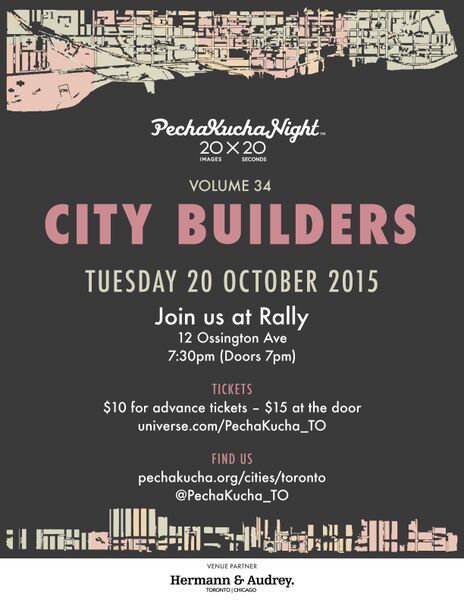
    The first is a Pecha Kucha talk being held here in Toronto on Tuesday, October 20th, 2015. If you’ve never heard of the Pecha Kucha movement, it’s basically all about rapid fire presentations. Each person gets 20 slides and 20 seconds for each one. 

    Here are the details for the upcoming Toronto event:

    image

    The second event is being held in Ottawa in the new year. I’ll write more on that closer to the date when I have more information to share.

    I haven’t yet figured out exactly what I’m going to talk about at each event, but I am starting to think about a few things.

    When I started writing this blog, it was intended simply as an outlet for my own city-related – and also personal – thoughts. Ultimately, the blog evolved into having its own mission, which is to promote the building of beautiful, sustainable, and globally competitive cities. And so clearly in my mind blogging was and is in fact a form of city building.

    But writing is vastly different than the kind of city building I do for a living. During the day I worry about things like rental rates, building setbacks, bulkhead locations, parking counts, and a bunch of other fun stuff.

    The two are certainly related, but the latter feels a lot more tangible. The result is spaces that people will occupy and buildings that will have some sort of impact on the overall built environment.

    But as you all know, city building is a lot more than just bricks-and-mortar. It is political. It is emotional. It is subjective. It is ego-driven. And it is so many other things. Because of this, words do have a role to play in shaping the cities we live in. And hopefully my words are having some kind of positive impact.

    At the same time, I see myself as simply part of a larger set of trends that are happening in both city building, as well as in many other sectors. Trends around transparency, decentralization, and the democratization of information.

    Technology today allows us to connect at zero marginal cost. And that is empowering people like me to self-publish, people to crowdfund real estate development projects, people to crowdsource community feedback for projects, and to do many other exciting things that weren’t possible before. Without this blog, most of you reading this right now would have absolutely no idea who I am.

    So I guess I kind of do know what I’m going to talk about.

  • Why can’t cities reach equilibrium?

    The October issue of The New Yorker has an interesting piece called: Naked Cities – The death and life of urban America.

    I find the article ends up rambling a bit, but I like the idea presented right at the beginning. The idea that cities can never really find equilibrium. They’re either dying, or victims of their own success.

    Here’s that paragraph:

    Cities can’t win. When they do well, people resent them as citadels of inequality; when they do badly, they are cesspools of hopelessness. In the seventies and eighties, the seemingly permanent urban crisis became the verdict that American civilization had passed on itself. Forty years later, cities mostly thrive, crime has been in vertiginous decline, the young cluster together in old neighborhoods, drinking more espresso per capita in Seattle than in Naples, while in San Francisco the demand for inner-city housing is so keen that one-bedroom apartments become scenes of civic conflict—and so big cities turn into hateful centers of self-absorbed privilege. We oscillate between “Taxi Driver” and “The Bonfire of the Vanities” without arriving at a stable picture of something in between.

    I like this because there’s truth to it. But at the end of day, this is just one of the many challenges facing great city building. 

    To solve the problem of affordable housing you could just be a city in decline. But that’s not much fun. So the better option, however difficult it may be, is to figure out how to manage the negative externalities associated with winning.

  • Toronto housing — where we came from and where we’re probably headed

    This morning I’m working on a presentation that I’m going to be giving one evening next week to a delegation coming in from the US. The title of the presentation is the title of this blog post: Toronto housing – where we came from and where we’re probably headed.

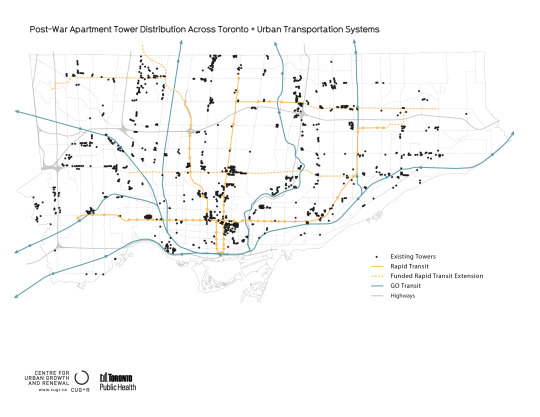
    My plan is to start in and around the 50s and 60s and talk about Toronto’s first tower boom following the war. For this time period, I’m relying a lot on the work of Graeme Stewart of ERA Architects, who is one of, if not the, expert on post war towers in this city.

    image

    I’m then going to move onto our current high-rise condo boom and compare the two.

    Because the interesting thing about the first boom is that, after it finished, we basically returned to the typical North American housing model: building single-family homes. And it wasn’t until this recent boom of the early 2000s that we once again resumed building more high-rise than low-rise housing. That is still the case today.

    But the question I want to address is really, what’s next? Where are we headed? Is history going to repeat itself or is – dare I say – this time different?

    I’ll eventually get to those questions here on Architect This City, but first I want to hear from you. So here’s what I’m proposing: leave your thoughts in the comment section below and I will feature the best ones in my presentation next week as the voices of Toronto. I’m sure many of you know that I’m a big fan of crowdsourced information.

    So here goes. Where is Toronto housing headed and how will we be living in the next 10+ years? Will we be raising families up in towers or not? Please comment by Sunday, September 27, 2015 at 6pm (ET) to make sure I have time to feature you in the presentation. 

    Thanks for participating 🙂

  • Affordable housing and the economics behind developing new rental apartments

    light trail in concrete jungle by Tassapon Vongkittipong on 500px.com

    https://500px.com/embed.js

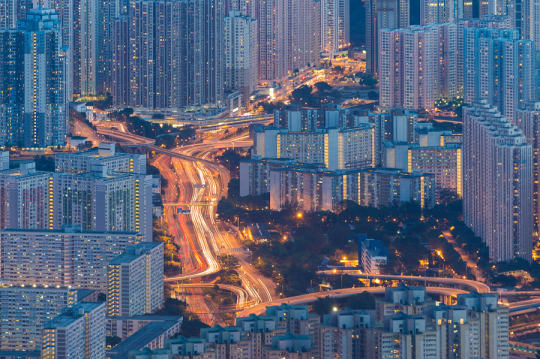
    In most big cities around the world, there is a pressing need for more affordable housing. We know that inclusive cities make for better cities. But from San Francisco to Hong Kong, you always hear people talking about how expensive housing is.

    So why is this such a difficult problem to solve?

    Part of the problem, I think, is that many people don’t understand the economics behind building a new building. Oftentimes I hear people say that because developers make so much money, they should just build more affordable housing. Done. Simple.

    But things are not that simple.

    To illustrate my point, let’s walk through the thought process for developing a new rental apartment building.

    In its simplest form, developers are concerned with: revenue – costs = profit. And since many of the costs associated with building a new building just are what they are, it all starts with revenue, which in our case would be rents.

    To build a new rental tower in Toronto, your rents typically need to be at least in the high $2′s per square foot per month. Otherwise the economics don’t work. But to make the math simple, let’s say you need $3 per square foot in rent. That means a 1,000 sf apartment would rent for $3,000 per month.

    That’s not cheap. There are only so many people who can afford these kinds of rents and only so many areas where you can command these kinds of rents, which means there are only so many areas in Toronto where new rental apartments will be built by the private sector.

    If the rents instead happen to be $2 psf – meaning that same 1,000 sf apartment now rents for $2,000 per month – then for-profit developers will not build (barring any unique deal circumstances). Even at $2.50 psf / $2,500 per month, it would be difficult to make the numbers work here.

    And by the numbers, I am talking about tight returns that really only start to make sense in our environment of record low interest rates. Which means that when interest rates start to rise (pushing cap rates up), it may not even make sense to build rental apartments when the rents are in the high $2′s per square foot. This is particularly true if you’re competing against condo developers to buy the land. They can afford to pay more. 

    In this scenario (of rising interest rates), many real estate firms might simply opt to buy existing assets instead of taking on the risk of building anything new. Now all of a sudden your supply of new market rate apartments (not to mention affordable apartments) has dried up. Remember, it’s been decades since Toronto built rental apartments at any sort of meaningful scale.

    It’s for reasons like this that Vancouver launched a program called Rental 100. In a nutshell, it helps to reduce the “costs” variable in the equation mentioned above so that developers are able to meet minimum project returns and build more rental buildings. They do that through things such as reduced parking requirements, additional density, development charge waivers, and so on.

    In some ways, these items are subsidies. The city is giving up revenue that it could have otherwise collected from a developer building, say, a condo. But in other ways, they are freebies. The city could be unlocking development sites that may have otherwise not been developed. In which case it’s not really forgone revenue.

    Vancouver’s Rental 100 program is a market rental housing policy. But there’s no reason that similar thinking couldn’t be applied to create an affordable rental housing policy. It has been done and is being done in many cities.

  • How high are your ceilings?

    I’ve been having a lot of discussions lately about ceiling heights. The clear height from the top of the floor to the underside of the ceiling.

    In Toronto there has been a bit of an evolution in ceiling heights. Older apartment and condo buildings often have 8’ ceilings. Newer buildings today often have 9’ ceilings. And we’re now seeing 10’ ceilings creep into the market, though I wouldn’t say it’s close to becoming the standard. It’s more at the top end. Of course there are also loft buildings with even higher ceilings.

    I am personally big on ceiling height. But I would be very curious to hear from the Architect This City community on this one.

    How high are your ceilings? What do you consider ideal? Do you even care? And is there a ceiling height where it would become a deal breaker for you when it comes to buying/renting a new place? I also think your actual height might have an impact on preference, so it would be great to also hear how tall you are.

    I have 10’ ceilings in my place. Not because my place is all that special, but because my suite is on the same floor as the building amenities. So the higher ceiling height is carried through (the rest of the building is 9’). I think it makes a big difference, particularly since my place isn’t all that big. I’m 6’3".

    Let me know your thoughts in the comment section below. This is great market feedback that will certainly be taken to heart.

  • Towards a post privacy world — what the Ashley Madison hack could mean for cities

    Blinded View by Markus Jentes on 500px.com

    https://500px.com/embed.js

    Ashley Madison is a website that helps married people have affairs. 

    Recently the website was hacked and over 33 million accounts were exposed. This included full names, email addresses, mailing addresses, and so on. Not surprisingly, this has gotten a lot of press. The site was/is marketed as being private and secure. And clearly that is not what it is right now.

    But there are people in the tech community, such as venture capitalist Albert Wenger, who believe that is merely a glimpse into the future – a “post privacy future.” He even argues on his blog that we as a society should be more accepting of the leak and that the release of this data could lead to a “more measured view of affairs.” (There are many who argue that humans are not intended to be monogamous.)

    For many, or probably most of you, I’m sure this position seems pretty radical. After all, this leak will likely destroy many marriages.

    But Wenger’s position on privacy is a fascinating one and he’s written a lot on the topic. The tension he sees is one between individual privacy vs. collective intelligence. In this part of the world, our society values the former over the latter. But he believes that we are headed towards a world where almost everything, yes everything, will eventually become public. Again, radical position. But consider how much we publicly share about our personal lives today versus 10 or even 5 years ago.

    What’s perhaps more relevant to the Architect This City audience though is what this could mean for many other industries beyond tech.

    I often think about what a “post privacy future” could mean for city building. Imagine if every architect, real estate developer, engineer, and other participant made public all of their work. This would mean that all designs, financial models, sales data, and so on were made widely available to anyone who wanted to see them.

    The thought probably scares many of you in the industry, but consider what it would mean for our collective intelligence. There’s a strong argument to be made that we would all be better off and that the process of building would become far more efficient. In fact, if truly everything were public, it could in theory eliminate most of the market’s concerns about overbuilding, a condo bubble, and all the other stuff that gets talked about.

    The reason people speculate on these market factors is because we don’t have all the data. We don’t actually know what’s going to happen. We have no idea. I know I certainly can’t predict the real estate market.

    So why aren’t we quickly becoming more public?

    Wenger raises the game theory principle known as the prisoner’s dilemma:

    “So one way to think about secrecy is that it leads to lots of prisoner’s dilemma style situations. Individuals (or companies) would be worse off if they were the only ones disclosing, but if everyone disclosed (or at least the majority), then everyone would be much better off. In the language of game theory, we are in a bad equilibrium.”

    In other words, if only one real estate developer disclosed her project’s financial information to the public, then she would probably be worse off against her competitors. But if every developer in the city did it, then the market as a whole would be better off because everyone would then benefit from collective intelligence.

    Using the example of infidelity, if one person is caught having an affair, then that person is more than likely worse off. But if over 33 million people are caught having an affair and it reinforces the statistic that between 30-60% of married people in the United States will have an affair at one point in their lives, then maybe it forces us as a society to rethink what marriage means today. And maybe that makes us all better off.

    This is a pretty far out there argument, though the city building example is probably more palatable than the Ashley Madison one. Regardless, I would love to hear your thoughts in the comment section below. 

    Are we heading towards a post privacy world?

  • The importance of having your own beliefs

    On Monday I watched the movie Moneyball for the first time. I really enjoy movies, but I unfortunately don’t watch a lot of them, which is why I am only now watching Moneyball. It was released in 2011.

    The movie is based on a 2003 book of the same name that many people believe changed the game of baseball. It emphasizes rigorous statistical analysis (known as sabermetrics) over gut feeling, instinct, and traditional metrics when it comes to assembling winning baseball teams.

    I don’t know a lot about sabermetrics, but I am now excited to read the book. Still, the dichotomy between the New York Yankees and the Oakland Athletics is incredibly interesting to me. And it reminded me of a post I wrote a few months ago ago called: When everyone thinks you’re wrong.

    In the movie, Billy Beane, the GM of the Athletics, realizes that he cannot compete with the Yankees dollar for dollar. The Athletics are a small market team and the Yankees, with their large payroll, will always be able to pay more for players. So he decides that he will need to think about the problem differently to win.

    What’s interesting about this is that it’s exactly the framework I talk about in my post when it comes to buying (real estate) development sites:

    “…you can really only win development sites in one of two ways. Either you’re willing to spend the most money or you see something and have a vision that nobody else sees.”

    Of course, lots of baseball teams today are now employing sabermetrics. But at the time, everyone thought Billy Beane was nuts. It’s hard to try something new and be different. Many of us just want to do what is least likely to fail.

    But there’s so much value in having conviction and being right about something that everyone else thinks is wrong. You won’t always get it right. And that’s okay. But when you do get it right, it’ll be magic.