Daily insights for city builders, delivered every morning at 6 AM ET. I’m Brandon Donnelly — a Toronto-based real estate developer and founder of Globizen. I’ve been writing here since 2013.

Tag: development

  • I can’t spend unrealized gains

    image

    Earlier this week the Wall Street Journal published an article claiming that the celebrated venture capital firm Andreessen Horowitz was lagging behind its elite peers in terms of returns.

    The firm then responded with a well-written blog post explaining why this accusation is off the mark. Their response was simply that you can’t measure returns on “unrealized gains.” Until there is a liquidity event – that is, the company gets sold or goes public – it’s just paper returns. And what matters is cash. 

    As the post clearly states: “I can’t spend unrealized gains.”

    But beyond just a rebuttal, the blog post is a great primer on how the venture capital industry works. We talk a lot about the tech space on this blog, so I thought some of you might find it interesting. 

    One of the reasons I like to follow the VC space is that there are many similarities to real estate development. Not only in the way that the funds are structured, but also in the way that the gestation periods are incredibly long.

    The post talks about this as a “J curve.” In the early years of a fund, the returns are negative. Money is going out the door to invest in immature and risky startups. And it’s not until the harvesting period (7+ years later) that the realized gains start getting paid out to investors (LPs).

    It’s also interesting to note that the exit timing for companies – at least according to Andreessen Horowitz – seems to be increasing (10+ years). This is yet another similarity to real estate development where it seems to be getting harder and harder to build and deliver new supply.

  • Preserving place

    I was recently asked: How do you go into a neighborhood, build new, and not erase and/or sterilize what makes that neighborhood interesting in the first place? 

    Gentrification is a controversial topic in city building. Too often I think we ignore what happens when we don’t invest in communities, but that doesn’t mean we shouldn’t be deliberate when we do make investments.

    Development is filled with tensions. We are constantly trying to navigate through constraints and balance out the wants of each and every stakeholder. It becomes an art. It doesn’t always work out as planned.

    To state the obvious, I would say that it starts with caring. If you’re not interested in community and city building, then the default response will be to simply replicate what worked on the last project.

    But every place has a local culture. And if city builders are to have any hope of preserving and building upon what makes that place unique, we have to first understand it. What made it successful in the first place? What is its DNA?

    Because then you’re in a position to think about both built form and programming in a way that is culturally sensitive.

    One example that comes to mind is the proposed redevelopment of Honest Ed’s / Mirvish Village here in Toronto. 

    The “micro tower” design is intended to create the sense that the area was built up organically over time. And the fine grain retail (50-60 individual retail spaces) is intended to house local retailers, micro retail startups, and pop-up shops. To me, both of these elements speak to the history and fabric of the area.

    Adopting a unique approach can also sometimes mean rethinking how you measure ROI. If all you care about is who will pay you the highest rent – right now – then you’re going to make a decision based on that metric.

    Maximizing revenue is not a bad thing. That’s what businesses are supposed to do. But sometimes there is or should be a larger vision at play. And sometimes you need to take a longer view.

    In Toronto’s Distillery District, the developers made the decision to eschew large chains and franchises (in favor of more local retailers) so that they could create a very particular place. Ultimately that particular place became a great place to sell condos, but they suffered early on for it.

    I like how Gary Vaynerchuk put it when he asked: What is the ROI of your mother? Sometimes you may not be able to measure it, but that doesn’t mean the ROI isn’t there.

    Any other suggestions?

  • The institutionalization of development

    Jones Lang LaSalle recently asked: Is there still room for the buccaneer property developer?

    But in the contemporary world of real-estate – corporatized, institutionalized and massively capitalized – is there any longer room for the swashbuckling “merchant developers” or are they doomed to go the way of the wildly-gesticulating floor traders in colourful blazers that once symbolized financial markets?

    “There is always room for the entrepreneur,” says Richard Bloxam, JLL’s head of capital markets, Europe, the Middle East and Africa. “It is, however, fair to say that real estate has been on a journey away from total reliance on the entrepreneurial model.”

    I’ve written about the institutionalization of the business before. And it’s something I’ve been asking developers that I interview for my BARED blog series. Are the days of the eccentric and larger than life developer behind us?

    The consensus appears to be no. 

    All that has changed is the capital source / stack. The skills that make for a successful developer haven’t changed. You still need to be creative and look for opportunities that others don’t see. You still have to navigate through all of the various constraints – of which there is probably more of today. You still need to be entrepreneurial in spirit.

    What I wonder though is if this change hasn’t undemocratized the business to a certain extent. It seems to me that it’s harder, today, to fly by the seat of your pants with just an idea (and no capital). The barriers to entry feel more significant. But as Richard says, “there is always room for the entrepreneur.” And I believe that.

    I would be curious to hear your thoughts. 

    Also, the next BARED post will be up shortly. Stay tuned.

  • BARED: David Wex, Urban Capital Property Group

    image

    David Wex started his career working for one of the big Seven Sister law firms in Toronto. But right from the outset, it was clear that he wasn’t in it for the long run.

    In fact, only a few days after he started, David had the clever idea of turning his desk around so that it faced the window, instead of the hall. That way, he could avoid eye contact with partners as they walked by his office, and reduce his chances of being assigned a file.

    Of course he couldn’t avoid being tracked down all the time. But whenever someone would try to assign him work, he would simply say: “I’m sorry, but I’m really busy working on something right now.” His nickname quickly became “One File Wex” and it was clear that he was headed towards the departure lounge and not a corner office.

    But already, David had his mind set on doing something related to cities. So while still working as a lawyer he decided to complete his Graduate Record Examination (GRE) in preparation for going to planning school. Ultimately, he decided not to go back to school, but instead leave the firm and just figure things out. He left in 1992.

    After leaving, he did in his words, “nothing” for a few years. He lived off his savings, spent some time working with a bunch of guys cleaning up the Don River, and tried to figure out a way to put together a development project.

    Eventually he met a friend of the Goodman family and this led to an introduction to the Dundee Corporation.

    It was the early 90’s and nothing was happening by way of development in Toronto. The real estate industry was in a deep recession. Ask anyone who was “active” during this time. It was a painful time to be in the business. But the Goodmans told David that he if could find a suitable site to develop, they would invest. Lesson: Developers are constantly leveraging other people’s money.

    So David went out and found a site on a sleepy street named Camden in Toronto’s Fashion District. This is not the Camden Street of today, which has an Ace Hotel currently in the works. It was a dead zone. By this point we are in 1995 and few people believed that anyone would want to live on a downtown street like Camden.

    Given the perceived undesirability of the site and the continued lull in the market, David tied up 29 Camden for C$700,000 with a 2 year option. What this means is that he had 2 years to figure out if he actually wanted to close on it. He could put very little money down and get the project going before having to worry about carrying the land. It wasn’t until midway through sales that he actually went firm.

    It’s hard to imagine being able to do this in today’s competitive real estate market, but that was the market at the time.

    Of course, the flip side to all of this is that it also took him 2 years to sell about 20 condominium units (out of a total of 55), at an average price per square foot of $195. Today you could sell those units in 2 hours at $800 psf.

    Brad Lamb – who was just starting out at the time – was the broker on the project. And activity at the sales office was so scant that everyone would get excited even when a car would drive down Camden Street. That’s how dead it was in the Fashion District.

    Eventually Dundee got impatient. Sales were slow. A lot of money had been spent on marketing. And the partners didn’t believe that “the bump and grind of Queen Street” (original marketing pitch) was the right way to position the product. David was also in the midst of rebranding his company from Red Rocket (named after our transit commission) to Scrappy Dog Real Estate Investments. By that point Dundee came in and said: “You’ve fucked up this project. You’re out.”

    David had felt like he had made it and become a developer with Camden Lofts. But just like that – before construction had even started – he was off the project.

    The deal that David struck with his partners was that he didn’t want any money out of the project (it didn’t end up making much money anyways). But he wanted to stay involved and be able to call Camden Lofts his project. And so to this day, Camden Lofts remains the first development project of his very successful real estate career.

    But Camden Lofts didn’t solidify David as a real estate developer. After the fumble, David took on the role of managing a loft conversion for what turned out to be some pretty dodgy landowners. The total management fee was a princely $5,000, but David wanted to complete his own project from beginning to end. And so he did just that with Century Lofts at 365 Dundas Street East. He also spent a great deal of time learning Illustrator, Photoshop, and other design tools so that he could do all of the marketing himself. This is an experience that would later manifest itself in his company’s business model.

    After tuning his craft for a couple of years, David met his current business partner, Mark Reeve. Mark was a corporate real estate developer and planner, and they talked about doing something together. So they did, and the result was Urban Capital Property Group. Mark was also able to planning consult on the side and that helped fund their fledgling business as they worked on breaking into the development game.

    The first project to come out of this relationship was The Sylvia, which was also on Camden Street (#50). However, you won’t find this project on their website because it was done in partnership with developer Intracorp. The relationship ended up not being a productive one and both David and Mark vowed never again to be involved in a project that they weren’t actively managing themselves. That vow continues to this day.

    The first project that Urban Capital did on their own was the 66-unit Charlotte Lofts. It’s the first project they completed from A to Z. They sourced the site, secured the financing, worked on the design, marketed it, and constructed it. It was a success.

    The partners did well but the learning curve remained so steep that neither felt that they had really “made it” with this project. Indeed, my interviews have uncovered that this is a common experience amongst new developers. It can take a few projects before they really hit their stride and, in some cases, even make any money.

    But who ever remembers the stumbles?

    Today, Urban Capital has completed over 4,000 urban condominiums and has another 2,500 in the works. They have developed over $2 billion worth of real estate to become one of Canada’s most influential urban infill developers.

    Unlike other Toronto-based condo developers, they have branched out beyond Toronto: east to Montreal, Ottawa and Halifax; and west to Winnipeg and Saskatoon, with other cities on the horizon. Their mission is to act as an urban regenerator by bringing high design urban living to new markets across the country.

    They have come a long way since the days of Scrappy Dog Real Estate Investments. Clearly David is the furthest thing from “One File Wex.”

    You can follow Urban Capital on Twitter and on Facebook.

    Image: River City 2, Toronto

    ———————————————————

    This is the first post in my new blog series called BARED (Becoming A Real Estate Developer). More posts to come in the following weeks. Subscribe to stay in the loop.


  • Dear City Council

    Kate Downing was formerly a planning commissioner in the City of Palo Alto. She recently resigned from her position and, about about a day ago, she posted her resignation letter on Medium. It has since gone viral.

    The reason it has spread so quickly, I think, is because it addresses the very same issues that so many cities around the world are facing: a lack of housing supply and eroding affordability.

    As a developer, I obviously have a vested interest in this matter. But to the extent that I can put that aside, I really do believe that our goal should be to build inclusive, rather than exclusive, cities.

    For instance, when I think of great cities such as New York and Toronto, I think of their history of taking in a large number of immigrants and then empowering them to climb the socioeconomic ladder. There’s something magical about that. One of my best friends likes to talk about this potential as “immigrant hustle.”

    But when we sterilize our cities by allowing only the incumbents to survive, I believe we place that socioeconomic potential in jeopardy. So for that reason, I am reposting Kate’s entire letter. I have bolded the points that stood out for me. Let me know what you think in the comments.

    ———————————————————

    Dear City Council Members and Palo Alto Residents,

    This letter serves as my official resignation from the Planning and Transportation Commission. My family has decided to move to Santa Cruz. After many years of trying to make it work in Palo Alto, my husband and I cannot see a way to stay in Palo Alto and raise a family here. We rent our current home with another couple for $6200 a month; if we wanted to buy the same home and share it with children and not roommates, it would cost $2.7M and our monthly payment would be $12,177 a month in mortgage, taxes, and insurance. That’s $146,127 per year — an entire professional’s income before taxes. This is unaffordable even for an attorney and a software engineer.

    It’s clear that if professionals like me cannot raise a family here, then all of our teachers, first responders, and service workers are in dire straits. We already see openings at our police department that we can’t fill and numerous teacher contracts that we can’t renew because the cost of housing is astronomical not just in Palo Alto but many miles in each direction. I have repeatedly made recommendations to the Council to expand the housing supply in Palo Alto so that together with our neighboring cities who are already adding housing, we can start to make a dent in the jobs-housing imbalance that causes housing prices throughout the Bay Area to spiral out of control. Small steps like allowing 2 floors of housing instead of 1 in mixed use developments, enforcing minimum density requirements so that developers build apartments instead of penthouses, legalizing duplexes, easing restrictions on granny units, leveraging the residential parking permit program to experiment with housing for people who don’t want or need two cars, and allowing single-use areas like the Stanford shopping center to add housing on top of shops (or offices), would go a long way in adding desperately needed housing units while maintaining the character of our neighborhoods and preserving historic structures throughout.

    Time and again, I’ve seen dozens of people come to both Commission meetings and Council meetings asking Council to make housing its top priority. The City Council received over 1000 signatures from Palo Alto residents asking for the same. In the annual Our Palo Alto survey, it is the top issue cited by residents. This Council has ignored the majority of residents and has chartered a course for the next 15 years of this city’s development which substantially continues the same job-housing imbalance this community has been suffering from for some time now: more offices, a nominal amount of housing which the Council is already laying the groundwork to tax out of existence, lip service to preserving retail that simply has no reason to keep serving the average Joe when the city is only affordable to Joe Millionaires.

    Over the last 5 years I’ve seen dozens of my friends leave Palo Alto and often leave the Bay Area entirely. I’ve seen friends from other states get job offers here and then turn them down when they started to look at the price of housing. I struggle to think what Palo Alto will become and what it will represent when young families have no hope of ever putting down roots here, and meanwhile the community is engulfed with middle-aged jet-setting executives and investors who are hardly the sort to be personally volunteering for neighborhood block parties, earthquake preparedness responsibilities, or neighborhood watch. If things keep going as they are, yes, Palo Alto’s streets will look just as they did decades ago, but its inhabitants, spirit, and sense of community will be unrecognizable. A once thriving city will turn into a hollowed out museum. We should take care to remember that Palo Alto is famous the world over for its residents’ accomplishments, but none of those people would be able to live in Palo Alto were they starting out today.

    Sincerely,

    Kate Downing

  • For the love of compactness

    I’m in Provincetown, Cape Cod right now. One of the things that is great about this town is the scale of it. It’s compact and many of the streets feel like laneways or alleys (I’m obsessed, I know). It’s all about pedestrians here. Even the main drag, Commercial Street, is effectively a pedestrian street – though it’s not technically closed to cars most of the time.

    There’s something liberating about being able to get where you need to go by walking or biking or skateboarding. And all of those things are done here. I enjoy the inherent efficiency that compactness brings. That’s why I was excited to learn this morning about the following proposal at 24 Mercer Street in Toronto (via Urban Toronto):

    image

    It’s a 12 unit, 17 storey building on a 195 square metre lot. The proposed FSI is 16.8. And it will have zero parking. I would be incredibly curious to know what the construction costs will be and how the overall project pencils out. But regardless, it’s exciting to see someone trying to make use of such a tight site. I would love to see more of this in Toronto and I am certain we will.

    What do you think about projects like this? Some of you may call this “poor planning,” but I see the efficient use of resources.

  • Low cost energy efficient homes perched atop of surface parking

    A regular of this blog recently suggested (in the comments) that I take a look at the London-based design firm ZED Factory. ZED stands for Zero Energy Development.

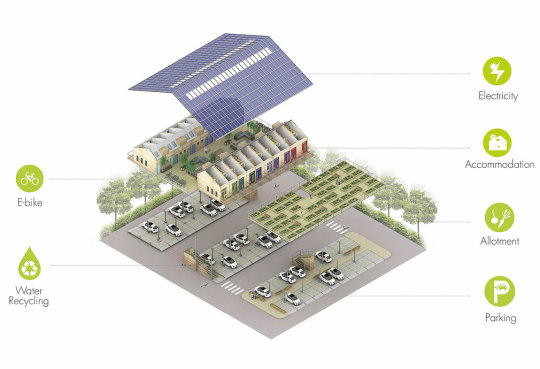
    The first project that caught my attention was ZED Pod. ZED Pod is a small, low cost energy efficient modular home that is designed to sit atop of surface parking lots. In other words, it’s a way to repurpose under-utilized surface parking without compromising existing parking ratios. All you really need are the air rights. And since the “land” is cheaper, the homes can be cheaper. They can also be easily relocated if the parking lot were to get developed in the future (though they are designed as permanent structures).

    image

    In some ways, there is something perverse about the way that driving and parking have such a profound impact on the urban landscape. Even when it’s buried underground and hidden from sight, the structural column grid needed to layout efficient parking will often carry up through the building impacting suite layouts. We’ll even restrict housing supply when parking requirements can’t be met. Should it be parking or people who come first?

    But cars aren’t going away. And ZED Pod is a clever way of dealing with an existing urban condition – however suboptimal it may be. I found the concept interesting and I thought you all might as well.

    Image: ZED Factory

  • Two open real estate development positions

    I recently alluded to some life changes on this blog. Well, I am now ready to share: I am leaving my development position at CAPREIT.

    I wasn’t intending to leave. I wasn’t looking to leave. And frankly, I felt conflicted. But sometimes life has a funny way of presenting opportunities that you just have to say yes to. As my mother likes to tell me: “Life is what happens to you while you’re busy making other plans.” More on this in a later post. Stay tuned.

    What I would like to talk about today are the opportunities that this may create for some of you. There are now two open development positions at CAPREIT. Both positions would be based in downtown Toronto (St. Lawrence Market).

    The first opportunity is essentially a Director level role where you would be responsible for growing the development team at CAPREIT. You should be able to lead a team, identify new development opportunities, create pro formas, assemble/manage consultant teams, secure development approvals for complex urban infill sites, and generally lead projects and people through the entire development lifecycle. For more information and to apply, click here.

    The second opportunity is at the Coordinator level. You would be reporting day-to-day to the above person and you should have working knowledge of the development process. For more information and to apply, click here.

    I would just like to add that in both cases you would be working on some very exciting urban infill projects and you would be joining an organization with great people and a great corporate culture. I mean this sincerely. If you have any questions about the two roles, feel free to reach out to me directly. And if you’re in the market, consider applying.

  • The back-end of our cities

    I love cities. We all love cities right now. 

    Everyone, for good reason, seems to be fixated on both people returning to cities (like those narcissistic Millennials) and people urbanizing for the very first time. This latter scenario is happening rapidly across the developing world and in many cases – but not all cases – it is helping to lift people out of extreme poverty.

    But by most measures, urban areas represent only about 2-3% of the world’s land area, despite housing over 50% of our population. So here’s an interesting thought for this morning: What is happening and what will happen with the remaining 97-98%?

    In this recent talk by architect Rem Koolhaas, he attempts to dissect the future of living, loving, and working through the lens of architecture. However, he starts by saying that architecture is, in fact, too slow to properly capture the zeitgeist of any time period. It is, “an unbelievably slow art.” That said, Koolhaas has a remarkable ability to identify what is happening (see Delirious New York) and then call it out in a way that you probably haven’t thought about. 

    In the above talk, he hones in on the impact of Silicon Valley – certainly the spirit of our time – on the rural landscape outside of our cities. Interestingly enough, he also talks about how the tech industry has begun to borrow terminology from architecture in order to describe itself.

    Screenshot from the video:

    image

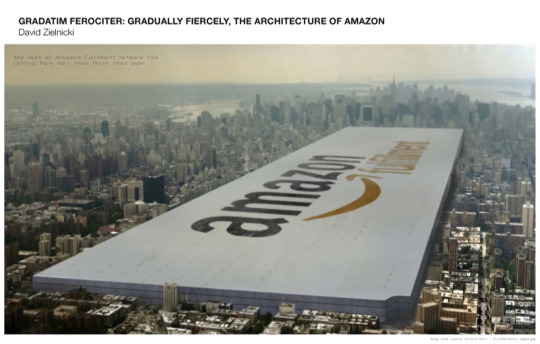
    Despite their ethereal appearance, technology giants still have large physical footprints for servers, production, logistics, and so on. But there’s no reason – or way – to accommodate them inside of our cities and so they cluster outside, in the 97-98% areas. These are places like the Tahoe-Reno Industrial Center, which is the home of Tesla’s new Gigafactory.

    Because of sheer scale and because there’s no need for them to possess much in the way of humanistic qualities, these are spaces which are void of architecture, urbanism, and, in some cases, a light spectrum beyond what is absolutely necessary for the specific function of the building (discussed in the video).

    Of course, the periphery has long serviced the core. But Koolhaas’ thinking has, as it often does, made me consider this phenomenon in a slightly different way. He paints a picture of a spiky world where we are all crammed into sensor and app-driven cities (the front-end), all of which are then powered by big mechanistic boxes that many of us may be naive to (the back-end). In some ways it feels like the Matrix. What we see and experience could just be the tip of the iceberg.

    Architecture may be unbearably slow, but as a society we have always built what matters to us most at the time. At one point it was places of worship. But today, at least for part of our landscape, it is boxes not intended for us to really experience. Maybe that’s not really architecture. Maybe it is simply the back-end for our cities.

  • The urban wealth pendulum

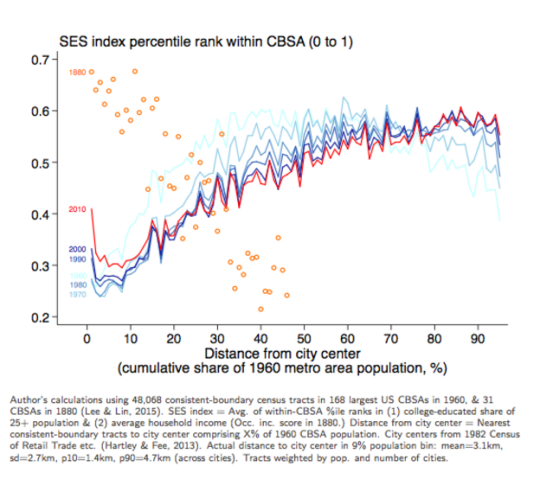
    Jeffrey Lin, who is an economist at the Federal Reserve Bank of Philadelphia, recently published the following chart:

    image

    I found it in this Washington Post article. And it’s packed full of fascinating information.

    The chart compares the socioeconomic status in US cities (y-axis) against “distance from city center” (x-axis) in 1880 and then in recent years (1960 to 2010 census data). The orange circles represent the 1880 data and the red and blue lines represent the recent census data.

    What this chart and research tells us is that in 1880, rich people overwhelmingly lived in the center of cities. And as you moved further away from the city center, socioeconomic status fell off pretty precipitously. This makes sense given that, at the time, it was hard to get around and travel long distances.

    However, in the post-war years, the exact opposite became true. We began driving and wealth decentralized. This should surprise no one. 

    But what’s interesting is how this appears to be reversing. In 2010 (the red line), there’s a sharp increase in socioeconomic status for people living basically right in the center of cities. And for the 30 – 60 km range, there has been a decrease in socioeconomic status essentially from the 1960s onwards. 

    The important takeaway here – which is spelled out in the Washington Post article – is that the neighborhoods which appear to be in high demand today are also in very short supply:

    “We have 80 years of essentially zero production of neighborhoods with these qualities,” Grant says. “We’ve spent the last 80 years building car-oriented suburbs. Then when the elites decide they want to go back into the city, there’s not enough city to go around.”

    This is one reason why supply matters.