Daily insights for city builders, delivered every morning at 6 AM ET. I’m Brandon Donnelly — a Toronto-based real estate developer and founder of Globizen. I’ve been writing here since 2013.

Tag: data

  • Why Bitcoin might still be a big deal

    Welcome to 2015!

    To start off the year, I thought I would talk about something pretty geeky, but very forward looking: Bitcoin.

    I wrote about Bitcoin just over a year ago when I was first starting to wrap my head around it, but a lot has happened since then. Many of you might know that 2014 was a terrible year for Bitcoin and that its price has declined significantly (chart from Coinbase):

    image

    But does that mean Bitcoin is a flop, or that the hype has just died down a bit?

    If you follow what’s being discussed within the tech community, you’ll know that there are still lots of people who are bullish on Bitcoin. But more precisely, they are bullish on the underlying architecture behind Bitcoin and something that is called the Blockchain.

    I’m not going to get too technical in this post (if you want that, go here), but I do want to talk about three things (that I’ve mostly learned from the folks over at Union Square Ventures): the Blockchain, why it matters, and what it could mean for specific industries such as transportation and real estate. I promise to make it relevant at the end.

    The way to think about all of this is in layers.

    The Blockchain is the foundation or base of Bitcoin. It’s essentially a decentralized public ledger that keeps track of all the Bitcoin transactions. Decentralized means that not one single person or company owns the database. It’s free for anyone and everyone to see. This structure is important because it enables peer-to-peer transactions across the internet, as opposed to going through a bank or other intermediary.

    But the key takeaway is that Bitcoin is simply one example of a “protocol” built on top of the Blockchain. And there are many others in the works, including a protocol for realtime ride sharing (Lazooz) and a protocol for a decentralized peer-to-peer marketplace (OpenBazaar). And so the real innovation is the Blockchain, not Bitcoin itself.

    Why does this matter?

    It matters because these protocols are, again, not owned by a single entity, which is remarkably different than the way most things work today. Take for example the residential real estate industry. In the Greater Toronto Area, the data that emerges from home listings and sales is owned by the Toronto Real Estate Board.

    And since this data is privately owned, a lot of it remains only accessible to “members” or real estate agents. The Competition Bureau has been fighting for more openness, but the Toronto Real Estate Board obviously wants to keep as much of this data as it can to itself. Who can blame them.

    But what if somebody came along and created a new protocol for a decentralized peer-to-peer home marketplace? In that case no one would own the data, which means everyone would have access to it. And that would completely change the landscape. I’m fuzzy on what this protocol would even look like, but it seems entirely possible given what else is in the works.

    And if this Bitcoin Blockchain revolution does actually take place, it wouldn’t be restricted to only non-tech legacy industries. Joel Monegro of Union Square Ventures believes that “decentralized protocols” such as Lazooz and OpenBazaar (mentioned above) could even have a big impact on companies such as Uber and eBay, respectively.

    I’m still trying to wrap my head around all of this, but I want to understand it and I thought you all might as well. Because even though it seems very tech right now, the implications would also be very non-tech if it turns out to be true.


  • How to apply for information

    This morning I was at Toronto City Hall looking for old drawings of a building that I’m now working on. While I was there, I also ran into John Tory, and so I was given the opportunity to congratulate him in person on his recent mayoral win. But that’s irrelevant to this discussion.

    What I instead want to talk about is access to information.

    We are living in a world that produces an unprecedented amount of data and information. Back in 2010, Eric Schmidt – the former CEO of Google – quite famously stated that we were creating as much information in the span of 2 days as we did from the dawn of civilization up until 2003. And that was 4 years ago. So I can only imagine what the numbers look like today. The internet is basically a giant data generating machine.

    But a lot of that information isn’t all that useful and much of the really useful information that’s out there isn’t yet digitally accessible in the ways that we have now become accustomed to. For example, for me to access old drawings and documents for a building in Toronto, I had to do the following…

    First, I had to file what’s called an Application for Routine Disclosure. It was a 2-page form that I was able to submit to the city over email. The fee for this application was $66.60. Once the city confirmed receipt of this application, they then went looking in their archives for any drawings and documents that might exist.

    After about a week, I called them up and they informed me that drawings had been found and I could now setup an appointment between the hours of 8:30am and 11:30am, Monday to Friday. I went in the next day and the lady – who was very helpful I must say – presented me with a stack of microfiche sheets (I think that’s what they’re called).

    I then took these sheets and walked over to a machine (shown below) where I could inspect the drawings. Everything about the machine had to be reversed. In order to get the drawings to show up properly, I had to put the microfiche sheets in upside down and mirrored left-to-right. 

    image

    As I looked through the sheets, I was then instructed to demarcate – with a post-it note – which drawings I wanted a copy of. At the end of it all, the lady filled out another form that would be sent to a printing shop who would then convert these microfiche drawings into PDF files for me. I think that will end up costing a few hundred dollars when it’s all said and done.

    However, at this point, I also learned that this procedure applied only to drawings, and not to any of the other documents that I was able to find on the microfiche sheets. For non-drawing documents, I actually had to file what’s called a Freedom of Information application at a separate counter upstairs. So I did that. I applied to free the information. It was only $5, but the turnaround time for that is 30 days.

    Now, I realize that we’re talking about old drawings and documents. Some of them were from the 1940s. But I’m a big believer in the value of open information. And so today was a good reminder to me that, even though we now have a tremendous amount of useful information at our fingertips, there’s still lots of valuable information that’s really difficult to get.

  • Top 10 (US) cities for young smart people

    image

    I’m always on the lookout for great websites and communities dedicated to cities. And today, thanks to a friend of mine, I found a new one called City Observatory. It’s my new favorite site for city geeks.

    They describe themselves as a “data-driven platform for sharing, analyzing and discussing the success of cities.” As soon as I read that, I immediately subscribed. I’m a big believer in using data to elevate the discussions happening around our cities and to cut through the bullshit.

    I’m looking forward to digging into more of their articles, but I did already take a look at the first report they published, which is called: “The Young and Restless and the Nation’s Cities”. Click here to download the PDF.

    What the report talks about is a demographic group that they refer to as “Young and Restless”, and which they define as being 25-34 years old and having a 4-year degree. And they focus on this group because they see it as critical to driving local economic development.

    They’re the next generation who are going to start those companies and drive growth and innovation. And since the data shows that as people age, they become less willing to relocate (which intuitively makes sense), cities today are quickly realizing that they need to capture this group of smart people while they’re still restless (i.e. mobile).

    So if this is important, which cities (in the US) are winning right now? Here are the top 10 cities via City Observatory:

    1. Washington D.C. 8.1%
    2. San Francisco 7.6%
    3. Boston/Cambridge 7.6%
    4. San Jose 7.5%
    5. Denver 7.5%
    6. Austin 7.0%
    7. New York 6.6%
    8. Minneapolis 6.6%
    9. Raleigh 6.5%
    10. Seattle 6.1%

    The percentage represents the portion of the population that’s 25-34 years old and has a 4-year degree. I’ve just listed the cities here, but in reality they reference the entire metro areas.

    Do any of the cities on this list surprise you? None are surprises for me. It’s more or less what I would have expected to see, except maybe for the absence of Chicago (it’s 12th according to this ranking).

    Is your city doing enough to capture this group?

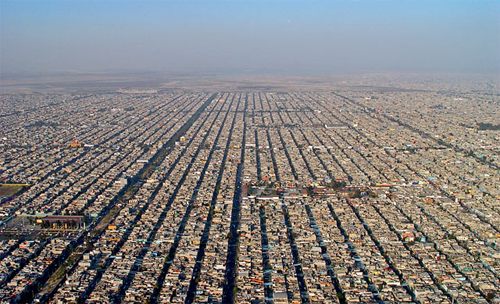
    Image: Flickr

  • How many households in Canada live in a condominium?

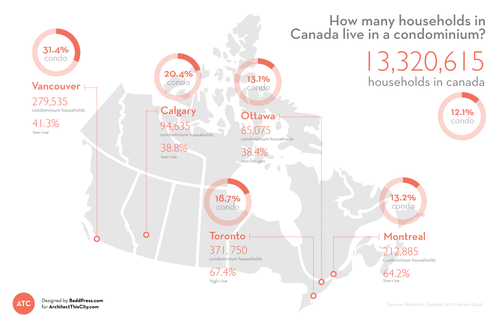
    Click here to zoom in / download a copy

    I’ve been meaning to introduce infographics and diagrams into my posts at ATC for quite some time now, so I’m excited to introduce the first one: How many households in Canada live in a condominium? I hope to make this a regular feature.

    While a lot of the new development happening in Canada is condominium – particularly in cities like Toronto and Vancouver – the vast majority of households in Canada still live in non-condominium dwellings. Only 12.1% of households are condominium households, which could be high-rise, low-rise, row-housing, or other, according to Statistics Canada.

    Perhaps not surprisingly, the Vancouver CMA has the highest percentage of condominium households at 31.4%. I would have expected Toronto to come second, but Calgary (20.4%) actually takes that position (probably) due to an abundance of low-rise condominiums (38.8% of all condos in the CMA). However, Toronto has, by far, the highest percentage of high-rise condominium households at 67.4%. This isn’t surprising to me.

    All of the data for this infographic was taken from Statistics Canada and the total number of households in each Census Metropolitan Area (CMA) was assumed to be “occupied by usual residents.” StatsCan defines this as households that are permanent as opposed to ones that could be second homes and so on.

    I hope you like the first ATC infographic.

  • A data-driven approach to city building

    Yesterday I wrote a post talking about the rise of community involvement in the city planning process and how many people feel that it’s undermining the expertise of trained city planners.

    My position is that community participation is only going to become more pronounced and that it’s likely a natural outcome given the internet and what we’re seeing with many other industries.

    So instead of lamenting, I think we as city builders need to figure out how to create better frameworks and processes for dealing with the changes that are currently underway.

    Because it’s not just community involvement that’s getting in the way of city building, it’s also politics. In too many cases we are allowing self interest to get in the way of rational city building.

    But what I was starting to get at yesterday is that as city building becomes more open and transparent, and we find new ways to collect and leverage decentralized data (traffic flows, public space usage, and so on), I think it’ll open up the possibility of a more data-driven approach to city building.

    Cities are complex systems and in the past we’ve made a lot of mistakes because our assumptions were incorrect. We assumed, for example, that building more highways would quickly solve congestion. It didn’t.

    But with more openness, more transparency, and more data at our disposal, I’m hopeful that we’ll discover countless ways to build better cities. And when that happens, I think we’ll find that the naysayers don’t have as much to say.

  • The death of planning expertise

    image

    Yesterday a friend of mine sent me this article written by a city planner talking about the death of planning expertise. The article talks specifically about the rise of “community participation” and how it has undermined the modern planning process. (I guess it’s not just architects who feel undermined.)

    …we have lost respect for “experts”—those who have knowledge and/or experience in a particular field—and have replaced it with a kind of “expertise egalitarianism” whereby everyone’s opinion is given equal weight. But it is not only that the layperson’s opinions are given equal weight, experts increasingly face outright hostility. Laypeople attack experts as being arrogant, elitist, and imposing, if not outright threatening, often because the expert insists he or she knows something the other does not. Even more ridiculous, rather than being viewed as helpful or even essential, expertise is viewed as harmful or even antithetical to community participation.

    But to be clear, the author is not arguing for technocratic rule. He simply believes that community input has reached a point where laypeople with only anecdotal evidence are given equal weight as planning experts, and that it’s miring the planning process and causing less than desirable outcomes.

    This topic is interesting to me for 2 reasons.

    First, it’s interesting because we’re basically talking about a form of decentralization, which, just so happens to be one of the macro trends being ushered in by technology and the internet. It used to be that we couldn’t decentralize. Communication costs were too high and the ability to share information in real time wasn’t possible.

    But today we can. So instead of, for example, only getting the news from one source (a newspaper, perhaps), we get it from millions of people on platforms like Twitter. We trust laypeople, just as much as we do “expert” reporters, to tell us and show us what’s happening in the world. Just yesterday I turned to Twitter to see what was happening with Toronto’s torrential rainfall (#TorontoStorm).

    And as a result of this trend, we’re seeing startups like Popularise that are, in some regards, trying to decentralize the planning process. The platform allows communities to decide what they want to see in their neighborhood and then share it. Think your neighborhood could use an organic grocery store? Great, you can spec that on Popularise.

    The second reason I find this topic interesting is because there’s a school of thought (let’s call it the “wisdom of crowds” school of thought, to name it after a book), which believes that in aggregation the opinions of many can actually be better than those of a few so-called experts.

    And in many ways I agree with this—though there are a number of prerequisites that need be met in order for this to hold true. For example, you can’t have groupthink taking place, which I think you could argue is what often happens with NIMBY movements.

    Nonetheless, there’s a shift taking place and it’s impacting not only the planning profession, but many others. In the end though, I don’t think it will make experts irrelevant. In fact, as industries continue to “open up” and as we harvest more and more data (that previously wasn’t available), I think we’ll all be surprised at how beneficial this ends up being. 

    Image: GSAPP