Daily insights for city builders, delivered every morning at 6 AM ET. I’m Brandon Donnelly — a Toronto-based real estate developer and founder of Globizen. I’ve been writing here since 2013.

Tag: cycling

  • Paris announces plan for “100% cycling city”

    Paris just announced plans to become a “100% cycling city.” A follow-up to plan vélo 2015-2020, which saw a doubling of the city’s bike lanes, plan vélo 2021-2026 includes 130 km of new bike lanes and 52 km of pandemic bike lanes that will now be made permanent.

    In addition to cycling lanes, the plans include new bike parking, new transit integrations, and a bunch of other things that are meant to strengthen the overall ecosystem in the city. The total budget for this second plan is about €100 million, which will bring the total cycling investment over the last 10-11 years to about €250 million. This is a serious commitment to cycling.

    It’s also a good example of one of the things that we have been talking about on this blog. This pandemic forced us to rethink how we allocate urban space — everything from outdoor restaurant patios to bike lanes. And as we can see here, many of the positive changes are not surprisingly starting to stick.

  • What tribe are you part of?

    This satirical piece in the Beaverton about “biking everywhere” is hilarious because it touches on so many cycling stereotypes:

    “It’s a great way to get around while also staying in shape,” said McFarlen as he biked through a red light. “From tattoo shops to my job at VICE to even the best Banh Mi in the city – I just hop on my bike and I’m there. Why does anyone drive ever? Gross!”

    But the other thing it does is speak to the trade-off between location and transportation costs. Brian McFarlen, the fictional protagonist from the article, is able to bike everywhere (low cost) because he allegedly lives in a central neighborhood (high cost):

    McFarlen, whose parents paid for him to go to film school and has no mortgage, kids, or debt, condemns people who drive in the city. “I hate cars – we should just get rid of all roads and replace them with bike lanes. Isn’t everyone able to live downtown and spend hours of their day biking around the city hitting up all the best micro breweries?”

    I think it’s natural for us humans to form tribes with others that are similar to ourselves. We have two wheels and you all have four wheels. We live in the city and you all don’t. All of these things make us different.

    But there’s certainly something to be said for having a bit of empathy for those outside of our particular tribes.

  • Minimalist smart biking device

    I just came across this smart biking device on Kickstarter. It is the next generation of their original SmartHalo, which did very well and is now sold in Apple Stores. The company is based in Montréal.

    Here’s how it works:

    https://www.kickstarter.com/projects/smarthalo/smarthalo-2-make-your-bike-smarter

    I know that a lot of you are cyclists, so I figured some of you might appreciate this. It looks pretty awesome. Delivery of SmartHalo 2 is expected by December 2019.

    Their Kickstarter campaign ended on July 2. The project got funded with about CAD 1.7 million from over 10,000 backers. But you can still pre-order a device, here.

  • Downward pressure on parking supply

    There’s a significant amount of downward pressure on parking supply in most major cities. Part of this has to do with the push toward more sustainable forms of transport, which is, of course, a good thing. But it also has to do with rising construction costs, the fear of obsolescence in the wake of autonomous vehicles, and probably many other factors.

    Developers, ourselves included, have responded by being cautious about the amount of parking being provided and by considering alternative future uses for the parking that is being built. I think it is also obvious that we will continue to see more, rather than less, parking stackers and other more efficient parking solutions.

    So far the cost of parking in dense urban centers has continued to rise. A new parking spot in the core of Toronto priced at $100,000 would not surprise me. And Hong Kong recently set a record for what is allegedly the most expensive parking spot in the world: USD 765,000 or CAD 1 million.

    But what is going to happen going forward?

    Researchers at the Singapore – MIT Alliance for Research and Technology and MIT Senseable City Lab, along with Allianz, have recently tried to quantify what the impact of autonomous vehicles will mean on required parking, and on traffic, in Singapore. The study is called Unparking.

    Today, they estimate the total number of parking spots in Singapore to be around 1,370,000. This is based on minimum parking requirements from the Housing Development Board and on the idea that home-work commuting consumes two parking spots: one at home and one at the office.

    They model four different scenarios, but the last one is based on fully autonomous vehicles and on shared parking spaces. Holding current mobility demands and traffic volumes constant, the demand for parking in this scenario drops by 70%.

    It is possible to reduce the number of parking spaces even further to 85%, but this has a negative impact on traffic congestion in their model. Fewer parking spaces means the autonomous vehicles have to drive around more picking people up. 

    I also don’t know if there was any consideration given to induced demand as a result of the more affordable autonomous vehicles. Demand for transportation services is generally thought to be fairly elastic.

    Whatever the case may be, numbers are made to be questioned. And Singapore is a unique city-state. But ¼ the amount of parking does not seem that far fetched to me.

    Photo by Tobias Jussen on Unsplash

  • Car-dependent spatial structure

    Earlier this week a 58 year old woman named Dalia was struck and killed by a car near the University of Toronto’s downtown campus. This tragedy has everyone talking about and questioning how to make our roads safer, though the answers are not difficult to find. Here is an excerpt from a piece that Richard Florida penned following the incident called, Toronto’s Deadly Car Crisis:

    Today, more Torontonians die from being hit by cars than from being killed by guns. In 2016, nearly 2,000 pedestrians and 1,000 cyclists in the city were hit by cars. Of these, 43 resulted in fatalities. On average, a pedestrian in Toronto is hit every four or five hours, and a cyclist every eight or nine. This means that Toronto’s rate of pedestrian deaths was 1.6 per 100,000 people in 2016 — worse than in Chicago, Seattle, San Francisco, Boston, Washington, D.C., Portland, Pittsburgh, Cleveland, and Buffalo. It has risen to 1.7 deaths per 100,000 people in 2017 and is on track to rise still further to 1.8 deaths per 100,000 this year. And, children and the elderly face the greatest risk of being struck and killed by a car. The problem is only getting worse. Across Canada, pedestrian fatalities increased by more than 10 percent between 2010 and 2016; at time when they decreased by more than 25 percent in European countries like Norway, Switzerland, and the Netherlands.

    The broader issue is what he refers to as Toronto’s “car-dependent spatial structure.” And it is detrimental to not only our public safety, as we saw this week, but also to our ability to grow as a global city. The Greater Toronto Area is projected to reach 10 million people by 2041. I agree with Florida that, for a number of important reasons, we are going to need to commit ourselves to a new model for growth.

  • Meet Replica

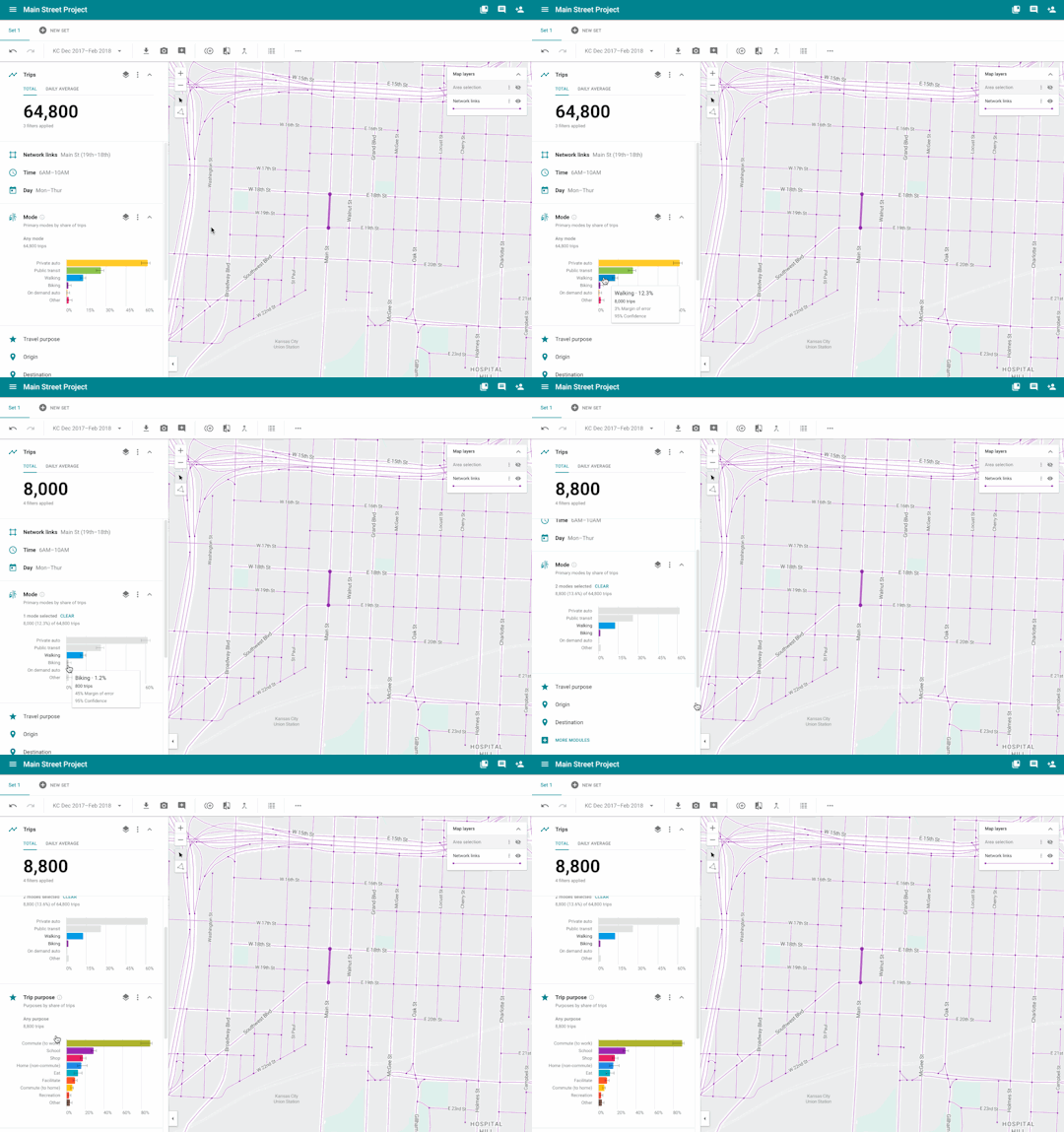
    Sidewalk Labs is currently building out a platform called Replica that will support them in their development plans here in Toronto. Replica is

    “a user-friendly modeling tool that uses anonymized mobile location data to give planning agencies a comprehensive portrait of how, when, and why people travel in urban areas.”

    Here is a preview of the Replica dashboard showing a section of Main Street in Kansas City. I hope the animated GIF shows up for you.

    The platform uses a combination of mobile location data (~5% of the population) and on-the-ground checks, typical stuff like manual traffic counts and transit boardings.

    The goal is to understand in real-time who is using a street, as well as how (driving? cycling?) and why (going to work?).

    Their introductory blog post obviously stresses the importance of personal privacy, but I am curious how they determine where people are going.

    I suppose if they pair journeys with destinations (and the durations at those destinations) they can make reasonable assumptions around the why.

    I think the benefits to all of this are clear. But does any or all of this worry you from a privacy standpoint?

  • Adelaide cycle tracks

    Earlier this week I was on Adelaide Street (Toronto) for a morning meeting. This is further north than my typical routine.

    For those of you not familiar with Toronto, Adelaide is a one-way street with separated bikes lanes. These “cycle tracks” were installed as part of a pilot project that launched back in summer 2014. As I’m sure you can imagine, they were highly controversial at the time. Many heated debates.

    But if you stand on Adelaide Street during the morning rush, as I did earlier this week, I think you would be amazed to see just how widely used these lanes actually are. Here’s a video of Adelaide (just east of Spadina) in action. It is by Gil Meslin and was filmed sometime between 840 and 855am on a weekday.

    However, I will say that I was far more impressed by the volume of bikes I saw in person. I wish I took a picture. They easily outnumbered the cars when I was there, which speaks to the latent demand for this sort of infrastructure. I can’t imagine a faster way to get across downtown in the morning.

    So if you haven’t already, check out Adelaide (or Richmond Street, which is also part of the cycle tracks program).

  • Blaze Laserlights

    This is a great idea:

    It is a bicycle light – by a London-based company called Blaze – that forward projects a bicycle symbol 6m in front of you as you ride. It also has a really bright white light.

    They will be (or have been) installed on London’s entire bike-share fleet and they are currently being piloted in New York City. Here is a video of it in action.

    One of the things I always watch for when I’m cycling is being in a car’s blindspot. Signalling seems to be a dying art, so you never know when someone might turn into you. If this light is able to project in front of the car and signal to the driver that a cyclist is nearby, then I could see this being a big safety improvement. Of course, this is just one scenario where a light like this might be helpful.

    Have any of you tried it?

    Image: Blaze

  • Inviting behaviors

    The following paragraph is a great way to describe urban cycling and to explain how our built environment can explicitly invite certain behaviors:

    “If you want people to drive, build more automobile infrastructure. If you want people to bike, build better bike infrastructure. In San Francisco, as in most US cities, we’ve treated the idea of bike infrastructure as secondary to optimizing traffic flow, and have wound up protecting parked cars with bike lanes instead of the opposite. Because of this our bike lanes are plagued with double-parking. While enforcement is an important piece of the puzzle, we usually fail to admit how inviting a striped space between parked cars and traffic appears to an Uber driver. Our built environment invites a driving behavior that causes cyclists to spend much of their commute pushed into traffic, encouraging a culture of every-man-for-himself cycling behavior, adding to the discouraging perception that bikes are for the young and fearless only. This perception is elevated by the fact that bicycling deaths in San Francisco are hovering at least four times higher than the average rate in Copenhagen, a city with ten times as many cyclists.”

    This snippet is from a blog post written by Alex Schuknecht (urban designer with Gehl). In the posts he also contrasts the cycling cultures of San Francisco and Copenhagen – two cities of similar size and density, but with fundamental differences. It’s a good read.

    Many of us probably assume that we are agents of our own lives. We decide what we do and when we do it. We’re our own boss. That’s at least how I want to feel.

    But the built environment is distinct from the natural environment in that we design it. It is not a given. And the environments we collectively choose to fund and build will ultimately have a significant impact on the way we “choose” to live our lives. 

    This gets back to the first line of the above quote: build more of this; get more of that. It’s also related to the startup mantra: “you make what you measure.” If all we’re measuring is traffic flow, then that’s the kind of city we will make. And that’s certainly be done.

    I don’t think a lot of us think in these terms. But we should.

  • The VanMoof hack

    8 years ago the Amsterdam-based bicycle company VanMoof started shipping bicycles to its customers. And since that time, they struggled to find a quality shipping partner that wouldn’t damage the bikes in transit. 

    They tried every varietal of shipping company, but the problem persisted. And since their goal was and is to sell 90% of their bikes online by 2020, they knew that they needed to solve this problem.

    So here’s what they did. This is a great story.

    They noticed that their bicycle boxes were about the same size as a large flatscreen TV. And since flatscreen TVs seem to always arrive in perfect condition, they decided to print a TV (along with an image of their bicycle) on the box.

    Here’s what that looks like (via QZ):

    The result? They immediately saw a 70-80% drop in shipping damages. That’s all it took. I love that.

    Since I know that a lot of you are cyclists, I thought you might appreciate this little hack. Their bikes are also quite stylish and reasonably priced if you happen to be in the market. (I am waiting to hear back on whether they ship to Canada.)