Daily insights for city builders, delivered every morning at 6 AM ET. I’m Brandon Donnelly — a Toronto-based real estate developer and founder of Globizen. I’ve been writing here since 2013.
Hotels play such an interesting role within cities. They are public-facing in a way that many other uses are not and they invite a mixing of different people – everyone from transients to locals. It is therefore no surprise that they can serve a variety of different roles. They can be cultural hubs. But they can also be places in which to misbehave.
When the Drake Hotel opened up on the west side of downtown Toronto in 2004, I remember it feeling far out. It was on the edge of that which was interesting at the time. But it quickly anchored West Queen West with its cultural and nightlife offerings. And today, we could be about to see the exact same story repeat itself in the east end with the new Broadview Hotel.
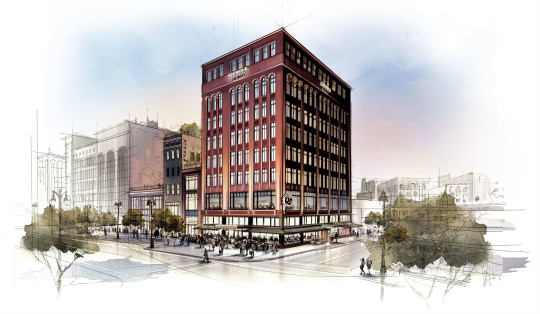
It’s for these reasons that I was both excited and curious to learn that Bedrock (real estate company) and Shinola are in the midst of launching a new boutique hotel concept in Detroit. It is called The Shinola Hotel. It will be located at 1400 Woodward Avenue. And it will be all about the city of Detroit. They expect it to open sometime in the fall of 2018.
What I am about to say may be an availability bias talking, but there seems to be a push by many companies into the hotel space. In 2015, Equinox Fitness announced that it would be opening its first hotel in 2018 at Hudson Yards in New York. And just last month furniture retailer West Elm announced that it would be opening a first set of hotels in both Savannah and Detroit. (Go Detroit!)
West Elm sells furniture. Equinox operates gyms. And Shinola makes and sells watches, bikes, and leather goods. But all of them are now in the hotel space. What other new hotel brands have I missed?
at 11AM eastern time, the global street artist Phlegm will start work on a giant 8-storey mural at the corner of Yonge + St. Clair in midtown Toronto. It’s going up on the west elevation of 1 St. Clair West.
Here’s what it will look like when it’s complete:
The piece is intended to be experienced at two different scales. From afar, you read it as a human figure embracing itself. (See it?) Once you get closer, you are then drawn into an intricate interpretation of the Toronto landscape – both built and natural.
Embedded within are depictions of the Royal Ontario Museum (including Daniel Libeskind’s Crystal), the SkyDome (yes, the SkyDome), the St. Lawrence Market (my hood), the CN Tower (obligatory), as well as other landmarks in the city. It’s going to be awesome.
At the time of writing this post, nothing yet has happened. But by the time it reaches you (email subscribers) it should be well underway. The hashtag for all of this is #PHLEGMPAINTS.
Big things are starting to happen at Yonge + St. Clair.
Every now and then I’ll come across a website, a product, or something that immediately resonates with me. Usually that means I’ll immediately subscribe to it, buy it, follow it, or do whatever the action is supposed to be. It doesn’t happen all that often – though I think it should be a goal of companies and organizations to delight – but that’s exactly what happened to me this morning when I stumbled upon Subtraction.com.
Subtraction is a blog about design, technology and culture (all things I love) and it’s written by Khoi Vinh. Khoi is Principal Designer at Adobe. Prior to this, he was Design Director of The New York Times and co-founder of the design studio Behavior, LLC. Fast Company also named him one of the 50 most influential designers in America. But enough of all that. His blog is great.
Whenever I write about blogging, I tend to get questions about other blogs I might recommend. So today I’m recommending Subtraction.com. I’ve also added it to my working reading list, which I don’t think many of you are aware of because you probably just read this blog in your inbox. But it exists and I’m happy to add to it if you have interesting suggestions. (Please leave a comment below.)
P.S. Because of Subtraction, I now have the movie High-Rise on my watch list. Have any of you seen it? Because I don’t have cable or Netflix, I tend to be painfully out of the loop on these sorts of things. It’s based on a book by J.G. Ballard and it’s the story of a 1970s suburban London apartment building that starts to socially degrade. How could I not want to watch that?
Earlier this week I attended the CityAge conference here in Toronto and participated in a panel discussion about talent.
The questions were all about how cities can attract and retain talent, and how they can best leverage the talent they already have. These are questions that a lot of cities around the world are thinking about.
In my responses I talked about things like transit connectivity, which is a problem that all of us in Toronto recognize we have. But I also focused a lot on quality of life, on sense of place, and on being a cool place to live. These are important factors.
But this wasn’t a government initiative to make Berlin a hub for talent. It was largely a grassroots movement that took hold for a myriad of reasons, one of which was simply empty buildings that people could colonize for parties. And it transformed the place into a city that later became known as “poor but sexy.”
That brought me to another point, which is that Toronto’s 2AM last call at the bar is laughable by global city standards. And we know that. That’s why whenever we host an event of any sort of notoriety – such as the Toronto International Film Festival – we extend it to 4AM. The people coming here from all around the world expect that.
This may seem like a small thing. And I am sure many of you here in the city would like things to stay just the way they are. But I think we need to loosen up.
I just stumbled upon a fascinating documentary series called Real Scenes. Each film explores “the musical, cultural and creative climate” within a particular city.
Below is Real Scenes: New York (click here if you can’t see it below). It’s an inside look at the underground music scene that has developed in Brooklyn, but that is at the same time being threatened by development and rising rents. Disclaimer: There’s a lot of f-bombs and a lot of hating on gentrification.
I’ve only watched the New York video from this series, but I plan to watch each and every one of them. The other cities are Tokyo, Johannesburg, Paris, Berlin, Detroit, and Bristol.
What’s fascinating about these short documentaries is that they give you a glimpse into a particular undertone within each city – one that would otherwise be hard to get if you weren’t living there and engrossed in the scene.
It’s also interesting to see how some people view change within cities.
To some, transforming a neighborhood from one that looks like a “bomb went off” to something more pristine, is a good thing. But to others, it’s the worst possible outcome. It all depends on your frame of reference.
Now, how do I get them to make a Real Scenes: Toronto? 🙂
After yesterday’s post about Toronto, I had a friend ask me on Facebook what it is exactly that I think happened to make this city so much cooler. Was it because of one iconic building like Toronto’s new City Hall? Was it because of our recent condo boom? Or was it something else? What changed exactly?
My response was that it’s a generational thing. Let me explain.
Toronto used to have the reputation of being a boring and staid city, and that’s because it was a boring and staid city. In the immediate post-war years, Toronto was overwhelmingly Protestant and the immigration policies at the time were specifically designed to exclude anyone who wasn’t white and from Western Europe or America. If you were Asian, Southern or Eastern Europe (especially Jewish), then you were at the bottom of the entry list.
Prime Minister Mackenzie King reflected the national mood when he observed that “the people of Canada do not wish to make a fundamental alteration in the character of their population through mass immigration.” Discrimination and ethnic selectivity in immigration would remain. “Canada is perfectly within her rights in selecting the persons whom we regard as desirable future citizens. It is not a ‘fundamental human right’ of any alien to enter Canada. It is a privilege. It is a matter of domestic policy.”
In the 1950s and 1960s, Canada started to slowly open up, but only because it needed to. It was in need of labour to fuel its robust post-war economy. Reluctantly, Canada began to look for workers in places like Italy. Initially, Canada had hoped to attract more northern and Germanic-like Italians, but with the European economy picking up, it was the southern Italians who came in the greatest number. In the 1950s, Canada’s Italian population jumped from around 150,000 to 450,000.
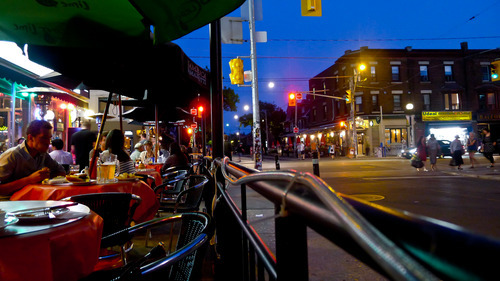
But this influx of espresso drinking Catholics was hard for Toronto to adapt to at first. They were so alien compared to Toronto’s population at the time. They wanted to do weird things like eat outside on patios, and that just wasn’t the way we did things here in Protestant and conservative Toronto. We ate inside. That’s where food belonged.
My best friend’s father – who’s also in the real estate development business – once told me that when he first moved to Toronto in the 1970s the real estate business was virtually run by two groups of people: Italians and Jews. In other words, the people building our city were the people that we were once afraid to let come here in the first place.
But in their quest for wealth and a better life (I have so much respect for people who are able to build something from nothing), these new Canadians also reshaped Toronto both physically (through building) and socially (by doing crazy things like eat outside on patios). They were not only building new lives for themselves, they were also rebuilding Toronto. They helped us grow up and not be so stuffy. And I absolutely believe that we’re a better city because of it.
However, I think the true impact of their efforts is happening right now through the next generation – their children. Millennials and Generation Xs (at least the younger ones) don’t remember when Italians were considered aliens. They remember growing up with martini bars on College Street (which is the original Little Italy for those of you unfamiliar with Toronto). They know a different and cooler version of this city.
But most importantly, those subsequent generations are now old enough (and have a lot more generational wealth behind them) to reshape this city even further. And with much deeper roots here, they have the passion to do just that. When I went to graduate school in the US, my parents were afraid I would never come back. That’s what they told me. But the more I traveled and the more I lived outside of Toronto, the more I wanted to come back.
Just like those early wave of pioneering aliens who got us to dine al fresco and taught us that if we shop on Sundays we’re not going to go straight to hell, I feel like I too want to shape this city. I want to make it even better. No city is perfect, but if there’s something you don’t like about Toronto, then here’s my advice to you: Go change it. I can tell you it’s possible, because new immigrants with no money managed to do it.
The first person who can tell me (in the comments below) which restaurant the patio shown above belongs to will get a free Architect This City t-shirt. If you’re from Toronto, this should be an easy one.
If you’re a regular reader of ATC, you’ll know that I often talk about cities in the same way that many people talk about products and services. (See: The business of cities.) And I do that because cities are our new economic unit and so I find it helpful to think of them as businesses fighting to attract and retain the best talent and win over customers (i.e. residents and businesses).
“This is an open challenge to the all the mayoral candidates. In the past 10 years, Toronto has undergone a cultural, artistic, and technological renaissance: The ROM, the AGO, and OCAD U all underwent architectural makeovers; TIFF rose to prominence as one of the most prestigious film festivals in the world; Nuit Blanche was unleashed in 2006, and Luminato in 2007, both to huge acclaim; the high-tech industry has created 30,000 new jobs; and The New York Times admitted that Toronto’s culinary scene is more ethnically diverse than the five boroughs. But here’s the thing: The story we tell ourselves and the world about our remarkable city needs an overhaul. Toronto Needs a Creative Director is a campaign committed to building a better story by better mobilizing the arts, culture, and technology sectors to enhance civic engagement. The CDTO (the office of Creative Direction for the City of Toronto) would function as a lab for incubating ideas where art, culture, politics, science, and technology intersect.”
Truthfully, I’m not yet sure if a Creative Director is the ideal approach. I haven’t had a chance to give it enough thought. But I am certain that Toronto would benefit from a bunch of smart people who were focused on telling our story to the world, crafting our brand and identity, and honing the experience of living or visiting this great city.
Last week I was reading the blog of James S. Russell, who used to be the architecture critic for Bloomberg News. He’s no longer the architecture critic, because Bloomberg got rid of his column:
My column, along with almost all cultural coverage, was eliminated at Bloomberg late last year in favor of a yet-to-be completed revamping that focuses on luxury and lifestyle.
Obviously, the decision saddens me personally, but it’s also a regrettably powerful signal that culture doesn’t matter in our society and economy.
As someone who spent a great deal of time studying art, architecture and design, his post really resonated with me. This is a depressing thought. It may be hard to measure the ROI of the arts, but that doesn’t mean there isn’t a return.
Ironically, Bloomberg–the former mayor of New York–understood this:
As Mayor of New York, Michael Bloomberg, the company’s founder, championed arts as valuable to the vibrancy of the city and as a powerful force for economic development. The city has seen unprecedented growth in arts facilities, thanks both to his administration’s efforts and his personal philanthropy. His post-mayoral activities are intended to nurture cities as fields of wealth creation by helping them become cauldrons of innovation, which he recognizes is entwined with vibrant cultural and lifestyle trends.
Whether you’re developing a building, planning transit, starting a company or just trying to do something different, there will always be haters. But pessimists don’t change the world—optimists do.
I came across a great post last night by venture capitalist Ben Horowitz. It’s called, “Can-Do vs. Can’t Do Culture.” And I think you’d be well served to keep a copy of it on file and read it before every single meeting where you’ll be asked to provide input on something new.
He’s specifically talking about a growing and discouraging trend of naysaying in the tech community, but the lessons apply more broadly to innovation as a whole.
I love these lines:
“The trouble with innovation is that truly innovative ideas often look like bad ideas at the time. That’s why they are innovative — until now, nobody ever figured out that they were good ideas.”
“From a psychological standpoint, in order to achieve a great breakthrough, you must be able to suspend disbelief indefinitely. The technology startup world is where brilliant people come to imagine the impossible.”
But the best part of Horowitz’s post is an excerpt from an internal Western Union report (then the largest telegraph provider in the US) recommending that the company not purchase Alexander Graham Bell’s invention (the telephone) and patents for $100,000.
The Telephone purports to transmit the speaking voice over telegraph wires. We found that the voice is very weak and indistinct, and grows even weaker when long wires are used between the transmitter and receiver. Technically, we do not see that this device will be ever capable of sending recognizable speech over a distance of several miles.
Messer Hubbard and Bell want to install one of their “telephone devices” in every city. The idea is idiotic on the face of it. Furthermore, why would any person want to use this ungainly and impractical device when he can send a messenger to the telegraph office and have a clear written message sent to any large city in the United States?
The electricians of our company have developed all the significant improvements in the telegraph art to date, and we see no reason why a group of outsiders, with extravagant and impractical ideas, should be entertained, when they have not the slightest idea of the true problems involved. Mr. G.G. Hubbard’s fanciful predictions, while they sound rosy, are based on wild-eyed imagination and lack of understanding of the technical and economic facts of the situation, and a posture of ignoring the obvious limitations of his device, which is hardly more than a toy …
In view of these facts, we feel that Mr. G.G. Hubbard’s request for $100,000 of the sale of this patent is utterly unreasonable, since this device is inherently of no use to us. We do not recommend its purchase.
It’s a classic example of The Innovator’s Dilemma (a book written by management guru and HBS professor Clayton Christensen). Many firms see their businesses disrupted because they blindly stick to the innovation that made them successful in the first place—ignoring what’s coming up on the horizon.
In the case of Western Union, they could not imagine “telephone devices” in every city. The idea was pure lunacy to them. Of course to us today, they look like myopic fools. We now not only have telephone devices in every city, but a full fledged computer in every pocket. Imagine that.
Which is why I think it’s important to remember that the way to drive the world forward is—to use Horowitz’s terminology—through hope and curiosity. Suspend disbelief. Think big. Dare to be crazy. Because you’re only crazy until you’re proven to be a genius.