Daily insights for city builders, delivered every morning at 6 AM ET. I’m Brandon Donnelly — a Toronto-based real estate developer and founder of Globizen. I’ve been writing here since 2013.
Apple announced a number of new products and services this week, including Apple TV+ and a new Apple credit card, which will initially only be available in the US.
Below is a video summary of the new Apple Card. In typical Apple fashion, it sounds and looks like an elegant solution and I already want to one.
I thought this topic would make an interesting follow-up to my recent post about whether cities should be banning cashless businesses so as to not discriminate against the “unbanked.”
Because embedded in the above credit card is the following cashback reward structure:
3% back on Apple purchases
2% back on purchases made with Apple Pay (iPhone)
1% back on purchases made with the (optional) physical card
And so what this “card” will do is pay you to always use your phone. The cashback reward system is also instantaneous and you’ll be able to spend that Daily Cash (that’s the name) just like you would actual cash.
Do you think this would change how you pay for things? I think for most people it will.
Three years ago I wrote about how I was one step closer to not only going cashless — I had pretty much already done that — but also going walletless. (That’s one of the things about writing a daily blog — there’s a public record.) I still carry a wallet in most cases, but I couldn’t tell you the last time I paid for something using cash here in Toronto. It was probably at a Vietnamese restaurant.
I did, however, notice on my trip last month that Germany and Austria are still quite reliant on cash. Many places only accepted cash and many places wouldn’t accept credit cards under a certain minimum spend. Fewer opportunities to just tap as well. I had forgotten how annoying it was to carry around lots of coins. You really need a change purse.
Still, a paradigm shift has taken place. And because of this shift, there’s a growing movement in cities toward banning cash-free businesses. Philadelphia, Chicago, San Francisco, New York City, and Washington, DC are all working on policy. The concern is that not accepting cash discriminates against lower-income patrons.
An additional 24.2 million US households (additional 18.7% of all households) are estimated to be “underbanked”, meaning they have at least one account at an insured institution, but they also rely on outside financial products — such as payday loans.
When surveyed, somewhere around half tend to cite “not having enough money” as one of the reasons for being “unbanked.” But the good news is that the percentage of people without a bank account seems to be declining (see above chart).
This is important because we all know where things are headed. And banning cashless businesses isn’t going to stop that march. There are deeper issues that need to be addressed. Here is an excerpt from a recent CityLab article on the topic:
“I certainly don’t think [this bill] is the right long-term solution,” said Rogoff. “The future does not lie in this direction. The future lies in giving people free debit cards and financial inclusion.” He cited the case of India. The country launched a program to decrease the number of unbanked and saw the percentage decrease from 47 percent of adults in 2014 to 20 percent unbanked in 2017 according to the World Bank Global Findex Report. “If India can manage to give people free debit cards, so can the U.S.” Rogoff said.
Kenneth Rogoff is a professor of public policy at Harvard University, the former chief economist of the IMF, and author of The Curse of Cash. If you’re interested in this topic, his book may be a good one to check out.
One evening this past spring I was leaving a Rotman School event at Liberty Grand on the west side of Toronto. There aren’t a lot of taxis coming through this part of the city, so I figured I was going to have to wait while I hailed one from my phone. But as luck would have it, one happened to be pulling up just as I walked out of the hall.
As he drove up and rolled down the window, I told him that I was going to the St. Lawrence Market area and that I needed to pay by credit card (I was trying to be a nice guy and avoid the inevitable fight when he was dropping me off). He responded by saying, “My machine is broken. Can’t you pay with cash?” I told him, “No, unfortunately I don’t have any cash on me. I need to pay with credit card.” He then rolled up his window and drove up closer to the entrance of the hall.
Faced with this scenario, I did what most people would probably do nowadays: I pulled out my phone so that I could hail either an Uber or a Hailo cab (I’m sad that Hailo has since left the North American market). I decided on Hailo (it was cheaper until UberX came along) and ordered a car.
But within a few minutes, the same taxi with the broken credit card machine circled back around, rolled down his window, and told me that his machine was now working and he would take me to the St. Lawrence Market. Knowing exactly what had happened, I said to him, “Wooooow, that’s funny that within the span of a few minutes your machine has magically started working again.” He wasn’t happy with that response.
Now, we all know why he didn’t want to take my credit card. He didn’t want to pay the fees and he wanted the cold hard cash. And who can really blame him for wanting to maximize his profits. But for the end user, this experience sucks. When it’s 2 in the morning and all you want to do is go home to bed, you don’t care about the few dollars he’s trying to save. You just, want, to go, home.
And that’s one of the reasons why Uber (and previously Hailo) is having such a huge impact on the market. Even before UberX arrived (the cheaper alternative), lots of people were more than willing to pay the Uber premium. And they continue to pay their controversial surge prices. But that’s because the experience is so much better than what’s offered today.
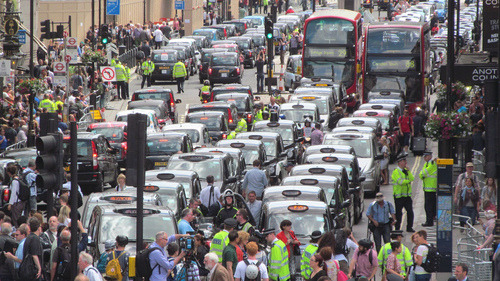
We all know that Uber is under a lot of fire for what they do, but Toronto mayor Tory is 100% right in saying that ridesharing and peer-to-peer taxis are here to stay. Toronto may be seeking a court injunction to stop the service in this city, but I would agree that it’s likely going to be a big waste of money. The cat is already out of the bag.
What’s happening here is no dissimilar to what happened with Napster. A court order may have forced the company to shut down, but it didn’t maintain the status quo for the music industry. That industry went, and continues to go through, a lot of change. So a better option, would be for everyone to sit down together and figure out what the future of the taxi industry is going to look like. Because I can guarantee you that it’ll continue to change.