Daily insights for city builders, delivered every morning at 6 AM ET. I’m Brandon Donnelly — a Toronto-based real estate developer and founder of Globizen. I’ve been writing here since 2013.

Tag: condo

  • The Philadelphia (real estate) story

    Real estate is a local business. And this weekend in Philadelphia really reminded me of that.

    Here’s what I mean.

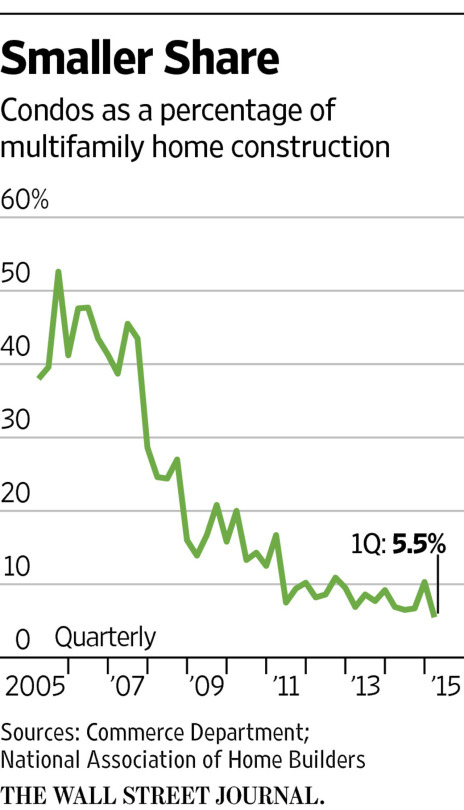
    The real estate story in Toronto is condos. We’re buildings lots and lots of condos. When my friend from Chicago recently visited Toronto for the first time, he told me that it feels very similar to Chicago, except that we have modern glass condo towers going up everywhere and they don’t. That’s our story right now.

    Low-rise housing in Toronto is becoming increasingly unaffordable (the average price of a detached home is well north of $1M) and so high-rise condos are now what many people can afford. When young people in Toronto talk about buying their first place, that now usually means a condo.

    But that’s not the story in Philadelphia.

    In Philadelphia, you can buy a 1,600 square foot, 2 storey, 2 bedroom rowhouse in a respectable neighborhood for sub US$400,000. And in speaking with my friends in Philly this weekend, that’s what young people are buying.

    This doesn’t mean that Philadelphia isn’t building new high-rise condos and apartments. It is. Obviously nowhere near as many as Toronto. But it is building. Far more than when I lived there before the Great Recession.

    However, the condo market is typically more upmarket. The target market isn’t so much first time buyers and the mass market; it’s more people who want full floor apartments in Rittenhouse Square. (I’m exaggerating only slightly.)

    Philadelphia is also building more rental towers than condo towers. (Rental has only recently become fashionable again in Toronto.)

    I’m guessing that a lot of this has to do with the fact that Philadelphia draws in a lot of transient students and academics each year. In fact, the most noticeably changed area from when I lived in Philly was University City. That’s the area that houses the University of Pennsylvania and Drexel University.

    So there seems to be strong demand for new rental housing in the city. I’m told vacancies are very low. But when it comes time to buy, young people don’t look to condos like they do in Toronto. They are looking mostly to rowhouses.

    This is interesting to me because it’s the exact opposite of Toronto. In Toronto, low-rise is expensive and so lots more people are buying high-rise. In Philadelphia, high-rise is expensive and so people are buying low-rise.

    I guess that’s why they say real estate is a local business. What works in one city may not work in another.

  • 1 bedroom condo for sale

    image

    I’m hijacking Architect This City today to help my mother out and try something new.

    She is looking to sell her 1 bedroom condo in the Radiocity Condominiums, located at 285 Mutual Street in Toronto. It’s called Radiocity, not because the developers thought New York was cool (my pet peeve), but because the site used to be the headquarters of the Canadian Broadcasting Corporation (CBC) way back when.

    The 2-tower complex is located north of Carlton Street, between Church Street and Jarvis Street, and is adjacent to Canada’s National Ballet School (designed by KPMB Architects). It’s close to College Park and Yonge & College.

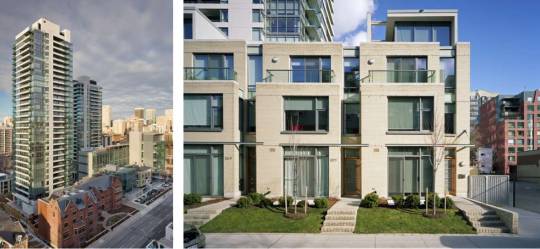
    It was completed/registered in 2005 and won a number of design awards, including one from the Royal Architectural Institute of Canada. Notable about the design is the way it integrates townhouses at the base, a public courtyard (with public art) between both towers, and the Ballet School. (A deal struck with the developer and the CBC allowed the school to buy their portion of the land for $1). 

    The buildings were developed by Context Development and designed by architectsAlliance, which is actually the same developer-architect duo behind the building I currently live and own in. I’m clearly a big fan.

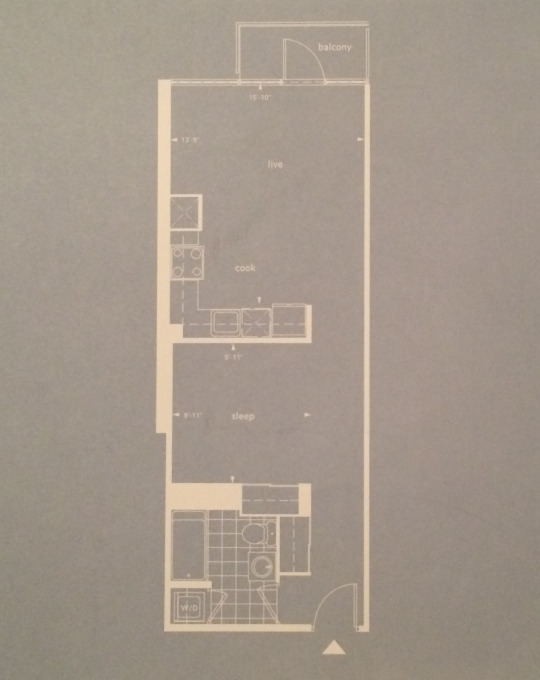
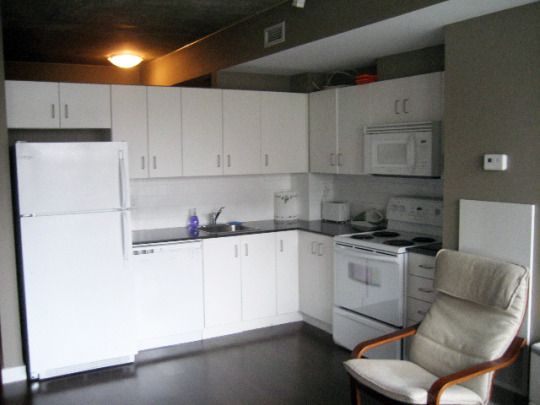
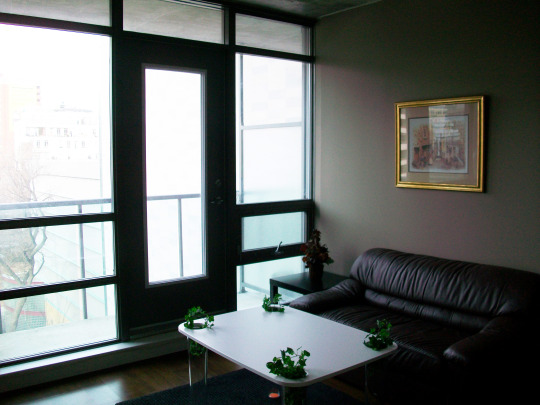
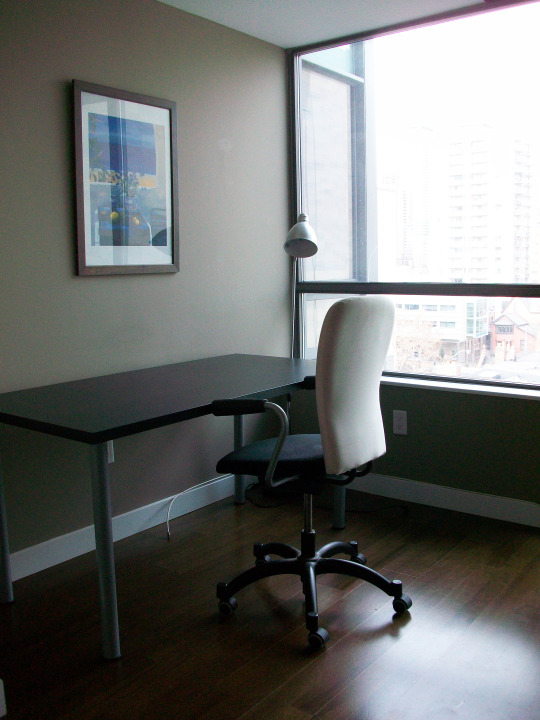
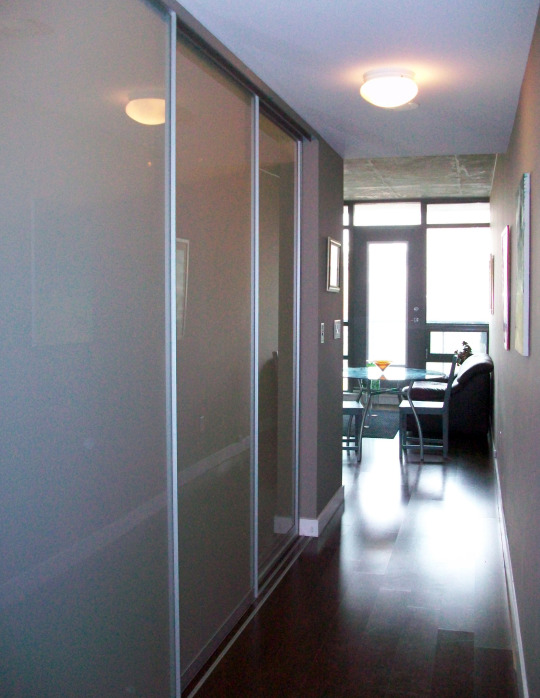
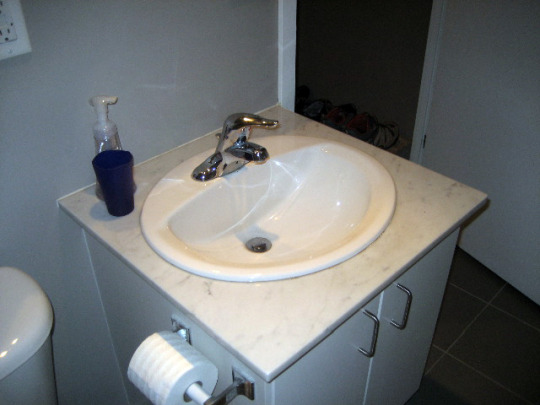
    The suite is about 560 square feet. It has 9’ exposed concrete ceilings. It has one full bathroom (tub), with a stacked washer and dryer. The bedroom is about 10’ x 10’ and is setback from the outside windows and enclosed with 3 x translucent sliding doors from C-Living. (I had them installed myself and they’re much better quality than the sliding doors you’ll find in most new builds.) The kitchen and living area is open concept, and there’s a north facing balcony that overlooks a quiet private courtyard. You basically get a view of trees, greenery, and the city. The suite is located on the 7th floor.

    Here’s the floor plan:

    image

    And here are a few photos. They are all the right proportions and haven’t been stretched to make the space look bigger 🙂

    imageimageimageimageimage

    The building has 24-hour concierge, visitor parking, and 3 floors of amenities. The amenities include a gym, aerobics room, party room, saunas, media room, boardroom, multiple lounges, 2 x guest suites, a party room, and a billiard room. 

    College subway station is a 7 minute walk (600m).

    image

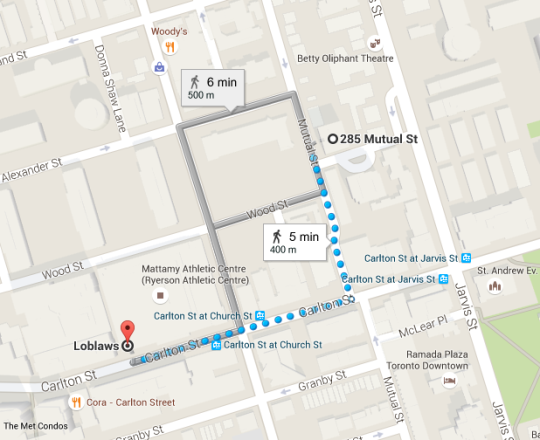
    The Loblaws grocery store at Maple Leaf Gardens (which is awesome and also includes an LCBO) is a 5 minute walk (400m). Though I’m fairly certain you could do it in 4 minutes.

    image

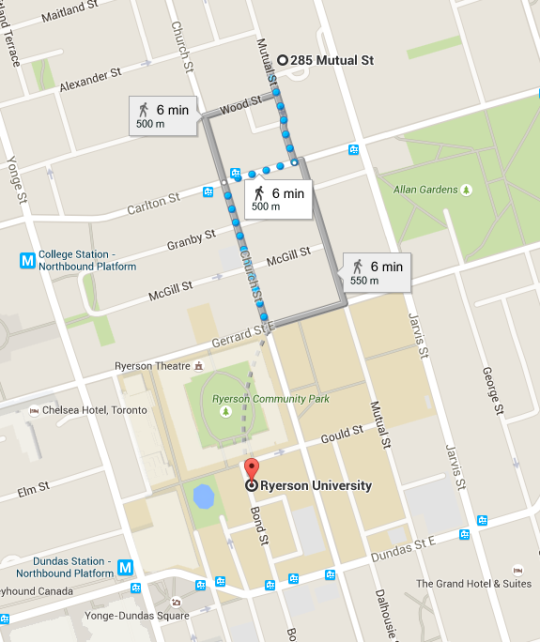
    And you’re a 6 minute walk to Ryerson University (500m).

    image

    The asking price is C$349,900. The maintenance fee is $426.64 per month and the property taxes are $2,039.19 per year.

    It’s a private sale, but she is willing to cooperate with buyer’s agents (2.5% commission). It’s currently furnished, but you can have it either way you want (unfurnished or furnished).

    If you have any questions or would like to book a viewing, please send her or me an email. If you’re an agent just looking for a listing, please don’t. Thanks for reading. Regularly scheduled programming will resume tomorrow.

    Image at the top of this post is from architectsAlliance.

  • The evolving gig economy

    This morning venture capitalist Fred Wilson wrote a post on his blog talking about the gig economy and Hillary Clinton’s economic speech last night. 

    Here’s a snippet from Clinton’s talk:

    Meanwhile, many Americans are making extra money renting out a small room, designing websites, selling products they design themselves at home, or even driving their own car. This on-demand, or so-called gig economy is creating exciting economies and unleashing innovation.

    But it is also raising hard questions about work-place protections and what a good job will look like in the future.

    So, all of these trends are real and none, none is going away. But they do not determine our destiny. The choices we make as a nation matter. And the choices we make in the years ahead will set the stage for what American life in the middle class and our economy will be like in this century.

    The headlines this morning are making it seem like Hillary Clinton is taking direct aim at companies like Uber. But the transcript suggests that she’s being far more balanced than that: these new companies are creating exciting opportunities, and they are not going away, but there are still things to figure out.

    That’s basically how I feel.

    Take, for example, Airbnb. I think Airbnb is a great idea and company. A lot of my friends use it both as consumers and as suppliers of space.

    But for many (most?) condos in Toronto, owners are strictly prohibited from renting out their units on leases that are less than six months. It’s a direct ban on short-term leasing and it’s written into the Condo Corporation’s Declaration.

    And there’s good reason for that. Who wants to buy a condo only to find out that next door is being operated as a nightly hotel? Most people would even prefer that their neighbor is an owner rather than a renter.

    That doesn’t mean I believe Airbnb should not exist. I think we’ll likely end up getting more transparent about how buildings (and portion of buildings) are operating, as opposed to it being a shadow economy. And that could help.

    If you have any ideas for how companies like Airbnb might be better integrated into urban life, I would love to hear from you in the comment section below.

  • The tragedy of the commons

    https://500px.com/embed.js

    In 1968, Garrett Hardin wrote an article where he coined the term: the tragedy of the commons. Hardin was an American ecologist who was obsessed and concerned with the prospect of human overpopulation.

    In his article, the term tragedy of the commons was used to describe a situation where individuals – all acting independently and in their own self-interest – actually end up behaving in a way that is detrimental to the larger group and that negatively impacts some sort of common resource.

    Just in case, here’s another definition via Investopedia:

    An economic problem in which every individual tries to reap the greatest benefit from a given resource. As the demand for the resource overwhelms the supply, every individual who consumes an additional unit directly harms others who can no longer enjoy the benefits. Generally, the resource of interest is easily available to all individuals.

    So what would be an example of a tragedy of the commons?

    You may not have thought of it in these terms, but I bet you that everybody reading this blog has experienced one.

    I will give you two examples.

    1. The first is that of electricity consumption. 

    In most condominiums, there are two types of ways that electricity gets billed and paid. Either the whole building gets one bill (master metering) or each individual resident gets a bill (submetering). 

    In the case of master mastering, each resident’s consumption isn’t tracked and so nobody knows who is consuming what. But in the case of submetering, each individual resident only pays for the electricity that they use.

    Not surprisingly, the data shows that submetering can cut electricity consumption by 10 to 30%. That’s because it creates a 1:1 relationship between usage and cost. There’s now a strong incentive to conserve.

    With master metering, there isn’t a 1:1 relationship between usage and cost. The additional burden/cost of consumption actually gets shared by everyone else in the building. And since each individual is looking to maximize their own benefit, they lose the incentive to conserve. As a whole, this makes the entire group worse off.

    2. The second example is that of congestion on public, un-tolled roads.

    In most cities, public roads are a resource that is “easily available to all individuals” (to use Investopedia’s terminology). They are basically free. The marginal cost of driving another kilometer to work on a road is basically nothing (other than a bit of gas and some time).

    What this does is create a situation where individuals – in their pursuit of maximum individual benefit – start to overload the road. Everybody just wants to get where they need to go and there’s no incentive to conserve the resource (i.e. the road). Once again, the result is that the entire group becomes worse off.

    That’s why building more road rarely/never works. You’re simply increasing a resource that is easily available to all individuals. What we should instead be doing is looking at submetering our roads (i.e. pricing our roads). It’s been proven time and time again to reduce road congestion basically overnight.

    I had never heard of the term tragedy of the commons before today, but I like it a lot. So the next time you’re stuck somewhere in traffic, you can now scream to yourself: What a tragedy of the commons!

  • Pre-leasing, pre-selling, and building on spec

    When you build a new office building, the typical strategy is to pre-lease a certain portion of it. That is, you sign leases with a tenant or a few tenants so that you know for sure that X% of the building will be occupied upon completion. It’s a way to manage risk. If you don’t do this, then you are said to be building the office building “on spec.” 

    When you build a new condo building, the typical strategy is to pre-sell a certain portion of it. That is, you sell suites to purchasers based on plan drawings, certain finishes, and a model suite intended to illustrate what that future suite will more or less look like. And the reason this is typical is because most construction lenders will require you to do that.

    So when you see office buildings and condo buildings going up, there are usually already tenants and residents who plan to move in or investors who plan to rent out their suite and have generally transferred that risk away from the developer. 

    Because really the only time that a purchaser or investor wouldn’t close on a condo suite (and walk away from their deposit) is when the market corrects so badly that it actually makes financial sense to do that. That happened in the U.S. in 2008-2009 in a number of markets.

    But by contrast, when you’re building a rental apartment building you don’t have anything to pre-sell and your tenants (unlike office tenants) aren’t going to sign leases with you for some space that will be ready in 3 years. If you’re lucky, they might sign a lease with you for an apartment that will be ready in 3 months. This means that by default you are also building “on spec”.

    Now rental apartments are often considered to be the safest real estate asset class and the least correlated with the macroeconomy. But as a developer and city builder, this dynamic is still something to keep in mind.

  • The big challenge is suburban infill

    Photograph Thorncliffe Park Drive (TORONTO) by Jenver Rosales on 500px

    Thorncliffe Park Drive (TORONTO) by Jenver Rosales on 500px

    Between the 1950s and 1980s, Toronto built a lot of towers. A 2010 report by the Centre for Urban Growth and Renewal identified 1,925 rental apartment towers of 8 storeys or more across the Greater Toronto Area. 

    That’s the second largest inventory of apartment towers in North America – many or most of which are in car-oriented suburban neighborhoods.

    Of course, Toronto continues to build a lot of towers. But this second and current wave of towers is quite different than the last. Virtually all of them are now condo (as opposed to rental) and most are concentrated in central neighborhoods that are generally well-serviced by transit.

    This has created a lot of positives for the city. It brought more people into the core to live, which in turn brought more retailers and employers into the city. It has created what I believe is a more vibrant and exciting 24/7 city.

    But this return to city centers (as well as the economic spikiness it has created) is now well established both in Toronto, as well as in other cities all around the world. Every real estate conference or panel you go to now talks about Millennials and their desire to be in walkable communities. We got it.

    And relatively speaking, those kinds of communities aren’t that difficult to create when you’re infilling city centers. Certainly not at this point. The street grid and bones are usually all in place. And the urban form is often conducive to transit.

    The real challenge – and thus opportunity – for Toronto and lots of other cities is how to urbanize the (inner) suburbs and in particular these “towers in a park”. If you follow this space, you’ll know that there’s a lot more that we could be doing.

    How do we rethink their relationship to the rest of the city? How do we better connect them through transit? How do we plug them in economically? In my opinion, these are far more difficult tasks. But they’re important ones for the long-term success of our cities.

  • A few thoughts on Toronto’s rental resurgence

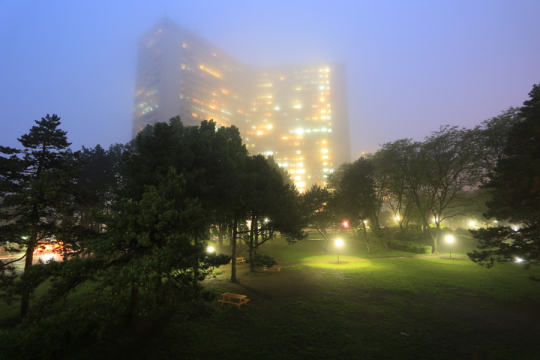
    Photograph Condos in Fog by Richard Gottardo on 500px

    Condos in Fog by Richard Gottardo on 500px

    Earlier today I attended a lunch and learn talking about the renewed interest in rental apartment development here in Toronto. Since this is a topic I’ve written about a few times here on Architect This City, I thought I would summarize some of my key takeaways from the panel discussion:

    • Market fundamentals are strong for purpose-built rental apartments. Vacancy is very low and demand will likely outstrip supply for many decades to come given the barriers to building (land availability, planning/approvals, and so on).
    • As of September 2014, CMHC reported 2,212 purpose-built rental units under construction in the Toronto region. And yet the annual demand for new rental housing is likely somewhere between 10,000 to 30,000 units (clearly some of this demand is being absorbed by condo rentals – the secondary rental market).
    • Millennials and retirees are seen as core markets for new rental apartments. Millennials want to live in urban centers and they like the flexibility that renting provides. Retirees want to know that they won’t be asked to move out because the owner wants to sell their condo unit.
    • It’s almost impossible to compete against condo developers when it comes to buying land (despite the next point). They (condo developers) will pay more. Therefore intensifying our “tower in a park” building stock is going to be a critical component of meeting rental demand in the region.
    • Part of what’s driving this interest in purpose-built rental (on the part of developers) is a softening condo market. So don’t be surprised when some developers flip back to condos when it makes financial sense to do so.

    It was interesting to hear this last point. It’s something that has been on my mind, but for whatever reason wasn’t really being talked about by the industry. That’s not to say that I think the condo market is in trouble though. It has just become more balanced. And ultimately that’s probably a good thing.

    Either way, I think that more rental and more housing options are a positive for the city and for consumers.

  • Condo or rental apartment — does it matter?

    Photograph Community by Evgeny Tchebotarev on 500px

    Community by Evgeny Tchebotarev on 500px

    Toronto is the condo capital of North America. For a number of years now, there have been more condos under construction in this city compared to any other in North America, including New York.

    But recently the real estate community has become incredibly interested in building multi-family apartments (also known as purpose-built rental buildings). Which is why about 7 months ago I wrote a post called, Rise of rental.

    It has been decades since Toronto built rental apartment buildings at any sort of scale. That means that our existing stock is generally pretty old and that condominiums – rented out by individual investors – have been almost exclusively fulfilling the need for rental apartments in this city.

    But given that purpose-built rental apartments are on the rise, I’ve been thinking a lot lately about them and about the consumer perspective. 

    And so here’s my question to you:

    If you were looking for a place to rent, would it make a difference whether it was a condominium (rented out by an individual investor) or whether it was a professionally managed apartment building? You can assume that the suite itself is identical.

    There are obviously many differences between both forms of tenure, but I’m curious to what extent that factors into the decision making process for consumers. It hasn’t really been an option in recent years, but that seems destined to change.

    I hope we can have a discussion in the comment section below.

  • From seigneurial land tenure to condominium plans

    One of the things I noticed this past weekend when I was on my Porter Escape in Quebec City was that there’s still evidence of the seigneurial land use system. I saw it on île d’Orléans.

    Established in 1627 in New France, the seigneurial system was a feudal way of distributing land and creating subsistence farming for those who occupied it. It was ultimately abolished in 1854, but you can still see vestiges of it.

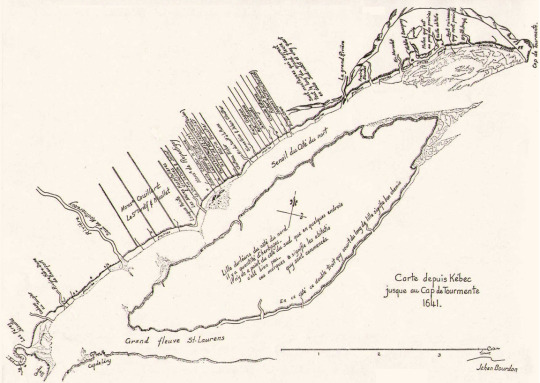
    With the seigneurial system, a typical farming lot was a long and narrow strip of land emanating from the water, which in this particular case was the St. Lawrence River. Here’s a map from 1641 showing what that looks like:

    image

    The reasoning behind this spatial arrangement was rather simple. By having long narrow lots, it meant that you could maximize the number of farmers who had direct access to water. This was needed for navigation, but also for many other obvious reasons. This was an efficient layout.

    At the same time, the long strips meant that each farmer had access to a broad cross section of different kinds of land. They had fertile land for growing, land for their home, and frequently land with trees so that they had material to build, fuel to burn, and so on. It also meant that, despite the overall lot sizes, people actually lived fairly close to each other. It created communities.

    Of course, there’s a lot more to the seigneurial system than just its physical form and there are reasons it was eventually abolished. But today I just want to focus on spatial layout. Because I think there are parallels to how we continue to plan our communities.

    If you live in a city you’ve probably come across a narrow rowhouse, a narrow townhouse, and/or a long and narrow condominium – which many people like to pejoratively refer to as a “bowling alley” plan. In these cases, the width of the home could be somewhere between 10 and 13 feet.

    If you stop and think about this, it’s exactly the same spatial principles as the seigneurial land use system. But instead of maximizing the number of people with access to the St. Lawrence River, it’s about maximizing the number of people who front onto the street and who have access to natural light.

    In tight urban conditions, it’s not uncommon to have no “side yard windows.” In my case, I live in a condominium with 20′ feet of windows on one side only. The other 3 sides of my box have none. And that’s a fairly common urban condition.

    I find this interesting because as much as the world is rapidly changing, some things don’t actually change all that much.

    Image: Wikipedia

  • Cities without people

    Some people believe that cities are all about bricks and mortar. While other people believe that they are first and foremost about people. Though I wholeheartedly believe that our built environment has a profound affect on our lives, I am in the latter camp. 

    Real estate to me is an outcome. It is the result of people needing space. A new condominium is built because people need a place to live. A new office building is built because somebody built a great company and it needs to house its growing workforce. So at the end of the day, what is a city without people?

    Perhaps the best way to demonstrate this point is to show you what cities look like without them. This morning I stumbled upon an interesting series of city photographs where almost all of the people have been removed. They are by artists Lucie & Simon and the project is called Silent world.

    The top image is Times Square and the bottom image is Queensbridge in New York.

    Images: Lucie & Simon