Daily insights for city builders, delivered every morning at 6 AM ET. I’m Brandon Donnelly — a Toronto-based real estate developer and founder of Globizen. I’ve been writing here since 2013.

Tag: community opposition

  • Density vs. infrastructure in Liberty Village

    A beautiful new 43-storey rental building was just approved in Toronto’s Liberty Village neighborhood. More info about the project can be found, here. Not surprisingly, some people in the community were against it. Here is a recent article that blogTO published talking about people who live in high-rises not wanting a new high-rise next to them.

    One argument that is being made is that the neighborhood is already full. It has reached its density limit. We also hear this about the City of Toronto as a whole. But we know this isn’t true. Architect Naama Blonder recently did a study that found we could fit another 12 million people within our boundaries with more efficient land use policies.

    This particular site in Liberty Village is also about 400 meters from a future subway stop on the Ontario Line. So it is exactly where we should be putting more density. The problem today is that the area is suffering from a massive infrastructure deficit. The road network is inadequate and the King streetcar hasn’t been prioritized.

    It’s no wonder the area feels full. But the reality is that there are lots of examples of highly livable neighborhoods from around the world with much higher population densities. The difference is that they have the right infrastructure, the right public realms, and the right modal splits.

    Liberty Village will get there as well and it’s already underway. For a preview of the future, check out the City of Toronto’s Public Realm Strategy for the area. It was published in April 2024 and it includes things like new streets, new mid-block connections, and new parks. It is what the area needs and it’s exciting to see it happening.

  • Dangerously positive precedents

    This is the battle that is now playing out across Toronto — and many other cities — as we look to intensify our existing communities; even in the ones sitting on higher-order transit. Cities rightly want to see it happen. But local ratepayers do not.

    From the Globe and Mail:

    “This project is in no way gentle intensification,” said the architect Terry Montgomery, representing the powerful local group the Annex Residents Association. “It will set a dangerous precedent for all areas in the city which currently [are zoned for] low-scale residential-buildings.”

    It’s not clear whether that legal argument is true. At the meeting, City of Toronto planning manager David Driedger and director Oren Tamir – who, to their great credit, were supporting the development – said it would not set a precedent.

    But if it did, why would that be “dangerous”? It is commonsensical. The Lowther site has two subway stations within an eight-minute walk. Toronto’s Line 1 and Line 2 intersect right here. This is one of the best-located, best-connected places in all of Canada.

    Alex Bozikovic is, of course, right. This is commonsensical. 

    If our goals are to create more homes, improve housing affordability, reduce traffic congestion, and make us overall a more sustainable city, then there’s no better place to build than on top of transit within our already built-up areas.

  • It shouldn’t take 17 years to build affordable housing

    If you are the Los Angeles County Metropolitan Transportation Authority and you own excess land next to a transit line that you’ve just recently built, one possible option could be to give this land to a non-profit housing developer so that they can build some affordable housing. And this is exactly what was agreed to in 2007 with the Lorena Plaza site in the Boyle Heights neighborhood of LA. The proposal: 49 affordable units geared toward people making 50% of the AMI.

    However, like all things in development, things do take time. And when building new 4-storey housing complexes, there is always the real possibility that you might face several years (or longer) of fierce opposition. In the case of Lorena Plaza, it apparently took the developers from 2013 to 2020 to reach a settlement with the local councilman and their immediate neighbor (a commercial plaza). In the end, this project is now expected to occupy next summer (2024), which brings the total project timeline to 17 years.

    This is probably an extreme example and, thankfully, some of the rules have since been changed to help speed up projects like this one. Still, it is no wonder we can’t build enough new housing. (Los Angeles wants to build some 450,000 new homes by 2029.) Time isn’t free. And according to the WSJ, this relatively small project ended up costing US$34.2 million to build. That’s nearly US$700k per suite. A number that will buy you a lot of home in many cities across the US.

  • LVMH’s Cheval Blanc Hotel faces opposition in Beverly Hills

    I am sure that most people aren’t going to feel bad for LVMH, but it is facing some opposition in trying to bring the first Cheval Blanc Hotel to North America. Last year, Beverly Hills City Council approved the hotel development on Rodeo Drive, but since then, enough signatures were collected that a special election is going to be held later this month for the ~22,000 residents who are registered to vote in Beverly Hills. And from the sounds of it, the results will decide the fate of the project.

    As I understand it, there are two mains groups that are upset:

    1. A union representing hotel workers
    2. Local area residents

    The official message from group #1 is that they want affordable housing. But there is speculation that they just want the hotel to be unionized. I don’t don’t, so let’s move on to group #2. Why would residents be opposed to this project?

    One way to think about this is that LVMH is trying to build a fancy new $2,000 per night hotel in one of the richest cities in the US, on one of its most luxurious streets. So, you would think that there would be a fit and that more than a few rich people would be excited about such a development. I guess this is true — and Council did vote in favor last year — but clearly there are other concerns:

    …some people were unhappy a 109-room hotel, framed by Rodeo Drive, Little Santa Monica Boulevard and Beverly Drive, would rise nine stories on one side and tower over surrounding retail and commercial spaces sitting at three and four stories high. Four buildings would have to be razed, and the idea of more traffic coming to the area was unsettling.

    It seems to be about scale:

    …Cheval Blanc opponents want to keep that small town vibe. “The area is charming and beautiful right now, and, if and when they are able to put that project out there, it will not be. It is very nice to be around low-rise buildings. You can sit at a sidewalk café in Beverly Hills and look across the street and see the hills. It is a very good feeling,” said Darian Bojeaux, an attorney who has lived in the city for 35 years and signed the petitions launching a special election. “Let them build a code-compliant hotel that is three stories high. Let them build something nice that doesn’t ruin the city.”

    Here’s an aerial of said small town vibe for context (I’ve marked the number of proposed storeys):

    What’s interesting about this situation is that it seems to isolate the concerns. Because what is being proposed here is an obviously compatible use. It is a rich thing in an area for rich people. Residents don’t seem to be saying that this is a problem. Instead, it is height that could potentially “ruin the city.” (Ignore for a second that there’s already an office building of similar height across the street.)

    What this tells me is that if you’re thinking about proposing nine storeys of Ferragamo and Balenciaga, that’s probably not small town enough. Saint Laurent needs to be no more than three.

  • Honks against housing in San Diego’s University City

    The University area is one of 53 community planning areas in the City of San Diego. And this one, as the name suggests, houses the University of California, San Diego (UCSD), which is at the northern end of the blue transit line.

    The last time the University Community Plan was updated was in 1987, and so it’s an old plan and it is currently being redone to better align with the City’s current strategic plan — which includes things like “creating homes for all of us” and “championing sustainability.”

    The final draft community plan won’t be available until later this year, but there are two draft scenarios available for download. Here’s what Scenario A looks like:

    The “T” circles are transit stops on the Blue Line (which runs south to downtown and then to the Mexico border), the olive green areas are institutional (UCSD, hospital, etc.), and the purple areas are “urban villages” with densities that go as high as 218 dwelling units per acre (darkest purple). For the other areas, please refer to the legend.

    Now let’s put this residential density into some sort of context. One acre = 43,560 square feet. So we’re talking about 218 homes on every 43,560 square feet of land. For context, our mid-rise Junction House project is 151 homes and our site area is approximately 22,000 square feet (about 0.5 acres). That puts us at roughly 302 homes per acre — more than what is proposed here.

    In total the revised plan could allow for somewhere between 35,000 to 56,000 new homes in the University City area. Not surprisingly, the community has reacted by organizing rallies, such as this one, here, called “Honks against housing”:

    (I used a screenshot because embedded tweets don’t seem to show up properly in my email newsletter.)

    This is, again, not unexpected. And all of the typical things could be said about incumbent residents opposing new homes on top of an existing transit line, next to a major university. But what stands out to me about this protest is its format.

    These residents are worried that high-rises will destroy their community. So presumably they are looking to get the word out to as many people as possible. And one of the ways they have decided to do that is stand on the side of a busy road and appeal to people in their cars.

    Ironically, I think this actually reinforces the need for an updated Community Plan. Because it speaks to the car-oriented nature of this community and the need for better land use planning around its existing transit stations.

    In my view, the line of thinking here should not be, “this is going to destroy our community. How will our roads ever accommodate 35,000 new homes?” It should be, “how do we better plan this community so that our next generation of residents have the luxury not to have to drive everywhere?”

    If you’d like to offer constructive feedback on this plan, I’m told that you can email Nancy Graham at nhgraham@sandiego.gov.

  • CloudKitchens quietly expands across Latin America

    Despite having somewhere around 4,000 employees and being valued at upwards of $15 billion (2021 figure), CloudKitchens remains an incredibly secretive company. In 2020, it was reported that they had spent over $130 million in the preceding two years on properties in about two dozen cities, and this week the Financial Times reported that they have been quietly building “dark kitchens” across Latin America, alongside a new food and convenience goods business called Pik N’ Pak.

    The way this all supposedly works is that the “dark kitchens” prepare the food for delivery and pick-up takeaway, and any excess space within these buildings is used to store convenience goods like over-the-counter medicines and pet foods. I guess it is literally about picking and packing various items that you can then attach to takeout orders. In both cases, the food and goods are delivered to customers using local app companies such as Uber Eats.

    All of this appears to represent a shift in the supply chain for takeout food and various convenience goods. But what I am really curious about right now is what the real estate footprint of this network looks like within our cities. What is the optimal square footage of a ghost kitchen? What radius do they serve? And how does this ultimately change the landscape of our cities? I don’t know the answers to these questions, but change appears to be underway. Here’s an excerpt from the above FT article:

    “…the growth of dark kitchens across Latin America has caused controversy in certain cities. The proliferation in São Paulo, the largest city in the Americas, sparked objections from residents living nearby, with banners against new facilities appearing in well-heeled neighbourhoods. The town hall has proposed local regulation of dark kitchens and earlier this year placed a temporary ban on the issue of new licences. People have complained about noise, smells, smoke and motorcycle drivers — known colloquially as motoboys — waiting outside to collect orders. One unhappy local said his son had been nicknamed “bacon” and bullied in school because of the odour on his clothes, according to Cris Monteiro, a city councilwoman.”

    Travis Kalanick seems to have a knack for upsetting people and changing the way our cities operate. Although, the same could be said about a lot of other startups.

  • Does new housing supply need better economic incentives?

    I watched a bit of the English leadership debate the other night. Eventually I got frustrated and went to bed, but I understand that housing affordability and overall affordability were important topics.

    What is clear, to anyone who cares to look, is that in most big cities we are not building enough new housing. According to the above Economist article (linked in the above tweet), the “rich world” has seen new housing production drop by about 50% (relative to population) since the 1960s.

    There are many reasons for this. But part of the problem is bureaucracy. Things move exceedingly slow. And another part of the problem is community opposition. Urban sprawl can be easier to swallow because there’s an out-of-sight-out-of-mind phenomenon at work. Stuff may be happening, but it’s not happening in my backyard.

    But now that so much of what we do is centered around intensifying existing neighborhoods, we are faced with a battle between the incumbents (existing residents) and the future residents of a community that don’t have nearly as much say — if any at all.

    What I like about the Economist article is their line of thinking for how to address this dynamic, which, at the end of the day, is rooted in what I will call expected selfishness.

    The approach is around aligning incentives. How could we better structure the delivery of new housing so that more stakeholders stand to directly benefit? Because as we have seen with laneway housing here in Toronto, homeowners will gladly build in their backyard when they stand to benefit directly.

  • NO TOWER on Commercial Drive

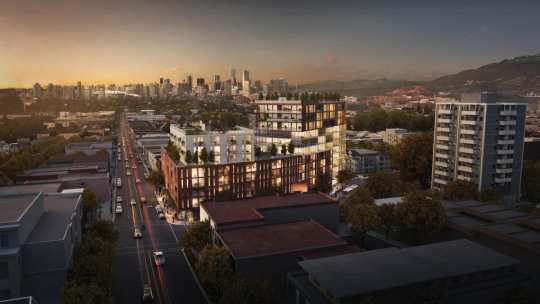
    For the past week or so I’ve been seeing the proposed Kettle Boffo Project in Vancouver make the rounds online. Here’s a rendering of the project, which is located at Commercial Drive and Venables Street:

    image

    The reason it has been making the rounds is that a community group called NO TOWER (written in all caps) has come out in fierce opposition of the 5 to 12-storey building. They have over 3,500 signatures.

    As an outsider looking in, this is surprising. The scale of the project seems appropriate. The height roughly matches the existing building shown above to the right. It may even be lower. And the project will provide somewhere around 30 social housing units, as well as additional space for the Kettle Friendship Society non-profit, who are currently on the site. (Note: An application to the city hasn’t yet been made.)

    What this has me thinking about is the push and pull between bottom-up and top-down planning. 

    When architect Bjarke Ingels talks about his Dryline project in New York, he likes to refer to it as the love child of Robert Moses (top-down planning) and Jane Jacobs (bottom-up planning). In the case of this project, it’s because it’s a large infrastructure project that they are trying to root into the local neighborhoods. Makes sense.

    But this same thinking could also apply to overall city building. Local communities rightly have their own wants. But at the same time, cities need to be thinking about the overall. The challenge is finding that right balance.

    I would be curious to hear your thoughts on the Kettle Boffo Project in the comment section below – especially if you’re from Vancouver.

  • Bad neighbors build wind turbines

    image

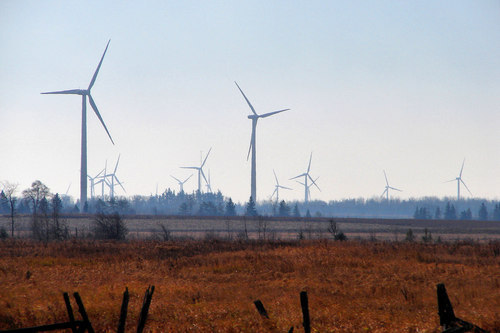
    On Friday when I was driving up to Thornbury, I ended up taking a route that goes through Shelburne, Ontario. I’ve taken this route at some point before, but I don’t remember seeing so many wind turbines. I guess it must have been before this particular wind farm had been built out.

    It turns out that these wind turbines belong to the Melancthon wind facility, which is the largest installation in Canada. The facility contains 133 wind turbines and has the capacity to generate 545,000 megawatt hours each year – enough renewable energy to power roughly 70,000 households. The facility is owned and operated by TransAlta and they’ve entered into a 20-year contract to supply renewable energy to the Ontario Power Authority.

    But what I also happened to notice were the many signs posted around with wording like the title of this post: “Bad neighbors build wind turbines.” And after speaking about it with people over the course of this weekend, I very quickly learned that there was fierce community opposition to this project.

    The concern with wind turbines is typically twofold. People don’t like the way they look and they worry about the noise that they will generate. There’s even an alleged condition called “Wind Turbine Syndrome.”

    I personally think they look quite beautiful. They seem so symbolic of the future and progress. But I am intrigued by the noise concern and so I decided to do a bit of research. I found this video from the UK. The big takeaways are that living beside a main road is generally much louder than living beside a wind turbine, and that a wind turbine isn’t usually that much louder than a quiet suburb, until you get fairly close to it. So I wonder if it’s really as bad as people are making it out to be.

    Either way, the issue at hand is incredibly important. We’re talking about renewable energy. And while you may not like the look of wind turbines scattered across the horizon as much as I do, I strongly believe that we need to figure out ways to wean ourselves off of fossil fuels. It’s for this reason that I’m a big supporter of both wind and solar power.

    So perhaps the counter to those signs scattered around Shelburne is the following: Responsible communities build wind turbines.

    Image: Wikipedia