Daily insights for city builders, delivered every morning at 6 AM ET. I’m Brandon Donnelly — a Toronto-based real estate developer and founder of Globizen. I’ve been writing here since 2013.

Tag: community engagement

  • Community open house for Project Bench

    This afternoon, the team, including the Town of Lincoln, hosted a community open house for Project Bench. This is our upcoming development project in the Niagara Benchlands.

    This was a follow-up to the pre-application community meeting that we held last November, and it is a precursor to the statutory public meeting that will be held in two weeks on July 8th at 6 PM.

    If any of you would like to attend, this upcoming meeting will be held in the Council Chambers of the Town of Lincoln at 4800 South Service Road in Beamsville, Ontario.

    Overall, the team feels that today went very well. We’re looking forward to continuing the dialogue with the community and further refining our development application.

    Community meetings are a critical part of the development process and, over the years, I have come to learn the following:

    • Open houses, like the one that was held today, are a good format for encouraging dialogue. The typical setup includes presentation boards, representatives walking the floor, and some sort of mechanism for people to provide feedback (post-it notes on a site plan can work well).
    • Part of why this is a good format (compared to a straight presentation followed by a Q&A) is that it humanizes the team and it gives the community an opportunity to ask all of their questions. A lot of concerns can be addressed through clear explanations.
    • The most common concerns are usually (1) height, (2) density, and (3) traffic. There are obviously others, but this is a good high-level list.
    • Many/most people tend to conflate height and density. But as we have talked about many times before on this blog, they are not one and the same. Density tends to be harder to grasp, which is why you’ll often hear people criticize tall buildings, but not cities like Paris and Barcelona, despite being two of the densest cities in the world.
    • A developer’s job is to be creative. You have to manage a myriad of competing interests and then thread the needle as best you can. Community meetings are about listening, learning, and then trying to figure out where the needle might go.
    • The objective should be to make as many people as possible excited about the development. In other words, do great work.

    What else would you add to this list?

  • Creating change

    I was reading about a proposed development earlier today (it doesn’t really matter which one for this story) and I immediately thought to myself, “wow, this is a beautiful development. I like what they’ve done here.” The project happens to be by one of my favorite architects in the city. Sadly though, we have yet to work with them on any of our projects.

    I then decided to read the comment section of the article. There were dozens and dozens of comments and virtually all of them were negative and against the development. What is, of course, clear is that we all have different beliefs. We all see things differently. And that’s part of the reason why creating any sort of change is usually so difficult.

    But if you think about it, so much of our world resolves around change. If we want to address climate change, we are going to need to make changes. If we want to improve housing affordability, we are going to need to make changes. If we want to build more inclusive and economically prosperous cities, we are going to need to make changes.

    The challenge with all of this change is that we have inertia working against us. Case in point: I’m sure that most of us have been in a meeting at one point or another when a decision was made purely based on what was done the last time around. We did X. So let’s do X again. Why change? Probably a safe bet.

    Seth Godin once said that, “if you do anything that matters, it means you’re trying to change something.” He was talking about the world of marketing. But I believe that there’s a universal truth to this. Change unlocks potential.

  • Too much low-rise — Theresa O’Donnell in conversation with Larry Beasley

    I attended the above talk last night over Zoom. (Shoutout to Michael Mortensen for inviting Slate’s development team and for helping to moderate the Q&A.) The talk was a conversation between Larry Beasley (former Director of Planning for the City of Vancouver) and Theresa O’Donnell (the newly appointed Director of Planning for the City of Vancouver). Prior to this, Theresa was the director of planning for cities such as Las Vegas, Nevada, and Arlington, Texas.

    I’d like to point out two comments that she made last night that I found interesting.

    The first is that community meetings over Zoom actually aren’t all that bad. And the reason that they’re not all that bad is that they tend to draw out larger crowds (they are easier to attend), and so the feedback on development applications tends to be a bit more inclusive / representative. I agree with this overall view and I’ve been arguing for years (here on the blog) that the typical approach to community engagement is pretty much broken. The opinions become lopsided when you erect too many barriers to participation.

    The second point has to do with the amount of land in Vancouver (and other North American cities) that is dedicated to low-rise housing. It’s too much and it’s going to need to be addressed in order to increase overall housing supply and to chip away at the housing affordability problem. This won’t be news to this audience, but it’s interesting to see how widespread this belief has become. Of course, the big questions remain: How gentle should gentle density be? How much intensification should these neighborhoods see?

    I also appreciated her comment that it’s pure lunacy (my words, not hers) to have higher order transit lines running through mostly low-rise neighborhoods. We need much higher densities to sustainably support these kinds of investments in infrastructure. For us Torontonians, a good example would be (most of) the underdeveloped Bloor-Danforth subway line, though there are other culprits.

    Welcome Theresa.

  • The good in change

    This deserves a blog post. Below is a great tweet by Jason Thorne. Jason leads the department of planning and economic development at the City of Hamilton, where, full disclosure, we have a development project.

    https://twitter.com/JasonThorne_RPP/status/1169749295299538944?s=20

    I have said this many times before on the blog, but the challenge with most “community engagement” is that cities typically hear from the people who disagree. Those voices are then taken as representative.

    My gut tells me that we need to make it easier for people to agree. We need to reduce the barriers. Some will take the time to write a thoughtful letter. But most won’t.

  • What I like about Sidewalk Labs’ generative design tool

    Last week I went for a tour of Sidewalk Labs’ “307” workshop here in Toronto. In it they have a generative urban design tool that allows you to toggle things like density, building shape, building height, the amount of green space, the distribution of green space, and so on.

    Perhaps some of you have seen it or used it before. The controls look like this:

    After you’re done playing around with the dials, you are then able to provide feedback on the design that you’ve birthed through two very simple feedback buttons. One is a happy face. And the other is a sad face. (I wonder if the placement of these two buttons has any impact on responses.)

    What I like about this tool is that it immediately imposes a certain degree of reality and it forces you, the participant, to acknowledge the various trade-offs that need to be considered when you’re designing and planning a city.

    For example, if you want lots of parks and public spaces, but you want to hold population density constant — perhaps because you’re trying to make use of an investment made in transit infrastructure — well then you’ll need to accept taller buildings.

    A very similar thought process goes into each and every development pro forma as we all try and manage the myriad of competing interests. But I guess this is also true of life in general. There are gives and there are takes.

  • Laneway suites all across the city

    As of August 2018, the City of Toronto has allowed laneway suites (accessory dwelling units) to be built as-of-right in the Toronto and East York area of the city (subject to meeting some criteria).

    This was a tremendous step forward for the city. And I know a number of people who are currently taking advantage of these new planning permissions.

    Toronto is now looking at expanding these permissions across the entire city and they have just started their community engagement phase. The first public meeting took place today and the next three will be taking place over the course of this month. Click here for the when and where.

    This is a natural extension of the policies that have already been put in place around laneway suites and I’m excited to see this moving forward.

    For those of you who already own property in Toronto & East York and are considering building a laneway suite, there are two programs that you should be aware of.

    The first one allows eligible property owners to defer development charges on the new secondary dwelling unit for up to 20 years. This is meaningful. And the second is a $50k forgivable loan if you make the laneway suite an affordable rental for at least 15 years. (The cap is the City of Toronto Average Market Rent.)

    I still remember what happened when I tried to build a laneway house almost 10 years ago. I was told, by the city, that a house cannot be built behind another house. I knew that would change. Now look at how far we’ve come.

    Image: Lanescape

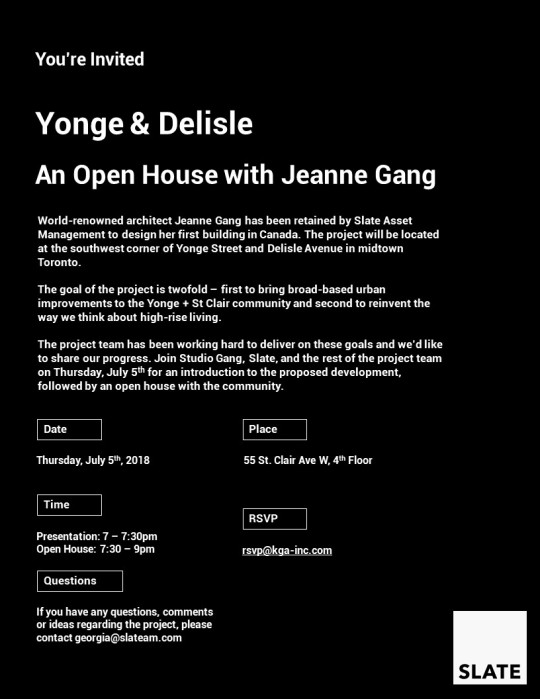
  • An open house with Jeanne Gang

    image

    On Thursday, July 5th, Slate Asset Management, Studio Gang, and the rest of the project team will be hosting a community open house where we will introduce designs for a new block plan and mixed-use building at Yonge + St. Clair. This will be Studio Gang’s first project in Canada. We’re pretty excited.

    It’s important to note that while the proposed design has been influenced by some of the early discussions we had with city staff and the local Councillor, we are still very much at the beginning of this process. Which is why alongside this community open house, we are also launching yongedelisle.ca.

    This will be our “neighbourhood engagement” website as we go through the planning process. You’ll find updates from the project team as they become available, and you’ll also have a direct way to get in touch. We’re also testing out this interactive page where you can vote on the city building principles that matter most to you.

    So hopefully we’ll see you on Thursday, July 5th. Invite details above. Please RSVP, here, if you can. But if you forget to do that, don’t worry, you can still just show up. For more on Jeanne Gang, click here.

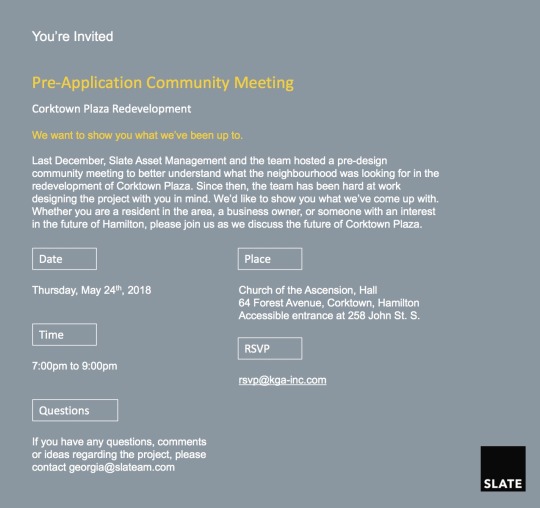
  • Pre-application community meeting in Hamilton

    At the end of last year, Slate hosted a “pre-design community meeting” for the redevelopment of Corktown Plaza in Hamilton. It was the first time we hosted a meeting like this.

    We learned things that evening and this May 24th we’ll be hosting our “pre-application community meeting.” See above for the full invite details. Lots of pre things.

    At last year’s meeting we had no design. It was about learning. At this month’s meeting we will be presenting a design proposal for the site. So hopefully some of you will be able to make it out.

    Regular scheduled programming will resume tomorrow on the blog.

  • Supply-side toolkit for greater housing affordability

    image

    McKinsey Global Institute just published a “supply-side toolkit” for cities struggling with housing affordability. This seems to be every successful city.

    The article includes a long list of potential tools. Some of them you may agree with. And others you may disagree with. But I am sure that many of them will be familiar to you. One of the tools in the toolkit is accessory dwelling units.

    Of course, the overarching theme is that housing supply has not and is not keeping pace with housing demand:

    California, for instance, added 544,000 households but only 467,000 net housing units from 2009 to 2014. Its cumulative housing shortfall has expanded to two million units.

    Another one of the tools in the toolkit is “overcoming NIMBYism.” Here is an excerpt:

    People who come to a city to work need to be able to find an affordable place to live there. But the voices of existing homeowners who want to preserve the status quo often drown out those of newcomers, young adults, low-income service workers, and renters who need more housing. After a 2009 audit found that neighborhood councils were not representative of the city’s broader population, Seattle replaced these bodies with a central Community Involvement Commission that includes mayoral and council appointees chosen to represent a broader set of stakeholders.

    I am intrigued by Seattle’s move to create a central body and a new approach to public engagement – one that moves away from local district-councils. However, it appears that this Community Involvement Commission is still very much in its infancy.

    If any of you are familiar with the Seattle market, I would be curious to hear your thoughts on it in the comment section below. I am, however, going to spend some time reading up on it.

    For the full toolkit, click here.

    Photo by Sarah Brink on Unsplash