Daily insights for city builders, delivered every morning at 6 AM ET. I’m Brandon Donnelly — a Toronto-based real estate developer and founder of Globizen. I’ve been writing here since 2013.

Tag: climate change

  • The re-allocation of capital (and predictions for this decade)

    I have stayed at two hotels over the last month where I did not need to interact with a human as part of the check in process. And in one of those two instances I didn’t even need to interact with a computer at the hotel.

    My room key was issued to me through an app and I used that (and Bluetooth) to open my hotel room door (after the app, of course, notified me that my room was ready).

    This is prediction #2 in Fred Wilson’s annual roundup of what is going to happen next in the world. Automation is reducing the costs associated with operating many businesses. Who is going to be the beneficiary of this consumer surplus?

    The other prediction that should interest most of you — because the impacts would be widespread — is this one here regarding climate change:

    The looming climate crisis will be to this century what the two world wars were to the previous one. It will require countries and institutions to re-allocate capital from other endeavors to fight against a warming planet. This is the decade we will begin to see this re-allocation of capital. We will see carbon taxed like the vice that it is in most countries around the world this decade, including in the US. We will see real estate values collapse in some of the most affected regions and we will see real estate values increase in regions that benefit from the warming climate. We will see massive capital investments made in protecting critical regions and infrastructure. We will see nuclear power make a resurgence around the world, particularly smaller reactors that are easier to build and safer to operate. We will see installed solar power worldwide go from ~650GW currently to over 20,000GW by the end of this decade. All of these things and many more will cause the capital markets to focus on and fund the climate issue to the detriment of many other sectors.

    For the rest of Fred’s predictions, click here. These are always great reads.

  • Making cities resilient to climate change

    This past fall, Goldman Sachs published an important report about “making cities resilient to climate change.” In it, they remind us that the scientific consensus is that the world has already warmed from the pre-industrial era (and will likely continue to do so) and that a great many of us live near water (and will likely be impacted going forward).

    About 40% of the world’s population lives within 100 kilometers of a coast, and about 10% of the world’s population lives in a coastal settlement that is less than 10m above sea level. Above is a list of some of those cities, along with their average elevation in meters. The cities with single digit elevations include Bangkok, Miami, Alexandria, and Amsterdam.

    Goldman’s prediction is that this need for “urban adaption” could lead to one of the largest infrastructure build-outs in history. And that cities all around the world should already be thinking about how they will finance and equitably execute on greater resilience (assuming they aren’t already).

    Click here to download a full copy of the report. The diagrams showing the average change in global mean surface temperatures against the pre-industrial period are something you should all look at it. The 2015-2019 change is pictured above.

    Charts: Goldman Sachs

  • New York City is testing new “flex gates”

    I spent a good chunk of this morning talking and thinking about underground building details that most people (unless you’re in the industry) would never think to consider. This is not a criticism on most people. I mean, I don’t know how iPhones are made. I just use and enjoy them. But when it comes to buildings, I’m paid to ask questions and understand how things work.

    There’s a lot of risk in the ground.

    You have to think about things like bearing capacity, environmental contamination (usually), hydrostatic pressure and, generally, how you’re going to manage water, particularly if you have a high groundwater table. Usually this last one is about making sure you’re keeping the water out. A pretty important detail both below and above grade.

    So when I came home tonight and saw the below tweet, I felt obligated to write about it.

    If you read the reply from NYC’s Metropolitan Transportation Authority, you’ll see that this is them testing something they call a “flex gate.” It is a flood barrier that allows them to seal off subway entrances in the case of a storm surge and they run these tests (shown above) for 4 hours at a time to make sure they’re installed property. This one was.

    Managing water is a big part of city building. New York City, Miami, Venice, and countless others know this all too well right now.

  • Indonesia announces new capital city on the island of Borneo

    On Monday, Indonesia’s president, Joko Widodo, announced a plan to build a new capital city on the island of Borneo. The plan is in response to Jakarta’s formidable environmental challenges. It suffers from some of the worst air quality in the world and is struggling with a severe subsidence problem, which, I understand, is partially (or largely) a result of climate change and the unregulated extraction of groundwater.

    About 40% of the city now sits below sea level and the worst affected areas are supposedly sinking at up to 20cm per year. This gives Jakarta the dubious distinction of being the fastest sinking big city. On top of this, it is also one of the biggest cities in the world in terms of population. The Jakarta megalopolis has over 30 million people, placing it 2nd after Tokyo according to this list.

    Here’s a short video from the BBC that will give you some visuals to go along with the above. These are the sorts of urban challenges that will make you forget all about separated bike lanes and 45 degree angular planes. And they are not entirely unique to Jakarta. If you can’t see the video below, click here.

  • Bill Gates on tech and climate change

    Bill Gates recently spoke with David Rubenstein at the Economic Club of Washington, D.C. Full video, here.

    The bit that got a lot of attention is his admission that Microsoft should have dominated in mobile (in lieu of Android). The core competencies were all there and the company was in investing in mobile at the time.

    The technology discussions in general are interesting, but I also really enjoyed hearing about his efforts to address climate change. He spends a good chunk of time talking about that. Strongly recommend. (Related link: Breakthrough Energy.)

    On a somewhat unrelated note, this is also the first time I’ve seen every question and answer neatly transcribed below a video. This makes it very easy to find the parts that may be of interest. All video discussions should have this.

  • A new way to grow islands

    MIT’s Self Assembly Lab and Invena (which is an organization based out of the Maldives) are trying to invent a system of underwater devices that naturally harness wave energy to restore and/or create new beaches, sandbars, and islands. The hope is that this line of thinking could be scaled up and eventually used a response to sea level rise, as well as other coastal challenges.

    Here’s a short video explaining the initiative:

    With over 40% of the world’s population supposedly living in a coastal area, this is a problem that will need to be addressed. Already we are seeing these concerns start to rear their head in the real estate markets of some particularly vulnerable cities. The team installed their first field experiment in the Maldives this past February and a second one is expected in Q4-2019.

    For more information on the “Growing Islands” project, click here.

  • Climate gentrification is reshaping coastal cities

    Last year, Jesse Keenan, Thomas Hill, and Anurag Gumber of Harvard University, published a research paper called, Climate gentrification: from theory to empiricism in Miami-Dade County, Florida.

    What they were trying to uncover was a possible relationship between climate change and single-family home pricing in places, like Miami, that are vulnerable to sea level rise and flooding. This phenomenon is colloquially referred to as “climate gentrification.”

    One of the things that they uncovered through their work was, in fact, a positive correlation between the rate of price appreciation of single-family homes in Miami-Dade County and incremental measures of higher elevation. In other words: there’s value in higher ground.

    Recent reports (like this one from the WSJ) that Little Haiti in Miami is experiencing a surge in investment, seem to, at least partially, support this finding. Little Haiti sits about twice as high as Miami Beach, which is only about 4 feet above sea level.

    Here is a diagram from the WSJ showing the change in home prices since 2018:

    I’m not sure that this diagram necessarily reinforces the above finding. Mid-Beach in Miami Beach is shown as having an 8% gain, and yet it sits, like pretty much the rest of the Beach, within a 100-year floodplain. But already Miami is looking to manage the impacts of, “gentrification that is accelerated by climate change.”

  • Impact of temperature on economic production

    In 2015, Marshall Burke, Sol Hsiang, and Ted Miguel published a paper in Nature that looked at the relationship between temperature (climate) and economic output. They examined the historical impact of temperature changes (1960-2010) on 166 countries and then used this data to try and predict the potential future impacts of climate change on GDP per capita.   

    What they discovered is that temperature has a non-linear impact on economic production. Put differently, there’s an optimal annual average temperature. And it turns out to be 13 degrees celsius. If a country sits below this average number, then warming increases productivity. But if a country sits above this number, then warming has a negative impact on productivity. And the impact gets worse (stronger negative correlation) at higher temperatures.

    Some of you are probably wondering whether the correlations they found should be interpreted as causation. For what it’s worth, the study tries to correct for non-temperature related economic changes (such as a recession or policy changes) and it also looks at how individual countries perform against themselves during temperature fluctuations. So the control and treatment groups are arguably pretty tight.

    All of this suggests that there are a number of countries that stand to benefit from climate change (at least from this perspective). They are the ones that are cold today. 

    For more on the study, click here.

  • Thoughts on California’s wildfires

    What is happening in California right now is both sad and scary. I woke up to these photos in the New York Times. So I spent the morning reading up on wildfires and what causes them. 

    I am sure many of you are thinking: Is climate change doing this?

    It’s important to note that California is designed to burn. The characteristics that make the state a highly desirable place to live – mild winters and hot and dry summers – also make it a highly flammable place.

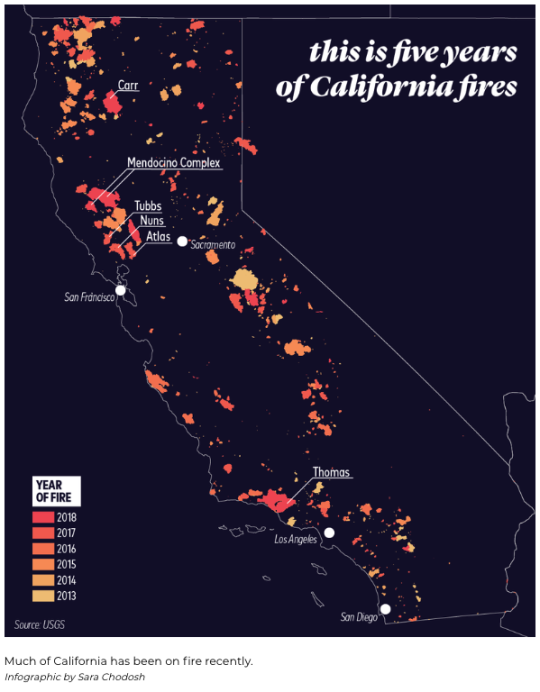
    Below is a map from Popular Science showing how much of California has burned over the last 5 years. Most of California’s hottest fires (13 of the top 20) have occurred since 2000.

    image

    But these naturally occurring fires are actually important for the regeneration of its forests. So one argument is that the current policy of “total fire suppression” is actually partially responsible for this increase in severe wildfires.

    Low-intensity forests aren’t burning like they used to and it is creating more densely packed forests for even larger wildfires. In other words, through our actions we could be exchanging smaller and more frequent fires for bigger and more severe ones.

    The other concern is development. 

    California had a population of about 24 million people in 1980. Today it is closer to 40 million. And much of that growth has occurred outside of existing urban areas (too hard to build). This has meant more people living in suburban and rural areas – adjacent to wildlands.

    Ed Glaeser has repeatedly argued that the best way to respect nature is to actually stay as far away from it as possible. Humans are a destructive species. Living in a dense city is good for the planet.

    Now let’s address the climate change issue.

    Daniel Swain, who is a climate scientist and author of the Weather West blog, published this popular thread on Twitter about a day ago. At the time of writing this post, it had been retweeted and liked over 10,000 times.

    From his perspective as a climate scientist, this is not all about climate change. That’s the wrong question to ask. It’s more complicated and nuanced than that. But climate does indeed act as a “threat multiplier” to the other factors we’ve already discussed.

    Fire season typically begins and ends with rain. When the fall rainy season starts, the fire season ends. One of the biggest risk factors is a dry fall, particularly after a hot and dry summer (or after multiple hot and dry summers, as has been the case in California). 

    Because according to Swain, fall means the start of “offshore wind” season, which can help to stoke these wildfires. 

    Unfortunately, one of the projected outcomes of climate change for California is more precipitation concentrated in the “winter” months, at the expense of precipitation in the shoulder seasons (spring and fall). So that means a longer fire season.

    Swain believes that if Northern California had received close to its typical amount of rain this fall, it is almost certain that this tragedy would have been avoided. 

    That, however, makes me wonder about the relative importance of all the factors we have discussed today.

    For Daniel Swain’s full thread, click here.

  • Future of the American city

    image

    The Knight Foundation has just announced $1 million in support to the Harvard Graduate School of Design for a multi-year, multi-city, and applied research effort that they are calling the Future of the American City. The program will start in Miami and Miami Beach, but the plan is to expand to Boston, Detroit, and Los Angeles.

    As part of this initiative, the GSD will embed faculty and urban researchers into the local community, as well as organize three design studios that will build on each other every year. In the case of Miami and Miami Beach, the 3 themes that will be explored are urban mobility, affordability, and climate change. As you know, these two cities are center ice for the problem of sea level rise.

    This sounds very similar to a design studio that I took at Penn, which was centered around water and housing issues in Bangladesh. It was a multi-year research studio (5 years in this case) and we visited and got paired up with locals in Dhaka during the course of the studio. I think these types of programs are a great way to ground the research in reality. 

    And as a fan of Miami and Miami Beach, I am curious to see what the teams come up with over the next 3 years.

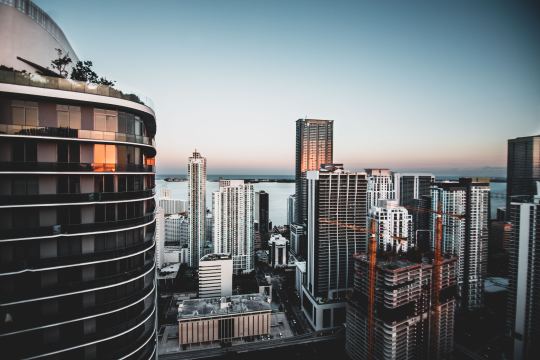
    Photo by Blake Connally on Unsplash