Daily insights for city builders, delivered every morning at 6 AM ET. I’m Brandon Donnelly — a Toronto-based real estate developer and founder of Globizen. I’ve been writing here since 2013.

Tag: citylab

  • Puerto Rican migration during and following Maria

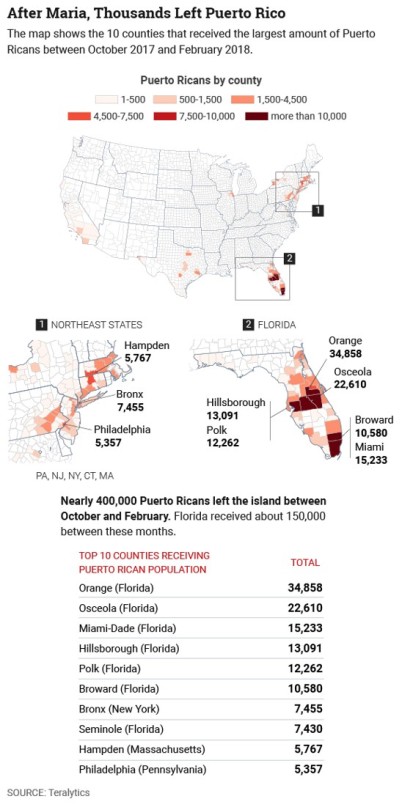
    Teralytics recently looked at data from 500,000 smartphone users to determine how, when, and where Puerto Ricans moved between August 2017 and February 2018 during and following Hurricane Maria – generally considered to be the worst natural disaster on record for the area. 

    CityLab published the data here and along with the following maps:

    image

    It shows the locations and the top 10 counties that received Puerto Rican population during the above time period. Florida and the Northeast are at the top of list, which isn’t all that surprising. Privacy concerns aside, it is once again an example of the kind of granular data that we now have access to. Prior to this data being available, all we apparently had was estimates.

  • Regional accents and “da Bulls”

    I find regional accents fascinating. 

    I generally think that Toronto has a fairly neutral accent. But then again, when I lived in Philadelphia, I used to notice the accident every time I came home. Maybe it is because I had adopted a bit of the Philly accent. For the record, I never picked up “youse.”

    According to some classifications, most of Western and Central Canada would fall under “General Canadian.” But I find that there are noticeable differences between the accents in Toronto and, say, Calgary. Really there are differences even within the Greater Toronto Area.

    CityLab has a recent article up about why city accents are fading in the US midwest. They chalk it up to two main factors: education and geographic mobility. But I also wonder if today’s online connectivity isn’t muting some of the local varietals.

    That’s the interesting thing about accents, they – much like the language itself – are constantly changing and evolving. On that note, I’ll end with this classic parody of the Chicago accent: Da Bulls!

  • Top US metro areas for VC investment

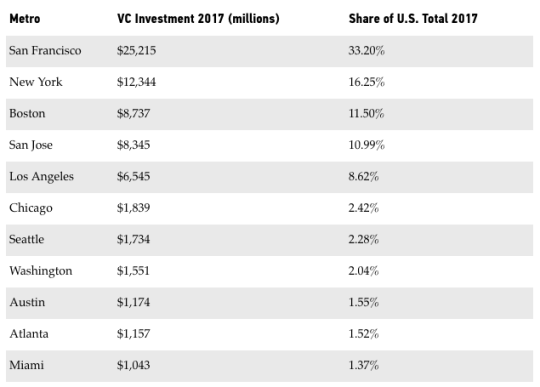
    Below is a list of the US metro areas that saw a billion dollars or more in venture capital investment last year (2017). It is taken from a recent CityLab article by Richard Florida where he talks about the “geographic inequality of high-tech venture capital.”

    image

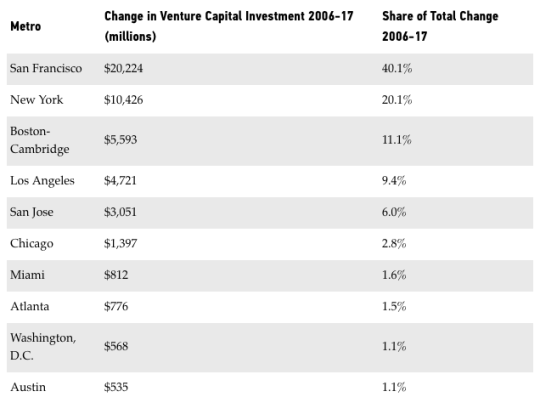
    It’s worth noting that San Francisco – not San Jose (Silicon Valley) – is at the top of the list with nearly 1/3 of the US total last year. It’s also interesting to note that when you look at each metro’s share of the total change from 2006-2017 (the chart below), you get Los Angeles now punching above San Jose. 

    image

    Florida also gets into which economic and demographic variables seem to be associated with higher levels of venture capital investment. For the rest of the article, click here

  • Solutions to NIMBYism

    Earlier today Richard Florida published a piece in CityLab called: Anatomy of a NIMBY. The article cites a recent paper by Paavo Monkkonen (of UCLA) that focuses on the relationship between NIMBYism and housing affordability – a much talked about subject these days.

    More specifically, the paper identifies “four different strains of NIMBYism” and then offers up some possible solutions, which include things like a more inclusive process and better data. I’ve publicly supported these kinds of approaches on this blog many times before.

    But in addition to the above, I wanted to point out two other ideas from the paper and Florida’s article.

    The first is about shifting land use decisions up to the regional level, and maybe even the state level. This one is particularly timely given that there’s a lot of discussion in Toronto right now about shifting land use decisions in the exact opposite direction – from province (OMB) to city.

    The second is a suggestion from Yale professor David Schleicher that he refers to as “tax increment local transfers.” Essentially, the idea is to somehow allow current residents to participate in the future tax revenues generated from new development in their neighborhood.

    There’s lots of interesting reading buried in the above links.

  • Moving to the big city

    When I was 18 years old, I
    moved from the suburbs of Toronto to Waterloo, Ontario, which is about an hour
    west of the city.

    I largely did this for two reasons.

    Firstly, I had started
    visiting friends at both Wilfrid Laurier University and the University of
    Waterloo while I was in high school, and I thought that I wanted
    that kind of University town experience.

    Secondly,
    I started University as a Computer Science student and I figured that Waterloo
    was a pretty good place to study that. Research In Motion (later renamed to
    Blackberry) was an important company at the time and interesting things were happening.

    Though
    to be clear, I was a student at Laurier and not at the University of Waterloo – the better of the two schools for Computer Science – because I didn’t have
    the grades for the latter.

    But a
    funny thing ended up happening. I hated living in Waterloo. I felt so out of
    place. So much so that I spent every weekend back in Toronto visiting my
    friends who had instead decided to go to the University of Toronto.

    And I
    remember vividly how I felt during those weekends. I would stand in my friend’s
    apartments – most of which had dens and solariums that were hacked into
    bedrooms so that they could afford to live there – and I would look across the skyline and
    think to myself: why the hell do I not live here?

    So I
    transferred to the University of Toronto. And that solved that.

    The
    reason I bring up this story today is that I was reminded of it while reading a recent CityLab article by Richard Florida called, The
    Self-Confident City
    .

    The three
    main arguments in the article are:

    (1) Where
    we choose to live has a massive impact on our life outcomes.

    (2) Self-confident
    people – according to a recent study – seem to be drawn to big cities.

    (3)
    Self-confidence can also be a self-fulfilling prophecy
    for people in big cities.

    Now,
    I don’t know if it was really self-confidence and youthful hubris that told me I needed to live in a bigger city than Waterloo. (It was probably part of it.) All I know is that I
    wanted to live in a super dynamic place that felt bigger than me. I wanted to
    feel like I was a small fish in a big pond trying to make some sort of
    meaningful dent.

    That
    was true for me when I was 18. And it remains true for me today at 32.

  • A short history of redlining

    In 1933, the United States Congress created the Home Owners’ Loan Corporation (HOLC). With foreclosures rising as a result of The Great Depression, the task of the agency was to provide new low-interest mortgages to both homeowners and private mortgage lenders. Between 1993 and 1936, the agency served about one million households.

    By 1935, the parent company of the agency (the Federal Home Loan Bank Board) decided to initiate something called the “City Survey Program.” The idea was to look at local real estate trends – including the racial and ethnic composition of the country’s largest cities – in order to get a better understanding of how to manage all of these outstanding loans.

    One outcome of this program was the creation of the HOLC’s infamous “residential security maps.” (Philadelphia’s is shown at the top of this post.)

    These were maps that categorized city neighborhoods according to 4 grades. Grade A neighborhoods (green) were the best ones. They were ethnically homogenous and had room to be further developed. Grade B neighborhoods (blue) were the second-best ones. They were already completely developed, but were still considered desirable. Grade C neighborhoods (yellow) were starting to decline and showed an “infiltration of a lower grade population.” And finally, grade D neighborhoods were considered “hazardous” and colored in red. These neighborhoods had low homeownership rates, old crappy housing, and an “undesirable population”, which, at the time, largely referred to Jews and African Americans.

    Some have argued that the HOLC and their “residential security maps” are what kicked off systematic mortgage discrimination in America’s inner city neighborhoods – later referred to as “redlining.” This was the practice of denying credit to people who lived in these undesirable neighborhoods (and even to real estate developers who wanted to build in these undesirable neighborhoods).

    But University of Pennsylvania professor Amy Hillier has argued that these maps simply reflected the ethos of the time period. Using a sampling of HOLC mortgages, she found that 62% of them were issued to grade D (red) neighborhoods. The agency, itself, was not actually redlining in practice.

    Furthermore, she also looked at private mortgages issued in Philadelphia between 1937 and 1950 and found that security grade rating actually had no impact on the total number of loans issued. She did, however, discover slightly higher interest rates for properties located near and in the bottom security grades.

    All of this is to say that “redlining” is likely not the only culprit for inner city decay. There are other factors at play.

    To that end, the National Bureau of Economic Research recently published a working paper, which I discovered through CityLab, called, “Racial Sorting and the Emergence of Segregation in American Cities.” The key finding here is as follows:

    “Our preferred estimates suggest that white flight was responsible for 34 percent of the increase in segregation over the 1910s and 50 percent over the 1920s. Our analysis suggests that segregation would likely have arisen in American cities even without the presence of discriminatory institutions as a direct consequence of the widespread and decentralized relocation decisions of white urban residents.”

    In other words, it wasn’t just mortgage discrimination; it was also just general discrimination. That actually makes a lot of sense, because, if you think about it, the former couldn’t have occurred without the latter being present.

    Here’s how the research paper puts it (via CityLab):

    “Policies that reduce barriers faced by blacks in the housing market may thus not prevent or reverse segregation as long as white households have the ability and desire to avoid black neighbors.”

    (Note: Most of the information and data used in this post was sourced from the work and research of Amy Hillier.)

  • The value of lifestyle in attracting human capital

    When I was in Revelstoke, BC last year I met a number of people who had made the move out there from Toronto. When I asked if they missed living in a big city, pretty much everyone gave me the same answer: “No, I love it here.”

    This past week when I was in Park City, Utah, I similarly met a number of people who had made the move from New York and other large cities. And when I asked them the same question, I heard statements like: “I used to live in New York, but then I got a life and moved out here." 

    In these two examples, the obvious draw is the mountains. But it’s not like everyone just moved and became a ski bum. In fact, Inc Magazine recently published an article talking about Park City’s robust startup scene. People are figuring out how to combine hard work with the lifestyle they want.

    What I find interesting about this is that it runs counter to the trend of young people preferring big cities. Here’s a quote from NPR:

    “But affordable real estate and waterfront views don’t have millennials biting. They continue "a multigenerational pattern of young adults preferring more expensive urban areas over lower-cost rural ones because the lifestyles and opportunities in such places make the extra burden of cost worth it,” says Robert Lang, professor of urban growth and population dynamics at the University of Nevada, Las Vegas.”

    However, some small towns clearly have a unique lifestyle advantage: mountains. And that seems to be a strong enough draw that some people are simply figuring out how to create the economic opportunities for themselves.

    For me, this is yet another reminder that if you’re trying to attract the best human capital to your city or town, you need to think about lifestyle. And since young adults aged 18-34 are far more likely to move around than any other generation, you should also be thinking specifically about what this generation wants.

    Here’s a chart from CityLab that shows how precipitously migration falls off (in the U.S.) once people finish school and get settled in a job:

    image

    Obviously, not every town or small city is blessed with mountains. But there are many lifestyle advantages that can be created. It’s for this reason that I keep talking about nightlife and Toronto’s laughable 2AM last call. Those are lifestyle things and we can do better.

  • Amsterdam is about to host the first Night Mayor Summit

    Canal Reflections by Peter Elliston on 500px.com

    https://500px.com/embed.js

    What is a night mayor, you might ask?

    Well, just as the name suggests, a night mayor is the chief executive officer of a city’s nighttime activity. And in 2014, Amsterdam became the first city ever to have one.

    Why is this important, you might ask?

    Well, for most cities the night is a blindspot. It’s viewed as something that needs to be carefully controlled as opposed to something that is celebrated and leveraged. Amsterdam saw this opportunity and, in my opinion, is now at the forefront of rethinking the night.

    Here’s an example of the kind of changes that this has meant for the city (via CityLab):

    “Until recently, Amsterdam enforced what by continental European standards is a fairly strict curfew: nightclubs had to close by 4 a.m. on weekdays and 5 a.m. on weekends. The city often had problems with noise and disorder at the exact moment when all the clubs closed, filling narrow inner city streets with rowdy people.

    To solve this problem, the night mayor suggested not less, but more time for people to go clubbing. He has helped push through the granting of 10 24-hour licenses for nightclubs. Crucially, all of them were located not in the dense city center but in thinly populated districts around Amsterdam’s outer ring road. The result was a marked reduction in street noise.”

    Some of you are probably feeling skeptical as you read this. Especially since 4AM and 5AM hardly seem strict when compared to other cities (Toronto’s last call is at 2AM). 

    But I would not underestimate the importance of what Amsterdam is doing. We are living in an era of the 24-hour global city and it’s about time that governments woke up to that. I’m sorry Toronto, but 2AM is an absolute joke.

    The night can be your competitive advantage in attracting human capital. As the CityLab article cited above suggests, a big part of what transformed Berlin into a capital of cool was its nightlife. 

    I wholeheartedly believe that and I have no doubt that the night will start to become a greater focus in city building.

    If you’d like to learn more about the Night Mayor Summit, click here.

  • UberPOOL is the new networking tool

    crossing by Milan Kalkan on 500px.com

    https://500px.com/embed.js

    UberPOOL launched in Toronto last week. It was tested in Toronto last summer and it’s been available in other cities for awhile, but now it’s officially here.

    If you’re not yet familiar with UberPOOL, it basically allows you to share your ride with other people who are headed in the same direction. I’ve heard some people on Twitter complain about route inefficiencies, but I’ve had only positive experiences with it so far.

    The disadvantage of this system is that it’s a bit slower. You’re stopping to pick up other people on the way. But the advantages of this system are twofold. First, it’s cheaper, which means it’s already starting to eat into my transit usage. And second, you get to meet new people everywhere you go.

    This second piece is really interesting to me, because I place a lot of emphasis on getting to know as many people as I can. That’s one of the reasons I blog every day and one of the reasons I spend a lot of time on Twitter. I get exposed to people that I might otherwise not meet. And I believe there’s huge value in that. I want to sit down and have a coffee with everyone. (Time doesn’t always allow that to happen.)

    Because since the beginning of cities, personal connections is one of the things that has made urban life so valuable. Here’s an excerpt from a CityLab article published back in 2013:

    “If you look at the interaction patterns of cities,” Pan says, “You will see that they grow super-linearly with population with the same growth rate as productivity, as innovation, as crime, as HIV, as STDs.”

    All of those facets of urban life have appeared until now to share a somewhat mysterious mathematical relationship. But this research suggests that this particular super-linear growth rate is directly tied to how dense cities enable us to connect to each other. As cities grow, our connections to each other grow by an exponential factor. And those connections are the root of productivity.

    “What really happens when you move to a big city is you get to know a lot of different people, although they are not necessarily your ‘friends,’” Pan says. “These are the people who bring different ideas, bring different opportunities, and meetings with other great people that may help you.”

    Clearly there can also be some negative externalities associated with urban life – such as crime and disease. But it’s also clear that for a many people, the benefits far outweigh the potential negatives. Big cities tend to make us more productive. And as we’ve discussed here before, they can also bring us happiness in ways not associated with economic success.

    If you’ve used UberPOOL before, I would be curious to hear about your experiences in the comment section below.

  • A site-specific light installation on Wabash Avenue

    A Kickstarter project called The Wabash Lights has just reached its funding goal of $55,000 to implement what it is calling the beta version of its project. 

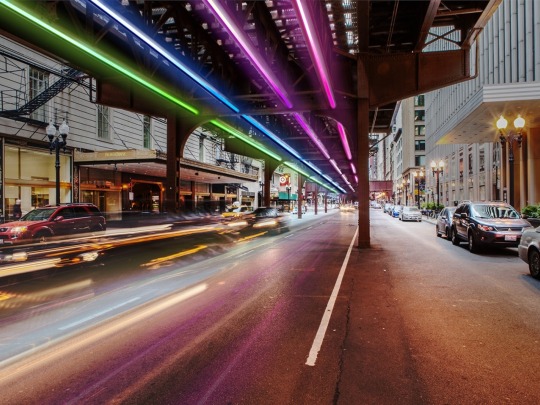
    The project is a site-specific and interactive LED light installation on the underside of the elevated train tracks that run along Wabash Avenue in Chicago.

    The lights are completely customizable (color, patterns, pulses, and so on) and they will be controllable via web and mobile. So anyone walking down the street will be able to have some fun with the lights.

    Here’s a video from the creators explaining more about the project:

    [vimeo 131322692 w=500 h=281]

    It’s a clever idea and I can see the lights becoming just as recognizable as Chicago’s bean.

    But the true success measure will be whether or not it draws people to the area and it changes the composition of the street. Elevated structures aren’t great for street life. That’s why I fought (unsuccessfully) to have the elevated Gardiner Expressway East removed here in Toronto.

    It’s interesting to hear the one woman in the above video talking about how Wabash isn’t really a street you go to. It’s just the street between Michigan and State that you have to pass through. That’s how I feel about most parts of Lake Shore Blvd in Toronto.

    Here’s how CityLab described it in their writeup about the project:

    “While the L tracks are as iconic to Chicago as some of its skyscrapers, their presence overhead doesn’t necessarily bring in the foot traffic compared to other nearby streets.”

    But something like The Wabash Lights could really make a difference.