Daily insights for city builders, delivered every morning at 6 AM ET. I’m Brandon Donnelly — a Toronto-based real estate developer and founder of Globizen. I’ve been writing here since 2013.

Tag: city life

  • A few observations from Paris

    The last time I was in Paris was in 2006. That’s a long time ago and so it was great to be back in the city earlier this week. I don’t know the city as well as I do many other cities, but I speak enough French to be dangerous and we spent a good amount of time on this trip just exploring. On average, we clocked about 20,000 steps a day. So here’s a list of some of the things I was reminded of or learned of on this visit. If any of you are more familiar with the city, please feel free to speak up in the comment section below.

    • I love Paris.
    • The Parisian art of people watching is alive and well. One of my favorite things about Paris is how so much of the cafe seating faces out toward the street. That’s what you’re supposed to be watching: urban life.
    • Most cities have a clear message. In Los Angeles, it’s probably that you should be more famous. In Boston, it’s arguably that you should be smarter. And in New York, it is perhaps that you should be richer. In Paris, the message feels loud and clear: You should be more fashionable.
    • Compared to Toronto, the center of Paris feels far more static. Less construction. Less change. Less that is new. That’s not such a bad thing given how beautiful the city is. But in my view, cities are about balancing preservation and progress. From what I could tell, a lot of the new construction seemed to be happening in the suburbs and in the outskirts of the city.
    • That said, COVID feels much further along in Paris. The city was very open and everyone seemed to be back in the office. Locals said that the city was operating at maybe 80%. It felt busy.
    • Dress shoes are dead in Paris. Everyone wears cool sneakers no matter how young or old. Think business suits with Nike Air Maxes. My hypothesis is that it’s just far more practical given how much people walk in Paris. I plan to adopt this strategy immediately.
    • In addition to walking, everyone seemingly bikes and/or uses an electric scooter. Again, it didn’t seem to matter how young or old. Paris also seems to have solved the scooter clutter problem, as has many other cities. There are designated spots (painted lines next to on-street car parking) and that’s where you’ll find the scooters. Toronto needs to get on board.
    • Traveling at 300 km/h on a train is a highly civilized way to move between urban centers.
    • There’s nothing wrong with having a picnic and drinking a bottle of wine (or two) in a park. In fact, it is probably something that should be celebrated. Let people be grown-ups.
    • When you purchase a baguette, you should immediately take a bite out of it to see how fresh it is.
    • The Eiffel Tower, much like the CN Tower, looks far better when illuminated.
    • Balconies of any size can be wonderful. We had a small Juliet balcony off of our hotel room in Nice and we used it every day for croissant eating and to dry our bathing suits. In a more permanent situation, I am sure we would have started growing things on it.
    • Midrise buildings do indeed create nice urban street walls. But it’s important to keep in mind that Paris’ midrise blocks are also deep and dense and with lots of courtyard conditions. That’s how the city is able to house so many people at such low building heights.
    • Facing conditions between buildings is less of a concern when you employ less glass. Smaller punched windows allow you to better manage privacy. I would go so far as to argue that if Paris were an all-glass city, much of its current built form would be fairly unlivable.

    What did I miss in this list?

    Photo by Alexander Kagan on Unsplash

  • [Book] Survival of the City

    I jus pre-ordered a copy of Edward Glaeser and David Cutler’s new book called, Survival of the City: Living and Thriving in an Age of Isolation. (I’m usually a hard copy kind of guy, but I decided to try this one out on Kindle / my iPad). The official release date is September 7, 2021, so if you’re reading this post in your inbox, the book is now available online.

    I’m not familiar with the writing of David Cutler (he’s a public health expert), but I am a follower of Edward Glaeser and have written about his work on a number of occasions. Glaeser’s last book, Triumph of the City, was a kind of celebration of the wonders of urbanism. After reading it, you couldn’t help but feel that cities are our best chance at creating healthy, sustainable, and wealthy communities.

    But in listening to Glaeser throughout this pandemic I have noticed that his commentary on the future of cities hasn’t been filled with unbridled optimism. You get the sense from him that cities are at a crossroads. This is not to say that city life will not persist, because it will. Cities are powerfully resilient. But not all cities are created equal. Some will continue to flourish in this new economy, but others will not.

    This is one of the arguments that they make in this new book and I’m looking forward to reading it once it lands in my Kindle app.

  • Long live the city

    The sentiment around downtown/urban condos has completely changed over the last month or so. This is happening in Toronto and, from what I hear, it’s happening in many other cities as well. Carolyn Ireland published an article in the Globe and Mail today called, “For downtown Toronto condos, the worm has turned.”

    But I can also speak to what we (and our colleagues in the industry) are seeing on the ground. A sense of urgency has returned. Prices are starting to push upward. And people are buying. The last few weeks have also seen some very successful condo launches in the city including 8 Wellesley by CentreCourt Developments. I can’t remember if they sold out in 7 minutes or 7.5 minutes.

    None of this is necessarily surprising. Interest rates are low. The US is doing a good job at vaccinating its people. Single-family home prices have exploded over the last year (pushing buyers toward condos). And there seems to be an emerging view that the second half of this year is going to be pretty good. (This was my view at the beginning of the year and stand behind that position.)

    Today was a beautiful spring-like day in Toronto. I was out for a site visit this morning and the sidewalks were filled with people milling about and enjoying the sunshine. City life isn’t going anywhere my friends. Long live the city.

  • What will be the new New York City?

    Peggy Noonan argues, in this recent WSJ article, that the world has changed forever. A human habit was broken during this pandemic and city life, including office life, will never be the same in New York City. She qualifies this by saying that some people will return to offices, potentially in significant numbers. (People like being around other people.) But that things will never be what they once were. We’ve learned that we can decentralize and still get work done.

    As many of you know, I am bullish on cities and I am bullish on offices. So I found myself disagreeing with many of her arguments. But Peggy does raise some valid concerns: How are cities going to pay for what just happened over the last 12 months? According to the Partnership for New York City, the city lost about 500,000 private-sector jobs since March 2020. About 300,000 residents from high-income neighborhoods also filed for a “change of the address” during this time period.

    Given that the top 5% in New York represent about 62% of the state’s income tax base, the movement of people to low-tax states (and warmer places) is something to watch. It’s also a trend that existed well before this pandemic.

    At the same time, I’m not necessarily convinced that (at least some of) these fleeing rich people aren’t coming back. I was speaking with a real estate agent over the weekend who is based in a popular US resort/recreation market and while he told me that, yes, he’s seeing a massive influx of people from expensive coastal markets, these people are largely choosing to rent. They want to take the lifestyle for a test drive and they are also waiting to see what happens with the world once city life returns.

    There will be real financial challenges coming out of this. But as I’ve said time and time before, cities are remarkably resilient. And as Jack Shafer argued in this recent article about “memorializing the pandemic,” humans tend to have short memories, especially when it comes to bad things. The Spanish Flu has been regarded by many as a forgotten pandemic. We moved on and the same will happen this time around.

  • That hustle and bustle

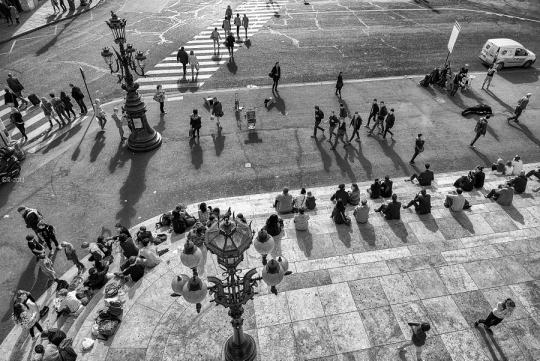
    Street Scene(s) by Olivier Rentsch on 500px.com

    https://500px.com/embed.js

    One of things I love about cities is the hustle and bustle of people. 

    I would rather eat at a busy restaurant than a quiet or dead one. I would rather workout at a busy gym than one with nobody there. And I would rather work in an office or at a coffee shop than work at home by myself. Working at home actually drains me if I do too much of it.

    The reason for that is because I derive a lot of my energy from the outside world. Urban life energizes me. To Swiss psychiatrist Carl Jung, that is the defining characteristic of an extrovert. I am focused on the “outside world of objects.”

    But because of this, I can’t help but slowdown during the holidays. Once the city dials down and the streets become emptier, my mood actually changes. I don’t feel as energized.

    It’s fascinating to think about the connection that many of us have with urban life. Since the first cities were established there has always been some kind of centralized place, market, or agora (in the case of ancient Greek cities) where people came together to exchange goods and ideas.

    But one of the most interesting turning points for modern urban life, as we know it today, came in 19th century France with poets and writers such as Charles Baudelaire.

    At the time that Baudelaire was active, Paris was undergoing Hussmannization. It was being transformed from a medieval city with cramped narrow streets into a modern metropolis of broad avenues.

    And essential to these new streets and urban spaces was the flâneur. At the time, the flâneur was an important literary and artistic figure. He was a man about town. A man of leisure. An urban explorer in the new modern metropolis.

    Here is how Baudelaire defined the flâneur in his Painter of Modern Life:

    The crowd is his element, as the air is that of birds and water of fishes. His passion and his profession are to become one flesh with the crowd. For the perfect flâneur, for the passionate spectator, it is an immense joy to set up house in the heart of the multitude, amid the ebb and flow of movement, in the midst of the fugitive and the infinite. To be away from home and yet to feel oneself everywhere at home; to see the world, to be at the centre of the world, and yet to remain hidden from the world—impartial natures which the tongue can but clumsily define. The spectator is a prince who everywhere rejoices in his incognito.

    One of the central themes at the time was that of anonymity. The modern city had grown to such a scale that a paradox had emerged. Despite all its density and physical proximity, urban life had an isolating effect. It had become easy to just be a number in an ephemeral crowd.

    But fascinating to me is this idea that urban life – with all its ebbs and flows – could bring “immense joy” to the flâneur. In fact, the very definition of a flâneur was someone who did nothing. They weren’t capitalists on the pursuit of new material possessions. Their sole focus was urban life and nothing else.

    And while most of us probably don’t routinely wander around our own cities as tourists without purpose, I suspect that many of us can appreciate the impact that urban life has on us. I know I do. It gives me energy.

  • People in big cities walk faster

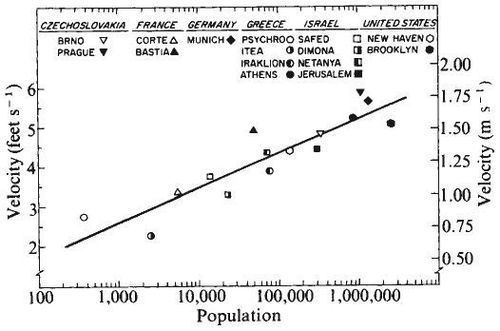
    One of the most interesting things about cities is that as they grow their “urban metabolism” also tends to increase. People become more productive. Economic output increases. It becomes easier to hail a cab (which is a test I like to use). And, according to this recent article by CityLab, people walk faster.

    Yes, research has shown that there’s a correlation between population size and the speed in which people walk. And some of the studies go as far back as the 1970s – like this one from psychologists Marc and Helen Bernstein:

    image

    In many ways, this makes intuitive sense. Life in the big city is a fast paced one. But why exactly do people start literally walking faster? The most probable answer seems to be, quite simply, that time is money. Subsequent research from the 1980s and 1990s has revealed that the best predictor of fast walking is economic output.

    When a city grows larger, they wrote, wage rate and cost of living increase, and with that the value of a resident’s time. As a result, “economizing on time becomes more urgent and life becomes more hurried and harried,” Walmsley and Lewis suggest. (Source: CityLab)

    The first thing that crossed my mind when reading all of this is that there must be some sort of upper limit. Humans don’t just keep walking faster and faster as the city in which they live in grows bigger. If that were the case, the mega cities of the world – such as Tokyo – would have people sprinting around all the time. But that’s obviously not the case.

    So this is a topic that could probably use some more data. And I would imagine it would be a lot easier to collect today given that we all now walk around with mobile sensors in our pockets (our smartphones). And pretty soon we may have mobile sensors on our wrists (smart watches).

    I would certainly like to see more data on this. The idea of an “urban metabolism” has always interested me.

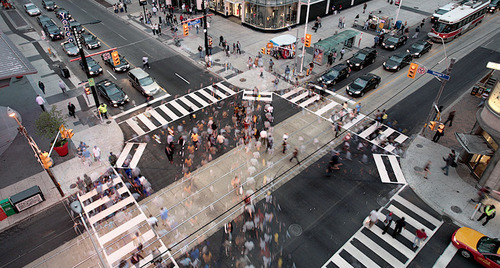
    Image: Dundas Square, Toronto via Flickr