Daily insights for city builders, delivered every morning at 6 AM ET. I’m Brandon Donnelly — a Toronto-based real estate developer and founder of Globizen. I’ve been writing here since 2013.

Tag: city building

  • The best party in town!

    Friend: Ever go to Jilly’s?

    Me: No, actually.

    Friend: Same.

    Me: What about you? [Addressed to random guy in elevator]

    Random guy in elevator: I’m from Portland. I don’t know what you’re talking about.

    I went to check out the new Broadview Hotel last night in Riverdale, Toronto. (Riverside if we’re being pedantic.)

    Originally built in 1891 and most recently a boarding house with strip club at grade (Jilly’s – the best party in town!), the building was acquired in 2014 by developer Streetcar and turned into a “58-room boutique hotel and charismatic gathering spot.” The soft opening was July 27, 2017.

    Official website here. Lots of interior photos here.

    Besides the pink neon above the lobby bar (which is obviously great), I really like what they did in the stairwells. Credit to Supermilk Studio. Here’s a photo I snapped last night while trying to find the WC:
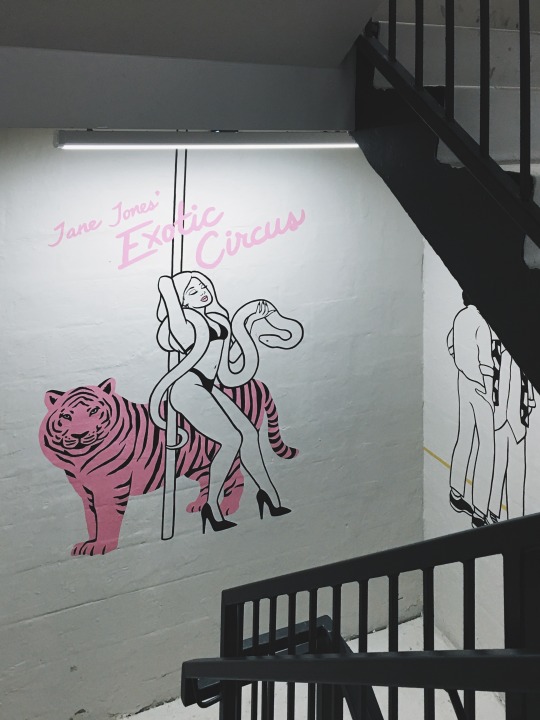
    Each floor is painted with murals that pay tribute to the building’s history, from the early days of Dingman’s Hall to its most recent iteration as Jilly’s.

    Interestingly enough, the building originally served as an important social hub for the community, though it did not initially house a hotel. On the ground floor was a bank (see, there’s a long tradition of this) and above it were offices and grand meeting halls.

    It wasn’t until the original developer sold the building that it was converted to a hotel and granted a liquor license. It’s worth noting that this conversion is said to have faced stiff community opposition. A hotel that serves alcohol to people? Not in my 1906 backyard.

    With the reopening of the new Broadview Hotel this summer, you could argue that east of the Don River is once again regaining its grand gathering spot. And the feeling I got when I stepped foot inside the hotel last night was that it was time. The demand was latent and, yes, condos wouldn’t have cut it.

    At the same time, this is obviously bigger than the east side. There are many who don’t know this building’s infamous history. Jilly’s? What’s that? Time to go for a walk in the stairwells.


  • Crazy girl down in Virginia Beach

    Last night I received an email from a 27 year old woman in Virginia Beach that really made my day. With her permission, I am sharing that email in full here on the blog, but redacting her identity. Here it is:

    Brandon,

    You don’t know me, but I just wanted to take a moment and say, thank you. I am a 27 year-old woman living and working in Virginia Beach, VA, with a Civil Engineering degree from Virginia Tech. Up until recently, I have been trying to “find myself” in my career with little success. I always had a feeling that I was “meant to do something” with my career. The problem was that I didn’t know what the hell I wanted to do. 

    Anyway, fast-forward to November 2016, and I decided to start applying to real estate development companies in the area. After all, it seemed like a pretty cool job. I began sending random emails to a few companies to see if they would hire me…. There wasn’t a real position open – I sort of just begged. Through all my random internet searches, I happened to find your blog one day… And to be honest, you have become a great inspiration to me.

    I began to love real estate development. Not just normal development, I want to make a difference. I began to feel excited and passionate about a science, a line of work, and an end vision and goal that several people share. I want to build these wonderful, competitive, beautiful, sustainable cities. I want to make our world better and more beautiful one place at a time. I was finally able to find myself through your work, so I thank you. You have helped me to commit to a career switch, be patient with my job hunt, and apply for an MBA program.

    Thank you for doing what inspires you because by doing it, you are also inspiring this crazy girl down in Virginia Beach! Keep it up.

    I wanted to share this email for two reasons.

    One, if you’re a firm in the Virginia Beach area, you should consider meeting her for a coffee. Send me an email and I’ll forward it along to her. It’s always challenging breaking into a new industry.

    And two, her email does a great job illustrating how important it is for people to feel fulfilled with their work. People want to make a difference. And some would argue that this desire is even more pronounced in the next generation coming up and entering the workforce.

    I feel lucky that I love what I do. And I know that many of my colleagues feel the same way. 

    Sometimes my friends in the development business will say to me that it’s hard not to become cynical and jaded over time. You start out wanting to change cities for the better and you think you’re doing the right thing, but then it feels like you’re getting punched in the gut every step of the way trying to do exactly that.

    That’s what life will do to you every now and then: It will punch you in the gut. If you want to accomplish great things, you have to take those. But it’s a hell of a lot easier to take them when you’re fulfilled by the work you do. 

    Trying to build better cities is pretty damn fulfilling. I am sure that many of you would agree, regardless of what side of the industry you happen to be on.

    Photo by Ravali Yan on Unsplash

  • Why you should sometimes ignore your customers

    In business we are told to listen to our customers. Be customer-centric. In city building we are told to listen to the community. Be community-focused. And there’s no question that these mantras exist for a reason. They are paramount.

    But when should you not listen?

    I watched a Chef’s Table documentary last night on Massimo Bottura (pictured above), who is the owner and operator of Osteria Francescana in Modena, Italy. Osteria Francescana is a 3 star Michelin restaurant and widely ranked as one of the best restaurants in the world.

    But it wasn’t easy for Massimo at the beginning. His goal was to bring the Italian kitchen into the 21st century and so his plates are often creative takes on classic Italian dishes. His restaurant blends the old and new; food and contemporary art.

    This approach upset a lot of people at the outset. Massimo was seen almost as a traitor who was turning his back on traditional Italian cooking within provincial Modena. Don’t mess with centuries of tradition they would say. Grandma knew best, son.

    Because of this, his restaurant sat empty in the early years, to that point that he was ready to close its doors. The only reason he kept it open was because his wife encouraged him to give it one more year. She said: This is the kind of food you want to make. If you don’t try, you’ll regret it.

    So he gave it another year and luckily he got a few breaks, including a glowing review by a well known food critic from out of town. Once this hit, the Modenese started to quickly rethink their distaste for Massimo’s idiosyncratic dishes. Before long, his restaurant was full.

    So what changed? It wasn’t the dishes. It was perception. The out of town critics and positive reviews gave people permission to like the dishes. This is critical because nobody needs permission to like tradition. It’s tradition, after all. There’s little risk in that.

    But there’s risk in liking something new that hasn’t been done before. Change creates uncertainty. And if Massimo’s wife hadn’t encouraged him to stick with it just a bit longer and ignore the naysayers, the world may not have one of its top restaurants.

    Sometimes we don’t know what we like and want until we are shown.

    Image: Osteria Francescana 

  • The death of Big Oil

    Designing a building for 5+ years into the future can be tricky. The pace of change in the world today is astounding.

    Last month Seth Miller published a Medium article called: This is how Big Oil will die. His argument is that the cost of running an electric self-driving vehicle will be so low – simpler technology and no labor cost – that the personal vehicle as we know it will come to an end. People are inevitably going to give up their cars, which will result in a peaking of oil consumption.

    We’ve talked about this future many times before on the blog. But Miller’s argument ties it back to oil and also comes with a set of predictions taken from a report prepared by the consulting company RethinkX:

    – Self-driving cars will launch around 2021.
    – A private ride will be priced at 16¢ per mile, falling to 10¢ over time.
    – A shared ride will be priced at 5¢ per mile, falling to 3¢ over time.
    – By 2022, oil use will have peaked.
    – By 2023, used car prices will crash as people give up their vehicles. New car sales for individuals will drop to nearly zero.
    – By 2030, gasoline use for cars will have dropped to near zero, and total crude oil use will have dropped by 30% compared to today.

    If all of these predictions prove to be true, then what should we be doing today to prepare our cities for this future?

  • What’s happening in Melbourne?

    image

    I’ve never been to Australia, so take everything I’m about to say in this post for what it’s worth. I also don’t know much about Sydney and Melbourne, other than the fact that I’ve studied the latter’s laneways and the tremendous impact they’ve had on revitalizing the CBD.

    However, recently I’ve had a few close friends visit these cities for the first time and, since then, I have started noticing a trend. All of them come back and tell me the same thing, that they prefer Melbourne to Sydney. They say: “Yeah, Sydney is nice and beautiful and all, but it’s not all that exciting. Melbourne feels way more dynamic. Oh, and have you seen their laneways? You would love them.” That’s what they tell me.

    So that’s what I have in my head when I read that Melbourne is now the fastest growing city in Australia; that it’s one of the most liveable cities in the world; and that by as early as 2031 it could take Sydney’s place as the biggest city in the country. Below is a chart from The Australian. If you can’t see it, click here.

    //platform.twitter.com/widgets.js

    Some argue that this is happening because housing is cheaper in Melbourne (median dwelling price of ~$700,000 versus ~$1 million). And some argue it’s because the jobs are there and the city has become a cultural and sporting destination. Whatever the case may be, net migration is estimated to be somewhere around 100,000 people per year.

    My own view – and I’ve made this argument before on the blog – is that we shouldn’t underestimate the importance of cool shit when it comes to cities. People vote with their feet more than ever today. And for a growing segment of the population, cities are a consumer good.

    Indeed, in 2001, Edward Glaeser, Jed Kolko, and Albert Saiz penned a research paper called the Consumer city, where they argued precisely that. The premise was that historically we have tended to think of cities as being centers of production, but we should also be thinking about them as places of consumption.

    Here’s an excerpt:

    “But we believe that too little attention has been paid to the role of cities as centers of consumption. In the next century, as human beings continue to get richer, quality of life will become increasingly critical in determining the attractiveness of particular areas. After all, choosing a pleasant place to live is among the most natural ways to spend one’s money.”

    This is why those coffee shops and cool laneways matter. Some cities have unfair natural advantages. Los Angeles has weather. Vancouver has mountains. Montreal has poutine. But for the rest of us, the amenities typically form part of the built environment. They are a product of our choices.

  • We’re working with superkül

    Today I am excited to announce that we are working with superkül architects on a new mid-rise condo project here in Toronto. Details about the site and project to follow.

    I am excited about this for a few reasons.

    It should go without saying that I love their work. Check out Compass House, SHIFT Cottage, Harbord Towns, and Oben Flats Queen East.

    You may also notice that they work at a variety of different scales and have a lot of single-family / custom home work. This was important to us because one of our goals for this project is to create really great homes within a boutique building. Emphasis on home.

    The other exciting piece is that one of the founding principals of superkül – Meg Graham – was one of my professors in architecture school. So there’s a sense of coming full circle.

    This matters to me because when I became a developer I told myself that I was going to be the kind of developer that gave a shit about design and actively worked to improve the built environment.

    I guess what I’m saying is that there’s a feeling of continuity. I haven’t forgotten where I came from, which was the world of architecture.

    Image: Blok Design

  • Driving in the HOT lane

    image

    Joe Cortright of City Observatory recently published an interesting post on HOT lanes (high-occupancy toll lanes) and cited a research paper by Austin Gross (University of Washington) and Daniel Brent (Louisiana State University). The paper looked at the behavioral response of drivers to dynamic HOT lane pricing. 

    They way HOT lanes work is simple: when traffic is light, the price dynamically decreases; when traffic is heavy, the price dynamically increases to ensure a minimum level of service. That is, the price increases until enough cars leave the lane and driving speeds increase to some minimum threshold. In this case, it’s 45 mph.

    The key takeaway from the report is that “value of reliability” appears significantly more important to drivers than “value of time”. Put differently: it’s less about the time I’m wasting in traffic and more about the uncertainty of not knowing when I’m going to arrive at my destination.

    It’s for this reason that HOT lanes are used more frequently in the morning (when you’re running late for that meeting) than in evening (when you’re just on your way home from work). 

    Gross and Brent estimate that the spread is about 7.5x. The typical driver values saving time at about $3 per hour and reliability improvements at about $23 per hour! This is fascinating because we tend to focus a lot on time. But arguably what people really want to buy is greater certainty.

    I can tell you that it’s definitely one of the things that I love about walking to work, or for that matter cycling somewhere. I always know how long it’s going to take.

  • Ian Gillespie: It’s not about business

    The founder of Westbank, Ian Gillespie, recently sat down with Bloomberg TV to discuss the Toronto and Vancouver real estate markets; his Mirvish Village (Honest Ed’s) redevelopment project; affordable housing; and the markets he is and plans to be focused on (Vancouver, Toronto, Seattle, Tokyo, San Francisco).

    I like the part where he says that he’s really not that interested in business.

    If you can’t see the video below, click here.

    https://www.bloomberg.com/api/embed/iframe?id=6542ca85-017c-436e-aefc-25d8f4bb9b66

  • Local rail-driven agglomeration economies

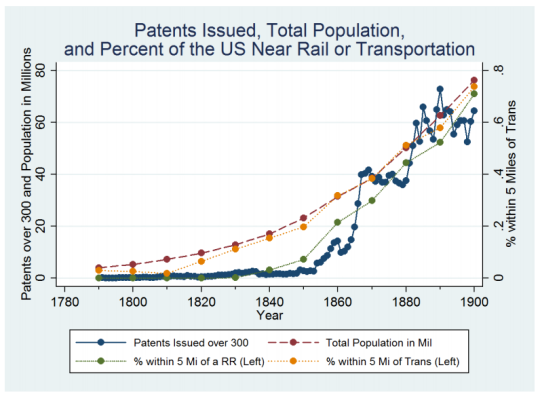
    This morning I came across the below graph in a Medium article by Eric Jaffe of Sidewalk Labs. It is taken from a research paper by Elisabeth Ruth Perlman called, Dense Enough To Be Brilliant: Patents, Urbanization, and Transportation in Nineteenth Century America.

    What this chart shows is patents issued – a proxy for innovation – in all U.S. counties between 1790 and 1900. This data is then compared against access to transport, such as rail. The discovery is a statistically significant relationship between innovation (patents issued) and rail (transport) access.

    The spike in the 1850s (shown above) is as a result of increased rail access.

    But Perlman takes it a step further and asks: what is causing this spike in innovation? Is it because inventors and creators started responding to the larger market now accessible to them because of rail connectivity? Or did transportation somehow improve productivity and the flow of information?

    To answer this question, she dug into the patents themselves (over 700,000 of them) to try and identify how ideas and key words were spreading. What she found is that rail access alone doesn’t encourage innovation. References to new technologies did not increase.

    What mattered was what happened locally. Transportation improvements promoted urbanization and density during her study period, and that’s what drove innovation. Connectivity created agglomeration economies at the local level.

    Obviously a lot has changed since the 19th century. But whether it’s rail connectivity or internet connectivity, have the rules really changed? Place still matters. What happens locally still matters. Perhaps even more. 

    This is an important lesson to consider as we build our cities and invest in transportation. Rail alone isn’t enough. What matters more is what we build around it. Are we dense enough to be brilliant?

  • Some thoughts on how we plan cities

    I came across this discussion on Twitter yesterday about how so many of the spaces we love in cities would not conform to today’s modern city planning practices:

    //platform.twitter.com/widgets.js

    This is a topic I’ve been thinking about lately and so it’s a timely discussion. In fact, I’ll often come across spaces in Toronto where I’ll think to myself: This is a really great space. But it’s highly unlikely that it could be built this way today. Naturally the question then becomes: What does this say about modern city planning?

    City planning is obviously important. But at the same time, we are almost certainly making mistakes and doing things that we will later regret. I say this not because I’m particularly critical of planning today, but because cities are enormously complex entities and it’s difficult to believe that we’ve figured everything out at this point.

    One thing I wonder about is if we aren’t over-planning and being too prescriptive about our cities. Some of you will probably argue the exact opposite. But hear me out.

    Vancouver is a city that has long been considered to be the gold standard in modern city planning. We talk about its podium + tower building typology. We talk about its “gentle density.” And we talk about its great public and recreational spaces, among many other things.

    But when I was there last month having dinner with a friend of mine, she said something to me that stood out. She said: “Brandon, Vancouver is a boring city. If it weren’t for my family being here, I would happily move to Toronto, New York, or somewhere else.”

    Cities are amazing places because they unleash human ingenuity. They allow new and unforeseen things to emerge. The challenge, I think, is to not sterilize that away when we plan and build. And all of us involved in the building of cities are probably guilty of doing that to an extent.