Daily insights for city builders, delivered every morning at 6 AM ET. I’m Brandon Donnelly — a Toronto-based real estate developer and founder of Globizen. I’ve been writing here since 2013.

Tag: city building

  • Two new chiefs

    image

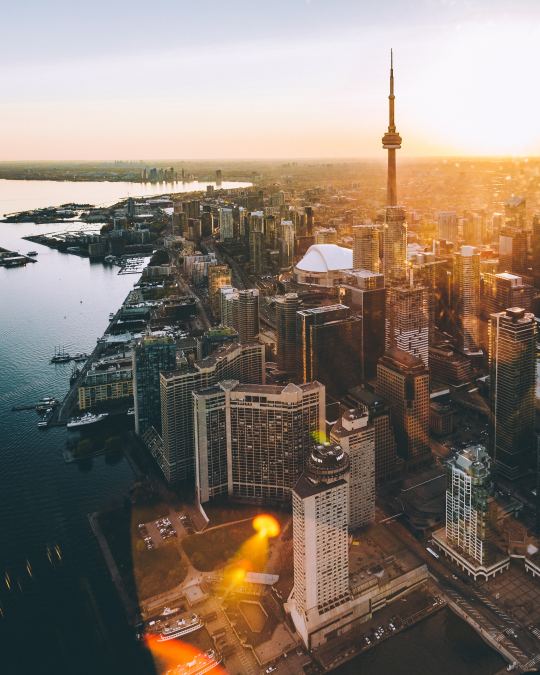
    There were some big announcements in the planning world this past week here in the Greater Toronto Area. Gregg Lintern (follow him on Twitter) was named the new chief planner of Toronto (he was previously the acting chief planner following Jennifer Keesmaat’s departure) and Andrew Whittemore (couldn’t find him on Twitter) was named the new chief planner of Mississauga.

    As I went through the articles announcing the above appointments, I couldn’t help but be reminded that this region is at an exciting and pivotal moment in its history. All of the talk is about improving urban mobility (i.e. becoming less dependent on cars); intensifying around transit stations (as well as gently intensifying neighborhoods); making downtown a better place for families; and so on.

    It can be easy to feel defeated in this big bad world of city making. Oftentimes things seem to get reduced to either urban vs. suburban rhetoric or, as if nothing else matters, this one simple question: “But, how tall is the building?” So its nice to know that those at the helm continue to see endless opportunity in this region. I know that I wouldn’t want to be doing what I’m doing anywhere else.

    Photo by mwangi gatheca on Unsplash

  • The 100 million city

    The Guardian recently published this reminder that the real population growth in the world today is happening in Asia and Africa. The article is called, “The 100 million city: is 21st century urbanisation out of control?” Much of the data is from this 2016 paper by Daniel Hoornweg and Kevin Pope, which projected the populations of the world’s biggest cities by 2100.

    The standout example is that of Lagos, Nigeria, which went from under 200,000 people in the 1960s to an estimated 20 million people today. Though, I would imagine that the ubiquity of informal settlements makes it difficult to come up with an accurate number.

    Still, it is one of the world’s top 10 largest cities and, by 2100, it may be the largest city in the world. The Guardian described the population as young, fertile, and increasingly urban. The median age in Nigeria is 18 and the fertility rate for the content is 4.4 births per woman.

    I am mentioning all of this today because I think it grants some perspective. This is an immense city building challenge, not only because of the unprecedented growth rate, but also because it remains largely poor. Lagos, a city, may add more than 2.2x the population of Canada, a country, during the balance of this century.

  • It Will Never Work

    On March 31, RIBA North (Royal Institute of British Architects North) in Liverpool will be opening the doors on a new exhibition that explores 25 years of award winning work by the developer and self-described “regenerator”, Urban Splash. I love the name of the exhibition. It’s called: “It Will Never Work.”

    Here is a short description of the exhibition:

    Urban Splash profess to have started without a plan, purposefully ignoring advice and routinely rejecting accepted development processes. At every step ‘it will never work’ has been a call to action rather than a discouragement.

    The company’s maverick presence on the development landscape of the North has changed the way we live, work and play in our cities, and their continued success as ‘established innovators’ is helping to shape urban futures.

    If you aren’t familiar with the work of Urban Splash, I would encourage you to check them out. When I was first starting out in development and scouring the world for developers that actually cared about design and cities, these guys were on my shortlist.

    So I have been a longtime follower and I have developer friends here in Toronto who I know also admire their work. Sadly, I have no plans to be in Liverpool anytime soon. But maybe some of you do.

  • Hmm…architecture and basic income

    Albert Wenger recently published a post on his blog about architecture and basic income. Albert is a venture capitalist and is currently working on a book called World After Capital, which I have mentioned before on this blog. He is also an advocate of basic income as a solution to the growing inequality that the modern economy seems to be producing.

    In this latest post he wades into the world of architecture with two assertions that I would like to respond to today. The first is that with basic income the current trend of everyone piling up in large cities will end. We will decentralize in search of cheaper land on the outskirts of cities. And the second is that affordable housing could perhaps be produced with a more open source approach to architectural drawings and new construction.

    In terms of his first point, I’m not entirely clear why someone earning a basic income would suddenly decentralize. In the comments there is some discussion about how retirees, on a fixed income, often move outward in search of more affordable housing. I understand that phenomenon, but I am not convinced in this scenario. 

    There has been lots of talk about the demise of cities because of new technologies and other factors. But agglomeration economies have proved, again and again, to be a powerful centralizing force. Let’s also not forget about the environmental impacts of large scale decentralization, which would only be partially mitigated by the widespread adoption of electric vehicles. 

    Secondly, you can build a house without an architect. The issue isn’t that good bathroom details are hard to come by. Some of the bigger issues are likely the availability of land (decentralization, I guess, is supposed to solve this); construction costs (it’s a highly inefficient process that generates copious amounts of waste); and the immense regulatory burdens imposed on new construction (process, time, and costs).

    All of this stemmed from a visit that Albert did with a group of architecture students who are researching the relationship between architecture and basic income. I would be very curious to see what they produce.

    What are your thoughts?

    Photo by Mathyas Kurmann on Unsplash

  • Are we entering a new era of tech-driven city building?

    Emily Badger of the New York Times published an interesting piece yesterday talking about the tech industry’s current obsession with trying to fix cities. And there are certainly many problems to fix.

    Staying true to tech and engineering parlance, there’s lots of talk of optimization. How do you technologically optimize a city, for things such as affordable housing?

    There’s no doubt that many of you will sympathize with this statement: 

    To planners and architects, all of this sounds like the naïveté of newcomers who are mistaking political problems for engineering puzzles.”

    But naïveté is not always a bad thing and with all of the money sloshing around in this industry, there’s also no doubt that this is likely a new era of city building.

    The article ends by quoting JD Ross, the 27-year old co-founder of Opendoor – a startup that we have discussed many times before on this blog and is now valued at over $1 billion.

    It is him saying that he wants to figure out how to put $100 million into this space as soon as he can figure out the right target to optimize for. “It’s better than buying a Bugatti.”

    Of course Sidewalk Toronto – which is mentioned a few times throughout the article – is already a perfect example of tech infiltration.

    But I think Dan Doctoroff gets it right when he posits that the real naïveté will come from disrespecting urbanist traditions.

    Photo by David Alacaraz on Unsplash

  • Become a Sidewalk Toronto Fellow

    Sidewalk Toronto is currently looking for “12 smart, creative, and caring people who are interested in the future of Toronto’s waterfront and how we [Sidewalk Toronto] can responsibly incorporate technology to improve urban life.”

    Each Fellow will complete a 2-day orientation session in Toronto; 6 days in Amsterdam and Copenhagen; 5 days in New York City and Boston; 3 days in Vancouver; and then do a final 2-day working session back in Toronto before presenting their takeaways.

    This feels like a response to the criticism that Sidewalk Toronto wasn’t doing enough to listen to the community and that it simply wanted to build a tech-infused neighborhood that could serve us more ads – but it’s cool nonetheless. 

    If you’re between 19-24 years old and you live in Toronto, you can apply here. It sounds like a fun opportunity for young city builders. I know that I certainly would have been all over it when I was in that age bracket.

  • Good morning Hong Kong

    image

    It’s about 6:30 am on new year’s eve day and I’ve been awake since around 4:00 am because of jet lag. I initially resisted, but now I am up and starting my day. 

    The coffee shop downstairs doesn’t open for another hour so this is coming to you live from my surprisingly spacious hotel room. (I’ve been in far smaller both here in Hong Kong and in New York.) There’s a wide array of teas available in this room, but sadly no coffee. I could go for a coffee right now.

    I took the express train in from the airport last night, which is what I did the last time I was in Hong Kong over a decade ago. It takes just over 20 minutes and it is a great way to get into Central. It immediately signals to you that this city thinks and cares about efficiency.

    The experience of landing and getting into a city is an important, but often neglected, consideration. For many people this is their first impression of a place and so it only makes sense to pay attention to it. 

    Think of it like fine dining. Most nice restaurants will greet you at the front, take your coat, and show you to your table. Few expect you to come in the backdoor and wander bewildered through the kitchen. But that’s what some cities ask you to do after you land.

    Come to think of it, I left Toronto aboard our own airport express train. That’s standard practice for me. And so I started and ended my 2-day journey on efficient rail. I’m good with that.

    Before signing off for today, I would like to apologize for missing yesterday’s post. I was in the air for over 19 hours without internet. I also didn’t have much to say. As always, you should expect me to show up here every day. But expect more travel-related posts over the next week to go along with my Instagram posts.

    I would also like to point you toward this tweet storm by Shawn Micallef (discovered during jet lag haze). Please do me a favor and check it out. It is a hilariously accurate satire about many of the city building challenges that cities face today, told by way of a miniature “Dickens Village.”

    https://platform.twitter.com/widgets.js

    And with that, I wish you all a happy new year. See you on the other side. Bring on 2018.

    Photo: Night shot of Gloucester Road from pedestrian overpass

  • The neighborhood of the future (part 2)

    I have been traveling since the weekend and so I am behind on my reading. One of the benefits of writing this blog every day is that I am forced to read as much as I can. I have to be a sponge.

    Right now, I am still reeling in excitement over the Sidewalk Toronto announcement and getting caught up on that reading. 

    This week Sidewalk Labs published the entire vision section of their RFP response to Waterfront Toronto. This is the response that won them the Quayside partnership. It’s 196 pages and can be downloaded here.

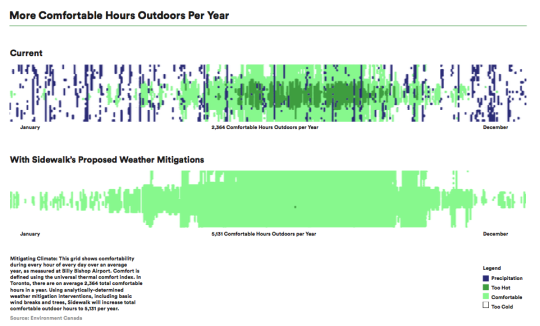
    I’m still making my way through the package, which I am obviously going to do, but I thought this was a great diagram:

    image

    As is stated in their RFP response, inclement weather affects pedestrians and cyclists more than drivers. Toronto’s most notable response has been our PATH system, which pulls both people and retail below grade, away from the elements.

    But Sidewalk’s research suggests that with the right wind, sun, and precipitation strategies, they may be able to 2x the number of comfortable outside hours per year here in Toronto. That’s what the above diagram shows.

    Of course, there is so much more in their RFP response. But I need more time to digest it all. I’ll be sure to report back to all of you once I have done that. If you don’t feel like going through all 196 pages yourself, you can watch this 4 minute YouTube video instead.

  • Network effects for autonomous vehicles

    In my recent post about why I write about tech on this city building blog, I made a pithy comment about autonomous vehicles and why it is “largely a software challenge.” 

    The argument I was trying to make was that the hardware, similar to smartphones today, will likely become a commodity. More of the value will end up flowing to the firms that control the software.

    Benedict Evans has an excellent deep dive into this topic on his blog. The post is called: Winner-takes all effects in autonomous cars.

    Here’s an excerpt about hardware:

    To begin with, it seems pretty clear that the hardware and sensors for autonomy – and, probably, for electric – will be commodities. There is plenty of science and engineering in these (and a lot more work to do), just as there is in, say, LCD screens, but there is no reason why you have to use one rather than another just because everyone else is. There are strong manufacturing scale effects, but no network effect. [My link, not his.]

    And here’s his conclusion:

    So, the network effects – the winner-takes-all effects – are in data: in driving data and in maps.

    That said, it is still early days for autonomous vehicles. Who knows if these network effects will end up being highly defensible or weak. There are still lots of assumptions and questions at this stage.

    From a city building perspective, one of the major concerns with autonomous vehicles is that they could tempt us back to car-centric city planning. That would be a shame.

    Photo by Zachary Staines on Unsplash

  • Why I write about tech on my city building blog

    I had a friend ask me this week about how I decide what to write on this blog. His comment was that I tend to write about a variety of different topics. He wondered: Isn’t it better to focus on one particular niche?

    The simple answer is that I write about what interests me. And secondary to that is any concern around what will get the most clicks. In fact, I try not to fall into the trap of worrying about the latter. Sometimes it can be paralyzing to fixate on what will appeal most to the tens of thousands of people who read this blog on a regular basis.

    The reality is that my interests are much broader than, say, just design and real estate; though these two topics are clearly central. 

    I learned a long time ago while studying architecture and art history that what we make as a society is generally a product of the cultural milieu at the time. In other words, the built environment doesn’t happen in a vacuum. It is the physical manifestation of what we believe to be true at a particular moment.

    Today, it’s pretty hard to ignore the importance of tech. Think of some of the most valuable companies in the world right now: Apple, Google, Amazon, Facebook, and so on. Now, technology has always shaped our cities, but what makes this moment different is the decisive shift toward software.

    It’s arguably no longer about who can build the best mousetrap. It’s about who can build the best software layer on top of that mousetrap.

    In 2011, venture capitalist Marc Andreessen (previously the co-founder of Netscape) published a widely shared essay called, “Why Software Is Eating the World.” And over the past 6 years he has been proven to be very right.

    The 3 main points he aimed to make with that essay are as follows:

    1. Every product or service that can become software will become software.
    2. Every company will have to become a software company.
    3. The winning companies will be the best software companies.

    Depending on your industry, this may sound ludicrous to you. Certainly in 2011 it probably seemed that way. 

    But a perfect example of this phenomenon is the iPhone. The phone itself is manufactured in China, albeit where a lot of great hardware innovation is taking place. 

    But at this point, phones have become fairly commoditized. The profits that Apple makes from the iPhone disproportionately come from the software layer and the app ecosystem it has developed.

    You could make a similar argument with Tesla. Autonomous navigation – which most of us can agree will have a profound impact on cities – is largely a software challenge. 

    And so if you believe that autonomous vehicles will be a fundamental part of the future of mobility, then it’s not that hard to believe in point number three: the winning car company will also have to be the best car software company.

    Some industries have been less touched by tech and software – real estate being one of them. But if Andreessen is right and it’s not a question of if, but a question of when, then it behooves all of us to think about the potential impacts.

    I love how Andreessen ends this podcast discussion with Barry Ritholtz of Bloomberg and so I’m going to repeat it here to close out this post. He says: “There are no bad ideas. There are only early ideas.” 

    And that’s why I write about tech on my city building blog.

    Photo by Michal Pechardo on Unsplash