Daily insights for city builders, delivered every morning at 6 AM ET. I’m Brandon Donnelly — a Toronto-based real estate developer and founder of Globizen. I’ve been writing here since 2013.

Tag: city building

  • What use could driverless cars serve beyond just transport?

    image

    Here’s further evidence that technology is starting to infiltrate into many other industries, including architecture. London-based architect and designer Pernilla Ohrstedt is currently working on an exhibition for Dezeen and MINI Frontiers that will architecturally visualize the 3D data that driverless cars collect in order to navigate around.

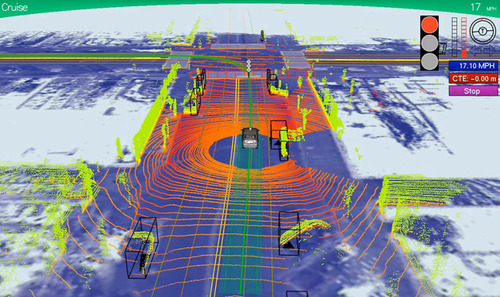
    I had never thought of this before, but as a byproduct of driverless cars, we’re about to start collecting detailed replicas of all of our cities – well beyond the static images we currently have with Google Streetview. In order to navigate by themselves, driverless cars are constantly scanning their surroundings to create a “point cloud” replica of the built environment. This point cloud basically tells the car where they are, where they should drive, and what obstacles might be around.

    It could look something like this:

    image

    Already there are firms like ScanLAB emerging to provide 3D scanning, publishing, and visualization services. But this is obviously just the tip of the iceberg. I can only imagine what innovation will emerge from the passive collection of all this data once driverless cars become commonplace in our cities.

    As one example, it could be a way for us to systematically measure the correlation between the qualities of a street and the vibrancy of its street life. Is there a perfect width? An ideal traffic volume? A right scale? All of this data could make city building more of a science (and perhaps less political).

    My hope though is that this data would be open and accessible to all, so that clever entrepreneurs could build on top of it.

    What are some of your ideas?

    Images: Dezeen
  • What to do when a car is blocking your bike lane

    I was out for a bike ride last night and, on my way home, I decided to try out the new dedicated bike lane on Adelaide Street. Usually I would take King Street, but it was completely full because of Caribana parties.

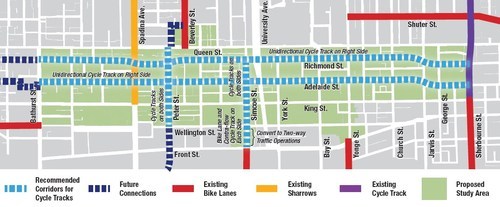
    For those of you who may not be aware, the city of Toronto is currently piloting two dedicated bike lanes on Adelaide Street and Richmond Street in the downtown core. Both streets are one-way and because the lanes were so big to begin with (highway-like spacing), I’m told that these new bike lanes didn’t even eat up a driving lane.

    Here’s a map of the pilot area:

    image

    Given that dedicated bike lanes are a scarce resource here in Toronto, I have to say that it was rather luxurious having my own piece of road. And because there’s no longer any fear of parked car doors swinging open, I was able to ride a lot faster than I normally would. 

    But as my friend Evgeny pointed out earlier this week, there’s a big difference between dedicated and grade separated bike lanes. Indeed, on my trip from Bathurst Street to Church Street last night, I encountered 3 cars parked in my lane.

    //platform.twitter.com/widgets.js

    So, I hope that these bike lanes become a permanent fixture downtown, but that the city makes them grade-separated. I’m sure people will use them. At the same time, I think they could also act as a catalyst for more pedestrian life along both of these streets.

    If you haven’t yet tried them out, I would encourage you to do so. The city is tracking usage and so you would be supporting the cause. And if there’s anybody parked in your lane, below is one way to handle it. It’s a video by Casey Neistat out of New York. If you can’t see it below, click here.

    [youtube https://www.youtube.com/watch?v=bzE-IMaegzQ?rel=0]

  • Who should zone cities?

    image

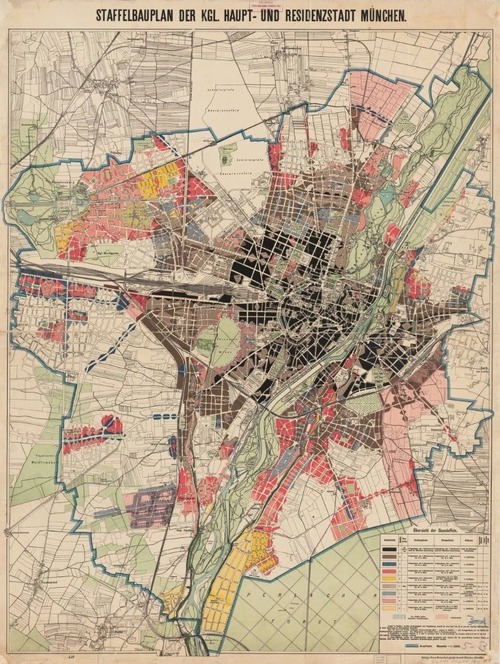
    The Old Urbanist has just published an informative post called “Where Zoning Went Wrong.” In it, he talks about some of the defining characterstics of American city planning and suggests that the delegation of planning authority from states to local municipalities is what has caused many of the challenges that city builders now face.

    But before we get into that discussion, let’s outline the characeristics. By way of Edward Bassett’s handbook on zoning (1922), the Old Urbanist outlines 9 characeristics of American planning. They are:

    1. Approval of the exclusion of commercial activity from residential zones
    2. Failure to disapprove of the exclusion of multifamily from residential zones
    3. Extreme deference to localities
    4. Insistence on a “comprehensive” plan
    5. Irreconcilable conflict between planning and zoning
    6. Heavy reliance on legal process as a substitute for sound policymaking
    7. Rejection of aesthetic concerns
    8. Concern with protecting the wealth of well-to-do homeowners
    9. Lack of comparative focus

    If you’re a planner or city geek, some of these items will be familiar to you – particularly the first one. Single-use zoning (or Euclidean zoning) is widely criticized as being hugely detrimental to cities, which is why mixed-use is so much in vogue right now. We’ve realized that there are tremendous benefits to creating neighborhoods and precincts where people can live, work, play, and learn. And not just do one of those things.

    But one point that somewhat surprised me was number 3: the deference to localities. The Old Urbanist’s argument is that around the world – from Germany to Japan – state and federal governments play a much more active role in city planning as compared to the US. And that the result is a different kind of city. As one example, most other countries don’t have single-family detached-only residential zones. The US does.

    Now, you could argue that it’s partially cultural. The US is all about individualism, whereas many other countries around the world have a greater sense of collectivism. But as the Old Urbanist suggests, it could also be because local municipalities are more prone to NIMBYism, which can ultimately lead to downzoning and more restrictive land use policies. Interesting.

    It was surprising to me though because I’m a firm believer in strong cities. They drive the economy and I generally believe that they deserve to look after themselves. And so could it really be that they need higher levels of government to keep advocacy groups and community opposition in check?

    Immediately I thought of the planning environment here in Toronto and Ontario. The Places to Grow Act, which is largely responsible for the intensification we’re seeing across the region, is provincial legislation. And “the Board” (OMB) that hears appeals arising from the municipal planning level is also provincial. So in other words, provincial decisions trump municipal ones.

    Many people believe that the OMB should be abolished. But probably an equal number of people believe that it’s critical to keeping development moving in Ontario. And, given our discussion here, it could be keeping our land use policies in check.

    But at the same time, I wonder if there isn’t a way to structure local planning such that it doesn’t succumb to individual interests and instead keeps the greater city building agenda at the forefront. If you have any thoughts on this, I’d love to hear from you in the comment section below.

    Image: Old Urbanist

  • The role of the private sector in city building

    image

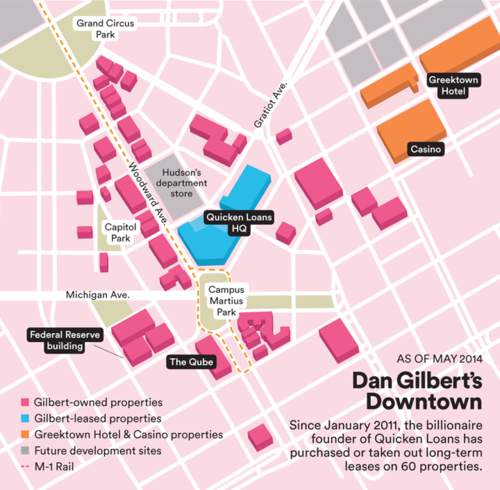
    The New York Times published an interesting and popular article last Friday called The Post-Post-Apocalyptic Detroit. It of course talks all about the efforts of billionaire Dan Gilbert, but it also talks about the initiatives of many small and local entrepreneurs who are doing their part to help revive the city – while at the same time making a profit.

    One thing that I found interesting about the article is the extent to which the private sector has taken over the responsibilities of the public sector. With only 35,000 of the city’s 88,000 streetlights actually working, the city simply doesn’t have the money to pay its bills. When I visited the city last fall, I was told that the city couldn’t even afford batteries for its parking meters. 

    So the private sector has stepped up. 

    In downtown, Dan Gilbert pays for his own security force to patrol the area 24 hours a day both on the ground and through 300 surveillance cameras. And in the Jefferson East corridor, John Stroh III – of the Stroh Brewery Company – is paying for 3,500 hours of private security in order to help transform the area into a walkable retail strip.

    It’s a model that relies on the funding and vision of rich people to catalyze change. And it strikes me as a quintessentially American way of going about it. In Canada, I’m not so sure it would be approached in quite the same way, which I think is both good and bad. I think in Canada there would be more government involvement.

    If the rich people are there and willing to step up (like they are right now in Detroit), then I would assume the capital would be deployed more efficiently and that change would happen more quickly. But if the rich people aren’t willing to step up, then nothing happens and the place declines.

    That might be an oversimplification, but I think there are differences.

    To end, I’m going to leave you with this Bloomberg video about Steve Case’s (former AOL founder) “Rise of the Rest” road trip to Detroit. If you can’t see the video below, click here.

    [youtube https://www.youtube.com/watch?v=_RUG0H4VThM?rel=0]

  • The importance of storytelling

    Last night I was out for drinks with a friend of mine who runs an architecture firm in the city called Reflect Architecture. We started talking about the importance of marketing and storytelling in city building and then got onto the topic of Danish architect Bjarke Ingels and his firm BIG.

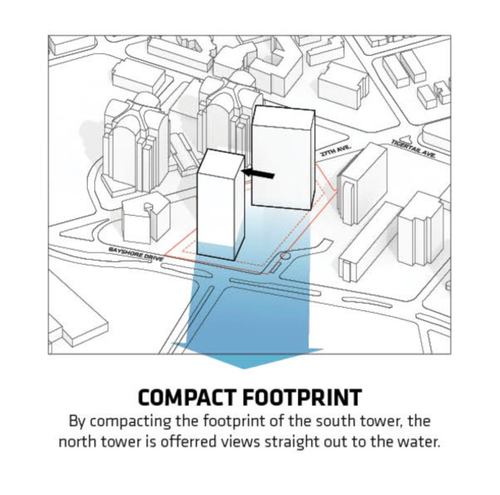
    At only 39, Bjarke Ingels has become a celebrity architect at a relatively young age. He’s working on projects all over the world from Vancouver to New York to Shenzhen. And he describes his work as a combination of “shrewd analysis, playful experimentation, social responsibility and humour.” But what has always interested me about BIG is their use of dead, simple, diagrams (see above for an example).

    A diagram is just a graphic way of communicating information. And lots of architects use them as a design tool. But what BIG does is use them to create a narrative around each and every project. If you look at their website you’ll see that every project is presented using a series of diagrams that outline the process used to arrive at the final design. You’ll never just see the final product. You always see the steps involved. Click here for an example from Vancouver.

    What’s powerful about this approach is that it demonstrates that there’s a logic behind every design outcome (even if sometimes it might be contrived or done after the fact). It’s not form for the sake of form; it’s form as a result of the uses in the building, the urban context, and so on. 

    But at the same time, I think it taps into a deeper psychological phenomenon: people love stories. In fact, research shows that when we’re told stories, our brains actually become more active. We pay closer attention.

    I mean, just think about how much people enjoy hearing about rags-to-riches stories. Nobody likes to talk about some rich person who was born rich. That’s not an exciting or interesting story. And it changes how we perceive that person. We want to hear about that guy or girl who came over from a war torn country and built an empire from nothing. Now that’s a good story.

    What I’m getting at is that I think a big part of Bjarke’s success has come from his ability to masterfully storytell and market both himself and his projects. Architecture schools don’t usually teach you how to market and sell; they teach you how to design. But the reality is that you need to sell. And storytelling is a great way to do that.

    If you liked this post, I recommend you check out this TED talk by Bjarke Ingels and this short interview with marketer Gary Vaynerchuk where he talks about how he used storytelling to sell wine.

  • The death of planning expertise

    image

    Yesterday a friend of mine sent me this article written by a city planner talking about the death of planning expertise. The article talks specifically about the rise of “community participation” and how it has undermined the modern planning process. (I guess it’s not just architects who feel undermined.)

    …we have lost respect for “experts”—those who have knowledge and/or experience in a particular field—and have replaced it with a kind of “expertise egalitarianism” whereby everyone’s opinion is given equal weight. But it is not only that the layperson’s opinions are given equal weight, experts increasingly face outright hostility. Laypeople attack experts as being arrogant, elitist, and imposing, if not outright threatening, often because the expert insists he or she knows something the other does not. Even more ridiculous, rather than being viewed as helpful or even essential, expertise is viewed as harmful or even antithetical to community participation.

    But to be clear, the author is not arguing for technocratic rule. He simply believes that community input has reached a point where laypeople with only anecdotal evidence are given equal weight as planning experts, and that it’s miring the planning process and causing less than desirable outcomes.

    This topic is interesting to me for 2 reasons.

    First, it’s interesting because we’re basically talking about a form of decentralization, which, just so happens to be one of the macro trends being ushered in by technology and the internet. It used to be that we couldn’t decentralize. Communication costs were too high and the ability to share information in real time wasn’t possible.

    But today we can. So instead of, for example, only getting the news from one source (a newspaper, perhaps), we get it from millions of people on platforms like Twitter. We trust laypeople, just as much as we do “expert” reporters, to tell us and show us what’s happening in the world. Just yesterday I turned to Twitter to see what was happening with Toronto’s torrential rainfall (#TorontoStorm).

    And as a result of this trend, we’re seeing startups like Popularise that are, in some regards, trying to decentralize the planning process. The platform allows communities to decide what they want to see in their neighborhood and then share it. Think your neighborhood could use an organic grocery store? Great, you can spec that on Popularise.

    The second reason I find this topic interesting is because there’s a school of thought (let’s call it the “wisdom of crowds” school of thought, to name it after a book), which believes that in aggregation the opinions of many can actually be better than those of a few so-called experts.

    And in many ways I agree with this—though there are a number of prerequisites that need be met in order for this to hold true. For example, you can’t have groupthink taking place, which I think you could argue is what often happens with NIMBY movements.

    Nonetheless, there’s a shift taking place and it’s impacting not only the planning profession, but many others. In the end though, I don’t think it will make experts irrelevant. In fact, as industries continue to “open up” and as we harvest more and more data (that previously wasn’t available), I think we’ll all be surprised at how beneficial this ends up being. 

    Image: GSAPP

  • What the hell does gesamtkunstwerk mean?

    image

    I’m a big fan of Canadian developer Ian Gillespie and his firm Westbank. They are the developers behind projects like the Shangri-La Vancouver, the Shangri-La Toronto, the mixed-use Woodward’s complex, and the upcoming Vancouver House (shown above) designed by Danish architect Bjarke Ingels (who just so happens to be one of my favorite architects). I would easily count them as one of the preeminent city builders in the country today.

    In support of their commitment to city building (and as a way to offer the public a peek of Vancouver House), they recently staged an exhibition called Gesamtkunstwerk. I think this is great on so many levels. Not only was it probably a great sales tool, but it’s also introducing the public to a largely obscure and academic term, and showing off a deep commitment to design. Unless you studied art, architecture, or something like the philosophy of aesthetics, you probably haven’t come across this term before.

    Gesamtkunstwerk is a German word, which literally translates into a “total work of art.” It was introduced in the 19th century by an opera composer by the name of Richard Wagner, who felt that opera represented a total, or complete work of art. Later, the term was picked up by architects. Some interpreted it to mean that architects should be responsible for everything from the building itself to the furniture and everything else that goes inside of it. Everything was art.

    Westbank now wants to introduce the idea of gesamtkunstwerk into the real estate development business. They want to use it as a guiding philosophy for all of their projects. And what that means is that the building itself and its relationship to the greater city should be thought of as a “total work of art.” They seem to be reintroducing the term with an inherent city building tinge–one that I don’t think was ever there before. 

    What a great philosophy.

    Image: Westbank

  • How mobile apps are going to help us build better cities

    image

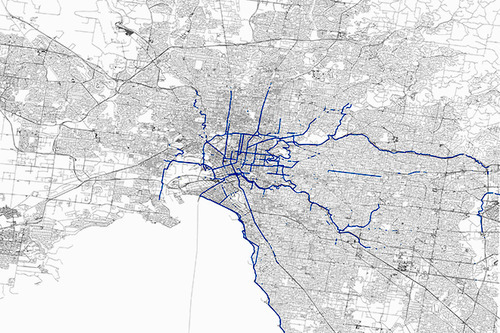
    Some of you might know that I’ve recently started using a mobile app called Strava. It’s a platform that allows you to track your runs and bike rides, as well as those of your friends. It tells you your speed, elevation changes, and it also maps your trips–among many other things. Here’s what my 50 km ‘Ride for Heart’ looks like from last Sunday.

    But what’s even more interesting is how cities are starting to use the data this app collects:

    For $20,000 a year, transportation planners and others can access Strava Metro, which provides an unprecedented look at where and how people are biking. It can tell them where they speed up and slow down, for example, or where they might stay in the street or ride on a crosswalk. That information can reveal where bike lanes or traffic calming measures would be useful, and if those already installed are effective.

    It’s a perfect example of how “tech” is infiltrating so many other sectors. Mobile technology and networks are generating huge amounts of data and it’s happening at an increasing rate. We’re gaining insights into the way people live that simply wasn’t possible before. Some of this information will inevitably be misused, but a lot of it will be used to improve the way we live our lives.

    I know that the City of Toronto also has its own proprietary cycling app and is hoping to collect similar sorts of data from it. But intuitively, I don’t think they’ll be able to compete with the scale of a platform like Strava. Though I certainly applaud the initiative.

    The information age is an exciting time.

    Image: Strava via Wired

  • Invitation to guest blog

    I have a secret to tell all of you.

    When I rebranded this blog a few months and renamed it Architect This City, it wasn’t just to come up with a more interesting name (initially this blog was just called “Cities”). That was partially the reason, but it was also so that I could begin to create a brand that was independent of myself.

    I wanted to do this because I’ve been thinking for a while that I would like to open this blog up to guest bloggers and eventually turn it into a much larger conversation around cities—one that me alone would never be able to provide.

    I also keep hearing from a lot of readers that—time permitting—they would “love to start their own blog” and create something similar to ATC. Well, here is your opportunity. If you’re passionate about cities and would like to write a post or two, shoot me an email. Let’s work together to architect awesome cities.

  • It’s all about people

    Yesterday evening I met up with a talented Toronto-based technology entrepreneur who also happens to be passionate about cities. The conversation meandered between both worlds, but we ended up coming back to one central theme: It’s all about people.

    Facebook didn’t just buy WhatsApp for the technology. It spent $19 billion on almost half a billion active users. That’s what matters. Do people want to occupy your (real or virtual) space? Have you created a community? Whether it’s an app, a building or a neighborhood, you’re useless without engaged participants.

    And to be perfectly honest with you, that’s my ultimate goal for this blog. Ideally I’d like each and every post to inspire conversation and debate (just like this one did on gentrification). A one-sided conversation can only take you so far. The real value happens within communities.