Daily insights for city builders, delivered every morning at 6 AM ET. I’m Brandon Donnelly — a Toronto-based real estate developer and founder of Globizen. I’ve been writing here since 2013.

Tag: cities

  • My #CityResolve

    Yesterday the Urban Land Institute here in Toronto launched a great social media initiative called #CityResolve. The idea is that instead of making a personal New Year’s resolution, that you instead make one that would benefit your city as a whole. This is great for me because I don’t really believe in New Year’s resolutions.

    You can read more about the initiative here, but all you have to do is tweet your resolve using #CityResolve. One person will be selected for a one-on-one meeting with Toronto’s Chief Planner, Jennifer Keesmaat – where you could then pitch your idea directly to the top 🙂

    For me though, I feel like I’ve already been acting on my resolve, which is this blog. When I started writing every day back in August 2013, I did so for myself, but also for a clear mission: To promote the building of beautiful, sustainable, and globally competitive cities. I don’t profess to have all the answers, but I hope to initiate the right kind of discussions.

    If that feels like a cop out though, here’s another:

    //platform.twitter.com/widgets.js

    What’s yours?

    Image: Flickr

  • Engaging with the sharing economy

    image

    Last week I wrote (yet another) post about Uber where I argued that leading cities will be the ones that engage with the sharing/rental economy (as opposed to try and outright ban it) and that Uber is going to continue to impact current beliefs around vehicle ownership.

    As to be expected, some people agreed with me and some people didn’t:

    //platform.twitter.com/widgets.js

    But I also discovered following that post that there are groups, and hopefully cities, who are working to adapt to the changing realities brought about by disruptive innovation.

    One of those groups is The National League of Cities – which I truthfully don’t know that much about. But they have created something called “The Sharing Economy Advisory Network.”

    “Cities across the country have been struggling to respond to the rapid emergence of the Sharing Economy,” said Clarence Anthony, National League of Cities executive director. He continued, “Cities are looking for ways to update and improve their current regulatory framework to ensure that regulations like safety and health protect residents, while at the same time supporting the growth of new businesses. It is imperative for cities to learn how this industry operates and discover ways to engage in order to support these new modes of doing business and to create jobs.”

    It sounds like the right kind of initiative and I wish them lots of success. I hope it’s effective and I hope that Toronto will look at how it too can properly manage these economic changes. This is going to take both the private and public sectors working together.

    Image: Sidecar

  • Do you know where you spend your time?

    Yesterday my friend Sachin Monga published a really great article on Medium called, 2014: My Year in Review. It was broken down into a few sections that included everything from his favorite blog posts of the year to all of the images he posted on Instagram. He called it “a stream of personal observations, data, and highlights for the year.”

    And it put my end of the year blog post to shame.

    One section that really stood out for me though was Places & Transit. Using a mobile app called Moves, Sachin extracted an incredible data set for where he physically spent his time and how he got around in 2014. I can’t believe I haven’t heard of this app yet – it’s totally in my wheelhouse. But I’m clearly late to the party. Facebook bought them in the first half of last year.

    The data set included how many hours he spent at home and at work. His top 3 most visited coffee shops. His top 5 most visited friends. How many nights he stayed in a hotel. His average daily commute time. And his total distance walked and cycled, among many other things. It was fascinating. I love data – especially when it was previously impossible or difficult to collect it.

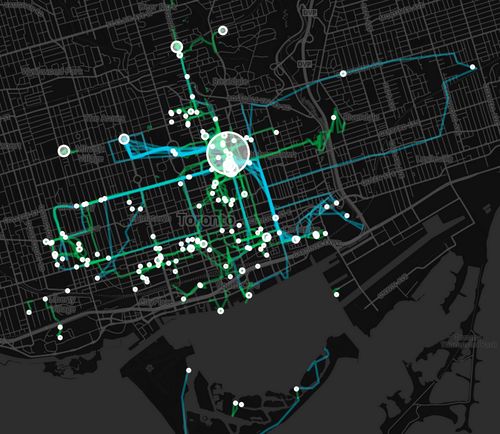
    He was also able to translate his data into a set of beautiful maps, showing where he spent his time and how he got around. Here is his personal map for Toronto. The larger the circle, the more often he was there. Blue lines are cycling. And green lines are walking.

    image

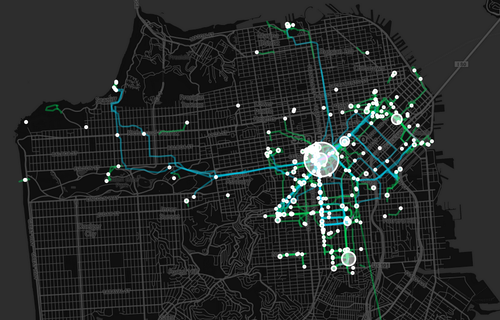
    And here’s San Francisco (where he now lives):

    image

    After reading his post, I immediately downloaded Moves. And I can’t wait to see how my personal map of Toronto will look like in a few weeks and months. Once I have enough data points, I’ll be sure to share it with you all here.

    In the interim, do you have any ideas for what this kind of data might be used for? I can certainly think of many. Let us know in the comment section below.

  • That’s a wrap

    Today is the last day of 2014.

    It felt like a frenetic year for me, and so I have to say that I’ve been really enjoying this holiday break. I needed the downtime. I needed the time to think and strategize. And I got all of that this holiday. (The only thing that would make this break even better would be some more snow on the mountains.)

    I’m super excited for the new year and what’s ahead, but before getting into that, I thought it would be worthwhile to look back at what happened in 2014.

    I was initially going to list out some of my thoughts, but then I figured that a better way would be to simply list out the most read Architect This City posts. That way it’s my (daily) thoughts, but curated according to what readers cared about most this past year.

    Click here for the top 15 most read Architect This City posts of 2014. I’ve listed them on a “topics” page that I plan to update every year.

    If you’re looking for some other 2014 themed reading material, I recommend also checking out the best #cityreads of 2014 by CityLab; the best articles of 2014 from ArchDaily; and what just happened? by venture capitalist Fred Wilson.

    Happy new year everyone! Thanks for reading. See you in 2015.

    Image: Family and friends lunch at Pizzeria Libretto, University

  • Life below zero and underground

    image

    A few years ago, I was touring a friend from the US around Toronto’s Financial District and the first thing he said to me was: “You have no retail.” And that’s certainly what it might look like at first glance.

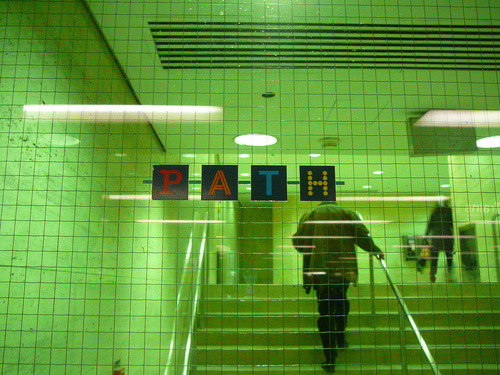
    But there’s actually lots of retail. It’s just all underground in an over 30 kilometer long network of walkways called the PATH.

    Initially conceived of as the antidote to Canadian winters, “underground cities” are a kind of uniquely Canadian form of urbanism. Toronto and Montreal have the largest ones in the world and they continue to grow. As new towers are built, new connections are added.

    But the downside to all of this is that it pulls street life down underground. And it can conceal a lot of the urban vibrancy that is actually take place. So maybe we need to come up with design solutions to better connect these subterranean cities back to street level and also not forget about the street.

    I’m thinking about this today because of a CBC documentary I watched this morning called Life Below Zero. It basically argues that – unlike other cold climate cities and countries – the vast majority of Canadians actually hate winter. And underground cities are our way of trying to ignore it.

    Well, I don’t hate winter. In fact, I love it because it signals snowboarding season for me. But I may be in the minority. What’s your position on winter?

    Image: Flickr

  • Where Uber operates and where it’s banned

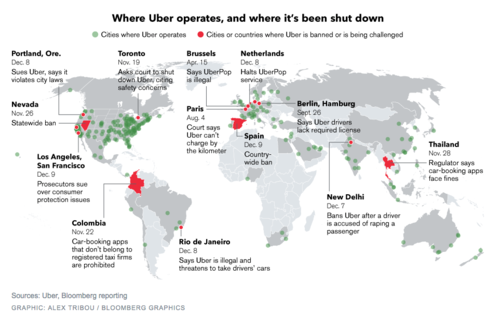
    Earlier this month, Bloomberg published this map showing where Uber operates and where it’s been banned (or is being challenged). You can click on the map for a larger version.

    image

    Uber operates in about 250 cities across the world. But it’s being challenged in a lot of them, including Portland, San Francisco, Los Angeles, Toronto, Rio de Janeiro, Paris, Berlin, as well as others.

    I don’t want to dismiss any of the safety concerns that have arisen lately, because those are very serious and they need to be addressed. Life safety is paramount. But I continue to believe that banning a service that many people clearly want to use isn’t the right solution.

    On top of that, I think it could lull many of the local taxi communities into a false sense of security about the future. Uber is moving incredibly quickly. UberX launched in Toronto in September of this year. And UberPOOL – their new carpool service – is likely next.

    With these releases, Uber is working towards a specific vision for the future: Their goal is to eliminate the need for private vehicle ownership. Should they be successful, this will not only impact taxis, but also car manufacturers and urban mobility in its entirety.

    So as difficult as it might seem right now, I think urban leaders would be better served trying to figure out how to harness these innovations. Cities have been trying for decades to get people out of their cars. Uber wants to do the same.

  • Spectrum of Hope

    image

    Built in the late 1940s, Regent Park was Canada’s first and largest social (public) housing project. Like many housing projects of this era, it was modeled after Le Corbusier’s “towers in a park” ideology, though in this case most of the buildings were only a few storeys tall and hardly towers. 

    It was built to correct what had become a major slum on the east side of downtown Toronto. And like many cities around the world, this type of built form was viewed as the solution. Urban slums were crowded and dirty. Density was bad. The solution was to spread people out and surround them with green space.

    But that didn’t work out so well. Regent Park failed. So today we are once again starting again. Phase by phase, the old is being demolished and the new is being built. However, unlike the last time, I think this time it’ll be for the better

    But there’s something very ironic about this story.

    Before Regent Park became Regent Park, it was called something else: Cabbagetown. That neighborhood of course still exists in Toronto – it’s adjacent to Regent Park – but it’s now a bit smaller having given up a portion of its land to the first iteration of Regent Park.

    Today, what remains of Cabbagetown has become an affluent and desirable inner city neighborhood with, allegedly, the largest stock of Victorian housing in North America. But of course it wasn’t always that way. At the time that Regent Park was being conceived, Cabbagetown was a slum. And that’s why we built Regent Park version 1.0. It was the solution for this entire section of the city.

    The photo at the top of this post is the southeast corner of Gerrard Street East and Parliament Street. The building at the corner is the Hotel Gerrard. The photo is from 1919, which means it’s a photo of Regent Park when it was still called Cabbagetown. It’s part of what we demolished to make way for the new. 

    In 2013, that same corner looked like this:

    image

    What’s ironic about all of this, is that the area we spared from grandiose urban renewal plans actually became the richest part. And where we intervened is where things got screwed up. So much so that we’re now starting entirely from scratch, again. All of this just makes wonder whether Cabbagetown, in its entirety, would have ultimately taken care of itself had we just left it alone. 

    But what’s in the past is in the past.

    So to end on a positive note, I’d like to share a short video that somebody recently shared with me called Spectrum of Hope. It was co-directed by 7 young artists from the neighborhood who are calling it “a piece for Regent Park, by Regent Park.”

    //player.vimeo.com/video/106104994?color=ff9933

    Spectrum of Hope from Twice Upon a Time – Toronto/NYC on Vimeo.

    I think it’s a great example of the positive momentum developing in this neighborhood. I hope you’ll give it a watch and then share it around. Click here if you can’t see the video above.

  • Is inclusionary zoning a good or bad thing for cities?

    Today is Christmas Eve. It’s the season of giving. So I thought it would be appropriate to talk about affordable housing.

    Yesterday, Mitchell Cohen – who is a real estate developer and the president of The Daniels Corporation – wrote an opinion piece in the Toronto Star talking about just that. It was called: A perfect storm for action on affordable housing.

    Here’s a snippet that summarizes the things he believes we should be doing:

    Municipalities across Ontario also have significant tools at their disposal to make a difference. To date, these tools have not been co-ordinated to achieve maximum bang for the buck. Property taxes can and should be waived not only for affordable rental homes but for affordable ownership homes as well. Additionally, cities can and should waive all development levies and other municipal fees for affordable rental and ownership housing.

    Combined, these two measures provide municipalities with powerful leverage to implement inclusionary zoning — the most important tool in the affordable housing tool box. Inclusionary zoning on a city-wide basis creates a level playing field, an opportunity for a constructive partnership between municipalities and private sector developers to create both affordable ownership and rental homes within every new building approved for construction.

    For those of you who might be unfamiliar with inclusionary zoning, it’s essentially a zoning requirement to build a certain number of affordable units in any new construction project. It originated – as far as I know – in the US, but has been fairly controversial since the outset.

    So today I thought we could have a discussion on the merits of inclusionary zoning. Do you think it’s a good or bad thing for cities? Is it really the most effective way to deliver affordable housing at scale? Leave your thoughts in the comment section below 🙂

    I don’t have a strong view on inclusionary zoning, but I do believe that affordable housing and a mix of incomes is critical to cities and neighborhoods.

    I do, however, wonder if it’s one of those things that seems to make a lot of sense, but actually has a bunch of negative externalities associated with it. Maybe the answer is to just prototype the idea and then iterate on it.

    What do you think?

  • My identity crisis

    If you’re a regular reader of Architect This City, there are many things that you might know about me

    You might know that I was initially trained as an architect, but that I immediately transitioned into real estate development after grad school (where I studied both architecture and real estate).

    After becoming a real estate developer, you might know that I completed an MBA with a focus on innovation and entrepreneurship (which happened by default as a result of the electives I ended up being interested in).

    And finally, you might know, given the content of this blog and my startup history, that I have a significant interest in technology. More specifically though, you might know that my interest is in figuring out how technology will continue to infiltrate and impact “non-tech” industries such as real estate.

    But what you might not know is how I even ended up in architecture and real estate in the first place. Unlike a lot of people who seem to have grown up wanting to be an architect – perhaps because they had a relative who was one – I didn’t decide to study architecture until a bit later on.

    Growing up my primary interests were: art and computers.

    During high school, my art teachers used to tell my parents that I was going to be an artist. And my computer teachers used to tell my parents that I was going to be a computer geek – or maybe they said computer scientist.

    Maybe it had to do with timing and the emergence of the commercial internet in the 1990s, but computers sort of won out during that point in my life. I spent a lot of time building them from scratch, playing with software, and asking my mom not to pick up the phone because I was literally dialed-in to the internet.

    So when it came time to enrol in university, I fairly effortlessly decided on computer science. It just seemed to make sense. But after about a year I realized that it wasn’t for me. I didn’t love programming like my classmates did and the thought of doing it for a living scared me.

    At the same time, I felt like I needed to feed the artist in me. I wanted something both artistic and technical. So I decided to drop out of computer science and give architecture a try. It just seemed like the perfect marriage of my interests.

    I immediately fell in love with architecture. And I spent the next 7 years studying it across 2 degrees.

    But during that time, two things hit me. First, I came to the realization that real estate developers are the ones who really have the most say in terms of how our cities are built. And second, that technology was having a massive impact on business and life.

    This told me that design alone wasn’t going to be enough. I also needed to engross myself in real estate, finance, business, and technology. So that’s what I set out to do. And I really enjoyed it. On the technology side, it felt like I was coming full circle in a way.

    But today, I feel a bit like a 3 legged stool. There’s the design leg. The real estate/business leg. And the technology leg. And oftentimes I feel like life would be a lot simpler if I could just balance on one of those legs – instead of trying to stand on all three. But that’s simply not me.

    These are my passions and I need all of them to stand-up.

  • Being exemplary

    image

    Yesterday morning I had coffee with a good friend of mine and fellow city geek. We don’t connect nearly as often as I’d like, but when we do we always have great conversations about cities and about Toronto.

    One of the things he asked me was whether I was still loving Toronto. And I responded by saying absolutely. We then both agreed that there are a lot of exciting things happening in the city right now. 

    But I qualified this statement by saying that I wish we were bolder. I wish we took more chances. Because while it’s great that we’re doing things like building more bike lanes and intensifying our growth centers, lots of other cities are doing those things as well.

    To be a leading city, you have to be prepared to do things that other cities think are wrong or won’t work and that are truly remarkable. Whether you’re city, company, or an individual, following trends is never enough.

    Take for example the dramatic anti-pollution measures that were recently announced by Paris mayor Anne Hidalgo:

    By 2020, no diesel fuel at all will be burnt within Paris. Regular cars will be banned outright from its more polluted roads, which will be open solely to electric and hybrid vehicles. Meanwhile, the city’s most central districts (the first four arrondissements) will be barred to all but residents’ vehicles, deliveries, and emergency services, transforming Paris’ Right Bank core into a semi-pedestrian zone. As a counterbalance, the number of cycle lanes will be doubled by 2020, while the city will fund an extended electric bikeshare scheme to encourage more people to get on two wheels. “I want us to be exemplary” Mayor Hidalgo has declared. 

    That’s how you win hearts: by being exemplary.

    As always though, I’m incredibly optimistic about the future. Toronto has a new leader at its helm and I know that there are a lot of passionate people in this city who care deeply about its future. I am certainly one of them.

    Image: Not my actual coffee (via Flickr)