Daily insights for city builders, delivered every morning at 6 AM ET. I’m Brandon Donnelly — a Toronto-based real estate developer and founder of Globizen. I’ve been writing here since 2013.

Tag: cities

  • Screw Toronto

    Hamilton, Ontario is on the rise. It’s no secret. 

    In fact, Toronto Life just ran a piece called The New Hamiltonians, where it profiled ex-Torontonians who have made the move west for more affordable housing and a higher quality of life.

    What stands out for me about the article is how there’s already growing resentment toward both developers and the local business owners who are helping to revitalize the city. Here is an excerpt:

    As builders encroach on Hamilton’s old neighbourhoods, a simmering resentment is building toward the upstart businesses that make rundown areas attractive to developers in the first place. Dave Kuruc, who owns Mixed Media, says that last year, the front door of his and neighbouring shops got slapped with a sticker that read “FUCK YOUR BOUTIQUE. DEFEND HAMILTON.” Last June, a bus tour for ­developers—branded “Try Hamilton!”—was interrupted by masked activists spraying sour milk out of water pistols and wielding signs that read “Developers + Investors = Predators.”

    So it’s not just developers. It’s also those damn boutiques. But the City of Hamilton eliminated development charges and put in place many other incentives for a reason. It wants to see more new construction. 

    Some people clearly aren’t happy about that.

  • The roots of the tree

    Yesterday morning I attended a CTBUH (Council on Tall Buildings and Urban Habitat) breakfast event called The Story of Marketing Tall Buildings.

    It consisted of a talk by William Murray, who is Group Director of the UK-based creative agency Wordsearch, and then a panel discussion with some of Toronto’s leading developers. (David Wex of Urban Capital was one of the panelists. Many of you will probably remember him from this BARED post.)

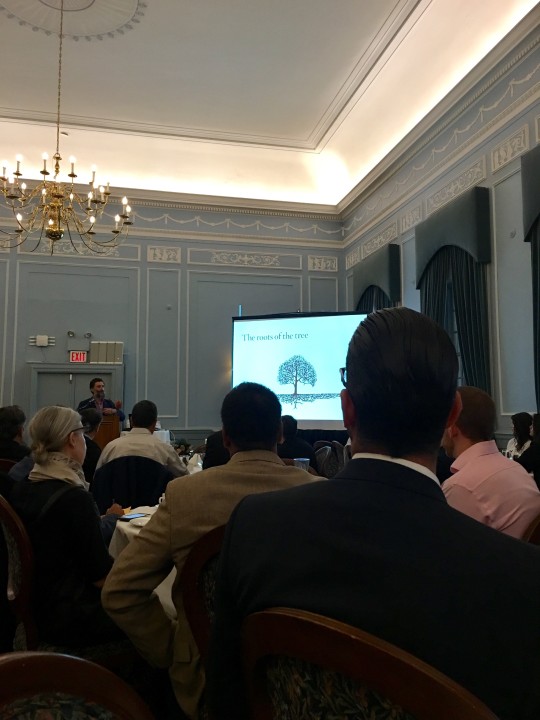
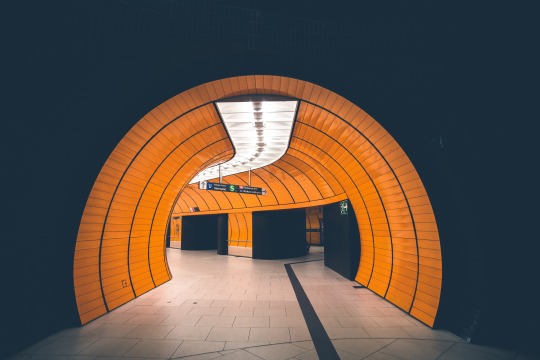
    Shown above is one of William’s slides. The title is: The roots of the tree. And I thought it was a great metaphor for what tall buildings, well really all buildings, should aspire to do.

    The tendency is to think of buildings as objects. Here, look at how beautiful this thing is. That’s obviously important, but what about its roots? What about the way in which it interfaces with its context and hopefully gives back? Is it a catalyst for positive change?

    I thought it was a good slide.

  • The U.S. cities that gained the most workers over the last 12 months

    One of the great things about social media is that it gives us access to data that previously didn’t exist or was difficult to collect.

    Take, for example, LinkedIn’s monthly report on employment trends called the Workforce Report. They look at which industries are hiring, where people are moving for jobs, and so on. Click here for the June 2017 edition. 

    Note that architecture/engineering hiring appears to be up nationally, which is usually a positive leading indicator.

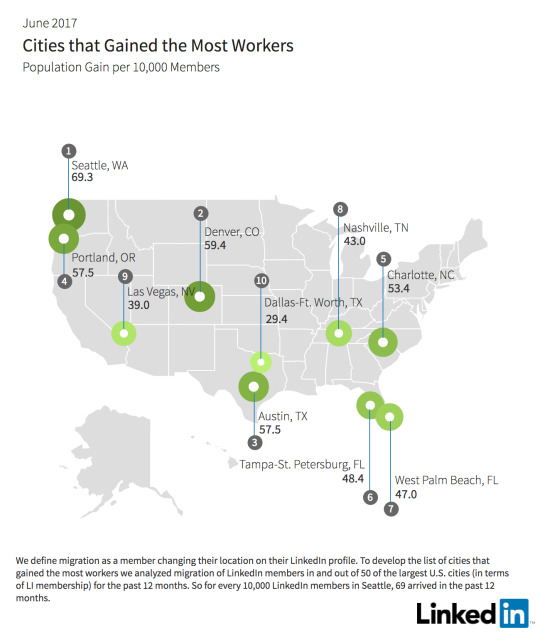
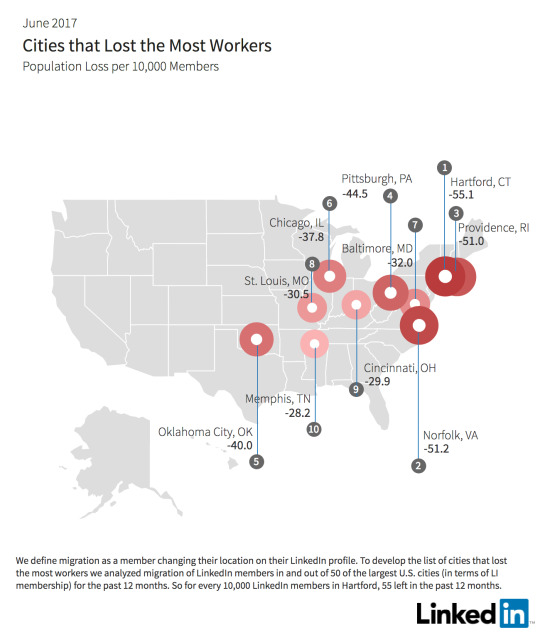
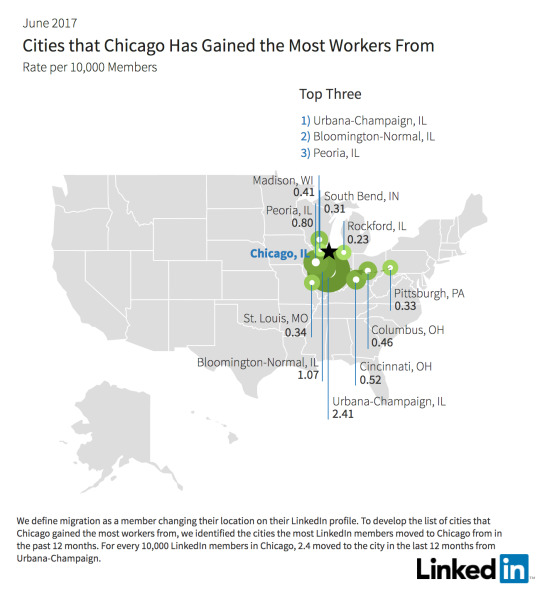
    I’ll leave you all to go through the report, but I did want to pull out a few of their maps and one of their takeaways. Below are maps of the cities that lost the most workers and gained the most workers over the last 12 months.

    The established trend of people moving from colder northern cities to warmer amenity-rich cities seem to play out here.

    That said, one of their “key insights” is that fewer workers today are moving to the San Francisco Bay Area. Since February 2017, there has been a 17% decline in the net number of workers.

    They blame housing affordability (ahem, lack of supply). People are simply turning to other great cities like Seattle, Portland, Denver, and Austin. They’re growing and cheaper.

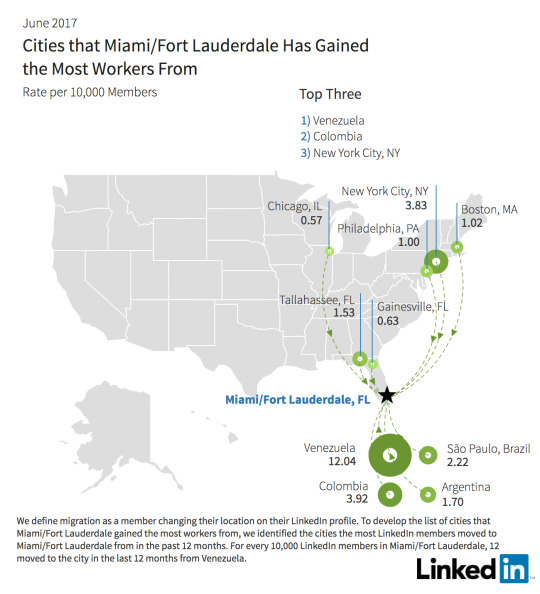
    One of the other cool things about the report is that you can drill down into individual cities to see where people are moving from. I looked up Miami and Chicago just to do a quick comparison. 

    Not surprisingly, Miami is seeing a significant contingent from South America. What’s interesting about this random comparison is how international Miami is and how regional Chicago is in terms of their draws.

    I would love to see similar data for Canada. This is valuable stuff.

  • Lessons in transit success

    image

    Dylan Reid of Spacing was recently at the International Transport Forum in Leipzig, Germany and has been publishing some interesting posts related to transit. Here is one about what makes transit systems succeed and fail.

    I really like the point that we too often think about transit projects as culminating with a big opening, while overlooking the importance of operations. It’s a bit like focusing on the wedding ceremony and forgetting that the ceremony is only really there to (hopefully) mark the beginning of a lifelong union.

    One of the reasons why this is important is because, as Reid points out, “fares need to provide a strong and consistent proportion of the agency’s funding.” So you need bums in seats, which means you need to build the right transit in the right locations. In other words, a new subway line through a low density suburb will probably result in an abysmal farebox recovery ratio.

    At the same time:

    “…fares will rarely cover all of an agency’s costs. Hong Kong’s Kam noted that, to be truly autonomous, an operator needs an additional dedicated, independent source of revenue. This cannot be based on additional transit-related non-fare revenue (e.g. advertising) – such revenue is helpful but never significant. It needs to be an external source. In Hong Kong, it is based on the agency’s extensive property ownership, but in other cities it could be a congestion charge, a dedicated sales or income tax, or other mechanism. Only with such a source can the agency have the independence to make its own choices for reinvestment and improvements.”

    This is one of the reasons why I am such a strong supporter of road pricing.

    Another point that Reid makes is that transit agencies should always have a consistent pipeline of new projects, rather than erratic periods of expansion. This makes a lot of sense given what it takes to ramp up for a large infrastructure project. But it’s obviously contingent on having sustainable funding sources.

    Click here if you’d like to read the rest of Dylan Reid’s post.

  • The gentrification cycle — is it a natural outcome?

    image

    Here is the stereotypical gentrification narrative: Rundown neighborhood sees artists (or other cool gentrification catalyst) move in. Area becomes cooler. Other people start to move in. Developers start building. People start to complain about gentrification.

    I don’t mean for this to be pejorative in any way. I was just trying to be matter-of-fact about it.

    When I wrote yesterday’s post about the Drake Commissary and the changes that have and will continue to happen in West Queen West and in the Junction Triangle, I knew in my mind that people would be thinking about gentrification. 

    Sterling Road is home to many artists and creatives. What will happen to them as the area develops? I am sympathetic to concerns around displacement. We’ve also seen what can happen to a neighborhood when even the big brands and big money decide to leave.

    But let’s dig into this narrative a bit more.

    Virtually every private sector building ever built was done with a profit motivation behind it. When that old abandoned brick-and-beam warehouse was built, it made economic sense to do so – or at least somebody believed that to be the case.

    In many/most cases this ends up being true. So when the building eventually loses its utility, it is because something has changed in the world. Manufacturing has gone offshore. People are now shopping online. The city has gone bankrupt. Tastes have changed and nobody wants to lease the building. The list goes on.

    When groups rediscover and repurpose these spaces they are effectively kick-starting a new lifecycle for the building. And under the right circumstances, a new cycle for the neighborhood. These are the artists, the nightclubs (see Berlin club scene), the brewers, and so on. This is a hugely valuable phenomenon for cities because fresh ideas often require cheap space.

    Of course, it may also be the case that the buildings aren’t empty. But new energy is still introduced to the neighborhood and things start to visibly change. 

    Where I think many people take issue is when these early adopters and pioneers ultimately get displaced because of their own actions. They are the ones who made the area desirable again and there’s a sense of ownership: “Hey, I was here first.” I get that. 

    But what we often forget is that what is old was once new. Some developer presumably made money building that abandoned building and many people came before us to lay claim to its spaces. 

    The fact of the matter is that neighborhoods and cities naturally go through cycles. They also ideally grow. That’s why I like when people talk about cities as organisms with metabolic rates. Change is a constant, even if it may not seem that way.

    Take, for instance, the suburban neighborhood where I grew up. We moved in when it was basically a new subdivision and so the area was filled with young families. I had lots of kids my own age to play with. It was loads of fun. The streets were always filled with kids.

    But we’ve all grown up and most of us have moved on, meaning the neighborhood no longer has the same character, despite the fact that the built form has basically remained the same. When I go back to the area, I no longer see any kids playing in the streets. But that’s not to say it won’t happen again.

    This is a subtle example of one of the ways in which neighborhoods go through cycles – this one being a demographic one. Though it can obviously happen through more dramatic changes, such as new development or the abandonment and repurposing of older buildings.

    So if we are to assume that these sorts of natural cycles and changes are happening all around us, here are my honest questions. 

    Can and should gentrification (i.e. investment) be stopped? If so, are we saying that neighborhood cycles should be halted at one precise point in time, perhaps after the early-adopters take root? Or should we try and temper the pace of change? Is it simply a case of too much of a good thing?

    Let me give another example.

    I live in a condo building that is less than 5 years old. It’s 33 storeys, which is one of the higher buildings in the area. I’m sure it was contentious when it was initially proposed.  

    There are people who live and own in my building who today have real concerns about the other developments proposed and underway in the neighborhood. They worry that it will negatively impact the neighborhood, traffic, their views, and so on. But how does that work?

    To me, this is selfish. Because this is not a case of investment with displacement. And less than 5 years ago – before my building was built and occupied – we were the outsiders. I was the guy that current residents were worried about. Who am I to now turn around and say that nobody else is welcome now that I’m here?

    I say all of this not because I profess to have all of the answers. But because these are hot button issues and I think we’d be well-served by more precision in our discussions. Cities change and grow. That’s what makes them incredible and resilient places. Stasis is not an option. 

    So how should we ride the growth and the cycles?

  • Rural America is the new inner city

    There’s an argument going around these days that rural America is the new inner city. That is, rural America has replaced inner cities as the geographies facing the greatest socioeconomic challenges. 

    In fact, it’s time for the stigma associated with the term “inner city” to disappear – if it hasn’t already. Blight no longer seems to be the concern. Instead, the concern is that our inner cities are becoming exclusive enclaves for the rich.

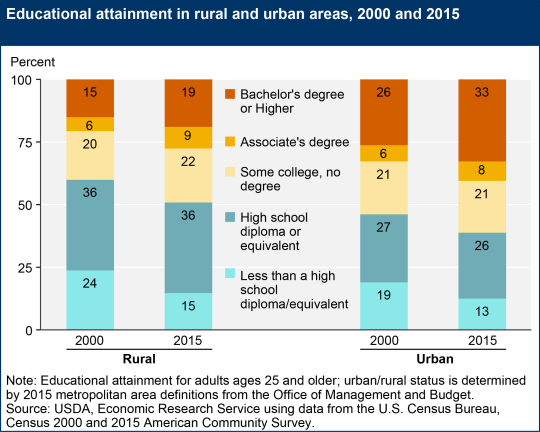
    The United States Department of Agriculture recently published data on educational attainment within rural areas. And since education is one of the biggest drivers of economic prosperity, it’s valuable to look at this data. 

    The first thing to note is that while educational attainment within rural areas is increasing, it still lags urban areas:

    image

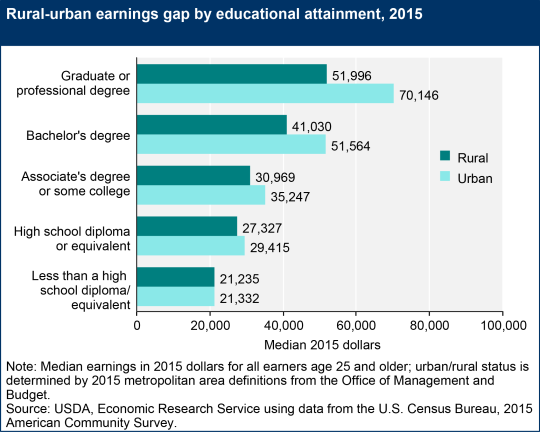
    The second thing to note is that even with the same level of higher education, the labor market will generally pay you more if you live in an urban area:

    image

    However, the spread between rural-urban increases as you move up the education ladder. With less than a school diploma, there isn’t much difference. But with a graduate or professional degree, there’s about a ~35% increase in earnings, on average, according to the above chart.

    So it should come as no surprise that many smart and educated people are choosing to live in urban areas. They should make more money.

    All charts from the U.S. Department of Agriculture.

  • So is this Brutalism or not?

    image

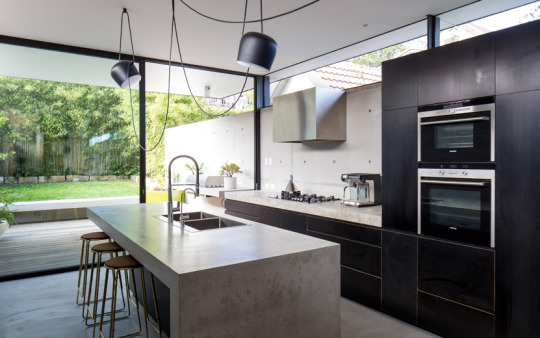
    The Spaces just featured 21 Scott Street in Bronte (a suburb of Sydney) as its property of the week. (The home is currently listed.)

    Designed by MCK Architects, the home is also called the “Upsilon House” and was supposedly designed for a fashion-industry couple.

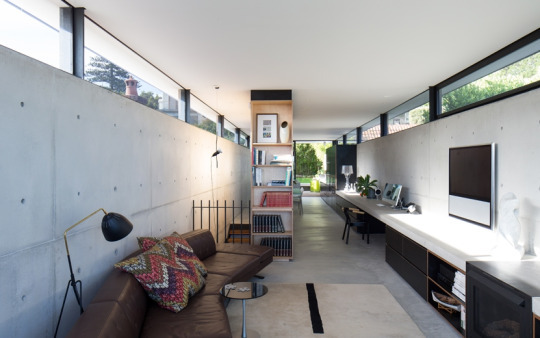
    Two things should immediately stand out to you about the house. One is how long and narrow the site and house are.

    Here is a lengthwise view of the main living floor:

    image

    Based on the plans provided by The Agency (listing agency), the house is about ~3.9m wide. That’s because of its tight site. However, the clerestory windows that run the length of the house would provide ample light.

    The other thing that should stand out is all of the exposed concrete. The Spaces calls it “soft brutalism.” I personally love it, but I recognize that it’s not for everyone.

    In any event, it reminded me of a recent blog post by Witold Rybczynski in which he responded to the New York Times calling Habitat in Montreal a brutalist building. His rebuttal: that’s a gross over-simplification. Brutalism, in its truest sense, is about dramatizing the “rough character of concrete.”

    But I particularly enjoyed how he ended the post:

    “There is another litmus test of Brutalism. Buildings like Habitat remain popular with their users. If people don’t hate it, it can’t be Brutalist.”

    If that’s the case, then 21 Scott is certainly not Brutalism in my book.

    Images via MCK Architects

  • Follow the sun and sprawl

    image

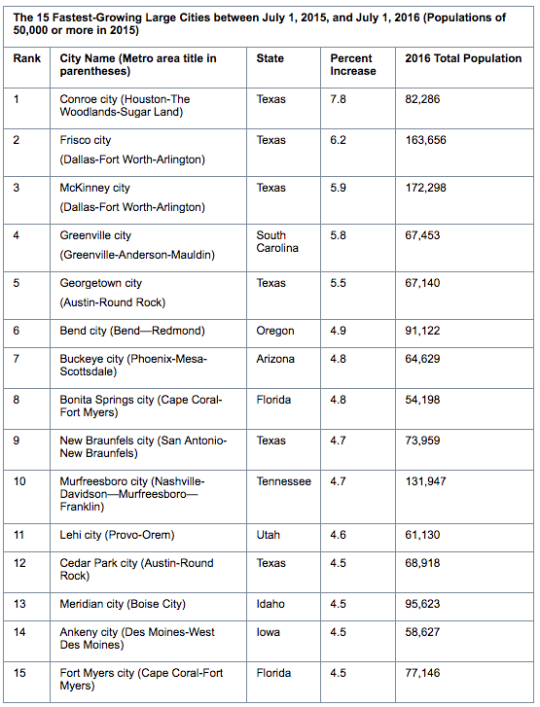
    The U.S. Census Bureau recently released it’s 2016 city and town population estimates. The press release can be found here.

    The headline isn’t a new one. Southern cities continue to grow quickly. This is not a new trend. Humans seem to like warm weather and the housing supply in southern cities tends to be more elastic. This keeps home prices relatively in check and allows the cities to more easily accommodate growth.

    From July 2015 to July 2016, 10 of the 15 fastest growing large U.S. cities were in the south (based on % growth). 4 of the top 5 were in Texas. 

    From 2010 to 2016, the population in large southern cities grew an average of 9.4%. Cities in the west clocked in at 7.3%. And cities in the northeast and midwest were at 1.8% and 3.0%, respectively.

    Two outliers near the top are Seattle and Denver. Since 2010, the population of these two cities grew 15.39% and 14.87%, respectively. I’m going to say it’s because of the skiing and snowboarding. Half-joking. For the top 25 large cities ranked by 2010-2016 growth rate, click here.

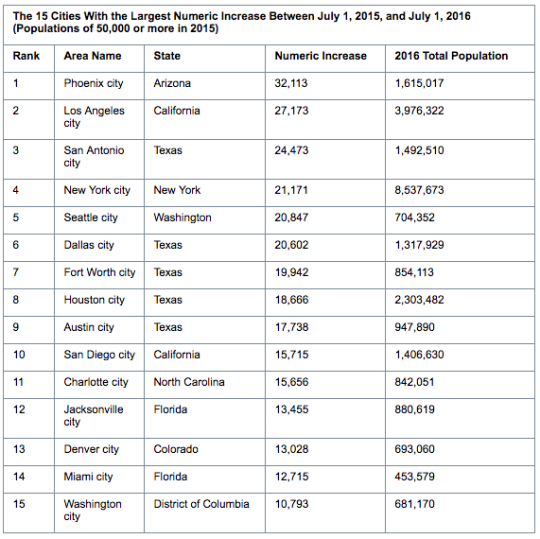
    In terms of absolute humans, Phoenix had the largest numeric increase between 2015 and 2016: 32,113 or about 88 people per day. After Phoenix it’s Los Angeles (27,173), San Antonio (24,473), New York (21,171), and Seattle (20,847). These are all city proper figures.

    It’s also worth noting which large cities aren’t growing. From 2015 to 2016, Chicago fell -0.32% and Detroit fell -0.52%. Philadelphia was only slightly positive at 0.19%. Going back to 2010, Chicago is still flat at 0.27% and Detroit is even more negative at -5.39%. Philadelphia is 2.5%.

    Follow the sun and the sprawl.

    The below charts are from the United States Census Bureau.

    imageimage

  • What’s happening in Melbourne?

    image

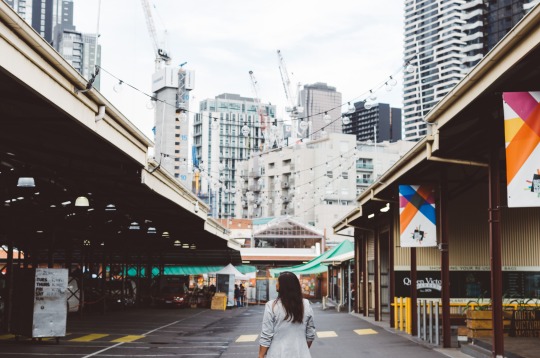
    I’ve never been to Australia, so take everything I’m about to say in this post for what it’s worth. I also don’t know much about Sydney and Melbourne, other than the fact that I’ve studied the latter’s laneways and the tremendous impact they’ve had on revitalizing the CBD.

    However, recently I’ve had a few close friends visit these cities for the first time and, since then, I have started noticing a trend. All of them come back and tell me the same thing, that they prefer Melbourne to Sydney. They say: “Yeah, Sydney is nice and beautiful and all, but it’s not all that exciting. Melbourne feels way more dynamic. Oh, and have you seen their laneways? You would love them.” That’s what they tell me.

    So that’s what I have in my head when I read that Melbourne is now the fastest growing city in Australia; that it’s one of the most liveable cities in the world; and that by as early as 2031 it could take Sydney’s place as the biggest city in the country. Below is a chart from The Australian. If you can’t see it, click here.

    //platform.twitter.com/widgets.js

    Some argue that this is happening because housing is cheaper in Melbourne (median dwelling price of ~$700,000 versus ~$1 million). And some argue it’s because the jobs are there and the city has become a cultural and sporting destination. Whatever the case may be, net migration is estimated to be somewhere around 100,000 people per year.

    My own view – and I’ve made this argument before on the blog – is that we shouldn’t underestimate the importance of cool shit when it comes to cities. People vote with their feet more than ever today. And for a growing segment of the population, cities are a consumer good.

    Indeed, in 2001, Edward Glaeser, Jed Kolko, and Albert Saiz penned a research paper called the Consumer city, where they argued precisely that. The premise was that historically we have tended to think of cities as being centers of production, but we should also be thinking about them as places of consumption.

    Here’s an excerpt:

    “But we believe that too little attention has been paid to the role of cities as centers of consumption. In the next century, as human beings continue to get richer, quality of life will become increasingly critical in determining the attractiveness of particular areas. After all, choosing a pleasant place to live is among the most natural ways to spend one’s money.”

    This is why those coffee shops and cool laneways matter. Some cities have unfair natural advantages. Los Angeles has weather. Vancouver has mountains. Montreal has poutine. But for the rest of us, the amenities typically form part of the built environment. They are a product of our choices.

  • 150 noteworthy Toronto buildings are opening up their doors this weekend

    This weekend – May 27 and 28, 2017 – is the 18th annual Doors Open Toronto. The event provides free and open access to “architecturally, historically, culturally and socially significant buildings across the city.” And in honor of Canada’s 150th birthday, 150 noteworthy spaces will be opening up their doors. The list of participating buildings can be found here.

    I’m going through the list right now and curating my weekend itinerary. I’ve never been inside the Don Jail or the R.C. Harris Water Treatment Plant, so I’d like to check those off. I plan to be on my bike and have my Fujifilm around my shoulder. If you’re also getting out this weekend, drop me a line on Twitter and let’s connect. What buildings are on your list?