Daily insights for city builders, delivered every morning at 6 AM ET. I’m Brandon Donnelly — a Toronto-based real estate developer and founder of Globizen. I’ve been writing here since 2013.

Tag: cities

  • World’s most diverse city-region

    For those of you who aren’t going to be in Toronto next week, you can stop reading now and check back tomorrow. For the rest of you, next week is The Future Cities Canada Summit, which will be taking place from November 7 – 9. Full schedule, here.

    Day 1 equals the Urban Land Institute Symposium 2018, which is all about Toronto urbanism. The tagline is: “Explore the urban frontiers of North America’s fastest growing, and the world’s most diverse city-region.” 

    A big part of day 1 will be bus tours around the city. And one of those tours is going to be focused on Toronto’s laneways. I am a speaker on that tour and the bus will be stopping at Junction House to talk about the laneway houses that we plan to release as part of the project.

    But there’s much more to this summit than just laneway housing.

  • China has a lot of people

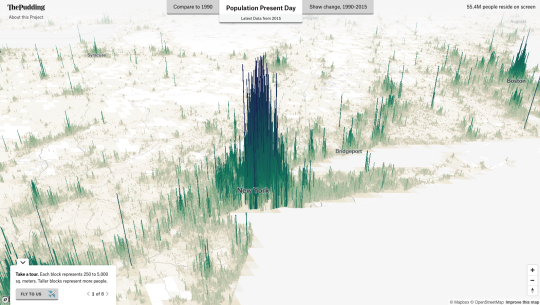
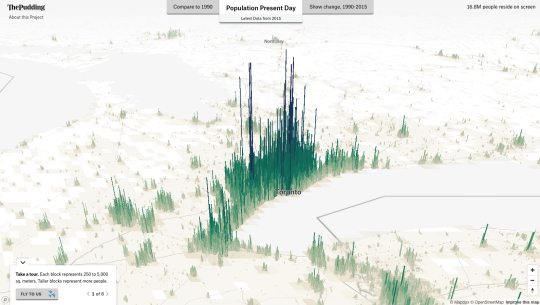
    Matt Daniels over at The Pudding recently visualized the world’s population in this spiky 3D map. You need to take a look. Better on desktop.

    The data is from 2015, but you can also compare it to and show the change from 1990.

    Here is the Greater Toronto and Hamilton region (16.8 million people reside in this screen grab):

    Here is the New York City region (55.4 million people reside in this screen grab):

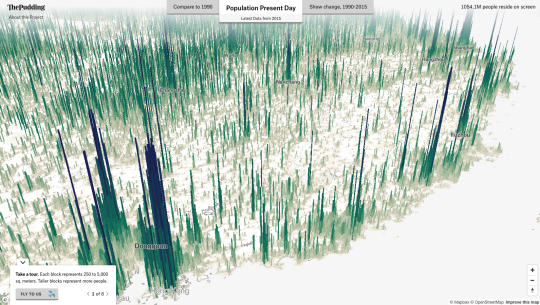
    And here is China (1.054 billion people reside in this screen grab):

    I tried to capture both Shanghai and Hong Kong in this image. Guangzhou, Hong Kong, and Shenzhen are currently in the mist of forming a 40 million-person megalopolis.

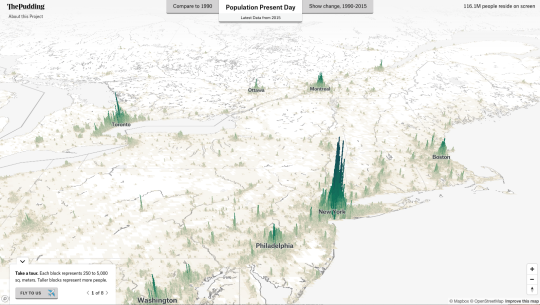
    If we pan back over to the northeastern United States and Central Canada – keeping the same scale as the above image from China – it looks like this:

    These last two images say a lot. 

  • Lyft announces subscription plan

    Last week, Lyft announced a new subscription plan

    It costs $299 every 30 days and you get 30 rides included (up to $15 each). So it represents a possible 1/3 discount on rides. If you go over the 30 rides per month or over $15 on any one ride, you simply pay the difference. Though as a subscriber, you get 5% off additional rides.

    Subscriptions are good for business. They can be like an annuity. And I suspect that with the above model, there will be unutilized rides every month that the company is just able to bank. You can’t carryover rides with this plan.

    But moreover, Lyft’s “All-Access Plan” is designed to help you ditch your car. Trade your car payment for a ride subscription plan. So if the numbers didn’t quite work for you before, maybe they do now. Depending on the situation, I can certainly see this plan being cost effective.

    But as ride hailing/sharing continues to nibble away at public transportation and personal vehicle ownership, what will this mean for cities?

  • BIG’s IQON in Quito

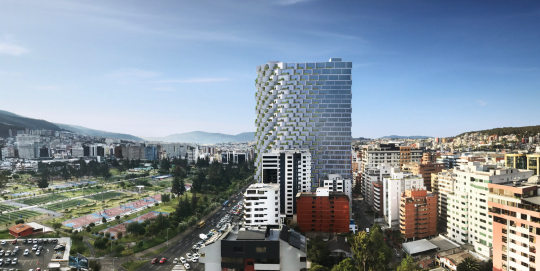
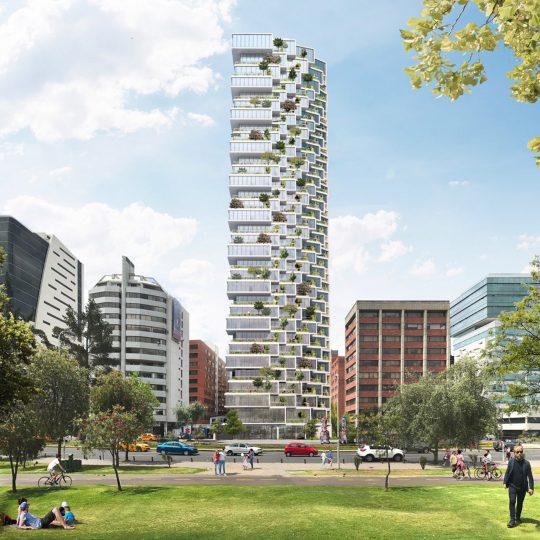
    BIG just announced its first project in South America. It is a 33 storey residential building in Quito, Ecuador. When completed, it will be the tallest building in the city. The developer is Uribe and Schwarzkopf

    Here are a couple of other images:

    The building is made up of “concrete boxes” that, when rotated, create terraces for the apartments. On one corner of the building the apartments are “through-units”, meaning they have two exposures. In this case, it is north and south.

    While different, we are starting to see some similarities across BIG’s projects, which isn’t meant as a criticism. I am thinking of Telus Sky, Vancouver House, and even KING Toronto. 

    They are, at least partially, about expressing the individual apartments and creating opportunities for outdoor spaces. This also serves to break down the overall scale of the building.

    What do you think of the project?

    Images: BIG

  • Cities are always changing. What’s happening in Miami Beach?

    image

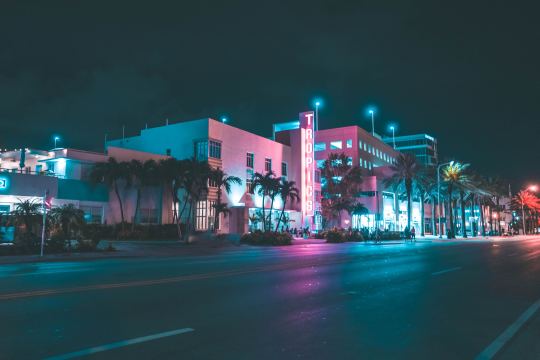
    The Miami Herald has a recent article up asking: Has Miami Beach lost its mojo? While the beach will always be an immense draw, there’s concern that entertainment dollars could now be starting to favor mainland neighborhoods like Wynwood, Brickell, and the Design District. 

    Here are some of the reasons why it is believed that may be happening:

    – Structural changes to the retail landscape

    – High rents have pushed out all of the interesting and distinctive tenants

    – City is too lenient when it comes to the nighttime economy; South Beach has become a circus

    – Investors and developers are worried about the Beach’s exposure to sea level rise

    – Strips like Ocean Drive and Lincoln Road have simply completed their urban cycle and are no longer attractive and novel

    – Overdevelopment of luxury housing (curiously, there’s a preservationist quoted in the article who appears to believe that restricting development to only mid-rise will result in less luxury housing)

    Many of these points are certainly not unique to Miami Beach. We know the retail landscape is changing. But as I was reading through the article, I was once again reminded that cities are always changing – even when we try and stop them from doing that.

    There are over 900 historic buildings in the Miami Art Deco District. Most are low-rise and mid-rise. This includes the iconic Ocean Drive. And yet the above article is all about the changes that the Beach has seen and experienced over the years.

    Oftentimes we only associate change with new buildings. But architectural preservation does not guarantee any sort of urban stasis. Cities are far more complex than that.

    Image: Photo by Ryan Spencer on Unsplash

  • Canadian minimalism

    I have one more note to share this week about Junction House and then I promise we’ll be back to regular scheduled programming. Below is a copy of the press release that went out yesterday afternoon. It includes a few more renderings for the project.

    ————————————

    October 11, 2018 (TORONTO) – After unveiling plans for a Studio Gang-designed tower at Yonge and St. Clair earlier in the summer, Slate Asset Management enters the fall market with a new mid-rise condo offering in the Junction. Designed by acclaimed Canadian architects, superkül, and emerging local interior design firm, Dialogue 38, Junction House further solidifies Slate’s approach of leading with design and city building when it comes to residential development.

    “We invest in designers because we believe in design innovation,” says Brandon Donnelly, VP of Development for Slate Asset Management. “For us, good design moves beyond aesthetics and actually solves problems and creates value for people. We want to empower each of our collaborators to come up with bold ideas, as well as think beyond our individual projects and consider the broader community.“

    Sited at 2720 Dundas St W, just as the road begins to bend, Junction House is conceived as a new gateway into one of Toronto’s most vibrant neighbourhoods. The ambitious design brief challenged superkül and Dialogue 38 to define a Canadian brand of minimalism that at the same time reflects the historic material palette and creative energy of the Junction community.

    “One of our inspirations was picking up on Scandinavian and Japanese approaches to minimalism, but through the lens of the Junction. What would that look like? How could we make sure our homegrown brand of minimalism is seen as approachable and in keeping with the neighbourhood?” says Donnelly. “We also really wanted to look at multi-storey suites – which eventually became The House Collection – and explore how we could replicate the single-family experience in a boutique mid-rise format,” he adds, citing the influx of families into the Junction and the need for new residential options in the city more broadly.

    “The building was designed from the inside out,” says Andre D’Elia, Principal at superkül. “We focused on the suites because, ultimately, that is where people are going to live and spend most of their time. We didn’t just design a nine-storey building, we designed 144 homes that occupy the same built form.”

    When it came to the exterior cladding, D’Elia says the focus was on reflecting the immediate context, while elaborating on the details. “We immediately thought of red brick, which is prevalent in the neighbourhood, and ended up cladding the first five storeys of the building with it. In order to add a sense of movement we staggered and angled the brick columns to play with light and shadow. We’re also introducing some old-world brick-coursing to add visual interest and mirror the local context.”

    Dialogue 38 was tapped for the interiors after Donnelly visited a café designed by the firm in the east end of downtown. “Their work is what motivated us to reach out, because it seemed to get the Canadian minimalist sensibility we were after,” explains Donnelly.

    Bennett Lo, Founder of Dialogue 38, says his approach was to focus on delivering design that would last. “We’re all influenced by trends and lifestyle, but our designs need to stand up against time. How do you produce something that is going to have immediate appeal and provide its own kind of interest, without feeling dated in a few years? The idea was to strip the design back and focus on the essentials, while at the same time incorporating aspects of the area. The suites and common areas will have smooth concrete ceilings and warm touches of wood throughout – and the lines are clean and open.”
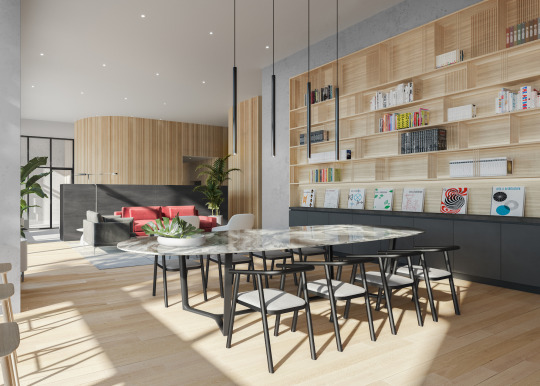
    The nine-storey building will also feature an expansive lobby that doubles as a co-working space, as well as a gym that draws on the warm materials of the suites and common areas. Lo says the design of the amenity space is optimized to encourage active use. “We focused on the amenities that we know people use, and spent our energy crafting spaces that embody the spirit of the building. The benefit of a boutique mid-rise is the opportunity to extend your living space in to the amenity spaces, and provide moments of social engagement in the building.”

    “We’re a short walk to the UP Express station at Bloor, which can take you downtown in less than 10 minutes. That proximity gives us an opportunity to have a dialogue between the Junction and the rest of the city. The proposed sign marks the Junction’s location and lets you know where you’re going, but also, where you should be,” says Donnelly.

    Junction House offers 1, 2, and 3-bedroom suites, as well as its signature House Collection, ranging from 500 sq. ft. to over 1,500 sq. ft. and starting from the $400s. To register visit: JunctionHouse.ca

    Press Contact:

    Vakis Boutsalis, kg&a

    Vakis@kga-inc.com / 416 537 0954 / 416 578 1741

    About Slate Asset Management L.P.

    Slate Asset Management L.P. is a leading real estate investment platform with over $6.0 billion in assets under management. Slate is a value-oriented manager and a significant sponsor of all of its private and publicly-traded investment vehicles, which are tailored to the unique goals and objectives of its investors. The firm’s careful and selective investment approach creates long-term value with an emphasis on capital preservation and outsized returns. Slate is supported by exceptional people, flexible capital and a proven ability to originate and execute on a wide range of compelling investment opportunities. Visit slateam.com to learn more.

  • A video and some art

    We made a video for our Junction House project. If you can’t see it embedded below, click here. You may have already seen some of the cut-downs on my socials, but this is the full version.

    [vimeo 293178524 w=640 h=300]

    The stickers under our projecting Junction House sign box irk me, but otherwise we’re all really happy with the way the video turned out. We wanted it to feel real and authentic.

    I am also thrilled to announce that we have partnered with a few local artists for this project. 

    The first is Leeay Aikawa. She is a multidisciplinary artist who moved to Toronto from Japan in 2003 and now works and resides in the Junction. We’re excited to have the opportunity to exhibit her work. You’ll find it in our “sales gallery” when that space opens.

    The next artist will remain a secret for now (though that’s a hint). Stay tuned to the blog and the socials.

  • Apple and the Milanese piazza

    image

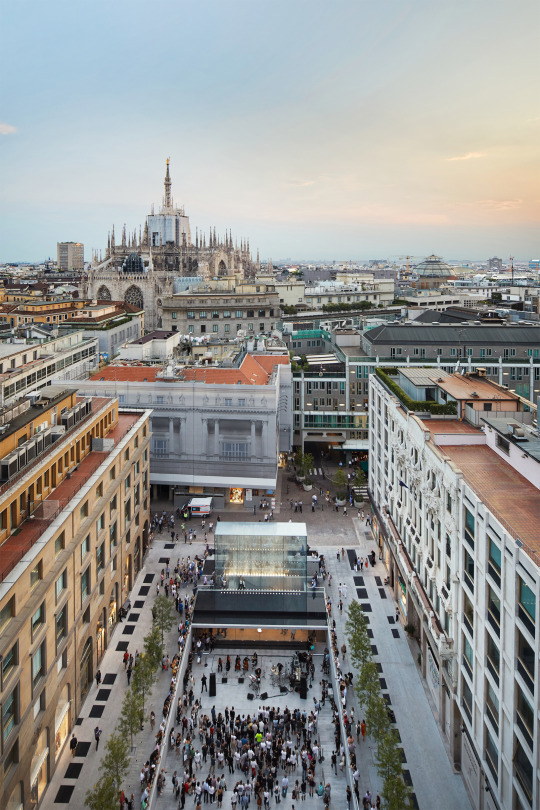
    This past July, the Apple Piazza Liberty opened in Milan. Above is a photo from the opening via Apple. There’s a band playing in the middle of the piazza.

    The store is central to Apple’s vision of transforming its retail locations into “town squares.” And in this case, the store is quite literally an Italian piazza.

    There’s a lot that is interesting about this store and this strategic move, as well as what this could signal about the future retail. (Curbed discusses that here.)

    The urbanists who read this blog will likely lament the privatization of public space. Because at the end of the day, it is a gray area. Can I hang out an Apple Town Square all day and just read a book?

    But at the same time, this is not necessarily a new idea. From the very beginning, the modern shopping mall was intended to be a new kind of town square. Or at least that’s how Victor Gruen saw it.

    However, what is perhaps new is this appropriation of public spaces for the purposes of what is arguably a new kind of retailing experience – one that almost feels paradoxical. 

    In the case of Apple Piazza Liberty, as well as in some of its other town squares, the actual retailing space is mostly hidden. Here it is underground. (How much to rent the basement?)

    And yet, Apple’s presence feels monumental and almost sublime. Glass box, waterfall, and subtle Apple logo sitting in the middle of a beautiful Milanese piazza.

    What a statement.

    Image: Apple

  • Unpacking the family condo

    John Lorinc has a piece in the Autumn 2018 issue of University of Toronto Magazine that is worth a read. It covers families in Toronto being priced out of the low-rise housing market and/or making the conscious decision to live in an apartment or condo.

    He raises an important question:

    The big question hovering over this generational transition is all about city-building, and whether increasingly dense metropolitan regions such as Toronto and Vancouver can figure out how to turn all those newly sprouted forests of highrises into true communities that are both affordable and appealing to the wide range of people who call these cities home.

    The reality seems to be that more people in this city – out of economic necessity and/or because of a lifestyle preference – are choosing to raise a family in multi-dwelling housing. I live in a condo and my neighbors are raising a child two doors down from me.

    I am sure that we will continue to see more of this and I am sure that we will get better at designing for families. We are trying to do our part with the 2-storey homes that we have incorporated into our Junction House project. 

    I would, however, like to respond to the underlying tone in the article that but for developers being stubbornly resistant to larger 3-bedroom apartments in this city, we would have a myriad of new condominiums filled with families.

    The reality is that there are market and structural forces (including cultural biases) that steer what gets built.

    There are affordability considerations. Larger condos cost more money than smaller condos. And that prices out many families, particularly if there are cheaper alternatives available in the form of low-rise housing. 

    The reason we appear to be at an inflection point today is because the cheaper alternatives are disappearing. (This of course returns us to the broader question of overall housing affordability.)

    There are also timing and financing considerations that likely create a supply-side bias. Most lenders require that a certain number of condo units be pre-sold before construction starts. 

    This means that, as a developer, you need people that can both afford what you’re selling and that are willing to buy three to five years out, and perhaps even longer. That can be difficult for many families.

    Lastly for this post, there’s the GST/HST New Housing Rebate in Ontario, which I have argued before on the blog could be incentivizing smaller suite sizes and could use a refresh for today’s home prices.

    All of this is not to say that we shouldn’t be designing for urban families and that we shouldn’t be focused on delivering more affordable housing to this and other cities. Those are two very important things.

    It is simply to say: there’s a lot going on here that needs to be unpacked. 

  • Our social connectedness

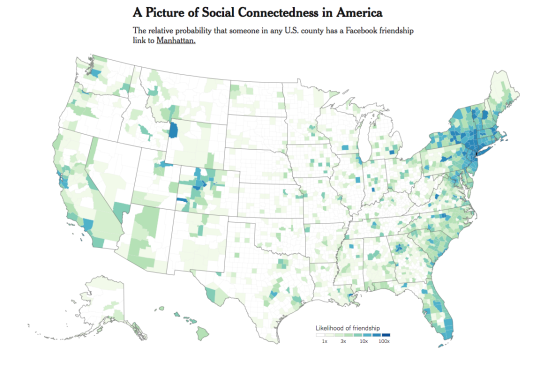
    Economists at Facebook, Harvard, Princeton and NYU recently analyzed anonymous Facebook data in order to study our social connectedness. The New York Times’ Upshot wrote about it here and it is a must read.

    There are a number of interesting takeaways from the study. One of them is that geography, distance, and political boundaries actually matter a great deal when it comes to our connectedness. 

    In other words, Americans are more like to be connected to someone nearby – within county or state boundaries – than they are to someone further away who may be infinitely more similar. This may seem somewhat intuitive.

    But at the same time, having a dispersed network also suggests certain things. Here’s the relationship that they discovered:

    These networks are important in part because of other patterns that are correlated with them. Counties with more dispersed networks — where a smaller share of Facebook friends are located nearby, or among the nearest 50 million people — are on average richer, more educated and have longer life expectancies. Places that are more closely connected to one another also have more migration, trade and patent citations between them.

    Counties that are more geographically isolated in the index are more likely to have lower labor force participation and economic mobility, and they have higher rates of teenage births. Some of the most economically distressed parts of the country appear to be the most disconnected: Among the 10 U.S. counties with the highest share of friends within 50 miles, six are in Kentucky.

    Again, it is worth checking out the full article. There’s also an interactive map to play around with.