Daily insights for city builders, delivered every morning at 6 AM ET. I’m Brandon Donnelly — a Toronto-based real estate developer and founder of Globizen. I’ve been writing here since 2013.

Tag: cities

  • The new studio geography

    If any of you have gone to architecture school (or know someone who went to architecture school), you’ll know that everything revolves around something called studio. Studio – that’s really all you need to say – is worth many multiples of your other classes and consumes an even greater multiple of your time. What time will you be in studio? How’s studio going? I was in studio really late last night. This is how the conversations go.

    So I was intrigued by Seth Godin’s post this morning comparing “working in a studio” to working in a factory. The latter, he says, relies on compliance: “More compliance leads to more profits. Do what you’re told, faster and cheaper, repeat.” And this was very much the narrative of the 20th century and was the model that empowered small-town America to thrive (see yesterday’s post).

    However, the studio is different. Here is how Godin defines it:

    The studio, on the other hand, is about initiative. Creativity, sure, but mostly the initiative to make a new thing, a better thing, a process that leads to better.

    It’s peer to peer. The hierarchy is mostly gone, because the tasks can be outsourced. So all that’s left is leadership.

    Initiative plus responsibility. Authority is far less important, as are the traditional measures of productivity.

    It is not difficult to tell the two apart, which is how Godin ends his post. But it is worth noting that the studio model also thrives in a different kind of geography, compared to the factory model. So not only is the studio itself a different place, it also wants to situate itself in a different kind of place. So in a way, what we are seeing today is the new studio geography.

  • Cities are labor markets

    Eduardo Porter recently published this piece in the New York Times on the “relentless economic decline” of small-town rural America. We often talk about rising income inequality, but the greater concern is the alarming rate of joblessness in many of these communities. Earning less than others is not as bad as earning nothing.

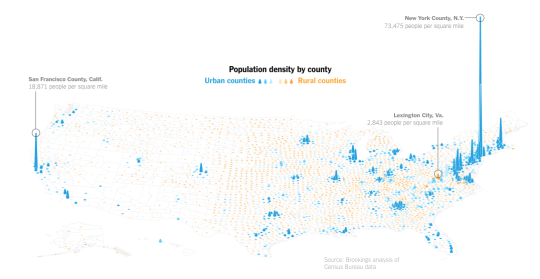
    I think the below map from the article, depicting population density by county, starts to show how uneven the economic landscape is across the US. Porter puts it this way: “This is the inescapable reality of agglomeration, one of the most powerful forces shaping the American economy over the last three decades.”

    image

    But, of course, we don’t really have a solution to this problem. Some are suggesting employment subsidies, such as the earned-income tax credit. While others are suggesting that we need to make it easier to build in the large blue spikes shown above. That way we’ll be able to more affordably accommodate the people who will ultimately need to move from rural to urban.

    While this latter suggestion may seem grim for small-town America, it is perhaps a reminder of what cities really are at their core: Cities are labor markets. They are the places where people come to get a job and make money.

  • Good vibrations

    image

    There are 614,387 bridges in the United States and 55,707 of them are thought to be structurally deficient according to the US Department of Transportation (2016). About 188 million people cross “a deficient bridge” every day in the US (also a 2016 figure).

    Inspections are often infrequent and only visual, and so MIT Senseable City Lab is currently on a mission to come up with a more scientific approach. They believe that there’s a solution in crowd-sourced data and that it’s possible to create a community-driven maintenance program.

    What they discovered through a recent study, called Good Vibrations, is that mobile phone sensors can actually pick up the natural vibrations and oscillations of a bridge. And, that a mobile sensor located within a traveling car is actually 120x more precise than fixed sensors located on the bridge.

    Part of the problem is that fixed sensors have poor spatial coverage. They are located in specific locations. Whereas mobile sensors give you data across the entire span of the bridge as someone crosses it. And if you know how a bridge normally vibrates, you can quickly tell when something is off. 

    Here’s a quick video overview of the study. And here’s what you should do if you want to get involved.

    Photo by Joseph Barrientos on Unsplash

  • Urbanizing the suburbs

    Commuter rail has typically functioned as a way to bring people from the suburbs into downtown for employment, and sometimes recreation. That has typically translated into good inbound service in the mornings, good outbound service in the evenings, and mediocre service the rest of the time. It has also historically meant lots of subsidized surface parking. Free parking was (and still is) often thought of as the key to putting bums in seats and increasing ridership.

    Here in the Toronto region, this service is provided by GO Transit, which, since 2009, has been owned by Metrolinx. But as one of the fastest growing regions in North America, this kind of service and thinking has become increasingly antiquated. That’s why Metrolinx and the Government of Ontario are working to profoundly change the economic geography of this region by both electrifying the lines and implementing 15 min, all-day two-way service. 

    This may seem like an incremental improvement, but it is not. It is a significant change that will transform the service from commuter rail to regional express rail. Of course, this now means that it is time to rethink the land use policies and built form that surround these key transit nodes. One of the places where this is happening today is at the Clarkson GO Station. The City of Mississauga is in the midst of a planning study that will ultimately guide future development around the station. 

    I think this one of the most important shifts taking place right now in this region and elsewhere. It is the maturation of our suburbs and it is going to result in more walkable and vibrant urban places across our cities. So if you have a few minutes, I would encourage you to complete this survey that the City of Mississauga recently put out. The results will help to guide their Clarkson Transit Station Area Study. 

    I also think think it is worth completing the survey even if you aren’t local to the area. How to urbanize the suburbs is a universal problem.

  • Embracing our cities

    This is a great TED talk by Edward Glaeser about why it is time to embrace our cities. If you can’t see it below, click here.

    [youtube https://www.youtube.com/watch?v=ILDwnzQNlGc&w=560&h=315]

    The talk was filmed in 2012 – right around the time that Triumph of the City was released – but the video was published at the beginning of this year.

    It is also a good add-on to yesterday’s post about transportation costs and cities. I love how passionate Glaeser gets about these topics.

  • A decentralizing or centralizing force?

    I was on two panel discussions over the last week and, as is the case with all real estate panels, the topic of parking invariably came up, as did the impact of autonomous vehicles.

    There seems to be a general consensus that the advent of driverless cars will result in less demand for parking. Every developer I know is trying to build as little parking as possible and is thinking about how – when the time comes – they might convert their parking into something more productive. I have yet to speak to anyone who is building excess parking in order to prepare for autonomy.

    Where there’s a split, however, is whether autonomous vehicles will represent a decentralizing or a centralizing force for our cities. Historically, new technologies have lowered transportation costs and encouraged decentralization. Before the advent of rail, the US population hugged the coasts, because it was cheaper to navigate across the Atlantic than it was to move inland.

    A similar phenomenon also played out with our streetcar suburbs and with our car-oriented suburbs. These new technologies made it possible for people to travel further distances in order to get to work and other places. So it is not at all surprising that many people today are inferring that autonomous vehicles will produce this same outcome.

    But there is a counterargument. 

    We know that the demand for transportation services is highly elastic. Uber and other ride sharing apps have demonstrated this to us. Lower fares translate into dramatic increases in demand. So the opposing argument is that as the cost per kilometer drops – autonomous electric vehicles are going to be much more cost effective to operate – we’re going to see boatloads of induced demand.

    This induced demand will then force us to look toward road pricing and other demand management tools in order to cope, which then begs the question: How much cheaper and more convenient will autonomous vehicles really be? 

    At the same time, it is important to acknowledge that autonomous vehicles should correct many of the inefficiencies currently caused by humans acting like humans. There is also the opportunity to operate these autonomous vehicles more like public transit than as personal vehicles. And that will have a profound impact on urban mobility.

    Still, it is not yet clear, at least for me, that autonomous vehicles will be the decentralizing force that many assume they will be.

  • City-states and superstar cities

    During the recent election here in Toronto, mayoral candidate Jennifer Keesmaat raised the idea of this city region, maybe, becoming its own province. It wasn’t the first time this idea has been floated, but it once again didn’t stick.

    Earlier this week, Richard Florida spoke at the Urban Land Institute’s Toronto symposium and he brought up a similar issue: Toronto is a ‘city state’ and needs to start acting like it. Here is an excerpt from a recent Star article about his talk:

    He also noted that in terms of total economic output, the GTA [Greater Toronto Area] — he included the Golden Horseshoe — is responsible for about “$700 billion” (U.S) in economic output.

    “Which means our … region is equivalent to that of Sweden. So we are a city state, a mega region.”

    He later added: “we are a powerful global city with lots of assets to build on,” he said.

    But he went on to say that despite all of these successes there’s a “sense that something is amiss, something is wrong.”

    I have long supported the notion that city regions need to see and think of themselves as one united and contiguous economic landscape. In our case, it is not about, for instance, Hamilton vs. Toronto. This is about our entire region vs. New York or Singapore (a city-state) or the Pearl River Delta megalopolis.

    The headlines coming out of Amazon’s recent announcement are clear: In Superstar Cities, the Rich Get Richer, and They Get Amazon. This is winner-take-all urbanism where you need to be a “superstar” in order to compete. 

  • Forever

    About a month ago, I said on the blog that we had partnered with two local artists for our Junction House project. The first was Leeay Aikawa and the second was a surprise. 

    Well the second one is no longer a surprise. It is Ben Johnston and he started work on his mural this evening. Here is a photo (courtesy of Shanique Small – thank you!):

    image

    It should be completed this week if you’d like to stop by 2720 Dundas Street West. I am planning to be there this Saturday to take some photos and generally just hang out in the Junction. 

    Stay tuned for more surprises. 

  • Tech and the North American office market

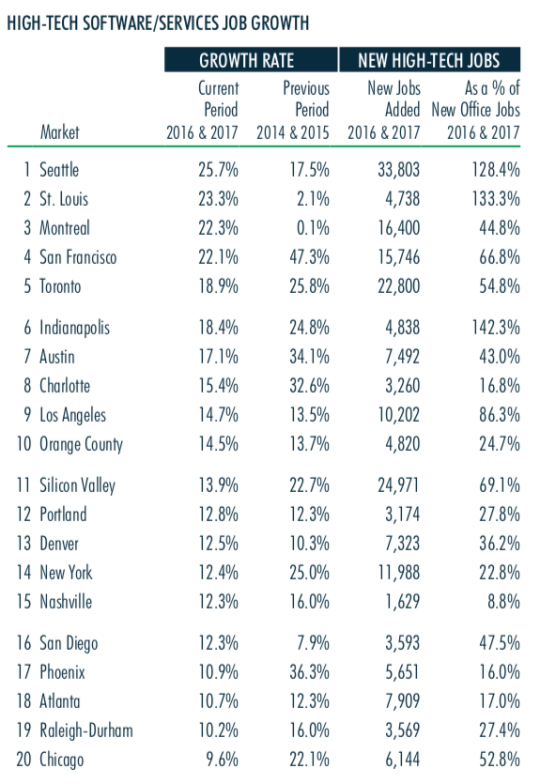
    CBRE recently published this report looking at the impact of the “high-tech software/services industry” on the North American office market. 

    Here are a few highlights:

    – Since 2010, tech has created ~1.1 million jobs in the US at an annual growth rate that is 3x the national average.

    – Seattle currently has the fastest tech job growth in North America. This is the first time in 7 years that San Francisco hasn’t been at the top of their list.

    – Silicon Valley, Toronto, New York, and Los Angeles all added more than 10,000 tech jobs from 2016 to 2017.

    – The biggest “momentum markets”, relying on 2016 and 2017 data, are Montreal, St. Louis, and Seattle.

    – Over the past two years (Q2-2016 to Q2-2018), Atlanta, Los Angeles, Orange County, Seattle, and Portland have all seen double-digit rent growth.

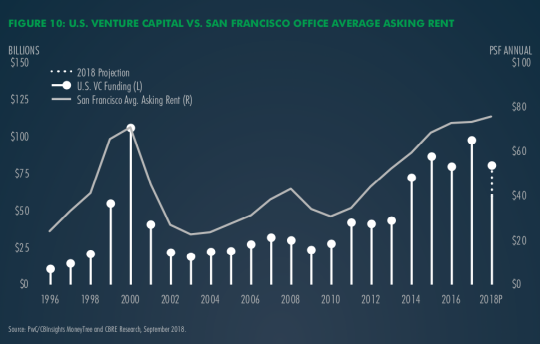
    One figure that also stood out for me was this one here showing the relationship between US venture capital investment and the average asking rent for office space in San Francisco.

    If you’d like to download the full report, click here. You’ll need to sign up for an account with CBRE, but it’s free to do that.

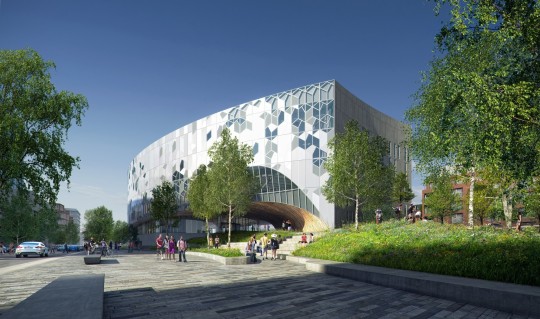
  • Project Profile: New Central Library, Calgary

    The City of Calgary opened up its New Central Library this past week on November 1st, 2018, after a five-year construction process. 

    Designed by Snøhetta (design architect) with Dialog (architect of record) and Entuitive (structural engineer), the building was previously named one of “the 12 most anticipated buildings of 2018″ and one that will surely serve as a landmark for the city.

    One of the most interesting things about this project, for me, is how it both gives back and integrates with the broader urban fabric. 

    It is both a library and public plaza, and it sits atop the city’s busiest LRT line. About 40% of the site area is taken up by tracks (and probably setback), which means that the structural system of the building was forced into 12m (~40 foot) clear spans (done in concrete). It is the first time in the city’s history that an active LRT line has ever been encased and built over.

    It is a magnificent building and reason enough to visit Calgary, if you aren’t already there. I am hoping to get out there and photograph this project sometime soon.

    Images: Snøhetta and Entuitive