Daily insights for city builders, delivered every morning at 6 AM ET. I’m Brandon Donnelly — a Toronto-based real estate developer and founder of Globizen. I’ve been writing here since 2013.

Tag: china

  • Visualizing the origins of MIT’s international students

    “Like the United States, and thanks to the United States, MIT gains tremendous strength by being a magnet for talent from around the world. Faculty, students, post-docs and staff from 134 other nations join us here because they love our mission, our values and our community.” -L.Rafael Reif, MIT President

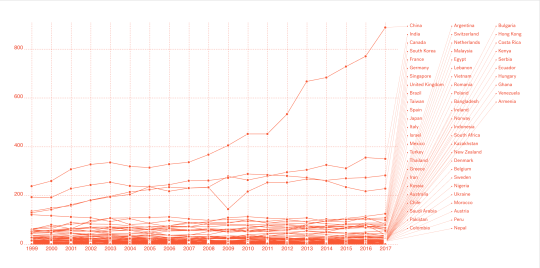
    The MIT Senseable City Lab recently analyzed nearly 20 years of ethnographic student data in order to visualize the origins of its international faculty, students, and researchers from 1999 to the present.

    The above chart may be a bit small (larger version here), but it shows all students (undergraduate, graduate, and visiting/others) by country. The top 5 countries are China, India, Canada, South Korea, and France.

    To give you some sense of the math, there are 3,808 international students at MIT as of 2017. 888 of them alone are from China – mostly at the graduate level (688 out of the 888). So China represents almost ¼ of MIT’s international student population.

    Another thing that stood out for me was the drop off in Canadians in 2009. You can see that “V” roughly in the middle of the chart. Canada went from 233 to 144 students. I wonder if this had something to do with the economic climate at the time. Not sure.

    Click here to see all of the visualizations. 

    Note that you can toggle by region and country, as well as by “Trump’s EO Countries.” That feature, as well as the quote at the beginning of this post, should give you an immediate appreciation for some of the motivations behind this exercise.

    Images: MIT Senseable City Lab

  • The Silicon Valley of hardware

    I generally dislike derivative city monikers – such as the title of this blog post. But I appreciate that it quickly gets the point across.

    Fusion recently published an interesting article talking about how Shenzhen, China is quickly rising as the hardware innovation capital of the world. Rather than simply serve as the place of production for companies such as Apple, the Chinese government would like to see it serve as a place of creation. In fact, some organizations are suggesting a terminology change from  “Made in China” to “Created in China.”

    A big part of the reason for all of this is that Silicon Valley long ago moved “up the stack.” It focused itself on software and internet services, because hardware wasn’t where the margins were. It wasn’t sexy. And so production got moved over to a low cost market. But now, with the rise of IoT, drones, and many other physical products, one could argue that Shenzhen has become highly relevant in the innovation ecosystem.

    It’s also important to think about how Shenzhen fits in to the larger Pearl River Delta region. Here is an excerpt from the Fusion article:

    “Shenzhen has the geographical footprint of Los Angeles, but a population three times its size at 12 million people. It’s part of the Pearl River Delta, which also includes Hong Kong, the global financial capital and port city; Macau, the world’s largest gambling city; Guangzhou, home to one of China’s major ports, trading centers, and factories; and Dongguan, a manufacturing hub. It’s as if the tech talents of Silicon Valley, the big banks of New York, the manufacturing plants of Detroit and Pittsburgh, the casinos of Las Vegas and the shipping ports of Long Beach were all in one small part of the US, and a two hour drive from one another.”

    If you’re interested in this topic – both hardware innovation and the rapidly growing city of Shenzhen – take an hour and watch this documentary from Wired. Embedded below.

    [youtube https://www.youtube.com/watch?v=SGJ5cZnoodY?rel=0&w=560&h=315]

  • America needs a new map

    image

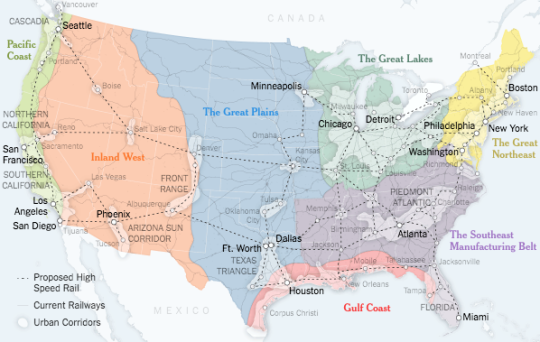
    Parag Khanna recently published an article in the New York Times calling for a new map for America

    Here’s why:

    “The problem is that while the economic reality goes one way, the 50-state model means that federal and state resources are concentrated in a state capital — often a small, isolated city itself — and allocated with little sense of the larger whole. Not only does this keep back our largest cities, but smaller American cities are increasingly cut off from the national agenda, destined to become low-cost immigrant and retirement colonies, or simply to be abandoned.”

    This is something that I’ve been writing about for awhile on this blog. As we continue to transition to an urban-based information economy, it strikes me that, here in North America, we’re going to need to refocus our governance structures around cities. We’re going to need to place our metropolitan regions at the fore if we want to continue competing with rising powers like China – which, by the way, seem to be adopting a megacity model.

    Here’s another snippet from the article:

    “While Detroit’s population has fallen below a million, the Detroit-Windsor region is the largest United States-Canada cross-border area, with nearly six million people (and one of the largest border populations in the world).

    Detroit’s destiny seems almost obvious if we are brave enough to build it: a midpoint of the Chicago-Toronto corridor in an emerging North American Union.”

    I’ve argued for this before and I continue to believe that it makes a lot of sense.

    Image: New York Times

  • Lo Mein Loophole

    Maria Godoy of NPR recently published an interesting piece called Lo Mein Loophole: How U.S. Immigration Law Fueled A Chinese Restaurant Boom.

    The article starts by talking about how rising anti-Chinese sentiment in the late 19th and early 20th century eventually lead to the U.S. passing new immigration laws. These laws explicitly restricted Chinese laborers from moving to the U.S. and even made it difficult for legal residents to return after a visit home to China.

    However, embedded in these laws was a small loophole:

    But, as MIT legal historian Heather Lee tells it, there was an important exception to these laws: Some Chinese business owners in the U.S. could get special merchant visas that allowed them to travel to China, and bring back employees. Only a few types of businesses qualified for this status. In 1915, a federal court added restaurants to that list. Voila! A restaurant boom was born.

    “The number of Chinese restaurants in the U.S. doubles from 1910 to 1920, and doubles again from 1920 to 1930,” says Lee, referring to research done by economist Susan Carter. In New York City alone, Lee found that the number of Chinese eateries quadrupled between 1910 and 1920.

    This is fascinating on so many levels. 

    For one, it’s always interesting when small loopholes have unintended consequences. It is doubtful that anyone could have predicted a Chinese restaurant boom.

    Secondly, despite the U.S. being a nation of immigrants, you see here a long history of trying to keep immigrants out. In the early 20th century, the fear was Chinese laborers who worked for low wages. Today, it’s Mexican laborers who work for low wages.

    Finally, it’s amazing to look back at the foundation that these early Chinese entrepreneurs no doubt created. Today, Asian Americans are often considered a “model minority.” The Pew Research Center refers to them as “the highest-income, best-educated and fastest-growing racial group in the United States.” 

    When it comes to Ivy League admissions, they’ve even been called the “New Jews” – referring to the fact that many believe that top tier schools have systematically biased admissions against both Jews and Asians because of their tendency to overachieve relative to “white Americans.”

    And to think that this may have all started, at least partly, with a Chinese restaurant boom.

  • The biggest international buyers of American homes

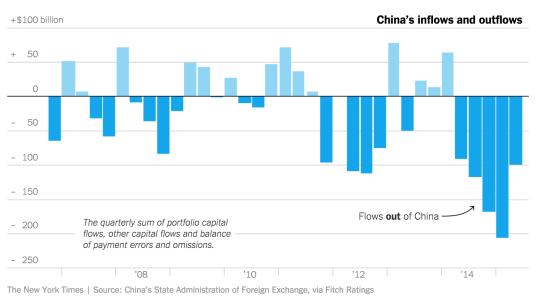
    A reader recently sent me a New York Times article talking about Chinese buyers flooding into the US residential real estate market. This is something that I’ve written about before, but I liked the “graphic” section called The Roots of China’s Real Estate Rush.

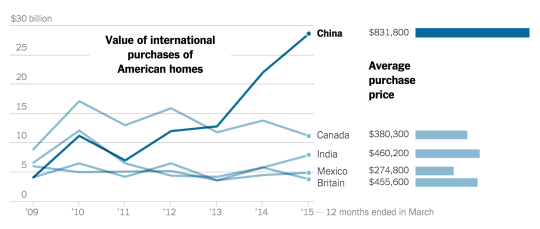
    Here are two of the graphs:

    imageimage

    The second chart shows you just how much more significant Chinese buyers are compared to the next biggest foreign customer of American homes: Canadians. And with the Canadian dollar where it is, it is no surprise that we are trending downwards. That doesn’t seem to be the case with the Chinese.

  • #donthave1million

    Tiny Park by David Brookfield on 500px.com

    https://500px.com/embed.js

    After I wrote this week’s post about Chinese homebuyers in Vancouver, I was surprised to learn about the racism debate that flared up in the city / on Twitter. I guess this really is a touchy subject. (See: #donthave1million)

    My reaction to the research was: Great to see someone (Andy Yan) putting in the time to try and better understand a market phenomenon. It’s painful how opaque real estate markets can be. Let’s get even more data so that we can make even better policy decisions. I didn’t read it as: let’s deliberately single out a race.

    Because the reality is that we all knew this was happening.

    Bloomberg recently published an interesting and related article that talks about China’s money exodus and how the Chinese logistically get their money out of the country. There are restrictions in place. 

    But first, here are two snippets from Bloomberg that describe the order of magnitude we’re talking about:

    This flood of cash is being felt around the world, driving up real estate prices in Sydney, New York, Hong Kong and Vancouver. The Chinese spent almost $30 billion on U.S. homes in the year ending last March, making them the biggest foreign buyers of real estate. Their average purchase price: about $832,000.

    In total, UBS Group estimated that $324 billion moved out last year. While this year’s numbers aren’t yet in, during the three weeks in August after China devalued its currency, Goldman Sachs calculated that another $200 billion may have left.

    Now here’s how it is being done:

    It works like this: Chinese come to Hong Kong and open a bank account. Then they go to a money-change shop, which provides a mainland bank account number for the customer to make a domestic transfer from his or her account inside China. As soon as that transaction is confirmed, typically in just two hours, the Hong Kong money changer then transfers the equivalent in Hong Kong or U.S. dollars or any other foreign currency into the client’s Hong Kong account. Technically, no money crosses the border – both transactions are completed by domestic transfers.

    And here’s a snippet that stood out for me because it shows how easy this has become:

    While the first exchange has to be set up face-to-face, customers can place future orders via instant-messaging services such as WhatsApp or WeChat, and money changers set no limit on how much money they can move.

    Given the scale and complexity of this issue – housing affordability – I have to believe that cities and policy makers would be far better off with more, rather than less, information. I hope we can work towards that.

  • The impact of Chinese buyers on Vancouver’s single family home market

    I have a new favorite blog that I think you might all enjoy as well. It’s called BT | A | Works and it is the “architectural and urban research and development division” of Bing Thom Architects in Vancouver. 

    I think it’s it’s important to have people in a firm who are researching and experimenting with ideas beyond the day-to-day tasks of a job. So I was excited to discover their work this morning.

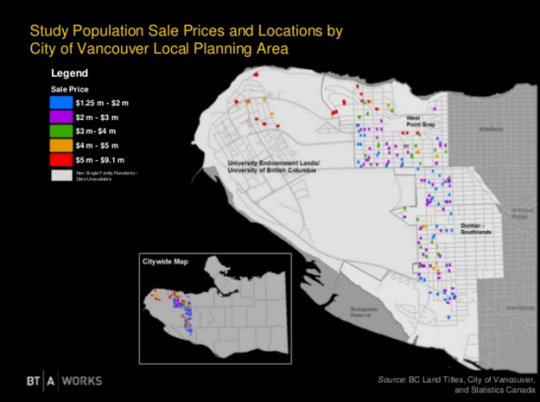
    Their most recent post is a look at ownership patterns of single family homes sold in 3 west end neighborhoods in Vancouver from September 2014 to February 2015 (a 6 month period). These are some of the most expensive areas in the city and, collectively, they found 172 properties sold with an aggregate value of around $520 million.

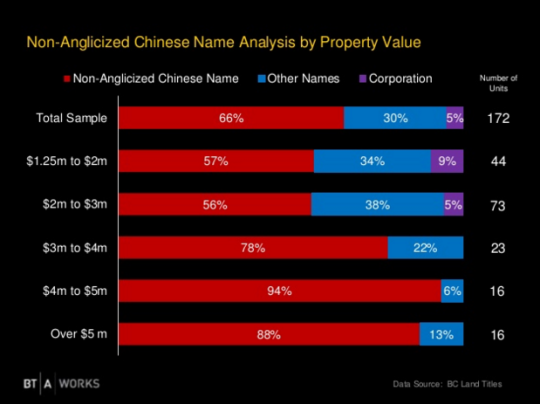
    Given the presence of foreign buyers in Vancouver’s real estate market, one of the things they then did was identify “non-anglicized Chinese names” on the title records. This means names like “Li Xian”, but not names like “Andrew Shui-Him Yan”, because the anglicized first name suggests that they are probably not a new immigrant or probably not living abroad.

    Here’s what they found:

    In total, 66% of the properties in the sample (172 properties) were associated with a non-anglicized Chinese name. And for properties over $5 million, the percentage jumps to 88%. The other interesting thing worth noting is that 23% of the registered owners declared their occupation as “homemaker/housewife.”

    I thought this would serve as an interesting follow-up to the post I wrote about a month ago called, Is Hongcouver better off than Vancouver? If you’d like to see the full BT | A | Works presentation, click here.

  • Is Hongcouver better off than Vancouver?

    The Twilight Zone | Vancouver by Apar Sidhu on 500px.com

    https://500px.com/embed.js

    It’s raining this morning in Toronto. The sun really hasn’t come up and out yet. And I’m spending the morning drinking coffee and reading a City Journal article from this past summer called “Hongcouver.”

    The article talks about how the Chinese – first from Hong Kong and then from mainland China (PRC) – have dramatically reshaped the economic and cultural landscape of Vancouver.

    I, unfortunately (it’s a great city), don’t spend a lot of time in Vancouver and so I don’t have an accurate sense of the local sentiment towards all of this change. But there’s no question the city has changed. 

    Here’s a snippet from the above City Journal article:

    As for the notion that Chinese money tended to be ill-gotten, Yu pointed out that the property boom was propelled by the structural disparity between prosperous Hong Kong, a dynamic economy, and the comparative backwater of Vancouver, still “living on the fumes of empire.” For the price of a Hong Kong flat, a Chinese immigrant—even, say, an accountant—could buy a splendid home on Vancouver’s West Side. “The Hong Kong Chinese who came could buy their way into any neighborhood. [They] knew that money was a tool,” Yu told me. “They weren’t going to accept a second-class citizenship in Vancouver. They could say, ‘I don’t care about your British Imperial manners, I am going to buy your house.’ ” The irony was that the Hong Kong arrivals—“more sophisticated than the people they were displacing,” with “better schooling, better English accents,” Yu said—were themselves the products of a system of law and finance instituted by the British with the establishment of their Hong Kong colony in the 1840s, after Britain thrashed China in the First Opium War.

    A lot of this was fuelled by the now defunct Immigrant Investor Program. The intent of the program was to allow “experienced business people” into the country in order to contribute to economic growth. If you had business experience, a net worth of at least C$1.6 million (that was gained legally, of course), and were able to invest C$800,000, then you could get permanent residency.

    Between the mid-1980s and the end of the 1990s, approximately 30,000 Chinese came to Vancouver via this investor-class visa. And between 1987 and 1997, it is estimated that this group of Chinese possessed about $35 to 40 billion in disposable income. No wonder they bought real estate.

    But the interesting question is whether or not Vancouver is better off now than it was in the 1970s before all of this migration really took hold. 

    There many who would argue that it is not. Vancouver now has the most expensive real estate in Canada and prices have completely detached themselves from local income levels – as they have in many international cities.

    But there’s also a strong argument to be made that this influx of money has made the Vancouver economy more dynamic. Unemployment in the city was cut almost in half between the early 1980s and 1991 during the first wave of migration. It went from 13.6% to 7.7%.

    In a way, it’s not all that different than what’s currently happening in San Francisco with tech and housing. I’m not saying there aren’t problems to be solved. But I think many of us can agree that the answer is not to eradicate the tech sector.

    That’s throwing the baby out with the bathwater.

  • From stuff to services

    This morning Fred Wilson linked to a Bloomberg article on his blog called, Maybe This Global Slowdown Is Different. There are a bunch of great charts throughout the piece and I’d like to share 3 of them here.

    The first chart shows how per capita energy consumption has dropped remarkably in the United States since the 1990s, but how, not surprisingly, China’s rate is increasing.

    The second chart shows car sales in the US. There was a big drop off during The Great Recession, and though sales have rebounded, they still haven’t reached their late 1990s peak. But that’s not to say that they won’t.

    And the third chart shows the tremendous shift in the US over the last 65 years from the consumption of stuff to services.

    This last one is fascinating. And it ties into the argument that the way value is created in our economy has shifted dramatically.

    But I wonder if this change is really as sharp as it seems. 

    If you look at what makes up “services”, you’ll see that housing (and utilities) and healthcare make up over 50% of what is considered to be personal spending on services. And if you look at housing and utilities spending since the 1960s in the US, it has increased dramatically. 

    So how much of this shift from stuff-to-services is actually being driven by housing?

  • The Beijing supercity

    image

    A few weeks ago I wrote a post talking about megalopolises and the importance of the Great Lakes region in North America. And I suggested that high speed rail could be one way to better stitch together the region.

    To some, I’m sure this sounded like a bit of a pipe dream. But thinking at the megalopolitan scale is something that I think we are going to need to do. Other parts of the world certainly are.

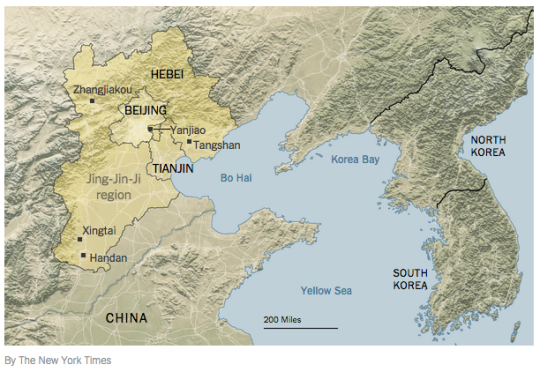
    The Chinese government is in the midst of developing a supercity around Beijing that is called Jing-Jin-Ji. It will span about 82,000 square miles and will house approximately 130 million people. 

    As part of the plan, a high-speed rail network is being built that will bring the region’s major cities within an hour’s commute. The objective is to compete with the Pearl River Delta and the Yangtze River Delta regions in the south.

    It’s a scale of planning and development that most people aren’t used to thinking about. But it’s happening right now.

    Image: New York Times