Daily insights for city builders, delivered every morning at 6 AM ET. I’m Brandon Donnelly — a Toronto-based real estate developer and founder of Globizen. I’ve been writing here since 2013.
“…he took the department through significant reforms: allowing new houses in back laneways, then garden suites; eliminating minimum parking requirements; even legalizing four-unit apartment buildings on any lot in the city.“
All of this was not easy, as anyone in our industry will attest.
I also got to know Gregg, a little, by way of our development projects. And I can say that he (1) genuinely loved our great city and (2) was always looking for ways to make things better, whether that be through planning policy or through processes internal to City Hall.
Toronto’s chief planner, Gregg Lintern, published this piece in the Toronto Star over the weekend where he argued that “expanding housing options in [Toronto’s] neighbourhoods is the missing piece of the growth puzzle.”
What he is saying is that if we’re going to have any chance at reasonably accommodating the 700,000 or so people who are expected to move to this city over the next three decades, we’re going to have to evolve our low-rise neighborhoods. That includes more retail, more amenities, more density, and yes, built form that houses multiple units.
I immediately thought that this was meaningful progress in the right direction. It is acknowledgement that things need to change and that our low-rise communities need to change.
But others felt that this was a case of soft-serve ice cream, arguing that there’s “danger in praising incremental, belated change when dramatic change is what’s needed.” I also see this point.
To quote the late architect Daniel Burnham, “make no little plans.” But this is arguably a little easier to subscribe to when you’re rebuilding after a great fire has decimated your entire city (he was instrumental in the rebuild of Chicago following its fire of 1871).
The unfortunate reality today, at least in this environment, is that bold vision isn’t often rewarded politically. The status quo bias is simply so great. Change is painfully slow. That’s why we rely so heavily on pilot projects when it comes to city building.
So while I too am a fan of bold vision, I also see value in what Simon Sinek and others refer to as consistency over intensity. Small, repetitive, and compounding actions can have powerful long-term results. You just have to keep going in the right direction.
And I think that many of us, or perhaps most, will agree that the right direction is rethinking our low-rise neighborhoods.
Toronto’s Chief Planner, Gregg Lintern, posted this on Twitter a few days (if you can’t see it below, click here):
44% of Toronto households in 2016 reported living in apartment units in buildings with 5 or more storeys; given rapid growth in that building form, I suspect by the 2021 census, we'll be a majority apartment dwelling unit city (if we are not already) pic.twitter.com/I4i7T1STdp
First, it’s a reminder that census data is painfully slow. Five years is a long time and a lot can and will change during that time period, including the kind of built form that people are living in.
Second, I agree with Gregg. Toronto is in the process of transforming into a majority apartment/condo dwelling city (if it hasn’t already), and it signals a pretty important juncture in our city’s history.
It also begs an important question: How should our planning response change and adjust as this percentage of urban dwellers continues to creep upward?
There were some big announcements in the planning world this past week here in the Greater Toronto Area. Gregg Lintern (follow him on Twitter) was named the new chief planner of Toronto (he was previously the acting chief planner following Jennifer Keesmaat’s departure) and Andrew Whittemore (couldn’t find him on Twitter) was named the new chief planner of Mississauga.
As I went through the articles announcing the above appointments, I couldn’t help but be reminded that this region is at an exciting and pivotal moment in its history. All of the talk is about improving urban mobility (i.e. becoming less dependent on cars); intensifying around transit stations (as well as gently intensifying neighborhoods); making downtown a better place for families; and so on.
It can be easy to feel defeated in this big bad world of city making. Oftentimes things seem to get reduced to either urban vs. suburban rhetoric or, as if nothing else matters, this one simple question: “But, how tall is the building?” So its nice to know that those at the helm continue to see endless opportunity in this region. I know that I wouldn’t want to be doing what I’m doing anywhere else.
When I was in Miami at the beginning of this month I missed an interesting event that I normally would have attended. It was a conversation between the Chief Planner of Toronto, Jennifer Keesmaat, and the former commissioner of the New York City Department of Transportation, Janette Sadik-Khan.
Sadik-Khan was appointed under the Bloomberg administration and quite famously oversaw a huge number of urban changes in New York. Projects such as the addition of hundreds of kilometers of new bike lanes and the creation of 60 new pedestrian plazas across the city – including the one in Times Square.
I was bummed I couldn’t attend, but thankfully Keesmaat wrote a post on her blog following the event and the Metcalf Foundation shared videos of the conversation.
Here’s a piece that I liked from Keesmaat’s blog post:
“But she also pointed out that when they demonstrated what could be done, when they quickly mobilized around action, residents clamoured for similar changes in their neighbourhoods. Not surprisingly, this is why her book is called Streetfight – because it is a fight. City building is often the battle of ideologies, and when you’re trying to change the status quo, there is always a significant demographic of the population that is fully committed to maintaining business-as-usual.”
If you have some time, you can also click here to watch the videos. There’s about an hour and a half worth of video, so you might want to open up a bottle of wine or something.
I just got
my tickets for NXT City Night,
happening Thursday, September 24, 2015 at 6:30pm here in downtown Toronto.
If you’re
not familiar with NXT City Prize, it’s an annual urban design competition where
young Canadians (35 years of age or younger) submit ideas to improve the built
environment. The top submissions win a total of $9,000 in prize money and the winning idea
gets paired up with the City of Toronto work on actually implementing it. That’s
the best part.
I think it’s
important to keep in mind that a lot of what makes cities great often happens
through citizen-led grassroots movements.
The
High Line in New York – which today attracts over 5 million visitors a year
and is believed to be responsible for over $2.2 billion in new economic
activity – was really the work of 2 friends who thought that preserving and
repurposing the High Line was a cool idea. Which is why in 1999 they founded a
non-profit called Friends of the High line. Amazing things happen when people and
passion get involved.
The event is
also taking place in a spectacular old warehouse building at 56 Maud Street
(formerly St. Andrew’s Market Hall). That alone is reason enough to come. I’ve been inside before. Get your Instagram ready. But
if that’s not enough, there’s also:
Open bar including Steam Whistle beer and Pillitteri Estate wine
Catering from Oyster Boy, Kanpai Snack Bar, Thoroughbred and many more
Art installations by Wayward Collective
Beats by Jesse Futerman and A Digital Needle
Local wares from GetFresh, Shopify, Spacing Store and Swipe
I hope to see
you there. Make sure to tweet at me
if you’ll be there so we can connect in person.
Jennifer Keesmaat is the Chief Planner of Toronto. She was hired for this job in 2012.
She has a Masters in Environmental Studies (Politics and Planning). She is a Registered Professional Planner with the Canadian Institute of Planners. And she was also the founder of 2 (city) planning firms prior to taking the position of Chief Planner for Toronto.
So presumably, she was hired for this job because she possesses some sort of expertise in the realm of planning. I also presume that she is expected to make her opinions known to other people so that informed planning discussions can occur and decisions can be made.
So I find it curious that in some circles, and in the media, Jennifer Keesmaat is being branded as a “troublemaker.”
Eventually Tory had enough and pulled Keesmaat into a meeting where he basically told her to zip it. “The mayor has said it is perfectly appropriate for staff to make their opinions public, as Ms. Keesmaat has done,” wrote his communications chief, Amanda Galbraith, in a statement. “It is not appropriate for city staff to campaign against councillors or the mayor on social media or through other public platforms.” Keesmaat counters that she never campaigned. “I stated an opinion,” she says simply.
But the “troublemaking” didn’t just start with the Gardiner East. Pretty much since the moment she took the position of Chief Planner and launched her own blog (ownyourcity.ca), she was dubbed a shit disturber. (Those bloggers!)
But if you ask me, these criticisms stem from an old and outdated way of thinking.
The last thing we need from government is less transparency and more politicking. We should be working towards more, not less, information. Even if that information doesn’t butter our metaphorical bread.
What do you think?
I think this will make for a great discussion in the comment section below.
“If the decision ultimately of the council is to support the hybrid I think frankly it’ll be a major step backwards and you’re going to miss a once in a lifetime opportunity, and I’ll be very frank, we’ll be the laughingstock of the world.”
-Paul Bedford, former chief planner of Toronto
As many of you I’m sure know, I have been a vocal and passionate supporter of removing the eastern portion of the elevated Gardiner Expressway in downtown Toronto. I have written about it so many times that a lot of you are probably sick of hearing about it.
I’m sorry if that’s the case. But it’s a hot and important topic in Toronto right now. We’re just over 3 weeks away from City Council finally making a decision. That is scheduled to happen on June 9th and/or 10th.
For the most part though, I was pretty confident that we would ultimately make what many of us believe is the right decision. But then this past week Mayor John Tory went public in his support for the “hybrid” option, which is basically to rebuild the elevated expressway in a slightly different configuration. And that really upset me.
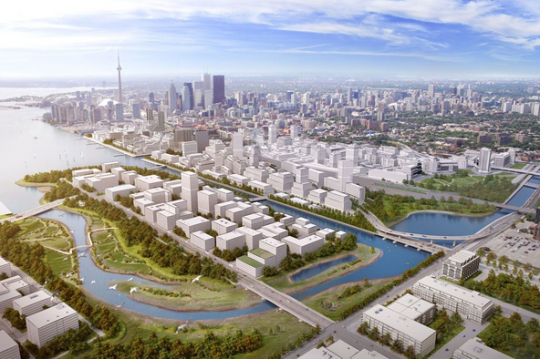
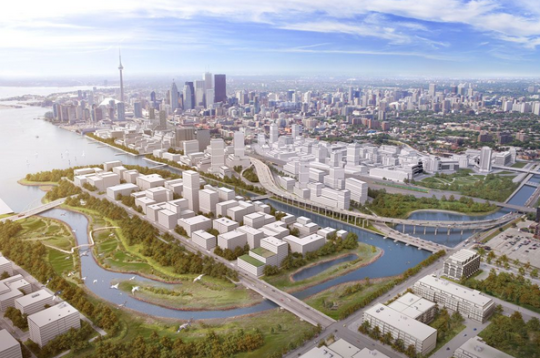
Here’s what that looks like (versus the remove option shown at the top of this post):
Have we learned nothing from our past city building mistakes?
Since that announcement, I went on Twitter every night this week to check out the discussions that were happening around #GardinerEast. And every night it got me so worked up that I then had trouble falling asleep. I have since stopped reading about the Gardiner East before bed.
But rather than just get frustrated, my friend (a fellow city builder named Stephen Job) and I decided to do something about it and create a petition using Change.org.
It is a petition that we will ultimately be sending to Toronto’s entire City Council prior to their June 9 meeting and we hope that you will consider signing it and sharing it with your network – regardless of whether or not you happen to live in Toronto. (Although it’ll certainly help if you’re a taxpayer and voter in the City of Toronto.)
We just finished getting it up and you can check it out and sign it by clicking here.
The headline immediately caught my attention because conventional economic wisdom would suggest that supply constraints – whether natural or artificially created – generally have a negative effect on housing affordability.
To be clear though, I support Ontario’s greenbelt. I think an urban growth boundary is the right thing to have if we want to build sustainable, walkable, and transit-oriented communities. But I’m also not blind to some of the potential (negative) externalities.
However, Keesmaat’s article got me wondering just how prevalent those externalities might be and to what extent our greenbelt is actually impacting housing affordability in Toronto. In her article she cites a recent report by the Pembina Institute that very clearly argues the following:
“There is no shortage of land throughout the GTA [Greater Toronto Area] to build single-family homes for decades to come, but this land is predominantly located far from the City of Toronto and other established centres of employment in the GTA.”
More specifically, the report found that of all the land available for development in the region (within our growth boundary), 81% of it is projected to still be unused by 2031. This got me thinking: it’s not that there isn’t land still available in the region; it’s that there isn’t land in the areas where demand is the greatest.
Put differently, young families aren’t clamoring for single family homes in High Park and Leslieville because the greenbelt has restricted their ability to find new housing. They’re doing so because they want to live in neighborhoods like High Park and Leslieville.
If you dive into the data, the report shows that in 2004 the average price of a detached home in Toronto was about $117,000 more than the rest of the Greater Toronto Area. As of 2013, that spread had grown to about $200,000. And indeed the data shows that it’s the core of the city where home prices seem to be appreciating the fastest.
So when it comes to housing affordability and supply, the greenbelt may actually be a red herring. Releasing it would not increase the supply of housing in areas where demand is already high, which is probably why this same report also found that – with or without an urban growth boundary – most Canadian cities are seeing similar increases in home prices.
So what should we be doing?
I think we should do two things: (1) focus on accommodating more growth in the areas that people already want to live in, and (2) figure out ways to transform the less desirable areas into more desirable ones. This second one will be the hardest, because it’s likely going to mean changing car dependent areas into transit-oriented ones, which is no easy task.
The good news though is that we are already doing these things. There’s more that I would like to see happen, but we’re headed in the right direction.
If your city has a greenbelt or you have experience with greenfield development in the Toronto region, I’d love to hear your thoughts in the comments. This is an area of development that I’ve never really been involved with.
You can read more about the initiative here, but all you have to do is tweet your resolve using #CityResolve. One person will be selected for a one-on-one meeting with Toronto’s Chief Planner, Jennifer Keesmaat – where you could then pitch your idea directly to the top 🙂
For me though, I feel like I’ve already been acting on my resolve, which is this blog. When I started writing every day back in August 2013, I did so for myself, but also for a clear mission: To promote the building of beautiful, sustainable, and globally competitive cities. I don’t profess to have all the answers, but I hope to initiate the right kind of discussions.
If that feels like a cop out though, here’s another:
I love technology. My #CityResolve is to use my phone less in public and talk to more people (strangers). People are what make cities great.