Daily insights for city builders, delivered every morning at 6 AM ET. I’m Brandon Donnelly — a Toronto-based real estate developer and founder of Globizen. I’ve been writing here since 2013.

Tag: cars

  • The hypocrisy of parking minimums

    image

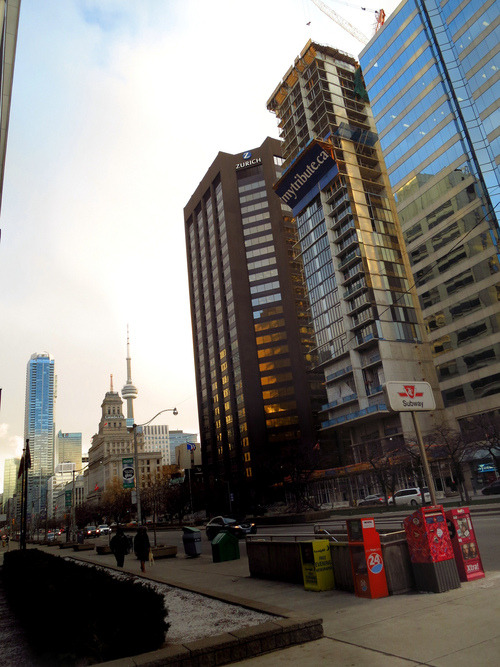
    Earlier today, Christopher Hume of the Toronto Star published a review of The Residences at RCMI building currently under construction on University Avenue. He gave the building a ‘B’ grade. 

    His main criticism was the faux facade that has been integrated into the base of the building:

    Then there’s the question of the historic 1907 building the RCMI occupied until recently. Though listed as a heritage site in 1973, the city approved its demolition. Planners also allowed the neo-classical front façade to be replaced with a replica that will fool no one, another example of the city talking out of both sides of its mouth.

    But faux facades aside, one of the things that makes this development project unique in Toronto is actually something that you can’t see from the outside: there’s no resident parking. Apparently there’s 9 spots for deliveries and other short-term uses, but for the 315 suites in the building there’s no parking.

    Depending on where in the world you’re from this may not seem like a big deal. I’ve written before about minimum and maximum parking requirements, and how some cities – such as Berlin – don’t have them. But here in Toronto, we do. And the city generally takes them very seriously.

    “To assume a residential development of the project’s scale might be totally car-free runs counter to expert study and experience,” municipal staffers argued. “Although there are many households in the downtown without cars, it would be highly unlikely to find 315 of them permanently concentrated in one building.”

    The fact planners were dead wrong is a shocking sign of a department either out of touch or that doesn’t believe its own hype.

    In so many ways – as Hume pointed out in his article – this is complete hypocrisy. We’re always talking about building walkable communities and encouraging alternate forms of mobility, but when it comes time to build anything new, we force a certain number of parking spots to be included. And so we end up encouraging the exact opposite.

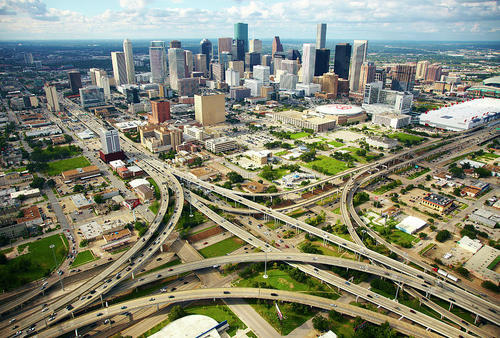
    This also has a significant impact on the way we build our cities. Parking minimums can actually render smaller sites “undevelopable” simply because there isn’t enough room to lay out the required parking. In fact, it might surprise you how much of what we do ends up being governed by cars, parking, and traffic.

    That’s why I think this image is so impactful:

    //platform.twitter.com/widgets.js

    But I’m certain that a lot of this will change as Toronto continues to grow. Progressive cities all around the world are rethinking their positions on parking, and on cars in general.

    Earlier this year Sao Paulo joined the club and got rid of parking minimums for sites along major transit corridors. And they actually imposed a parking maximum: 1 spot per residence. The expectation is that this will reduce traffic and improve housing affordability.

    Parking minimums may not seem like a big deal, but the reality is that their impacts are far reaching. They change development patterns, they change project economics, and they send a message about the kind of city you hope to build.

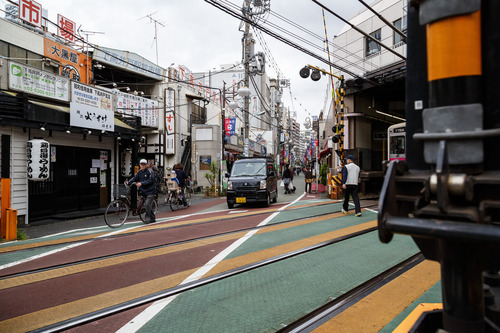
    Image: Looking south on University Avenue in Toronto (Flickr)
  • Who are you planning for?

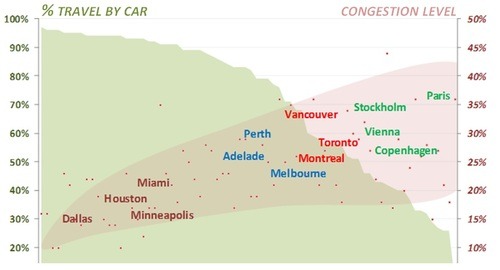
    I just came across the following chart via City Clock:

    It came from a study that looked at 74 cities in terms of two measures: the percentage of people that travel by car and the traffic congestion levels within those cities.

    The way to read the chart is to first look at the red dots. Each dot represents one of the cities studied. The position of the red dot corresponds to that city’s congestion levels. So for example, if we were to take Toronto, the congestion level is 27%.

    If you then take that same dot and draw a vertical line to the top of the green shaded area, you get the percentage of people who travel by car. In the case of Toronto, it is 56%.

    What’s interesting about this chart is that as congestion levels rise, it forces people out of their cars. In other words, the cities with the highest congestion levels also have the lowest auto share percentages.

    But the other way I interpret this chart is that the decision is almost binary: you’re either planning for cars or you’re planning for people. Based on this data, it’s hard to have both.

  • Avoiding driving

    If you’ve been reading Architect This City since last winter, you might know that every year I go on one big snowboard trip with a group of guys I went to grad school with at Penn. Last year we went to Jackson Hole and Vail, and this year the plan is to go to Banff and Revelstoke.

    We start planning it by the fall and so already we’ve been trying to sort out the details for this winter’s trip. But as we finalize the plans, one thing I’ve noticed is how I’ve automatically been trying to minimize the amount of driving that we’ll need to do. In fact, in a perfect world, we wouldn’t have to rent a car at all.

    Now, small mountain towns aren’t usually the best for public transit, but there are often ways to get around that. When we were in Jackson, we took the public bus to get to the mountain every day, as did most people who lived or stayed in town.

    This winter, the plan is to fly into Calgary and stay in Banff for the first leg of the trip. So I’ve been trying to figure out if there’s a train that can get us from Calgary to Banff and which hotels offer shuttle buses to the mountains. Because I’d rather not drive, and I know many of my friends feel the same way. It’s an added cost and it gets in the way of après ski.

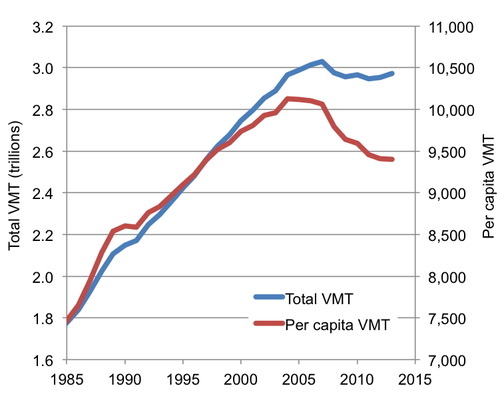
    What’s interesting about this, is that not only do I try and minimize the amount of driving I do here in Toronto, but I do it when I travel as well. And if you’ve been following the macro trends, you might know that many other people feel the same way. That’s why total Vehicle Miles Traveled in the US has been in falling since about the mid-2000s:

    image

    People are falling out of love with driving, and many believe that this shift is permanent. Here’s a recent report from the US PIRG Education Fund talking about just that:

    //platform.twitter.com/widgets.js

    I also think this shift is permanent – until maybe the nature of driving changes and cars start driving themselves. But at that point, it won’t be called driving anymore and there will probably be many other changes. So on this rainy Wednesday morning, my big bold prediction is that future generations will no longer drive.

    What do you think?

  • Multi-modal cities are the new reality

    CityLab published an article last week on multi-modal cities that caught my attention (because it used a picture of Toronto with about 3 or 4 streetcars stacked up along Queen Street). The premise of the article is that all of this car vs. transit debate is actually missing the bigger picture: our cities are multi-modal and we need to be planning for that.

    That’s not to say that the shift away from cars isn’t a good thing. It is. But it’s not as simple as saying that, instead of driving, people should now only take transit. In today’s cities people walk, bike, take streetcars, take buses, take subways, take taxis, take private shuttles, use Uber, and, yes, they still drive.

    From my own experience, this is absolutely how I get around Toronto today. I walk to the gym. I ride my bike whenever I’m going somewhere downtown. I take the subway to my office in midtown because it’s far and I would be too sweaty if I biked there. I use Uber and Hailo when I’m going out at night. And I drive when I need to go to the suburbs or leave the city.

    But the key takeaway here is that we now have a much tougher challenge on our hands. When we were only optimizing for cars – however detrimental to our cities that was – we only had one mode to plan for. Now we have several. Some of which are public and some of which are private.

    However we also have access to technologies that we didn’t have before. We are networked in ways that weren’t possible before and we’re at the dawn of many profound mobility changes, such as driverless cars. (Have you read about Tesla’s new Autopilot feature yet?)

    So as I’ve said before, I really believe that we need to look at this, not as a war on the car, but as a war on inefficiency. The problem we are trying to solve relates to mobility: What’s the best way to move lots of people around dense urban regions? Stop focusing so much on the technologies and focus more on the people.

    Image: Flickr

  • Riding an escalator for the first time

    image

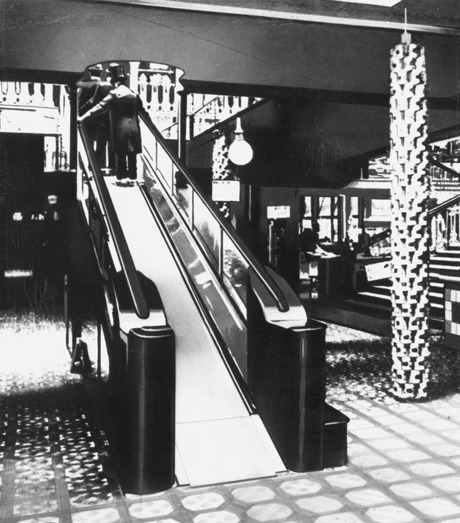
    On Wednesday, November 16th, 1898, Harrods department store in London opened up the first escalator – or moving staircase as it was called – in England. The first escalator-like machine in the world had actually been patented many decades before in the US, but this was the first real application in England and likely one of the first in the world.

    At the end of the 1800s, this was a big deal. Victorian England had never seen or experienced anything like this before and people were genuinely concerned about its use. More specifically, people worried what such a rapid change in elevation would do to the body. It was believed that it could discombobulate your inner workings. People were unnerved.

    Which is why when it was first introduced at Harrods, people were offered brandy and other substances at the top of the escalator in order “to revive them after their ordeal.” Riding an escalator was no small feat for these people.

    Now to us today, this sounds ludicrous. Most of us probably ride a few escalators a day. They’re ubiquitous. But I tell this story because I think it clearly underlines how disruptive the new and unknown can feel, and how difficult it can be for us to accept sometimes.

    If you go back throughout history, you could easily replace escalators for many other new technologies: the printing press, the automobile, the internet, and so on. And in some cases we were wrong to worry, and in other cases we were right to worry.

    Cars, for example, have had a pretty dramatic impact on our lives and the way we build our cities. And since the very beginning, they had no shortage of critics. But does that mean we should have never invented the car? I don’t think so.

    As I said earlier this week week, the goal in my mind is to find the right balance between preservation and progress. Just as we shouldn’t be so quick to erase our architectural history, we shouldn’t be so quick to erase our way of life.

    But at the same time, it’s important to remain open minded to what’s coming. I’m optimistic about the future. Change can be a great thing, even if it may feel as uncomfortable as riding an escalator for the first time. Maybe you just need a bit of brandy to calm your nerves.

    Image: Pinterest

  • Taxis just got 40% cheaper in Toronto

    UberX officially launched in Toronto today. Which means that Toronto’s taxi and limousine industry is about to get a lot more grouchy. For those of you who may not be familiar, uberX is Uber’s low-cost car service. Just like the regular version, you hail a car using your mobile phone. But this option will cost you 40% less than a regular taxi!

    Here are sample rates from the Financial District to Yonge & Eglinton (midtown):

    And from the Financial District to Pearson International Airport:

    image

    This is pretty exciting. Because as much as I think it’s great to use Hailo or Uber to hail and then pay for a car, the big problem in my mind has always been that cabs in Toronto are just far too expensive. The meter starts at $4.25 and shoots up faster than you can take a selfie in the backseat.

    But obviously there’s an entrenched industry here that is not going to be happy about a startup eating into their fares. So I wouldn’t be surprised if we see a lot more backlash here in Toronto – as has been the case in many other cities. However I don’t think that’s a viable long term solution for the incumbents.

    Uber is thought to be worth $18.2 billion right now. It’s probably not going to go away.

    So instead of protesting and trying to ban it, we should be figuring out how to adjust to this changing reality. For the incumbents, this might mean lowering fares or figuring out a better way to differentiate themselves. A 40% discount is a pretty compelling value proposition. For me personally, I don’t know why I would ever pay more for a regular taxi, unless there was no other option.

    On a side note, it’s worth pointing out that an uberX trip from downtown to Pearson is estimated to cost around $33 – roughly the same as what some people think the Union Pearson Express train will cost. That’s further evidence that charging a lot and targeting business travelers may not be the best strategy.

  • The war on the car

    image

    In today’s post I’d like to focus on the second tweet I embedded in yesterday’s piece about downtown Toronto. Specifically, the fact that almost 75% of downtown residents walk, cycle, or take transit to work, leaving drivers firmly in the minority.

    For me, this then makes me question whether or not we’re optimizing well enough for the majority. However, it’s often not that simple. And that’s because the downtown core is clearly regional in its draw, and the further you move out from the downtown core, the more the modal split flips. In the suburbs, driving is obviously the majority.

    And herein lies the tension and the reason for all this “war on the car” rhetoric: We have a downtown core with completely different mobility preferences than the rest of the region.

    But as Toronto continues to intensify and grow (the population of the Greater Toronto Area is projected to reach almost 9 million by 2036), I truthfully don’t know how we could reasonably expect to (efficiently) move that number of people in private cars. I’ve just never seen it done before.

    Some people think that if we simply got rid of all those damn streetcars on our city streets, that we’d be doing a lot to eliminate traffic congestion. But it’s not that simple. The Highway 401 here in the city is already 18-lanes and one of the widest in the world. And yet it’s perpetually clogged. No streetcars there.

    So I look at this tension as a growing pain. Sooner or later I think we’re going to realize that this war should really be a war on inefficiency. How do we move lots of people around big cities while minimizing waste, maximizing economic output, and enhancing quality of life?

    Now that’s a war worth fighting.

    Image: Helibacon

  • More thoughts on driverless cars

    image

    If you’re a regular reader of Architect This City, you’ll know that I’m a big supporter of public transit. And that’s because, as far as I can tell, it’s the most efficient way of moving lots of people around a big city.

    But more and more I’ve been thinking about how technology might change, or even disrupt, this school of thought. Which is why when I wrote this post a few days ago, I was careful to say that private cars aren’t the mobility answer. Because in reality, cars likely aren’t going to go away. We’re just going to use them differently.

    Here are the two things I’m thinking about most:

    1. Driverless cars

    I’ve written about driverless cars before in terms of how they might be used as a form of public transit. But I think it’s worth revisiting them for a moment. There are lots of driverless car critics out there and they usually fixate on the fact that a car is still a car, whether or not you happen to be driving it. It still takes up the same amount of space in our cities. Or does it?

    The key thing to keep in mind is that when we’re not longer driving the vehicle, it opens up lots of different possibilities in terms of how they might be used and also how they might be designed. I was watching this fireside chat with the founders of Google the other night and, for them, driverless cars offer the possibility of solving two big problems: traffic and parking.

    We know that parking takes up a lot space in our cities. But that’s really symptomatic of the fact that the utilization rate for most people’s cars is incredibly low. Most of the time a car is sitting parked and idle. But with driverless cars, they’ll be able to drop you off at your destination and then continue on to pick up their next ride–thereby minimizing the need for all that parking.

    This would bring the utilization rate way up for each car, which would also minimize the number of absolute cars that we’d need to have in our cities to move everybody around. Of course, this would mean that we’d be sharing cars. People wouldn’t own cars; they would be an on-demand service.

    2. Networked vehicles

    This brings us to my second point: driverless cars will be networked cars. Again, I’ve written about this before, but I specifically wanted to raise it again because of a new service that Lyft just launched in San Francisco called Lyft Line.

    The way it works is simple. You input where you’re going and Lyft will match you up with others who are going to more or less the same destination. The routes get shared and this brings down the costs to everyday use. It runs on the same principles as the on-demand minibuses I wrote about in Helsinki.

    But if you combine this with driverless cars, you’re starting to get at something incredibly interesting. Now all of sudden you’re getting the door-to-door convenience of private cars with many of the efficiencies of public transit.

    So in my mind, it’s very possible that platforms like Uber, Hailo, and Lyft could became major infrastructure backbones in a world of driverless cars. And if you think about it in this context, then I don’t think the valuations for these companies should seem all that surprising. These are potentially huge innovations.

    In the end, I don’t know how this will all shake out. I don’t think anybody does. I believe that strong public infrastructure (such as subways, light rail, and so on) will still be needed in big cities, but I’m starting to think that mobile apps and driverless cars will also form a big part of how we get around. Probably more so than most people think today.

    Image: Flickr

  • Could driverless cars be a big deal for cities?

    image

    I’m a big believer in public transportation. I generally believe that the only way to build a big, efficient, and sustainable city is on the backbone of a good transit system. But at the same time, I’m open to fresh ideas. And I’m concerned with the inability of most cities to actually build transit in a way that meaningfully responds to demand.

    So what are the alternatives?

    The first thought that comes to mind is the delivery system itself. Some cities, such as Hong Kong, have successfully combined transit delivery with real estate development as a way to improve the economics behind building transit. And I think that makes a lot of sense.

    But my other thought is that maybe the solution to urban mobility is something completely new. Maybe Google is on to something with their driverless cars. Is that the future? Many would disagree.

    We’ve established that cars don’t work all that well for getting people around in big congested cities. So what difference would it make whether or not the cars have a driver or not? Well, I was thinking about this last night and there are some meaningful differences.

    A network of driverless cars would give us perfect information about all to the cars on the road. Similar to to how Google’s Waze navigation app feeds off user input (both active and passive), we’d know the exact number of cars on the road and the precise point in which additional cars would cause a drop in efficiency (i.e. a reduction in vehicle speeds).

    At the same time, it could enable a powerful sharing economy. In a recent study done by MIT’s Senseable City Lab, it was found that roughly 80% of New York cab rides could be shared. That is, 80% of the time there’s somebody else who’s also traveling from roughly the same point A to the same point B.

    So here’s what I’m thinking.

    You use Google’s driverless car technology and the perfect information you get from the networked vehicles to create a fluid and ever-evolving transit network. What I’m imagining is that the driverless vehicles don’t operate based on a model of individual mobility; they instead operate on a principle of batched mobility.

    Let’s say for example that there are critical mass of people who want to leave Liberty Village between 8:00am – 8:30am to travel to the Financial District. What they would do is enter this itinerary and then a “station” would get formed somewhere nearby. Users would get notified of the station’s location, which would be determined based on proximity to the highest concentration of “riders.”

    The driverless cars would then get notified and would begin assembling the appropriate number of vehicles at the selected station location. As is the case with conventional forms of public transportation, most people would need to walk to the station. But never that far.

    In essence, it would function as a cross between private and public transportation. You would get the economies of scale generated by public transit, with some of the individual conveniences of private transportation.

    How does that sound?

  • Cost of a car

    Every time I bring my car in for service, I’m reminded of how expensive it is to maintain one. Between car payments, insurance, gas, parking in the city and service, owning a car eats into a lot of disposable income.

    So for cities where the residents don’t need a car to get around, there’s potentially a lot of additional income that can get placed in other sectors of the economy.

    Richard Florida, and others, have argued that we’ve historically been overspending on housing and transportation, and that it restricts capital from flowing into other, more productive, areas of the economy.

    I’d be curious to see a study that compares transportation spending versus other local economic measures. How would a driving city compare to a public transit or biking city?