Daily insights for city builders, delivered every morning at 6 AM ET. I’m Brandon Donnelly — a Toronto-based real estate developer and founder of Globizen. I’ve been writing here since 2013.

Tag: cars

  • The ROI of cycling infrastructure

    Toronto can’t make up its mind right now as to whether it would like to invest in additional cycling infrastructure. 

    Of course, we have a history of vacillating on topics like this. And I think it’s because we’re at a tricky inflection point. We are weaning ourselves off of the car, but most parts of the city remain underserved by transit and heavily dependent on the car.

    So today I thought I would share some numbers from a research study that was published last year by Stefan Gössling of Lund University and Andy S. Choi of the University of Queensland. It’s called, Transport transitions in Copenhagen: Comparing the cost of cars and bicycles.

    Much of the focus of the paper is on the cost-benefit analysis that the City of Copenhagen uses to make its cycling investment decisions. Here is an excerpt from ScienceDaily:

    “If the costs to society and the costs to private individuals are added together, the impact of the car is EUR 0.50 per kilometre and the impact of the bicycle is EUR 0.08 per kilometre.

    The study by Stefan Gössling and his colleague also shows that if we only look at costs/benefits for society, one kilometre by car costs EUR 0.15, whereas society earns EUR 0.16 on every kilometre cycled.

    “The cost-benefit analysis in Copenhagen shows that investments in cycling infrastructure and bike-friendly policies are economically sustainable and give high returns,” says Stefan Gössling.”

    So there you have it. Now I thought we could debate this in the comment section. Your thoughts?

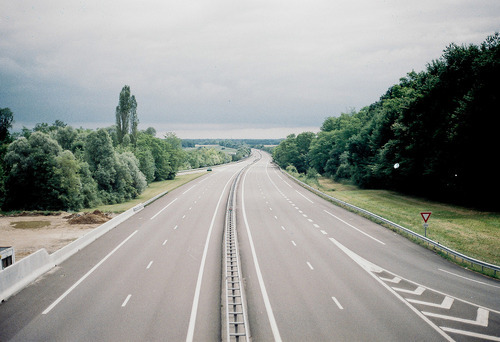
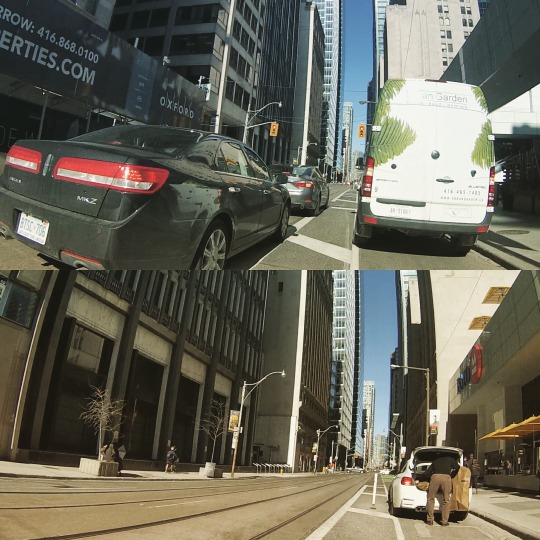
    P.S. The images at the top of this post were taken by me using my new GoPro bicycle handlebar mount.
  • Getting distribution and how that is changing

    Aaron M. Renn recently published an article in The Washington Post talking about carless cities and driverless cars. It’s an interesting read, but I’m not going to talk about those topics today. So if that’s what you’re looking for, you’ll have to read his piece.

    I do, however, want to focus on one particular aspect of it. 

    In it, he talks about how Tesla is shifting the “locus of power in the auto industry” from Detroit to Silicon Valley and, at the same time, changing the way cars are sold. Tesla sells direct to consumers through its corporate stores, whereas franchise laws in almost every U.S. state mandate that new cars need to be sold through dealers.

    I’m not sure how these laws came to be, but it’s interesting to note yet another example of technology and the internet sparking disintermediation. That is, the removal of middle people, distributors, brokers, and so on. It’s the same thing that is happening as a result of companies like Uber and technologies like Bitcoin.

    I would imagine that lot of these legacy distribution models exist today because it was previously the most efficient option. If you were a car company based in Detroit, a network of local franchisees all across the country working to sell your cars was probably a great thing. But now there are other options, as is the case with many other industries.

    So what’s next? 

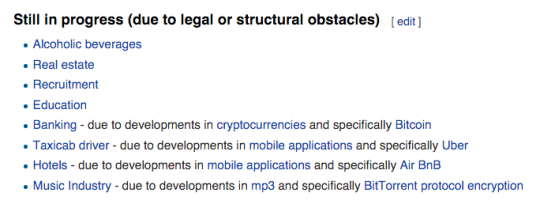
    Wikipedia calls out the following industries as still being in the midst of disintermediation:

    I bet you all know which one I’m watching closely.

  • 16 mobile theses and how tech might change the built environment

    Caucasian woman standing near passing subway in train station by Gable Denims on 500px.com

    https://500px.com/embed.js

    One of the things that I try and do here on this blog is examine the intersection of design, real estate, and technology. I didn’t explicitly set out to do that, but more and more I find myself thinking that way when I’m writing and when I’m giving talks.

    Part of that is because of my passions, but part of it is because there is a big and important overlap. One example of that is autonomous, self-driving cars. The tech community is enamoured with driverless cars, but everyone involved in the built environment should also be thinking about their impacts. Because it’ll be significant.

    Benedict Evans – who is a venture capitalist with Andreessen Horowitz in the Valley – recently published a post called, 16 mobile theses. It’s a look at 16 topics, trends, and shifts that are happening in the tech space. (There’s also a related podcast discussion.)

    If you’re involved in internet products, you absolutely need to give it a read. But I also think it’s interesting to read it through the lens of a designer or real estate person. Productivity is changing. Notions around the living room are changing. And yes, autonomous vehicles are going to have a profound impact on the urban landscape of our cities – just as cars did initially.

    Below are 3 excerpts from Benedict’s post that I really enjoyed.

    The first is about mobile and just how massive it is:

    “The mobile ecosystem, now, is heading towards perhaps 10x the scale of the PC industry, and mobile is not just a new thing or a big thing, but that new generation, whose scale makes it the new centre of gravity of the tech industry. Almost everything else will orbit around it.”

    The second is about how “networked” is quickly becoming a given:

    “Our grandparents could have told you how many electric motors they owned – there was one in the car, one in the fridge and so on, and they owned maybe a dozen. In the same way, we know roughly how many devices we own with a network connection, and, again, our children won’t. Many of those uses cases will seem silly to us, just as our grandparents would laugh at the idea of a button to lower a car window, but the sheer range and cheapness of sensors and components, mostly coming out of the smartphone supply chain, will make them ubiquitous and invisible – we’ll forget about them just as we’ve forgotten about electric motors.”

    And the third is about those self-driving cars:

    “The move to electric and the move (if and when) to autonomous, self-driving cars fundamentally change what a car is, but also what the whole automotive system might look like. Electricity changes the mechanical complexity of cars and hence changes who might build them and what they might look like. Autonomy and on-demand services change who buys them, meaning the buying criteria will be different. But they could also change the urban landscape just as much as cars themselves did – what do mass-market retail or restaurants look like if no-one needs to park?”

    Can you think of other ways in which tech will impact cities and the spaces we occupy?

  • Will parking spaces in cities become more, or less, valuable in the future?

    Parking Garage by Nuno Silva on 500px.com

    https://500px.com/embed.js

    Lately I’ve been having discussions around the future value of parking spaces in urban centers. So yesterday I tweeted out this poll:

    //platform.twitter.com/widgets.js

    The sample size is very small, but for what it’s worth, there are some/many people who believe that urban parking spaces will become more valuable in the future.

    This is a reasonable assumption. 

    Over the last couple of decades here in Toronto, I would guess that parking ratios for new multi-family developments have probably fallen by more than half. It used to be that you had to build 1 to 1.5 parking stalls for each unit and now we seem to be sitting somewhere close to 0.5. Although, there are also exceptions and some projects today are getting built with no parking.

    So given that the supply side of urban parking spaces seems to be getting constrained and many cities are actively trying to encourage other forms of mobility, it’s not unreasonable to believe that parking stalls will only become more valuable. That’s why a new underground spot in Toronto might cost you $60,000 today and why some spots in New York can even fetch a $1 million

    But this assumes that the demand for parking will remain more or less the same. What if it doesn’t stay the same? What if we were to experience a tipping point that rearranged urban mobility? What if the cost of driving became so high that people stopped driving at scale? In these scenarios, the demand side of the equation would change.

    If you’re a regular of this blog, you probably know what I’m going to say next. But already I can think of two innovations that would contribute to the above scenarios: Uber and driverless cars.

    Uber’s goal is to continually drive down the cost of transportation and eventually get you to no longer own a car. They know very clearly that the demand for transportation services is highly elastic and that the cheaper they get the more you will use them. And the way they get cheaper is by continually increasing the utilization rate of their drivers/cars. An idle driver/car is the enemy.

    Of course, the other way to drive down fares is to remove the driver all together. And once you’ve done that, there is, in theory, no reason that a car should ever sit idle – like they do today. (The utilization rate for my car is around 2%.) And if a car is never sitting idle, then why would you ever need to park it? Certainly you wouldn’t need to park it as often as you do today.

    All of this isn’t going to happen tomorrow, but I believe – despite the supply constraints – that we are going to end up with excess parking spaces in our cities. And that will mean that they are going to be perceived as less valuable than they are today. I also believe that it will eventually seem silly to drive your own car. 

    What do you think?

  • The second coming of the car

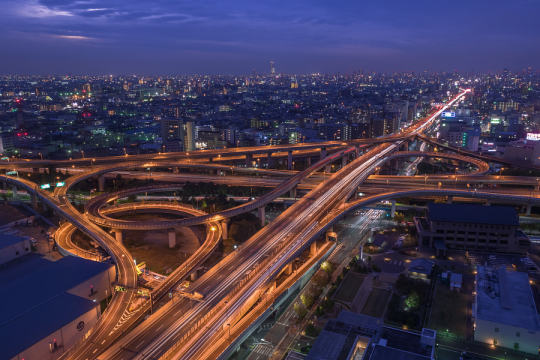
    Blue hour by Ryusuke Komori on 500px.com

    https://500px.com/embed.js

    As a kid growing up in the suburbs of Toronto, I remember when getting my driver’s licence and getting a car were some of my biggest priorities. 

    As soon as I turned 16, I went immediately to get my learner’s permit and then enrolled in a driving school so that I could shorten the time required until I could drive on my own. Every month counted at that age.

    It was such an important milestone that people born earlier in the year were seen as lucky. Because someone born in January, for example, could gain their driving independence before someone born at the end of the year even got their learner’s permit. As silly as it sounds to me right now, that spread was huge back then.

    But the world has changed and we are at the dawn of a new era: driverless cars. 

    Sooner than most people think, we are no longer going to drive ourselves around cities. I absolutely believe this. That means no more steering wheels. No more traffic calming measures on quiet residential streets. Safer streets. Perfect traffic information because all the cars will be networked. And a dramatic increase in urban efficiency. (Relevant post: The tragedy of the commons.)

    I can’t wait for this happen.

    Reid Hoffman, who is the co-founder of LinkedIn, recently wrote a fascinating article on autonomous vehicles called, Driving in the Networked Age. And in it he argues that cities should be starting to look at banning human-driven cars and generally putting in place policies to support networked autonomous cars. In fact, he sees it as an opportunity for Detroit to reestablish itself as the 21st century motor city.

    Again, I don’t doubt that this transition will happen. I think it’s a question of when, not if. But I also think that it’s going to be incredibly important to think about what driverless vehicles will mean for our cities and the built environment. 

    It’s once again an example of Marshall McLuhan’s famous phrase: The medium is the message

    Cars as a medium have had a profound impact on the way we live and the way we build our cities. We know this. But the medium is now changing. And while simply taking out the driver may seem like a small change, it is not. Have a read of Hoffman’s article.

    I’m excited about the possibilities. I don’t really like driving anymore. But let’s make this second coming of the car more positive for cities than the first. Deal?

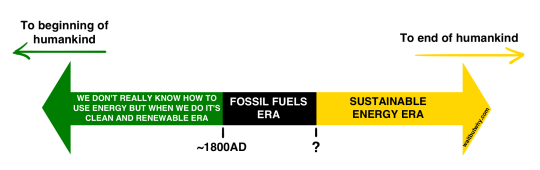
  • A history of energy and cars (and how Tesla is changing the world)

    image

    I spent this morning reading a long – but incredibly worthwhile – article by Tim Urban on Wait But Why called, How Tesla Will Change The World. (Are they all this long? It was my first time reading WBW.)

    The article, of course, talks a lot about Tesla, but it’s so much more than that. It talks about (1) the history of energy, (2) the history of cars, and then about (3) Elon Musk and Tesla. If you have the time, I highly recommend you give it a read.

    But since it is long and many of you probably won’t do that, here’s an extract from the third section on Tesla (EV = electric vehicle/car):

    EVs aren’t there yet. Right now, there are legit cons. But as the next few years pass, EVs will get cheaper, battery ranges will get longer and longer, Superchargers will pop up more and more until they’re everywhere, and charging times will just decrease as technology advances. Maybe I’m missing something, and I’m sure a bunch of seething commenters will try to make that very clear to me, but it seems like a given to me: the gas era is over and EVs are the obvious, obvious future.

    The car companies, as I mentioned, aren’t happy about all of this—they’re acting like a kid with a cupcake whose parents are forcing them to eat their vegetables.

    But how about the oil industry?

    Unlike car companies, the oil industry can’t suck it up, get on the EV train, and after an unpleasant hump, continue to thrive. If EVs catch on in a serious way and end up being the ubiquitous type of car, oil companies are ruined. 45% of all the world’s extracted oil is used for transportation, but in the developed world, it’s much higher—in the US, 71% of extracted oil is used for transportation, and most of that is for cars.

    As Tim states at the end of his article, this piece is all really about change and progress. Progress is not inevitable. It doesn’t just happen as time marches on. It happens because of strong willed people who believe in something that many others probably don’t. 

    Because with many changes – regardless of how critical or beneficial they may be to society as a whole – there will almost always be entrenched interests that would rather see things stay exactly the same. But in my view, that shouldn’t get in the way of doing the right thing.

    Image: Wait But Why

  • What will driverless electric cars mean for cities?

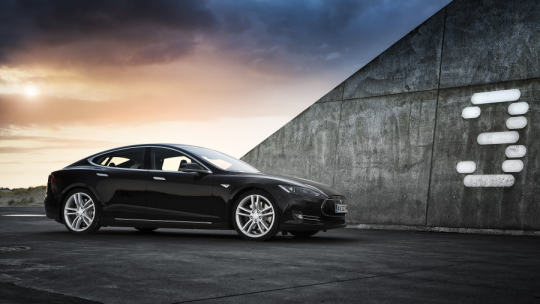
    Photograph T E S L A by Thomas Juel on 500px

    T E S L A by Thomas Juel on 500px

    Yesterday I posted a video about the career of Elon Musk. And it reminded me of something that’s been on my mind as I think about transportation, cities, and the future.

    Elon’s story for why he founded SolarCity, Tesla, and SpaceX is incredibly compelling. He chose problems and industries that he felt would move humanity forward. He felt that we needed sustainable forms of energy production (SolarCity), sustainable forms of transport (Tesla), and a way for humans to occupy other planets (SpaceX). That’s incredible ambition.

    Today though, I just want to focus on the transportation piece.

    Electric and driverless vehicles, I believe, are a step in the right direction. I honestly believe that at some point in the not too distant future we’re going to look back at that time when people used to drive their own cars and wonder how we ever allowed that to happen.

    But fundamentally, I think there still remains a question of how best to plan our cities. 

    There’s lots of talk today about peak car and the death of the automobile. Certainly within planning and urbanist circles, there’s an almost universal belief that planning (most of) our cities around the car, as opposed to people, was a huge mistake. Multimodal solutions with a public transit backbone are now the way forward.

    But will that always be the case as the notion of the “car” evolves?

    Intuitively, driverless vehicles feels like a massive opportunity to leverage data and better optimize our private transport assets. We know that the utilization rate for most private cars is incredibly low and so there’s lots of room to improve how we use and share private vehicles and how we move people around cities.

    But how big is that opportunity? Does a city filled with driverless electric vehicles and with networks like Uber mean that public transportation now becomes less important? And if so, how much less important?

    I can’t help but feel like private and public transport are on a collision course right now. I suppose that isn’t anything new. But this time around I wonder if private transport won’t figure out a way to achieve similar efficiencies to large scale public transport.

  • Marginal cost = 0

    Earlier this week I wrote a post called: The pull from services to products. And in it I made mention of the fact that part of what’s driving this pull towards products is that the marginal cost of servicing additional users or customers is almost nothing in a world of internet services and products.

    Well the reality is that this phenomenon is driving a hell of a lot more. It could – and probably will – fundamentally change almost all aspects of the economy.

    I know that sounds like a pretty audacious statement, but if you watch the following 10 minute talk by Albert Wenger (Union Square Ventures) you might start to feel the same way. He outlines 5 changes being driven by the fact that in the digital world, marginal cost = 0. The impacts go well beyond tech, capturing sectors such as transportation and industrial real estate.

    [youtube https://www.youtube.com/watch?v=sVEtTzlqsoE?rel=0]

    If you can’t see the video, click here.

  • Did we hit peak car?

    image

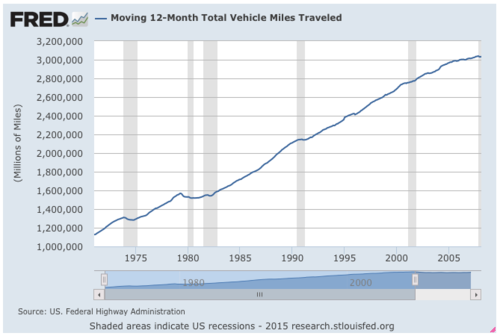
    The total number of vehicle miles traveled in the US used to largely do only one thing: go up. This is made it fairly easy for the Federal Highway Administration (FWHA) to forecast how much more Americans were going to drive in the coming years – they just extended the trend line.

    Below is what that looked like since the early 1970s (via FRED Economic Data). You’ll see that the total vehicle miles traveled went from somewhere around 1.1 trillion miles to around 3 trillion miles in and around the late 2000s. The shaded areas represent recessionary periods.

    image

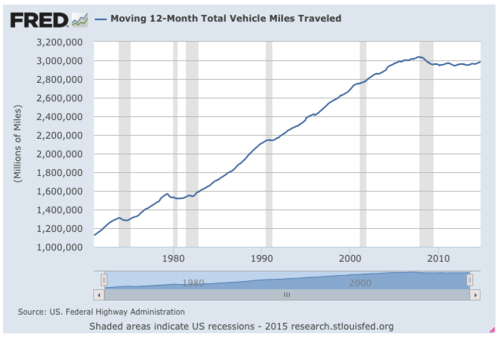
    But then in 2007, something happened. Total vehicle miles traveled peaked, declined, and then flat lined at just under 3 trillion miles. Here’s what that looked like (the ending time period is October 2014):

    image

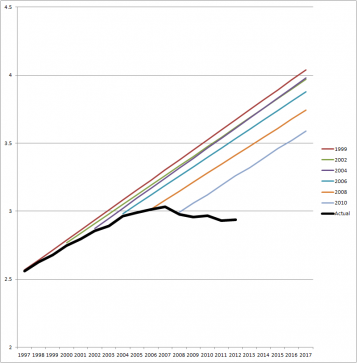
    However, since this was new for the FHWA, they continued to believe that this would ultimately correct itself and that total VMTs would eventually continue on their linear ascent. So here’s what their projections looked like (via State Smart Transportation Initiative):

    image

    Clearly things didn’t go as planned.

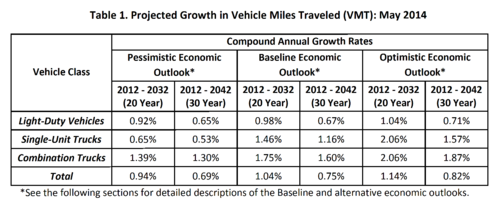
    But then in May of last year (2014), the FHWA finally changed its tune and released this forecast, which had the following projections:

    image

    It outlined 3 economic scenarios: a pessimistic one, a baseline one, and an optimistic one. In their baseline outlook, they believed that the annual growth rate for total vehicle miles traveled in the US would be 0.75% over a 30 year period running from 2012 to 2042.

    At the same time, they also stated that population growth would average about 0.7% per year through this same period. This means that the FHWA has more or less conceded that total vehicles traveled per person will likely remain flat, which is a significant change from previous forecasts.

    Now, given their track record, I don’t think any of us should put a lot of faith in the accuracy of these numbers. Per capita driving could flat line. But it might also go down, which is what it has been doing over the past few years.

    Either way, I do think it’s worth thinking about this shift. It’s a pretty big deal.

    Top Image: Flickr

  • A revolution in personal mobility

    In the spirit of Startup Weekend, I thought it would be interesting to go back in time and pretend to pitch one of the most disruptive innovations of the 19th century: the automobile.

    Typically pitches start by first outlining the problem. The idea is to make your audience aware of the pain point, so that they feel excited when you ultimately pitch your solution.

    In the case of cars, the incumbent technology would have been horses. So I can imagine somebody standing up and talking about how horses are slow and how they drop stinky poo all over our city streets. And that the time has come for a revolution in personal mobility! Enough of this crap! 🙂

    But while many of us probably can’t imagine a world without cars, try and put yourself in the shoes of somebody at the end of the 19th century who can’t imagine a world without horses. And then think about all the things we have subsequently done to make cars thrive:

    • We paved roads and created networks of freeways.
    • We invented rules of the road to ensure that people were operating these new devices properly.
    • We created a licensing system to ensure that anybody who was operating a car was doing so relatively safely and following the rules that had been created.
    • We created schools that taught people how to be better drivers.
    • We started insuring cars for when accidents inevitably happened.
    • We started having to accept fatal car accident and pedestrian deaths.
    • We built networks of gas stations. As of 2004, there were 168,000 retail locations selling gas in the United States.
    • We had to give over large land masses to parking. In fact, we reorganized entire cities so that the car could be better accommodated.
    • And we setup government transportation divisions to make sure the needs of the car were always being met.

    This is a long list of things we had to do to make cars possible and I’m sure there are many others that I have missed. Today, we all know how disruptive cars have been and we’re certainly questioning many of the things we have done. But we also accept this list as being largely normative.

    However, before they were the norm, they were insurmountable challenges. How will we teach everyone how to drive these new cars? How will we minimize accidents? How will we make it easy for people to refuel their cars? Where will people store them when they’re not using them?

    There were a lot of moving parts to figure out. 

    Which is why people like Paul Graham have argued that the best ideas almost have to live in your unconscious mind. Because your conscious mind would simply reject them as viable options as soon as you started thinking about all the required moving parts. I guess that’s why they say there’s a very fine line between crazy and brilliant.

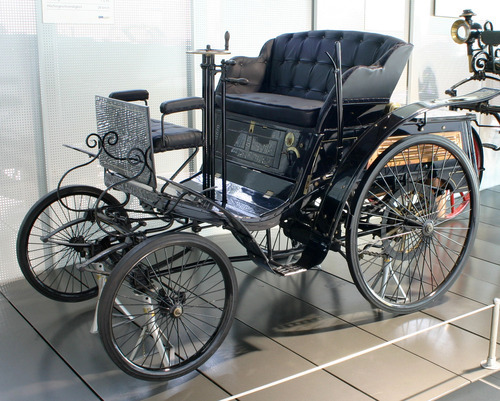
    Image: Benz Velo