Daily insights for city builders, delivered every morning at 6 AM ET. I’m Brandon Donnelly — a Toronto-based real estate developer and founder of Globizen. I’ve been writing here since 2013.

Tag: car

  • Automobile vs. tram

    In grad school, I was fortunate enough to be a teaching assistant for a class called Urban Real Estate Economics, which was taught by Dr. Richard Voith. It was one of my favorite classes. So if you ever find yourself at the Wharton School, I would highly recommend it.

    Richard is also the President of a consulting firm in Philadelphia called Econsult Solutions. And I think a lot of what they focus on would be of interest to the audience of this blog. Their focus is on urban economics, real estate economics, transportation, public policy, and – you get the idea.

    Recently, he wrote a post called, Moving Cities: Berlin, where he outlines some of the transportation decisions that West and East Berlin made in the second half of the 20th century. 

    What I found most interesting was how the trams of East Berlin were stigmatized to represent communism and a centrally planned economy. On the other hand, West Berlin was all about the free market, and the symbol for that was none other than the automobile. That meant that the trams had to go. 

    Here is a quote that he shares from B.R. Shenoy, first published in August 15th, 1960:

    “The main thoroughfares of West Berlin are near jammed with prosperous looking automobile traffic, the German make of cars, big and small, being much in evidence. Buses and trams dominate the thoroughfares in East Berlin; other automobiles, generally old and small cars, are in much smaller numbers than in West Berlin. One notices cars parked in front of workers’ quarters in West Berlin… In contrast with what one sees in West Berlin, the buildings [in East Berlin] here are generally grey from neglect, the furnishings lack in brightness and quality, and the roads and pavements are shabby…”

    My favorite line: “…jammed with prosperous looking automobile traffic.”

    Of course, Berlin wasn’t the only city to eschew trams in the 20th century. Detroit and Los Angeles both did exactly the same thing. But in Berlin, this philosophy wasn’t applied equally across the urban fabric. And that’s what makes it a particularly interesting case study.

    I don’t know Berlin well enough to comment specifically, but Richard writes about how parts of East Berlin remained quite pedestrian friendly compared to West Berlin. That makes intuitive sense, given that it didn’t reorient itself towards the car in the same way that the West did. That being the case, I am curious to what extent those parts of the city may be benefiting today.

    In any event, you should also give Richard’s article a read. You can do that here.
  • Everything you ever wanted to know about automated vehicles

    Last fall, David Ticoll (who is a research fellow at the Munk School of Global Affairs at the University of Toronto) published a thorough discussion paper called Driving Changes: Automated Vehicles in Toronto

    If you’re interested in driverless cars, and I know that a lot of you are, then it’s definitely worth a weekend read. It’s fairly long. He gets into the various automation levels, the transition period, the implications for policy makers, the benefits, and so on.

    Here’s a quick snippet on the topic of benefits:

    “This report provides bottom-up analysis based on Toronto-specific data. The result is a conservative estimate that were AVs to be at a 90% adoption rate in Toronto today, the result would be annual savings of $6 billion, or 4% of the City’s $150 billion gross
    domestic product. This includes $1.2 billion from reduced collisions, $2.7 billion out of congestion costs, $1.6 billion from insurance, and $0.5 billion from parking fees and fines. AVs will provide other quantifiable social and economic benefits that range from fewer deaths and hospitalizations thanks to lower particle emissions, to productivity gains in many business sectors.”

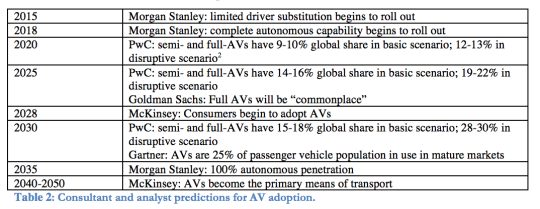
    But of course there’s the question of: when will this happen? Below is a chart from the paper that was assembled using various consultant/analyst predictions. Based on this, we’re still over a decade away from the consumer adoption of automated vehicles.

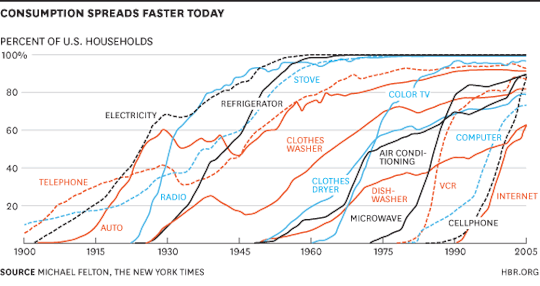
    However, these are just estimates and history has shown us that the adoption rate for new technologies has been increasing over time. Below is a chart by Michael Felton, which is also from the paper, that shows this phenomenon. Take a look at the telephone in comparison to the internet.

    Maybe I’m being overly optimistic (it wouldn’t be the first time), but consumer-facing driverless cars, at least to me, feel pretty close to the horizon.

  • We’re driving again

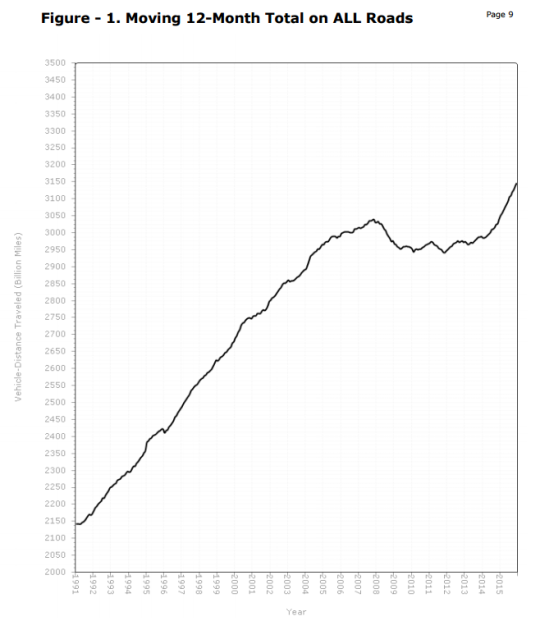
    For a number of years now, urbanists – including myself – have been thinking about “peak car.” And that’s because if you looked at vehicle miles traveled (VMT) in the United States since about 2007, the trend line was more or less flat. 

    This had us wondering whether or it was simply an outcome of the recession or some sort of broader shift.

    Well, if you look at the December 2015 numbers from the U.S. Department of Transportation, VMTs are once again growing. In fact, it’s now above the 2007 “peak.” Compared to December 2014, travel on all roads and streets in December 2015 was up by 4.2% or 10.6 billion vehicle miles traveled. 

    Here’s the chart:

    A lot of this could be because of lower gas prices. But I would be curious to hear your thoughts in the comments about whether or not you think 2007 to 2014 was (1) a recessionary blip or (2) a longer term trend in the making.

  • Brébeuf

    I woke up this morning at 5:30 am in a hotel in Ottawa.

    I then drove to Brébeuf, Quebec to meet some friends for a ski and snowboard weekend. (It’s beautiful here.)

    Upon arriving I was faced with a large hill that my rear-wheel car with all season tires was absolutely not prepared for. So that sucked up about an hour of time.

    After we unstuck my car, we then spent the day skiing and snowboarding at Mont-Tremblant. (First day of the season for me.)

    At this point all I can think about is a good night’s sleep, so I’m afraid that there won’t be much of a post today on Architect This City.

    But please feel free to hijack the comment section and talk about whatever you would like. Maybe we can get some action started there.

    I would actually be really curious to see what topics interest all of you.

  • Should you buy a car or just take Uber?

    Urban dawn by Raymond  on 500px.com

    https://500px.com/embed.js

    My friend Evgeny published a great blog post today called, On Car Ownership And The Future Of Transportation

    And in it he made the argument that instead of buying a car and an expensive downtown Toronto parking spot (average price: $40,000 – 60,000), most of us urbanites would be better of just taking a taxi or Uber.

    This got me thinking: At what point does it really make sense to completely forgo owning a car? (Full disclosure: I own both a car and a downtown parking spot.) So I decided to dig into the numbers a bit more and compare 4 mobility options:

    • Owning a car ($25,000 upfront) + downtown parking spot ($40,000 upfront) and driving yourself everywhere
    • Taking a regular taxi exclusively ($3.25 base + $1.75 per km)
    • Taking an UberX exclusively ($2.50 base + $1 per km)
    • Or, taking a futuristic driverless car everywhere (here I assumed $1.50 base + $0.25 per km)

    With the above numbers, I then assumed 15,000 km traveled per year and an average trip length of 15 km (so 1,000 trips per year). The trip length and number of trips per year matter because of the “base fare” that is charged when you take a taxi or Uber.

    I also assumed that the cost of owning a car is $0.60 per km (estimated from this Globe and Mail article) and that there is an opportunity cost to NOT renting out your downtown parking spot ($200/month). That is, every month that you spend driving yourself around and parking your car, you are forfeiting parking revenue.

    Finally, I looked at a 10 year time horizon and then “discounted” all the costs back to today’s dollars so that I could compare each mobility option.

    So what did I find?

    image

    What this says is that if you’re driving 15,000 km per year (average trip length 15km), then you’re better off taking UberX everywhere, as opposed to going out, buying a car and parking spot, and driving yourself around.

    But does this hold true at different travel distances?

    Based on my model, once you hit around 18,000 km per year, then you’re better of with option 1 (owning a car). That’s because the per km savings associated with driving yourself around are enough to offset the upfront costs of the car and parking spot.

    On the flip side, when you drop below 7,500 km traveled per year, even a regular taxi starts to make sense. That’s because you’re simply not traveling enough to reap the benefits of owning a car/parking spot. Again, high upfront costs; lower per km operating costs.

    Of course, there are a number of things I didn’t consider in my model. For one, most people finance their car and parking spot (it is bundled into their home mortgage). So I’m sure there are ways that you could change the above outcomes using leverage.

    At the same time, I didn’t account for the fact that when you’re being driven around (as opposed to driving around) you have the flexibility of doing work, responding to emails, and so on. If you want to attach a value to your time, then the scale would tip back in favor of taxis and Uber.

    But all of this was really just to make one point: look how cheap it could be to ride around in a driverless car. When that becomes the reality in our cities, which it will, it’s going to completely transform our current beliefs around cars, parking, and many other things.

    I guess that’s why General Motors just invested $500 million in the peer-to-peer ridesharing company, Lyft. They know the shit is coming.

  • Big box stores are the new noxious-use

    As a follow-up to yesterday’s post on New Urbanism, I thought I would post an interesting video discussion between Andrés Duany and Ben Stevens. 

    Duany is the father of New Urbanism and Stevens runs a great blog called The Skyline Forum where he interviews notable city builders, developers, architects, planners, and so on. If you can’t see the video below, click here.

    [youtube https://www.youtube.com/watch?v=QfZZ61C4YOY?rel=0&w=560&h=315]

    Once again it’s a great reminder that so much of what we do and build in our cities is dictated by parking requirements. One of the ways Duany differentiates New Urbanism from “old urbanism” is that the new explicitly provides for the car. 

    Regrettably, I think we do that almost everywhere nowadays. But I take his point that New Urbanism happens almost as an intervention in areas where there are few or no other mobility options besides the car.

    I also thought it was interesting that Duany refers to big box stores as the new noxious-use in cities, rather than industry. He describes the parking, not the stores themselves, as creating a “flume of unwalkability.”

    It always seems to come down to parking.

  • Driverless cars, urban mobility, and Toronto’s Gardiner Expressway

    image

    About a week ago I wrote a post questioning what driverless cars will mean for cities. I ended by saying that that it feels as if we’re going to see increasing tension between private and public transport.

    What I meant by that was simply that conventional notions around private car use are going to change. And ultimately that is going to mean that we need to rethink public transport and how that fits into a broader urban mobility framework.

    What do I mean by this?

    The International Transport Forum at the OECD recently published a fascinating report called, Urban Mobility System Upgrade: How shared self-driving cars could change city traffic. And it deals with exactly the sorts of things I am thinking about.

    The study looked of what might happen when all cars become self-driving in a mid-sized European city (specifically Lisbon, Portugal). They leveraged existing transportation data from the city, but replaced 100% of the human powered cars with two types of self-driving cars: TaxiBots and AutoVots.

    TaxiBots were driverless cars that would be shared with multiple people at the same time. In other words, they were a kind of pseudo-public transit. And AutoVots we’re your more conventional private taxi. They picked up one person at a time.

    So, what did they find?

    In the first scenario, they combined their TaxiBots and AutoVots with public transit (light rail) and discovered that the same number of people could be moved around with only 10% of the cars currently on the road. That’s a 90% reduction!

    They also found that the city needed 20% less on-street parking and 80% less off-street parking since driverless cars don’t need to sit idle waiting for a driver.

    In the second scenario, they removed mass transit from the equation. And in this instance they found that the city was still able to get around, but with an 80% reduction in the number of cars on the road. Remarkably, it also led to a 10% reduction in rush hour commute times.

    These are pretty profound changes. Reducing the number of cars on the road by 80-90% is a significant change. 

    But it’s also why I’ve been thinking about the tension between private and public transport. As we get better at optimizing “cars” (their definition will change), what becomes the role of true public transit?

    Ultimately, I think what will happen is a blurring of the two. In the example above, the TaxiBots served basically as small scale public transit. But that does not necessarily mean that true mass transit will become irrelevant. We’re just going to need to rethink how the entire mobility network fits together.

    I’d now like to bring this discussion back to Toronto for a minute.

    As many of you probably know from this blog, Toronto is on the cusp of deciding what to do with the eastern portion of the Gardiner Expressway (an elevated highway that runs across the downtown waterfront). It will go to City Council next month. 

    I firmly believe that we should remove it, but there many people who believe we shouldn’t. The main objection seems to be that the traffic projections indicate that removing it could make commuting into downtown – by car – 3 to 5 minutes longer by 2031

    By today’s standards, I believe this concern represents an outdated way of thinking about cities and urban mobility. Adding more lanes is like loosening your belt to deal with obesity. However, it gets even worse when you think about urban mobility in the context of this post.

    Given the profound transportation changes that are currently underway, I think there’s a strong likelihood that the Gardiner projections we have today will be completely wrong by 2031. I don’t know know for sure, but I’m guessing the models don’t account for the efficiencies being created by driverless cars and peer-to-peer networks.

    In other words, I am suggesting that those 3 to 5 minutes could prove to be a red herring. The relevant question should be: Which decision will allow Toronto to build the absolute best waterfront in the world? And in my opinion that leads to removing the Gardiner East.

    If you feel similarly, I would encourage you to write your local City Councillor.

  • A revolution in personal mobility

    In the spirit of Startup Weekend, I thought it would be interesting to go back in time and pretend to pitch one of the most disruptive innovations of the 19th century: the automobile.

    Typically pitches start by first outlining the problem. The idea is to make your audience aware of the pain point, so that they feel excited when you ultimately pitch your solution.

    In the case of cars, the incumbent technology would have been horses. So I can imagine somebody standing up and talking about how horses are slow and how they drop stinky poo all over our city streets. And that the time has come for a revolution in personal mobility! Enough of this crap! 🙂

    But while many of us probably can’t imagine a world without cars, try and put yourself in the shoes of somebody at the end of the 19th century who can’t imagine a world without horses. And then think about all the things we have subsequently done to make cars thrive:

    • We paved roads and created networks of freeways.
    • We invented rules of the road to ensure that people were operating these new devices properly.
    • We created a licensing system to ensure that anybody who was operating a car was doing so relatively safely and following the rules that had been created.
    • We created schools that taught people how to be better drivers.
    • We started insuring cars for when accidents inevitably happened.
    • We started having to accept fatal car accident and pedestrian deaths.
    • We built networks of gas stations. As of 2004, there were 168,000 retail locations selling gas in the United States.
    • We had to give over large land masses to parking. In fact, we reorganized entire cities so that the car could be better accommodated.
    • And we setup government transportation divisions to make sure the needs of the car were always being met.

    This is a long list of things we had to do to make cars possible and I’m sure there are many others that I have missed. Today, we all know how disruptive cars have been and we’re certainly questioning many of the things we have done. But we also accept this list as being largely normative.

    However, before they were the norm, they were insurmountable challenges. How will we teach everyone how to drive these new cars? How will we minimize accidents? How will we make it easy for people to refuel their cars? Where will people store them when they’re not using them?

    There were a lot of moving parts to figure out. 

    Which is why people like Paul Graham have argued that the best ideas almost have to live in your unconscious mind. Because your conscious mind would simply reject them as viable options as soon as you started thinking about all the required moving parts. I guess that’s why they say there’s a very fine line between crazy and brilliant.

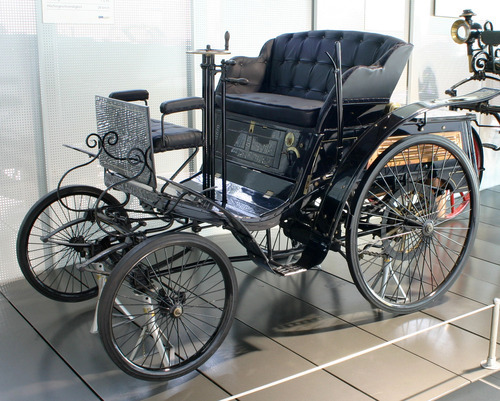
    Image: Benz Velo

  • Riding an escalator for the first time

    image

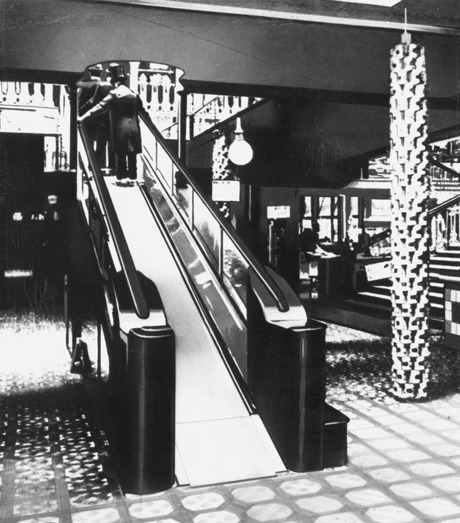
    On Wednesday, November 16th, 1898, Harrods department store in London opened up the first escalator – or moving staircase as it was called – in England. The first escalator-like machine in the world had actually been patented many decades before in the US, but this was the first real application in England and likely one of the first in the world.

    At the end of the 1800s, this was a big deal. Victorian England had never seen or experienced anything like this before and people were genuinely concerned about its use. More specifically, people worried what such a rapid change in elevation would do to the body. It was believed that it could discombobulate your inner workings. People were unnerved.

    Which is why when it was first introduced at Harrods, people were offered brandy and other substances at the top of the escalator in order “to revive them after their ordeal.” Riding an escalator was no small feat for these people.

    Now to us today, this sounds ludicrous. Most of us probably ride a few escalators a day. They’re ubiquitous. But I tell this story because I think it clearly underlines how disruptive the new and unknown can feel, and how difficult it can be for us to accept sometimes.

    If you go back throughout history, you could easily replace escalators for many other new technologies: the printing press, the automobile, the internet, and so on. And in some cases we were wrong to worry, and in other cases we were right to worry.

    Cars, for example, have had a pretty dramatic impact on our lives and the way we build our cities. And since the very beginning, they had no shortage of critics. But does that mean we should have never invented the car? I don’t think so.

    As I said earlier this week week, the goal in my mind is to find the right balance between preservation and progress. Just as we shouldn’t be so quick to erase our architectural history, we shouldn’t be so quick to erase our way of life.

    But at the same time, it’s important to remain open minded to what’s coming. I’m optimistic about the future. Change can be a great thing, even if it may feel as uncomfortable as riding an escalator for the first time. Maybe you just need a bit of brandy to calm your nerves.

    Image: Pinterest

  • The Human Scale

    Earlier today I stumbled upon a documentary called “The Human Scale.”  I haven’t watched it yet, but I’m planning to rent it from iTunes later this weekend. Here’s the trailer. Click here if you can’t see it below.

    [youtube https://www.youtube.com/watch?v=5CyLNS_ljHw]

    One of the things that’s so fascinating about studying cities right now, is that it feels as if we’re at a major turning point with respect to how we think about them. We’re coming off a long period (decades) of infatuation with the car, where planners and engineers predominately cared about one thing and one thing only: efficiently moving cars in and around cities.

    But having now fully built out cities around the car, we’ve come to realize two important things. First, that it’s virtually impossible to keep up with the demands of the car. No matter how many highways and roads you build, there always seems to be gridlock. And second, by focusing so closely on the car, we’ve built cities that aren’t great places for people.

    If you take a look at this short clip from The Human Scale (featuring Siena, Italy), I think you’ll immediately see how differently we used to build our cities and how disruptive the car has been to them.