Daily insights for city builders, delivered every morning at 6 AM ET. I’m Brandon Donnelly — a Toronto-based real estate developer and founder of Globizen. I’ve been writing here since 2013.

Tag: car

  • Apple’s next best thing is on the road

    I hate driving (specifically in the city), but I am fascinated by the next generation of Apple’s CarPlay, which I recently wrote about, here.

    One of the reasons why I’m fascinated is because so much of our built environment is built around the car. And since the built environment tends to be very sticky, I think one can safely assume that — for better or for worse, it’s actually worse — we’re going to need a lot of cars for the foreseeable future.

    According to Apple, 98% of new cars in the US come with CarPlay already installed. So, all cars. And the obvious reason for this is that many or most people want it. According to this survey, about 1/3 of new car buyers say that they wouldn’t buy a new car if it didn’t have Apple CarPlay or Android Auto.

    Apple believes this number is much higher at 79% of US buyers. I don’t know what the right number is, but I do believe the number is substantial and probably closer to Apple’s than the 1/3 figure. I certainly wouldn’t buy a new car without CarPlay.

    The result is a suboptimal situation for carmakers. Apple is still going to do whatever it takes to make carmakers want to use CarPlay. My recent post was largely about the design efforts that they have undertaken. But in the end, I’m not sure the auto industry has much of a choice.

    There’s likely no way they’re going to be able to compete with Apple (and Alphabet) from a software perspective and, in the end, consumers are going to want whatever pairs perfectly with their existing phone, since that’s where their entire life already lives.

    No wonder Apple killed their car project. They can just use everyone else’s cars. Even if this is a departure from their typical approach of controlling both the hardware and software.
  • The next generation of CarPlay

    Apple had plans to make an electric car. Then, earlier this year, it cancelled that project. Now, the plan seems to be to just get Apple CarPlay into everyone else’s cars.

    This is obviously smart, because it expands the Apple ecosystem, but it also means that they have to make it so that automakers want them in their cars.

    And since car companies have their own brands to manage, you end up with a somewhat unique scenario where Apple doesn’t own and control both the hardware and software, and it needs to be flexible in order to scale.

    This is if they want to control all of this:

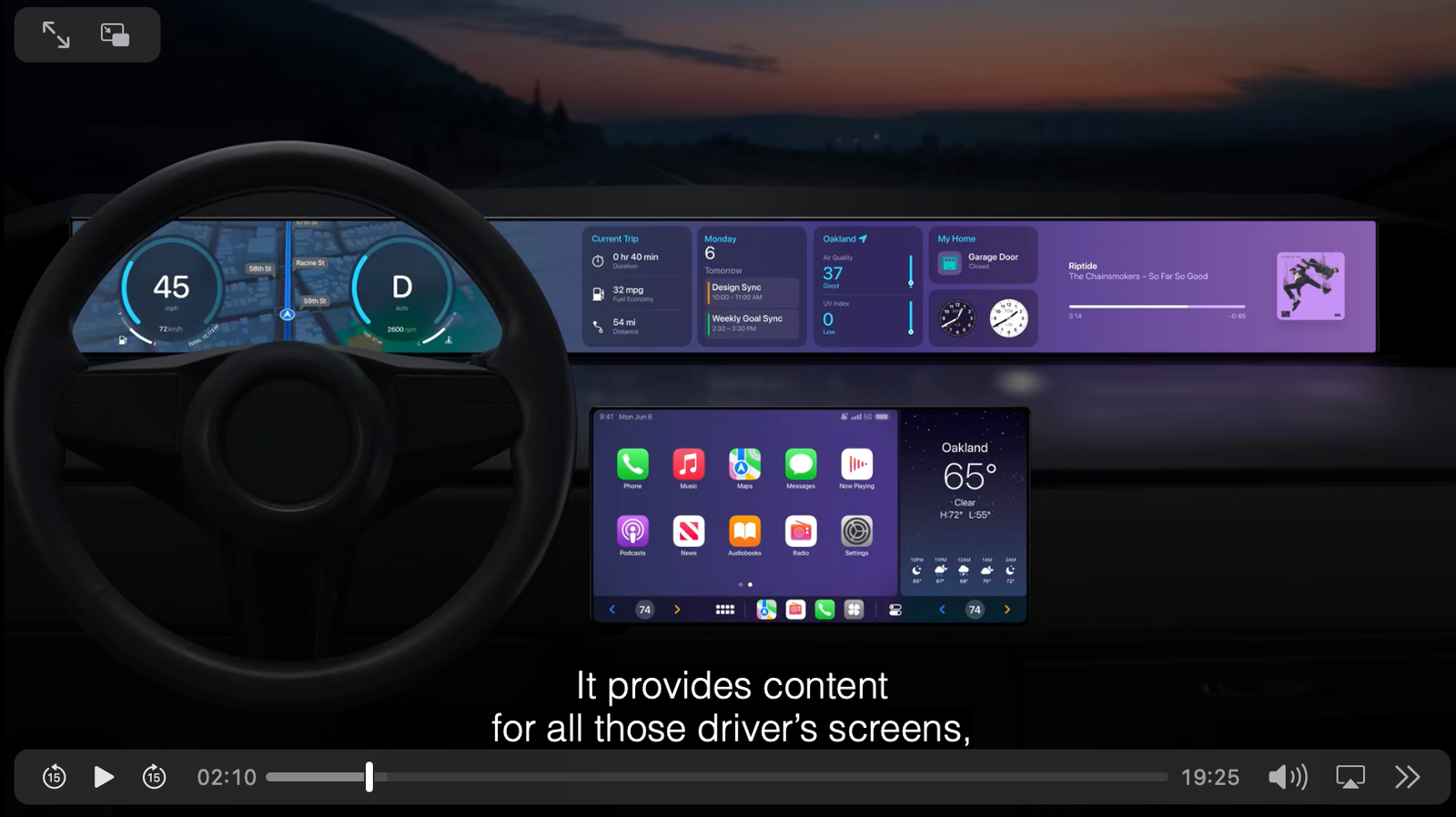
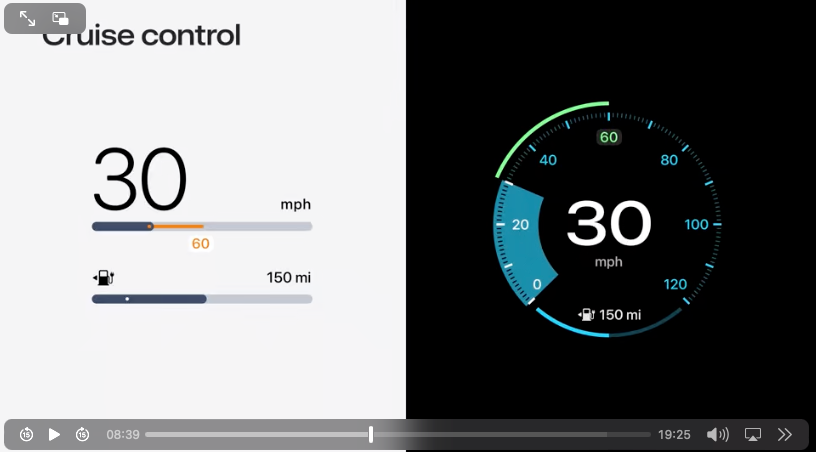
    The solution: A special co-branded experience that is going to allow car makers to heavily customize the appearance of CarPlay such that it reads as their own brand. This is how the next generation of the software will work and I think it’s a fascinating balancing act.

    Here’s another screenshot:

    If you’re also interested in this sort of thing, here’s a video explaining the new CarPlay’s design system. It’s primarily aimed at automakers and system developers, but you’ll also like it if you’re a designer.

  • Car washes are hot right now

    We talk a lot about walkable urban communities on this blog, and I’ll be the first to admit that this is my own bias. It’s my preference. But at the same time, we can’t ignore that, as of 2022, there were nearly 280 million registered personal and commercial vehicles in the United States. And that only about 8.3% of households do not have a vehicle. Most households drive in this part of the world.

    The result is that lots of people want to regularly wash their car(s). According to Bloomberg, there are some 60,000 car washes across the US, and the overall sector has been growing at roughly 5% per year (I’m not sure over what time period). More thrilling, though, are the stats that the car wash market is expected to double by 2030 and that there were more car washes built in the last decade compared to all prior years combined.

    The obvious reason for this is that there are a lot of drivers. But why right now? Apparently, there are other more specific reasons for the recent boom in car washes:

    Now, washes can take just 90 seconds, labor costs have been automated down, and recurring revenue from memberships has eliminated weather risks. Plus, the tax reforms enacted in 2017 by former president Donald Trump allowed car wash owners to claim 100% depreciation on new equipment — a generous subsidy to further investment. While that incentive was written to shrink over time, the tax proposal currently in Congress would restore the 100% depreciation allowance.

    This has the PE and real estate industries interested:

    “If private equity thinks it’s sexy, they’re gonna throw money at it, right?” said Emil Khodorkovsky, founder and CEO of Forbix, a real estate firm that just acquired a car wash in Santa Monica, California. “It’s a basic business. It isn’t complicated finance. Certain actors are getting squeezed but this one still has a much higher-yielding return than an apartment building or a retail center.”

    It’s hard to think of a retail use that is more antithetical to walkable urban communities. Even most drive-through places have the ability to service things that aren’t cars. It is also possible to go through a drive-through on a bicycle or other micro-mobility device. I have done this before and it was fun. But going through a car wash on a bicycle is probably a lot less fun.

    Intuitively, as long as there are lots of cars, there will be lots of people who want car washes. At the same time, there may even be a more urban use case, here. If you happen to have a garage and a driveway, there is always the possibility that you could wash your own car. But if you live in a walkable urban center and you park your car in a stacker accessed via an elevator, it’s probably a lot harder for you to do that.

    In this case, there’s a subscription for that.

  • A visit to BMW World

    Today we visited BMW Welt (World) and the BMW Museum in Munich.

    BMW Welt was designed by COOP HIMMELB(L)AU out of Vienna. It is the result of a design competition that the BMW Group held in 2001. Construction of the ~73,000 square meter facility was completed in 2007.

    The project is centered around a great hall and an elevated vehicle delivery area known as Premiere. It was designed — and this includes the HVAC system — to handle 40 car deliveries per hour, or 250 per day. I guess they don’t work a full 8 hours.

    Below are two photos that I took of the delivery area. The circles you see on the floor in the second picture are rotating platforms. This is where you want to pick up your new car.

    And here is a plan of the entire Welt space via COOP HIMMELB(L)AU:

    I also really enjoyed the BMW Museum, which is housed in a separate building adjacent to the BMW Tower (the one that looks like engine cylinders).

    The “art cars” were a lot of fun. I’m sure that many of you will be able to guess the artist behind this one:

    But what I enjoyed most were the classics like this one here:

    The least interesting cars for me were the ones that weren’t old enough to be “classic”, but also weren’t new and shiny. This can happen with architectural styles as well. Designs sometime need time to settle in.

    For more photos of BMW Welt and the BMW Museum, follow me on Instagram.

    Drawings/Isometrics: COOP HIMMELB(L)AU

  • Downward pressure on parking supply

    There’s a significant amount of downward pressure on parking supply in most major cities. Part of this has to do with the push toward more sustainable forms of transport, which is, of course, a good thing. But it also has to do with rising construction costs, the fear of obsolescence in the wake of autonomous vehicles, and probably many other factors.

    Developers, ourselves included, have responded by being cautious about the amount of parking being provided and by considering alternative future uses for the parking that is being built. I think it is also obvious that we will continue to see more, rather than less, parking stackers and other more efficient parking solutions.

    So far the cost of parking in dense urban centers has continued to rise. A new parking spot in the core of Toronto priced at $100,000 would not surprise me. And Hong Kong recently set a record for what is allegedly the most expensive parking spot in the world: USD 765,000 or CAD 1 million.

    But what is going to happen going forward?

    Researchers at the Singapore – MIT Alliance for Research and Technology and MIT Senseable City Lab, along with Allianz, have recently tried to quantify what the impact of autonomous vehicles will mean on required parking, and on traffic, in Singapore. The study is called Unparking.

    Today, they estimate the total number of parking spots in Singapore to be around 1,370,000. This is based on minimum parking requirements from the Housing Development Board and on the idea that home-work commuting consumes two parking spots: one at home and one at the office.

    They model four different scenarios, but the last one is based on fully autonomous vehicles and on shared parking spaces. Holding current mobility demands and traffic volumes constant, the demand for parking in this scenario drops by 70%.

    It is possible to reduce the number of parking spaces even further to 85%, but this has a negative impact on traffic congestion in their model. Fewer parking spaces means the autonomous vehicles have to drive around more picking people up. 

    I also don’t know if there was any consideration given to induced demand as a result of the more affordable autonomous vehicles. Demand for transportation services is generally thought to be fairly elastic.

    Whatever the case may be, numbers are made to be questioned. And Singapore is a unique city-state. But ¼ the amount of parking does not seem that far fetched to me.

    Photo by Tobias Jussen on Unsplash

  • Current state of autonomous vehicles

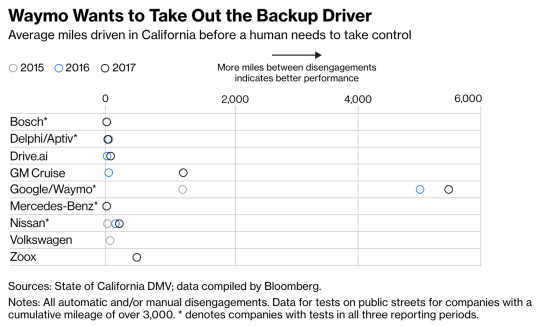
    This is an interesting piece by Bloomberg summarizing the current state of autonomous vehicles and in particular the (supposed) dominance of Waymo (Alphabet’s self-driving vehicle arm). Many believe they will be the first real entrant into the market.

    The company is currently running an “Early Rider” program in 25 cities. But its Phoenix trials are the furthest along, which isn’t at all surprising given the city’s car orientation and suburban fabric. Already Waymo has started offering passenger rides without a backup driver in the car.

    Overall, the company has come forward with four main business priorities:

    • Ride hailing
    • Trucking
    • Personal vehicles
    • Public transit

    But I still think that we’ll see a blurring of these priorities, if not outright cannibalization, as the cost per mile plummets. I mean, why own a personal vehicle if it is flat out easier and cheaper to just hail a robotaxi? 

    Here is an excerpt from the article talking about pricing:

    Tasha Keeney, an analyst at ARK Invest, says that Waymo could choose to offer an autonomous ride-hailing service today at around 70 cents a mile—a quarter of the cost for Uber passengers in San Francisco. Over time, she says, robotaxis should get even cheaper—down to 35 cents a mile by 2020, especially if Waymo’s technology proves sturdy enough to need few human safety monitors overseeing the autonomous vehicles remotely. “You could see software-like margins,” Keeney says.

    I can’t wait to be driven around for cents on the dollar. Click here to read the full article.

  • Electric vehicles are mostly leased

    At the beginning of this year, Bloomberg published this article talking about how the vast majority of electric car drivers lease, rather than own, their cars. The stats are as follows: In the US, about 80% of electric battery vehicles and about 55% of plug-in hybrids are leased, whereas only about 30% of all vehicles in the country are leased. 

    It is, however, important to note that the above doesn’t include any data points from Tesla. Since they sell their cars direct to customers, as opposed to through dealers, they have no obligation to publicly release this data. And so apparently they don’t.

    Conventional wisdom suggests that if you plan to drive the same car for an extended period of time – the average age of a car on the road in the US is over 11 years – it makes financial sense to buy. But in this case, people seem to be worried about technological obsolescence and the weak resale market for electric vehicles. This may also speak to the type of customers who are currently buying electric vehicles; they are early adopters and don’t want old cars.

    I’ve also seen someone argue that because some states require a percentage of car sales to be zero electric vehicles, it can be more cost effective for manufacturers to sell/lease them at a loss than pay the penalties or buy the ZEV credits. And with a lease, they at least get parts back at the end of the term. But I honestly don’t know much of a factor this plays.

    I hadn’t thought of this before I stumbled across the Bloomberg article, but it all makes sense to me. I find this reversal in ownership interesting because it tells me that how we consume cars can very easily change, and probably will moving forward.

  • The case for self-driving electric car fleets

    Below is a presentation by Frank Chen – head of research, deal, and investing at the venture firm Andreessen Horowitz – which makes the case for self-driving electric car fleets.

    He starts the presentation by talking about why he thinks this shift is going to happen faster than most people think. 

    One reason for this is that the batteries are becoming dramatically cheaper and the battery makes up a large part of the cost. By 2025, it is expected that electric vehicles will become cost neutral with ICE (internal combustion engine) vehicles assuming zero government subsidies.

    And by 2038, Bloomberg believes we will hit peak ICE vehicle sales. That is, electric vehicle and ICE vehicle sales globally will hit 50/50. Norway has already hit this threshold but they impose heavy financial penalties on ICE vehicles.

    2025 is not that far away.

    If you can’t see the presentation below, click here.

    [youtube https://www.youtube.com/watch?v=of5j-Lztqrg?rel=0&w=560&h=315]

  • Why dynamic road pricing is inevitable

    The Economist recently published an article called: How and why road-pricing will happen. If you’re a regular reader, you’ll know that there’s been lots of talk and support

    over the years

    on this blog for dynamic road pricing.

    It’s politically unpopular, but it’s an incredibly rationale way to deal with traffic congestion. 

    In Singapore – home of the world’s first congestion charge zone (1975) – they constantly monitor traffic congestion. As soon as average speeds drop over a three-month period, they simply raise the charge. Congestion gone.

    We know this works, but for many reasons road pricing is highly divisive. According to The Economist, there are a few reasons why this is going to become a bit more politically palatable.

    For one, the take from gas taxes and vehicle duties has been declining in Britain over the past couple of years. Electric vehicles will only exacerbate this trend. So governments are going to be forced to look elsewhere for money.

    Secondly, traditional tolls and congestion charges are becoming increasingly ineffective. Today in central London, private-hire vehicles are said to make up about 38% of all car traffic – almost double the share of traditional black taxis. 

    These are cars circling around the city, picking up passengers. Blunt charges based on suburbanites entering the city in the morning and leaving in the afternoon is simply not capturing the way that many of us move around our cities today.

    In other words, urban mobility is undergoing dramatic changes and the revenue and congestion management tools are going to need to adapt. If you’re interested in this topic, check out the full article here.

    Photo by chuttersnap on Unsplash

  • The ROI of cycling infrastructure

    Toronto can’t make up its mind right now as to whether it would like to invest in additional cycling infrastructure. 

    Of course, we have a history of vacillating on topics like this. And I think it’s because we’re at a tricky inflection point. We are weaning ourselves off of the car, but most parts of the city remain underserved by transit and heavily dependent on the car.

    So today I thought I would share some numbers from a research study that was published last year by Stefan Gössling of Lund University and Andy S. Choi of the University of Queensland. It’s called, Transport transitions in Copenhagen: Comparing the cost of cars and bicycles.

    Much of the focus of the paper is on the cost-benefit analysis that the City of Copenhagen uses to make its cycling investment decisions. Here is an excerpt from ScienceDaily:

    “If the costs to society and the costs to private individuals are added together, the impact of the car is EUR 0.50 per kilometre and the impact of the bicycle is EUR 0.08 per kilometre.

    The study by Stefan Gössling and his colleague also shows that if we only look at costs/benefits for society, one kilometre by car costs EUR 0.15, whereas society earns EUR 0.16 on every kilometre cycled.

    “The cost-benefit analysis in Copenhagen shows that investments in cycling infrastructure and bike-friendly policies are economically sustainable and give high returns,” says Stefan Gössling.”

    So there you have it. Now I thought we could debate this in the comment section. Your thoughts?

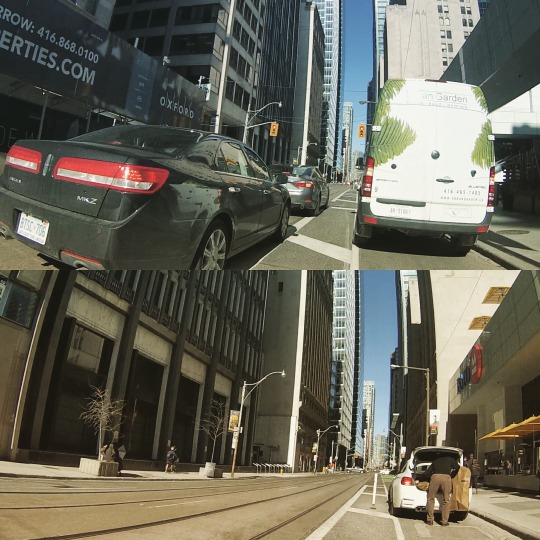
    P.S. The images at the top of this post were taken by me using my new GoPro bicycle handlebar mount.