
Daily insights for city builders, delivered every morning at 6 AM ET. I’m Brandon Donnelly — a Toronto-based real estate developer and founder of Globizen. I’ve been writing here since 2013.

Tag: capital city

  • Building new cities

    On this blog, we often talk about city building in the context of doing things to help improve a city — whether that be a development project, a new public art mural, or an interesting local business. These interventions help to build a city. But even more specifically, the term has, for many, come to mean building up a city in a positive way.

    But there is another way to think about city building. You can think of it in terms of building actual new cities. We’ve spoken about some of these before, namely this one in California and this odd one in Saudi Arabia. But apparently it is becoming more common. According to The Economist, the world is now building more new cities than it has in the last 80 or so years:

    Egypt’s “New Administrative Capital” is part of a rush of city-building. Firms and governments are planning more settlements than at any time in the post-war period, with many already under construction. Ninety-one cities have been announced in the past decade, with 15 in the past year alone. In addition to its new capital in the north, Egypt is building five other cities, with plans for dozens more. India is considering eight urban hubs. Outside Baghdad, Iraq, workers have just broken ground on the first of five settlements.

    In some cases, it is being done as a solution to urban congestion. If this city is too expensive and unaffordable, just create a new one. This appears to be part of the idea with the above city outside of San Francisco. Of course, new cities can also be created for ideological reasons, or for political purposes, which was the case with Brazil’s capital city, Brasilia.

    Here, the idea was to move the federal capital away from the country’s populated southeast region to a more geographically neutral location in the middle of the country. It also turns out that seeding a new city with government institutions is a good way to get one of these started. Existing cities do, after all, benefit from network effects.

    History points to characteristics shared by successful projects. State institutions can help anchor cities, as Brasília (in Brazil) and Chandigarh (in India) showed in the 20th century. Although both have had problems, people in Brazil and India are voting with their feet. Brasília’s population is growing at 1.2% a year, more than double the national average. Chandigarh, a state capital, is now India’s fourth-richest region on a per-person basis.

    But putting money, ego, and ideology aside, when does it actually make sense to start a new city in lieu of just expanding (or addressing the problems in) the one(s) you’ve already got? Population size can’t be the only factor in determining whether a city is “full”, because Tokyo seems to do just fine as the largest metropolitan area in the world.

    If it hasn’t already been done, I think this would make for an interesting research project. Until then, there’s this (paywalled) Economist article.
  • Indonesia announces new capital city on the island of Borneo

    On Monday, Indonesia’s president, Joko Widodo, announced a plan to build a new capital city on the island of Borneo. The plan is in response to Jakarta’s formidable environmental challenges. It suffers from some of the worst air quality in the world and is struggling with a severe subsidence problem, which, I understand, is partially (or largely) a result of climate change and the unregulated extraction of groundwater.

    About 40% of the city now sits below sea level and the worst affected areas are supposedly sinking at up to 20cm per year. This gives Jakarta the dubious distinction of being the fastest sinking big city. On top of this, it is also one of the biggest cities in the world in terms of population. The Jakarta megalopolis has over 30 million people, placing it 2nd after Tokyo according to this list.

    Here’s a short video from the BBC that will give you some visuals to go along with the above. These are the sorts of urban challenges that will make you forget all about separated bike lanes and 45 degree angular planes. And they are not entirely unique to Jakarta. If you can’t see the video below, click here.

  • Share your big idea for Canada’s #Capital2067

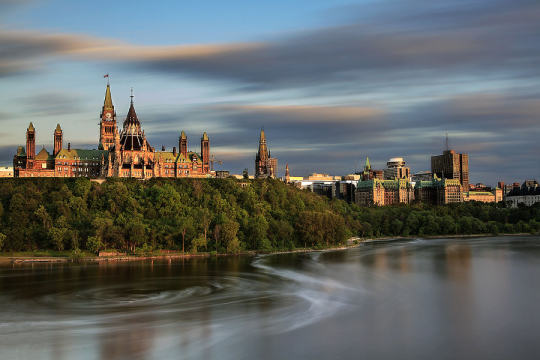
    Parliament Hill by Maryus Bio on 500px.com

    https://500px.com/embed.js

    On Thursday night I spoke at an Urbanism Lab event in Ottawa put on by the National Capital Commission.

    The event was all about the interconnection between the online world of blogging and social media, and the offline world of tangible city building.

    More specifically, one of the goals was to help inspire institutions, such as the National Capital Commission, to better leverage these new channels in order to get their message out.

    Social media and blogging may be ubiquitous, but lots of organizations are still getting their heads around it.

    So today I thought I would do my part and share something with all of you that, truthfully, I didn’t know was underway until I visited Ottawa.

    But first, how many of you (Canadians) are exactly aware of what the National Capital Commission does?

    The NCC is a federal Crown corporation that is focused on 3 specific mandates:

    1. They are the long-term urban planner of federal lands in Canada’s Capital Region. They are also the largest landowner in the region.
    2. They are the principal steward of nationally significant public spaces and buildings, including the Capital’s six “official residences.” Residences such as 24 Sussex Drive.
    3. And they are a “creative partner” on initiatives that tie into both development and conservation.

    To this end, the NCC is now working on a Plan for Canada’s Capital, 2017-2067. This is a 50-year plan that will outline what they do with federal lands, buildings, parks and other symbolic spaces in the Capital. And it will identity which projects would best craft and represent our national identity, as well as strengthen Canada’s influence in the world.

    This is all pretty important and interesting stuff. But unfortunately I didn’t know it was underway. And I also didn’t know what they were looking for “big ideas” from Canadians. These are ideas that will directly shape the 50-year plan.

    So if you have an idea – big or small – for the National Capital Commission, I would encourage you to click here and share it with them. Not only is this city building in the Capital, it’s also nation building.

    Please also feel free to copy and paste your idea(s) in the comment section of this post. These ideas definitely deserve a fulsome discussion. I will post mine once I write it.