Daily insights for city builders, delivered every morning at 6 AM ET. I’m Brandon Donnelly — a Toronto-based real estate developer and founder of Globizen. I’ve been writing here since 2013.
There are thousands of people who read this blog via email or by following on Tumblr. The rest of the readership just stops by on the web and visits periodically.
But of the thousands of regular readers, I know that many do not click through to the comment section. And that’s a shame. Because oftentimes I find the comments more interesting than my actual post.
The initial post was about Millennial housing choices (and some stats on marriage and fertility rates). The comments provided some additional color on the trends, but they also got into mobile dating apps and whether or not it’s easier or harder to meet people in cities, today. It was a fun discussion.
This got me thinking and reminded me that people come to cities not only because of labor markets, but because of dating markets.
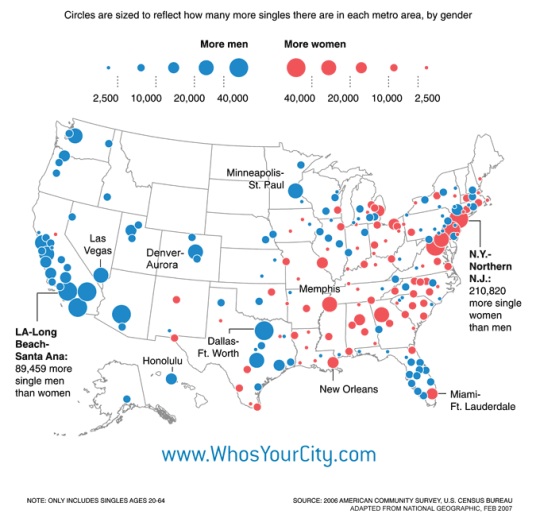
So for today’s piece, I thought I would post the following diagram from Richard Florida’s book, Who’s Your City? It shows how many more singles (aged 20-64) there are – according to gender – in the largest US metro areas.
I couldn’t find an equally detailed map for Canada, but based on this, it looks like Toronto is slanted towards single women and Calgary is slanted towards single men.
Having just spent the weekend in Calgary and Banff, I’ve been thinking a lot about importance of picking the right city in which to live. I’m not saying that I don’t love Toronto. Because I do. But I am incredibly envious of cities – like Calgary, Vancouver, and Denver – that have such easy access to incredible mountains.
Now, this might not matter to a lot of people, but it does to me. It’s a personal thing. There’s something really nice about landing in a city and seeing people leaving the airport with skis and snowboards in hand. And there’s something really nice about a city where so many people are active, outdoorsy, and fit.
It should start from the premise that the fundamental underpinning of the Canadian economy to have prosperity is dependent on the success of the cities, because 80 per cent of Canadians live in cities. -Toronto mayor John Tory
This week the leaders of Canada’s 22 largest municipalities are gathering in Toronto to figure out how to put urban issues on our national agenda. This is a topic I’ve touched upon many times before on Architect This City, but I continue to believe that it’s one of our most pressing issues.
We know that the vast majority of Canadians live in cities (see above quote) and we know that the vast majority of our economic output is concentrated in cities. In fact, roughly half of Canada’s GDP is produced in our 6 biggest cities alone – Toronto, Montreal, Vancouver, Calgary, Edmonton, and Ottawa-Gatineau.
But despite this concentration of wealth and economic activity, our governance structures do not reflect this reality. They’re outdated. They were built for a Canada that has passed. And so in my view, there’s a significant amount of untapped potential lying dormant in our cities if only we could get around to properly empowering them. There’s a “stimulus package” waiting to be unleashed.
In anticipation of this week’s leadership meeting, the Globe and Mail published an article called, Canada’s big city mayors ready to push urban agenda. And in it they included a number of interviews with Canadian mayors. It’s fairly long, but definitely worth a read. Here are a few relevant sound bites…
Vancouver mayor Gregor Robertson
We have an archaic system. Cities aren’t recognized in our constitution. It’s unbelievable. But Big City Mayors have set aside those important gaps because the needs are now so urgent on housing and transit, we can’t afford to spend a couple years debating structural change. For the time being, the focus is just on ensuring there’s more federal capital provided for transit and other urban infrastructure.
Calgary mayor Naheed Nenshi (on municipal funding sources)
I would prefer to levy myself, so that I’m ultimately accountable to my citizens and, if they don’t like it, they can get rid of me. Allowing others to levy the tools takes away predictability and stability, as well. That said, we’re starving here, and any improvement to the system that leads to those predictable, stable cash flows is a good thing.
Winnipeg mayor Brian Bowman (on the most pressing issue facing Canadian cities)
I’d say without question infrastructure and new funding models to modernize the ways that cities fund themselves. That’s something I’ve started discussions on already with some of my counterparts, Mayor [Naheed] Nenshi in Calgary, Mayor [Don] Iveson in Edmonton as well as Gregor Robertson in Vancouver. We’ve talked about a number of topics including the missing and murdered indigenous women and girls issue, public transit and rapid transit development. But the one consistent theme is that the way cities are funded is outdated.
Toronto mayor John Tory
I start from this premise: Are people paying enough taxes? In many cases, you could argue, not only are they paying enough taxes, they can’t afford to pay any more. We should be looking at the total amounts paid to all three levels of government and how that is being allocated. Do we believe that, in the case of Toronto, the federal and provincial governments are making adequate investments in transit, given the amount of money they take out of this area in taxation? I would say the answer is: not yet. [But] they have been doing better.
Montreal mayor Denis Coderre
We are negotiating a new pact between the province and Montreal, and it’s all about municipal autonomy. We need tools so we’re not always waiting in the hallway at the end of legislative sessions looking for amendments to make the city work better. Since 85 per cent of immigration in Quebec is going to Montreal, we need more control over tools of integration, like job creation and housing. Montreal needs financial leverage…
Two weeks ago I gave a brief presentation at The Laneway Project’s inaugural summit here in Toronto. I then wrote about it here on ATC.
At the time, I wasn’t sure if the event was being filmed or not, but it turns out it was. So here is my presentation from the event. It’s just over 7 minutes. Click here if you can’t see it below.
If you’d like to see the other 5 presentations and the Q&A session, click here.
Following the event, I was also interviewed by a radio show out of Calgary called Space + Place. If you are really into laneways and would like to listen to that as well, go here.
I’ve said this before, but I’ll say it again: I continue to be amazed by how much interest there is — both here in Toronto and elsewhere — in laneways. They may be overlooked today, but that’s going to change. It’s inevitable.
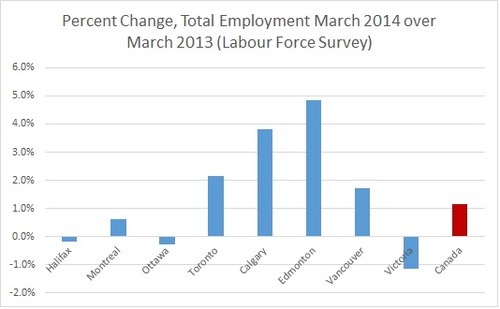
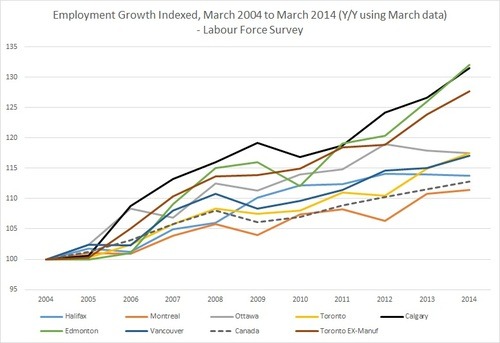
I was reading Wendy Waters’ All About Cities blog this morning and I came across the following charts showing employment growth across Canadian cities. The first chart shows total employment growth over the last year and the second chart shows employment growth over the past 10 years.
What is immediately obvious from these charts is that Calgary and Edmonton–both resource driven economies–have and are leading Canada in terms of employment growth.
Toronto isn’t that far behind though, particularly if you exclude manufacturing from the equation (see second chart). The decline of manufacturing in the Greater Toronto Area really represents a structural change in the economy.
I wanted to post these charts because, for all the talk about the rise of the information and digital age, Canada’s economy is still very much based on natural resources. We extract and sell. And we have one of the largest proven oil reserves in the world.
Now, I’m not opposed to this business model, but there’s lots of evidence out there to suggest that resource dependency ultimately hurts innovation and productivity–which makes sense. If we didn’t have resources, we’d be forced to figure out other ways to make money.
So while it’s great to see our cities growing, let’s not take it for granted.