Daily insights for city builders, delivered every morning at 6 AM ET. I’m Brandon Donnelly — a Toronto-based real estate developer and founder of Globizen. I’ve been writing here since 2013.

Tag: calgary

  • New rental supply needs to double in Toronto

    This week, RBC Economics published a study on Canada’s rental market where they argued that the pace of new supply needs to at least double in markets like Toronto in order to meet future housing demand and balance the market. Similar things, I’m sure, could be said about many other housing markets around the world.

    The report pegs the current rental housing deficit in Toronto at about 9,100 units:

    And because they believe that the cost of ownership is pushing more people into rentals, the number of renter households is expected to grow at an average rate of 22,200 units per year in Toronto.

    If you take 22,200 units per year over the next two years, and add in the current deficit of 9,100 rental units, you get to a total count of 53,500 rental units. This is what RBC Economics believes must be delivered to the market in order to restore equilibrium, and decrease the upward pressure on rents.

    Rental units are, of course, delivered to the market in two main ways. There’s purpose-built rentals and there are for-sale units that end up as rental housing. But even if you amalgamate both of these tenures, we are not building enough housing.

    Against this backdrop, I find it curious that developers are so often vilified. Earlier this week, I saw Jennifer Keesmaat tweet out that — as we ready for this fall’s federal election — any sensible housing plan must move away from our current for profit housing delivery model.

    Who, then, will build these 53,500 rental units? That part wasn’t clear to me.

  • Fees on homes

    A colleague of mine sent me this Bloomberg article today and said, “Here’s an article about things you already know.” The article cites a recent report by Altus Group that compared government-related fees on new housing across Canada and the U.S. What they discovered will not surprise any of you who are in the industry: Toronto has some of the highest government-imposed charges on new homes.

    For new condo apartments, the report found that government charges can add up to as much as C$124,582 per unit. That’s about 50% higher than the average unit in the U.S. and about 30% higher than the average unit in Canada (see above chart for the list of cities). While all of us in the industry can appreciate this, I don’t think most homeowners and tenants understand this. Hopefully they’re reading this post.

    Chart: Bloomberg

  • Slate announces minority investment from Goldman Sachs

    On Monday, Slate Asset Management announced a minority investment from Goldman Sachs Asset Management’s Petershill Program. This is great news, so here’s a copy of the full press release that went out.


    Toronto, August 19, 2019 – Slate Asset Management L.P. (Slate), a leading alternative asset management platform with a focus on real estate and real assets, today announced a passive, non-voting minority equity investment from Goldman Sachs Asset Management’s Petershill program, creating a strategic relationship with one of the world’s leading investment managers and positioning Slate for future success. The transaction will have no impact on the control or decision making of Slate. The day-to-day operations and management of Slate will remain unchanged.

    The investment provides capital that Slate will use to enhance its platform and increase its GP investments in current and future businesses and investment vehicles, further strengthening the firm’s alignment with its clients and investing partners.

    The investment accelerates Slate’s goal to build the leading independent alternative investment platform in real estate and real assets. As part of the transaction, Slate Founders Blair and Brady Welch have made a long-term commitment to the business.

    To date Slate has completed over $11 billion of transactions across Canada, the U.S. and Europe, through multiple vehicles spanning co-investments with global institutional partners, private equity funds and publicly-traded Real Estate Investment Trusts.

    “This investment in our platform is an endorsement of our people, our strategy and our future,” said Brady Welch, co-founder of Slate. “For our investors and our team, this is excellent news; our strategy and model remain the same, and we can now benefit from our new relationship with Goldman.”

    Blair Welch, co-founder of Slate, added that: “Since we started Slate nearly 15 years ago, we have showed that we can build tremendous value by providing our investors with a unique perspective, focusing on the fundamentals of the assets we acquire and delivering hands-on management that is innovative and creative. With our new relationship with Goldman Sachs, Brady and I are enthusiastic about what all of us at Slate can accomplish together over the next decade and beyond.”

    “Slate Asset Management is an incredibly innovative, dynamic real-estate focused alternative asset management platform,” said Robert Hamilton Kelly, Managing Director, Goldman Sachs Asset Management Petershill program. “We are big believers in the strategy, the team and the model. We are excited to partner with Slate as they work to capture the opportunities before them.”

    About Slate Asset Management

    Slate Asset Management L.P. is a leading real-estate focused alternative investment platform with over $6 billion in assets under management. Slate is a value-oriented manager and a significant sponsor of all of its private and publicly-traded investment vehicles, which are tailored to the unique goals and objectives of its investors. The firm’s careful and selective investment approach creates long-term value with an emphasis on capital preservation and outsized returns. Slate is supported by exceptional people, flexible capital and a demonstrated ability to originate and execute on a wide range of compelling investment opportunities. Visit slateam.com to learn more.

    About Goldman Sachs Asset Management’s (GSAM) Petershill Program

    The Petershill program is managed by GSAM’s Alternative Investments & Manager Selection (AIMS) Group, which provides investors with investment and advisory solutions across leading private equity funds, hedge fund managers, real estate managers, public equity strategies and fixed income strategies. With investments in over 20 asset management firms, the Petershill program provides strategic capital to mid-sized asset management firms and has raised over $5 billion of commitments since inception. GSAM is one of the world’s leading investment managers with more than $1 trillion in assets under supervision globally as of June 30, 2019.

    For more information:

    Slate Asset Management
    Katie Fasken
    416-583-1785

    Goldman Sachs
    Patrick Scanlan
    212-902-5400

  • A subway network at the scale of a country

    The Hyperloop space has a number of competing companies that are all trying to figure out how to move people (between cities) in low-pressure tubes at nearly the speed of sound (1,234.8 km/h). For what it’s worth, Virgin Hyperloop One, which was founded in 2014, has supposedly completed the most testing and raised the most money ($295 million as of December 2017).

    This morning I was reading up on the Toronto-based TransPod, which was founded in 2015 by Sebastien Gendron and Dr. Ryan Janzen. They raised a $15 million seed round from an Italian tech group in 2016 and are close on another $50 million round right now. Following this, they’ll look be looking for a few hundred million. They seem encouraged by where Canada’s Strategic Innovation Fund has been placing money.

    Supposedly, their biggest competitive advantage is cost. The company estimates their cost per kilometer to be about $25 million, which would put the cost of a Toronto-Montreal link at around $15 billion. This is not cheap, but it is allegedly cheaper. The travel time between these two cities could then be as short as 40 minutes.

    Virgin Hyperloop One has been similarly looking at a Toronto-Ottawa-Montreal line, as it would stitch together about 25% of Canada’s population. But apparently the federal government recommended that TransPod instead look at a line that sits entirely within one province — at least at the start.

    So the company has gone ahead and secured a 10-kilometer parcel of land in Alberta that will eventually form part of a future connection between Calgary and Edmonton. TransPod hopes to have this test track operational by 2022.

    However, their focus right now is on France. (Being in Europe is another differentiator for the company. Europe gets transport.) With the help of a few partners, the company has started work on a 3-kilometer test track in Limoges, France. Permits were received at the end of last year and they hope to begin testing by the end of this year.

    There’s no question that this technology has the potential to be transformational, which is why so many companies are competing in the space right now. But it’s obviously going to take a whole lot of moxie. Gendron is on the record talking about the risk-adverse nature of both Canadian regulators and investors when it comes to these sorts of large-scale innovations. That’s a problem that we need to address.

    The title of this post is a quote by Gendron taken from this TechVibes article.

    Image: TransPod

  • Canada admitted 321,065 permanent residents last year

    Bloomberg recently reported that Canada admitted 321,065 permanent residents last year. This is up 12% from 2017, where the country admitted 286,479. Last year was also the largest cohort since 1913 (the year before World War I), where the country admitted just over 400,000 people.

    Here is a chart from Bloomberg (it is interactive if you click through):

    Of course, Canada was a much smaller country back in 1913 (about 7.6 million people), and so on a percentage basis we are much lower than where we were at the beginning of the 20th century. We’d have to admit close to 2 million permanent residents a year to get to a similar rate.

    And that is not what is in the books. Here are the projected admissions for 2019 to 2021. All of the below stats are from the 2018 Annual Report to Parliament on Immigration.

    I couldn’t find a geographic breakdown for last year, but in 2017, about 40% of admitted permanent residents (or 111,925 total) ended up in Ontario and about 72% ended up in Ontario, Quebec, and Alberta (the top 3 provinces for this year). If we add in BC, it brings this figure up to 86%.

    Here are also the top 10 countries of origin:

    If you’d like to download a PDF of the full report, you can do that here.

  • Project Profile: New Central Library, Calgary

    The City of Calgary opened up its New Central Library this past week on November 1st, 2018, after a five-year construction process. 

    Designed by Snøhetta (design architect) with Dialog (architect of record) and Entuitive (structural engineer), the building was previously named one of “the 12 most anticipated buildings of 2018″ and one that will surely serve as a landmark for the city.

    One of the most interesting things about this project, for me, is how it both gives back and integrates with the broader urban fabric. 

    It is both a library and public plaza, and it sits atop the city’s busiest LRT line. About 40% of the site area is taken up by tracks (and probably setback), which means that the structural system of the building was forced into 12m (~40 foot) clear spans (done in concrete). It is the first time in the city’s history that an active LRT line has ever been encased and built over.

    It is a magnificent building and reason enough to visit Calgary, if you aren’t already there. I am hoping to get out there and photograph this project sometime soon.

    Images: Snøhetta and Entuitive 

  • Introducing Stephen Avenue Place

    Today, the Slate Canadian Real Estate Opportunity Fund I announced a new name for its 40 storey tower at 700 2nd Street in Calgary: Stephen Avenue Place

    It also announced that it has partnered with Oliver & Bonacini Hospitality and Concorde Entertainment Group to create three new dining destinations at the property: a top floor restaurant, a food hall, and a high-energy restaurant/bar/patio at street level.

    Here are a couple of excerpts from today’s press release:

    Stephen Avenue Place offers 620,000 square feet of rentable space at the nexus of the historic Stephen Avenue Walk and 2nd St. This classic of the Calgary skyline will undergo a significant renovation – from its public-access ground floor to exclusive tenant amenities and top-floor restaurant – that will reposition it as a modern hub for energy, innovation, business, dining and shopping.

    The acquisition and renovation of Stephen Avenue Place is part of Slate’s growing investment in Calgary. In the past 18 months, Slate has increased its footprint in Calgary to 2.3 million square feet with the purchase of 21 office properties, including 12 downtown.

    “We are thrilled to acquire and develop such a high-quality property in downtown Calgary that offers businesses, diners and shoppers the very best in location, amenities and access,” said Slate founding partner Blair Welch. “Stephen Avenue Place will undergo an extensive renovation to fully reflect the way we work and live now, while respecting and celebrating its history and future as a Calgary landmark.”

    For the full press release, click here. And to learn more about Stephen Avenue Place, including leasing opportunities, click here.

    Disclosure: As many of you already know, I work for Slate Asset Management L.P. I am responsible for the company’s ground-up development efforts.

  • North American cities with the most construction cranes

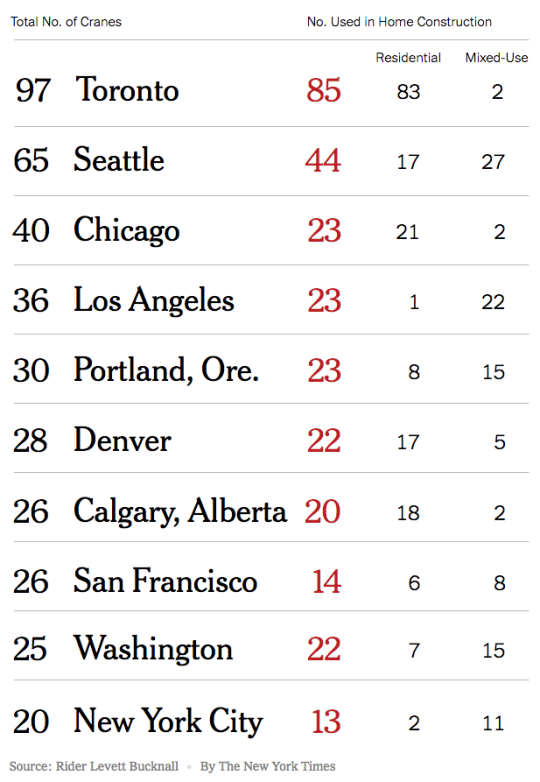
    Rider Levett Bucknall recently released its RLB Crane Index for Q3-2018. Here are the top 10 cities in North America (table via the New York Times):

    For the third consecutive reporting period, Toronto has taken the number one spot at 97 cranes – 85 of which are being used on residential projects. 

    I’m not at all sure how the study defines “mixed-use” projects. But given that Toronto only has 2 of them, it must not include projects with grade-related retail.

    Across North America, residential and mixed-use projects (whatever they are) make up approximately 70% of the total crane count. 

    I am surprised that Miami didn’t make the list.

  • Regional accents and “da Bulls”

    I find regional accents fascinating. 

    I generally think that Toronto has a fairly neutral accent. But then again, when I lived in Philadelphia, I used to notice the accident every time I came home. Maybe it is because I had adopted a bit of the Philly accent. For the record, I never picked up “youse.”

    According to some classifications, most of Western and Central Canada would fall under “General Canadian.” But I find that there are noticeable differences between the accents in Toronto and, say, Calgary. Really there are differences even within the Greater Toronto Area.

    CityLab has a recent article up about why city accents are fading in the US midwest. They chalk it up to two main factors: education and geographic mobility. But I also wonder if today’s online connectivity isn’t muting some of the local varietals.

    That’s the interesting thing about accents, they – much like the language itself – are constantly changing and evolving. On that note, I’ll end with this classic parody of the Chicago accent: Da Bulls!

  • Bowling Lane House, Calgary

    I just finished going through the work of Studio North. My friend Peter introduced me to them through this Globe article

    They are a Calgary-based design-build practice that have completed a number of laneway houses, as well as bigger projects such as this 34 unit townhouse project in Canmore, Alberta.

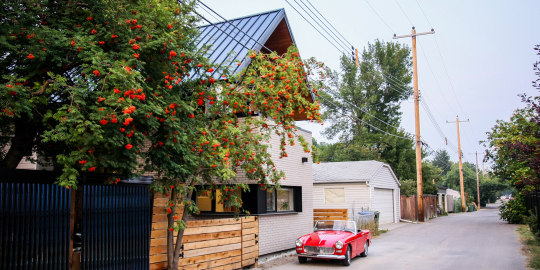
    What (not surprisingly) caught my attention was their focus on laneway/accessory dwellings. Pictured above is their Bowling Lane House in Crescent Heights, Calgary. 

    It’s a 700 sf one-bedroom house that sits behind a 1920′s heritage house. Here is an axonometric of that relationship (the existing house was made transparent):

    Here is an elevation from the main street. Look at how neatly it tucks behind the existing house. All you really notice is the garage of Bowling Lane House.

    Here is how Bowling Lane House fits into its laneway.

    And here are two images of the double height space that they managed to create within this 700 sf house.

    Notwithstanding that this is a wider lot than what you might typically find in Toronto, it is precisely the kind of housing – both in terms of design quality and scale – that I was trying to create with Mackay Laneway House. It’s also where I was planning to move.

    Kudos to the Studio North team for driving this initiative in Calgary. You can check out the rest of their projects here. They have a number of other laneway houses within their portfolio. And all of them are beautiful.

    All images from Studio North.