
Daily insights for city builders, delivered every morning at 6 AM ET. I’m Brandon Donnelly — a Toronto-based real estate developer and founder of Globizen. I’ve been writing here since 2013.

Tag: business

  • Technology x Business x Design

    John Maeda – Design Partner at venture capital firm KPCB – recently
    published the second and 2016 edition of his #DesignInTech
    Report
    . I shared his first one almost exactly a year ago.

    His core thesis is that we are heading towards a world where technology,
    business, and design become closely integrated – in school, in business, and so
    on. Throughout the report he looks at the increasing impact that design and
    designers are having within the startup ecosystem.

    Here are a few verbatim bullet points:

    – Design isn’t just about beauty; it’s about market relevance and meaningful
    results.

    – 36% of the top 25 funded startups are co-founded by
    designers, up from 20% in 2015.

    – The general word “design” will come to mean less as we
    will start to qualify the specific kind of design we mean.

    – Currently design education lags the technology industry’s
    needs for data-oriented, coding enabled graduates with business acumen.

    – We must consciously invest in education to develop a
    more hybrid perspective on creativity in the 21st century:
    Technology x Business x Design.

    – President Obama’s signing of ESSA (Every Student
    Succeeds Act) into law in 2015 is a positive sign: by turning STEM into STEAM (adding Art) in K-12 education as a US priority.

    As somebody who studied design (architecture), business,
    and computer science (briefly, before switching to architecture), I probably
    have a bit of a biased view here. But to the extent that I can be objective, I
    really see this as the future. I am a big supporter of the transformation from STEM to STEAM.

    Below is a quote that Maeda uses to end his report, which I will also use to end this post:

    “Engineers are efficient problem solvers. Business people think short term. Designer want things to be elegant and beautiful. All three need to create collaboration and harmony, and honor the value each other brings. There needs to be a new kind of ‘multi-dimensional’ approach to design that is yet to be invented.” –Linda Holliday
  • The social shift

    Those of you who know me or are regular readers of this blog, will know that I’m an avid social media user. 

    My favorites – judging by battery consumption on my phone – are Twitter, Instagram, and Snapchat (donnelly_b). I think it’s incredible what these platforms are doing to branding, marketing, personal connectivity, city building, and the list goes on.

    To that end, the March issue of Harvard Business Review has an interesting article by Douglas Holt called, Branding in the Age of Social Media. Whether you’re running a company, a city, or a real estate development project, I think you’ll find the information relevant.

    The article starts by describing a shift, brought about by social, whereby big brands are now struggling to capture the attention of consumers. Instead, consumers are listening to individuals and more grassroots movements.

    “Or consider Red Bull, the most lauded branded-content success story. It has become a new-media hub producing extreme – and alternative – sports content. While Red Bull spends much of its $2 billion annual marketing budget on branded content, its YouTube channel (rank #184, 4.9 million subscribers) is lapped by dozens of crowdculture start-ups with production budgets under $100,000. Indeed, Dude Perfect (#81, 8 million subscribers), the brainchild of five college jocks from Texas who make videos of trick shots and goofy improvised athletic feats, does far better.”

    So what should brands be doing? Holt argues that they need to tap into these developing subcultures and emergent ideologies:

    “These three brands broke through in social media because they used cultural branding—a strategy that works differently from the conventional branded-content model. Each engaged a cultural discourse about gender and sexuality in wide circulation in social media—a crowdculture—which espoused a distinctive ideology. Each acted as a proselytizer, promoting this ideology to a mass audience. Such opportunities come into view only if we use the prism of cultural branding—doing research to identify ideologies that are relevant to the category and gaining traction in crowdcultures. Companies that rely on traditional segmentation models and trend reports will always have trouble identifying those opportunities.”

    For me, this ties into one of my favorite lines from Simon Sinek: “People don’t buy what you do, they buy why you do it.” And now, thanks to social, it has become a lot easier to figure out what people and communities care about. It has become easier to figure out your why.

    Do you see this as being relevant to your work? I am certainly thinking about it in the context of mine.

  • Warren’s blog

    I just finished reading Warren Buffet’s 2015 annual letter to Berkshire Hathaway shareholders. If you haven’t yet read one of his letters and you’re at all interested in business and investing, I would encourage you to check them out. (By going to their website you’ll also get a reminder of what the web looked like circa 1995.)

    When I read them I feel as if I’m reading a giant blog post from Warren Buffet – albeit one that only gets published once a year. They’re well-written and easy to read. They’re personal. They’re light and humorous. (He drops Tinder, the mobile dating app, in this year’s letter.) And they’re packed full of invaluable information and insights.

    To give you a sample, here are two snippets that I liked:

    “Our flexibility in capital allocation – our willingness to invest large sums passively in non-controlled
    businesses – gives us a significant edge over companies that limit themselves to acquisitions they will
    operate. Woody Allen once explained that the advantage of being bi-sexual is that it doubles your chance
    of finding a date on Saturday night. In like manner – well, not exactly like manner – our appetite for either
    operating businesses or passive investments doubles our chances of finding sensible uses for Berkshire’s
    endless gusher of cash.”

    “America’s population is growing about .8% per year (.5% from births minus deaths and .3% from net
    migration). Thus 2% of overall growth produces about 1.2% of per capita growth. That may not sound impressive.
    But in a single generation of, say, 25 years, that rate of growth leads to a gain of 34.4% in real GDP per capita.
    (Compounding’s effects produce the excess over the percentage that would result by simply multiplying 25 x 1.2%.)
    In turn, that 34.4% gain will produce a staggering $19,000 increase in real GDP per capita for the next generation.”

    Overall, he remains, and rightly so I’d say, very bullish on the United States: “For 240 years it’s been a terrible mistake to bet against America, and now is no time to start.”

    What do you think?

  • The advantages of disadvantages in business and entrepreneurship

    This morning I stumbled upon an interesting book by Claudia Kalb called Andy Warhol Was a Hoarder: Inside the Minds of History’s Great Personalities

    I obviously haven’t read it yet, but I like the premise. The book examines 12 famous figures and makes the argument that each of them had some sort of mental health condition that aided them in their success. 

    Here is an excerpt from a recent Harvard Business Review interview with the author:

    “The most common one may be narcissism. Frank Lloyd Wright is a good example. He had classic narcissistic qualities — a sense of grandiosity, superiority, a huge and complete belief in his aesthetic sensibility, and disregard for architecture that did not live up to his standard. Narcissists also have an ability to be charming, and to lure people into their orbit. That’s obviously useful for an entrepreneur. The issue is that while these qualities may make you a good leader, they may not make you a winning boss. Employees often feel that narcissistic bosses are ruthless or lacking in empathy. Also, unlike people with depression or anxiety disorders, narcissists don’t suffer as much personally from their condition — but the way they behave can be much harder on the people around them.”

    Related to this topic is an emergent body of research that, more specifically, looks at the relationship between mental illness and entrepreneurship. And according to work done by professor Michael A. Freeman of UC-San Francisco and professor Sheri Johnson of Berkeley, there’s a significant relationship. 

    Below are two excerpts from a Washington Post article published last year.

    “Forty-nine percent of entrepreneurs surveyed reported at least one mental health condition. Nearly a third reported having two or more mental health issues, such as ADHD, bipolar disorder, depression, anxiety or substance use conditions. And half of the entrepreneurs who reported no mental-health conditions identified themselves as coming from families with a history of mental illness.”

    Why would these conditions be of any benefit to entrepreneurs?

    “For all of its ills, depression also brings empathy and creativity. Martin Luther King Jr. and Mahatma Gandhi attempted suicide as teenagers. Uncommon levels of empathy can allow a businessman to better understand a customer’s need. And a creative mind won’t be satisfied on the corporate ladder, but instead in a fast-moving start-up where he or she can unfurl ideas and dreams.

    Individuals with ADHD naturally make decisions faster, are comfortable working independently and are more creative, necessary skills at a start-up. They’re likely to be bored working for someone else.”

    From a city building standpoint, all of this is quite relevant. Because for all of the focus on promoting innovation and entrepreneurship, we don’t seem to be talking about healthcare and mental health systems. And there’s clearly an argument to be made that the two are connected.

  • The Business Blockchain Series

    I just backed this project on Kickstarter.

    https://www.kickstarter.com/projects/wmougayar/the-business-blockchain-books/widget/card.html?v=2

    I haven’t backed a lot of projects on Kickstarter, but I definitely enjoy the process of discovering a project that I’m interested in and then providing a small, seemingly insignificant, sum of money to help make it a reality.

    In this case, it’s a collection of two books by William Mougayar about Bitcoin, blockchains, cryptocurrency, and decentralization.

    These are all topics that I’ve touched on before on this blog, albeit with much less rigor than what I’m sure William will be applying to his books. I wrote this post about 2 years ago, when I first started wrapping my head around Bitcoin. And more recently, I wrote posts about how the blockchain could transform home buying and how Honduras is building a decentralized land registry system using the blockchain technology.

    So while at first glance it may seem like these books having nothing at all to do with city building and real estate, I am betting that they will over the long term, which is why I am doing my homework today.

    Here’s a snippet from William’s Kickstarter page:

    “The fundamental characteristics of blockchains are puzzling to consumers, corporations, governments, policy makers and regulators, because their implementation challenges centrally orchestrated trust, and enables a new kind of trust: one that is distributed, decentralized, from peer to peer, and not centrally managed by any single entity. Take any service, and add “without previous center-based authority”, and replace by “peer to peer, trust-based network”, and you will start to imagine the possibilities.”

    If all of this isn’t enough to pique your interest, then you should also know that William is from Toronto. Great things come out of this city 🙂

  • The benefits of sharing — what real estate could learn from tech

    One of the reasons I decided to start blogging was because I saw how open the tech community had become – with respect to sharing their ideas and experiences – and I thought that the same thing could and should be done in real estate, as well as in city building more broadly.

    But in many ways, the real estate industry is the antithesis of the tech industry. We are slow moving and secretive of our ideas. Now, some of this is driven by fundamental differences in terms of how these two sectors operate. It’s a lot easier to test and iterate on your ideas in tech than it is with actual bricks-and-mortar. But I still think about ways in which we, in real estate, could be pushing the envelope.

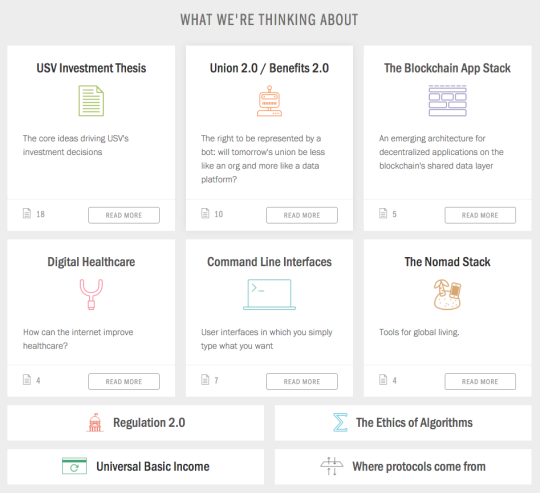
    As one example of what I’m talking about, take Union Square Ventures in New York. They call themselves a “thesis-driven venture capital firm”, which means they come up with a framework and core set of ideas, and then use those to drive their investment decisions.

    You would think that these frameworks and ideas would be pretty sensitive. I mean, they are the core drivers of their business. But their entire website is actually set up around sharing and collaborating – with the public – on these ideas. Here’s a screenshot:

    image

    Each topic is something they are “thinking about” and something they want to make an investment in (or already have). Fascinating.

    Many of you, I’m sure, would argue that there are risks to doing this. But there are also benefits, some of which are driven by collective intelligence. By sharing their ideas and hypotheses with the public, it helps to evolve their thinking. After all, their investment thesis is not a static thing. It grows over time.

    But in addition to this, it also makes it abundantly clear to their customers (entrepreneurs) what they believe in and what they look for. And I am sure this helps them with deal flow. More and more customers aren’t just “buying” a product, they are also “buying” a philosophical underpinning and belief system.

    Can you imagine a real estate firm doing something like this? I can. But it’s not happening yet, as far as I know.

  • I’m writing a book on becoming a real estate developer

    typerwriter closeup by Sean Gladwell on 500px.com

    https://500px.com/embed.js

    One of the most common questions I get from readers of this blog is: How do I become / get into real estate development?

    In fact, I get it so often that I’ve decided to write a book as my response. It may be a short one or it may end up a long one. If you’ve emailed or messaged me with this question and I haven’t responded, I’m sorry. There’s a lot of you out there. But I do want to help and that’s why I’ve decided to take on this hobby book project.

    As part of the book, I’ll be talking about my own journey, as well as the actual nuts and bolts of development. But I would also like to feature some much more established players in the business. In order to do that, I’ve decided to crowdsource some of the content for this book. 

    So here’s my ask to you: If you’re a real estate developer and would like to share your story, please complete this short questionnaire. You can be located anywhere in the world.

    My plan is to select a handful of developers from around the world and then feature their stories, one-by-one. I’m confident that there will be a lot of interest in hearing how successful developers established their careers and/or own businesses.

    I’ve been thinking about doing this for quite awhile now. It feels good to get started. 

  • Formula for life

    https://500px.com/embed.js

    Earlier this week I somehow stumbled on an old (2012) Medium story by Ev Williams, called, Formula for Entrepreneurial Success. (Ev is the cofounder of Medium, Twitter, and Blogger. He basically invented blogging.)

    His post includes 5 short recommendations, and is obviously aimed at entrepreneurs, but I think the lessons also apply more broadly to life in general. They resonated with me, so I thought they might also resonate with you.

    So whether you’re starting a company, developing a new building, or just living life, here are Ev’s 5 points:

    1. Work with amazing people. Don’t compromise on who you choose to found your company with and hire. Do not put up with ego-centric personalities or downer attitudes.

    2. Take on big challenges. It’s pretty simple: Hard things are valuable; easy things are not so valuable. Reaching the mountaintop is rewarding because it is hard. If it was easy, everybody would do it.

    3. Focus. Say no to most things: Features. People. Partnerships. “Coffees.” Projects. Only a few of them really matter. (Yes, it’s hard to know which.) Don’t get distracted.

    4. Take care of yourself. When you don’t sleep, eat crap, don’t exercise, and are living off adrenaline for too long, your performance suffers. Your decisions suffer. Your company suffers.

    5. Love those close to you. Failure of your company is not failure in life. Failure in your relationships is.

    If I had to pick one of the items from this list, I’d say I struggle the most with focus. It’s not that I can’t focus and complete tasks, it’s that I’m the kind of person who wants to fill every second of the day with something meaningful. And when people email me wanting to go for coffee or help with something, I want to do it.

    But unfortunately, time is a hugely valuable commodity and you have to be selective.

    So surround yourself with amazing people. Don’t be afraid of big challenges and risks. Focus. Eat well and lift weights (my preference). And love the important people in your life.

  • The 5 objectives of Rejection Therapy

    In the business world – particularly in the startup world these days – there’s a lot of emphasis on the importance of failure. The mantra is: “fail early and fail often.” Because if you’re not failing, then you’re likely not pushing yourself hard enough and getting out of your comfort zone. 

    Some people think we’ve gone too far in our celebration of failure, but I think there’s a lot of value in not being afraid of making mistakes. I try and adopt the same mentality when I snowboard. If I’m not physically falling, then I’m likely not trying things I’ve never done before. (I may have taken that philosophy too far this winter.)

    Here’s a video from Gary Vaynerchuk’s #AskGaryVee show where Jack and Suzy Welch are guests and the first question has to do with this exact topic: the importance of failure.

    Given all of this, I was fascinated to learn about something new this week called Rejection Therapy. I was out for beers with some good friends of mine earlier in the week and one of them – who is an educator here in the city – started telling me the story of Jason Comely.

    Jason was a freelance IT guy from Cambridge, Ontario. His wife had recently left him for someone “better” and he went into a deep slump. Eventually, he realized that he had become terrified of rejection. His wife had rejected him and he never wanted that to ever happen again.

    Initially he withdrew from life. 

    But eventually he decided that he was going to experiment with the exact opposite approach. He decided that he was going to force himself to get rejected by someone every, single, day.

    It didn’t matter how it happened, but he had to get rejected. He would walk up to strangers and ask for a ride home. He would ask for a discount before buying something. The list goes on. 

    Eventually he thought it would be a good idea to start documenting all of his rejections: this is what I did today and this how I got rejected. It became a game for him. When he would get his rejection for the day, he would celebrate it. Then he thought to himself: why not turn this into an actual game that other people could purchase? And that’s what he did.

    He calls it Rejection Therapy and here are the five objectives that he lays out:

    1. To be more aware of how irrational social fears control and restrict our lives
    2. Smash the tyranny of fear and reap the treasures (treasures include wealth, relationships and self-confidence)
    3. Learn from, and even enjoy rejection
    4. To not be attached to outcomes, especially when it involves the free agency of other people
    5. Permit yourself to fail

    Playing Rejection Therapy may not be for everyone. But I think the lessons are universally applicable. There’s value in trying. There’s value in asking. There’s value in making mistakes. And there’s value in not being afraid of someone saying no.

  • My identity crisis

    If you’re a regular reader of Architect This City, there are many things that you might know about me

    You might know that I was initially trained as an architect, but that I immediately transitioned into real estate development after grad school (where I studied both architecture and real estate).

    After becoming a real estate developer, you might know that I completed an MBA with a focus on innovation and entrepreneurship (which happened by default as a result of the electives I ended up being interested in).

    And finally, you might know, given the content of this blog and my startup history, that I have a significant interest in technology. More specifically though, you might know that my interest is in figuring out how technology will continue to infiltrate and impact “non-tech” industries such as real estate.

    But what you might not know is how I even ended up in architecture and real estate in the first place. Unlike a lot of people who seem to have grown up wanting to be an architect – perhaps because they had a relative who was one – I didn’t decide to study architecture until a bit later on.

    Growing up my primary interests were: art and computers.

    During high school, my art teachers used to tell my parents that I was going to be an artist. And my computer teachers used to tell my parents that I was going to be a computer geek – or maybe they said computer scientist.

    Maybe it had to do with timing and the emergence of the commercial internet in the 1990s, but computers sort of won out during that point in my life. I spent a lot of time building them from scratch, playing with software, and asking my mom not to pick up the phone because I was literally dialed-in to the internet.

    So when it came time to enrol in university, I fairly effortlessly decided on computer science. It just seemed to make sense. But after about a year I realized that it wasn’t for me. I didn’t love programming like my classmates did and the thought of doing it for a living scared me.

    At the same time, I felt like I needed to feed the artist in me. I wanted something both artistic and technical. So I decided to drop out of computer science and give architecture a try. It just seemed like the perfect marriage of my interests.

    I immediately fell in love with architecture. And I spent the next 7 years studying it across 2 degrees.

    But during that time, two things hit me. First, I came to the realization that real estate developers are the ones who really have the most say in terms of how our cities are built. And second, that technology was having a massive impact on business and life.

    This told me that design alone wasn’t going to be enough. I also needed to engross myself in real estate, finance, business, and technology. So that’s what I set out to do. And I really enjoyed it. On the technology side, it felt like I was coming full circle in a way.

    But today, I feel a bit like a 3 legged stool. There’s the design leg. The real estate/business leg. And the technology leg. And oftentimes I feel like life would be a lot simpler if I could just balance on one of those legs – instead of trying to stand on all three. But that’s simply not me.

    These are my passions and I need all of them to stand-up.