Daily insights for city builders, delivered every morning at 6 AM ET. I’m Brandon Donnelly — a Toronto-based real estate developer and founder of Globizen. I’ve been writing here since 2013.
This evening I was at my alma mater, the Rotman School, for a conversation between Roger Martin (the former dean of the school) and Canadian-Jamaican billionaire, Michael Lee-Chin. Michael is one of the most disciplined, consistent, and charismatic people I have never met. (The soothing Jamaican accent probably doesn’t hurt.)
One of his points this evening was about compounding. Not just compound interest, which is what many of you are probably thinking, but compounding in life. The thing about compounding is that the real benefits come later on. That’s why personal finance people will tell you that the key to financial freedom is to start saving and investing early on.
The problem with this is that, well, the real benefits come later on. And it can be frustrating when the rewards don’t seem to match the efforts. That’s why grit is so important and why some have suggested that it is a far better predictor of future success than things like IQ or a GPA score. There’s no substitute for hard work.
In the development business, projects tend to take a long time. We started working on Junction House back in 2016 and here we are now in 2019 planning for construction. So I thought this evening was a good reminder that there’s lots of value in long-term goals and that more of us (including companies) should be thinking along these lines.
This recent post by Sam Altman (of Y Combinator) on how to achieve outlier success was just passed around our office. And it’s so fucking good that I decided to regurgitate it here on the blog by listing all 13 of his thoughts along with some of his most salient points. All of the words below are his (not mine), but most of his words are missing. I wanted to make a more condensed version so that you could easily print out this post and affix it to your desk. I am about to do that. Thanks for a great post, Sam.
1. Compound yourself
I think the biggest competitive advantage in business—either for a company or for an individual’s career—is long-term thinking with a broad view of how different systems in the world are going to come together. One of the notable aspects of compound growth is that the furthest out years are the most important. In a world where almost no one takes a truly long-term view, the market richly rewards those who do.
2. Have almost too much self-belief
Self-belief is immensely powerful. The most successful people I know believe in themselves almost to the point of delusion. Cultivate this early. As you get more data points that your judgment is good and you can consistently deliver results, trust yourself more. If you don’t believe in yourself, it’s hard to let yourself have contrarian ideas about the future. But this is where most value gets created.
3. Learn to think independently
Entrepreneurship is very difficult to teach because original thinking is very difficult to teach. School is not set up to teach this—in fact, it generally rewards the opposite. So you have to cultivate it on your own.
4. Get good at “sales”
All great careers, to some degree, become sales jobs. You have to evangelize your plans to customers, prospective employees, the press, investors, etc. This requires an inspiring vision, strong communication skills, some degree of charisma, and evidence of execution ability.
Getting good at communication—particularly written communication—is an investment worth making. My best advice for communicating clearly is to first make sure your thinking is clear and then use plain, concise language.
5. Make it easy to take risks
It’s often easier to take risks early in your career; you don’t have much to lose, and you potentially have a lot to gain. Once you’ve gotten yourself to a point where you have your basic obligations covered you should try to make it easy to take risks. Look for small bets you can make where you lose 1x if you’re wrong but make 100x if it works. Then make a bigger bet in that direction.
6. Focus
Once you have figured out what to do, be unstoppable about getting your small handful of priorities accomplished quickly. I have yet to meet a slow-moving person who is very successful.
7. Work hard
I think people who pretend you can be super successful professionally without working most of the time (for some period of your life) are doing a disservice. In fact, work stamina seems to be one of the biggest predictors of long-term success.
8. Be bold
If you are making progress on an important problem, you will have a constant tailwind of people wanting to help you. Let yourself grow more ambitious, and don’t be afraid to work on what you really want to work on.
9. Be willful
People have an enormous capacity to make things happen. A combination of self-doubt, giving up too early, and not pushing hard enough prevents most people from ever reaching anywhere near their potential.
10. Be hard to compete with
Most people do whatever most people they hang out with do. This mimetic behavior is usually a mistake—if you’re doing the same thing everyone else is doing, you will not be hard to compete with.
11. Build a network
Great work requires teams. Developing a network of talented people to work with—sometimes closely, sometimes loosely—is an essential part of a great career. The size of the network of really talented people you know often becomes the limiter for what you can accomplish.
12. You get rich by owning things
The biggest economic misunderstanding of my childhood was that people got rich from high salaries. Though there are some exceptions—entertainers for example —almost no one in the history of the Forbes list has gotten there with a salary.
You get truly rich by owning things that increase rapidly in value.
13. Be internally driven
The most successful people I know are primarily internally driven; they do what they do to impress themselves and because they feel compelled to make something happen in the world. After you’ve made enough money to buy whatever you want and gotten enough social status that it stops being fun to get more, this is the only force I know of that will continue to drive you to higher levels of performance.
This is not new. It has been reported on before. But I just finished reading this article about Jeff Bezos’ relentless commitment to “high-quality and high-velocity decision making” at Amazon.
Here are a couple of high level points:
– There are decisions that cannot be easily reversed (Type 1) and there are decisions that can be (Type 2). Knowing which is which is important. To help get better at this, they are very diligent about tracking the outcomes of previous decisions.
– Make decisions without all of the info you wish you had, because if you don’t, you’re probably moving too slow. Speed is paramount. If you’ve categorized your decisions properly (see above), being wrong may not actually be that costly.
– There’s a company philosophy centered around “disagree and commit.” It is about moving forward – since speed is so important – without full consensus. In other words: We may not all agree, but can we disagree and commit to this?
Perhaps the most interesting, and seemingly paradoxical, aspect of Amazon’s “high-velocity decision making process” is that it is built upon narrative memos, instead of PowerPoint decks. In fact, decks have been banned at the company since 2004.
The reason for this is that narrative memos are more difficult to write, which means you really have to understand what you’re talking about. It encourages deeper thought and it allows nuances and interdependencies to come through.
Apparently important meetings start with everyone just sitting in a room reading the narrative memo, which are often between 4-6 pages. Once everyone has read the memo and is on the same page, the meeting starts.
As someone who writes a daily narrative, this approach really resonates me. It would be a hell of a lot easier if I could just show up here every day and throw down a few bullet points. But then both of us would get far less out of this practice.
Writing takes time. Bezos has acknowledged that these memos cannot be written in a day or two. But clearly there’s a belief that more time spent up front translates into greater overall speed. Their market cap suggests that is working.
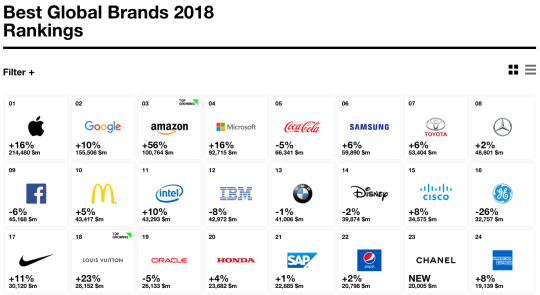
At the beginning of this month, Interbrand released its annual ranking of the world’s best global brands. This year’s 2018 report marks the 19th year of the study. If you’d like to download a free copy of the report, you can do that here. But below is a snapshot of the first 24 brands:
Apple and Google are in top position for the 6th year in a row. And Amazon is on a hockey stick trajectory with its brand value jumping by 56%. More than half of the list is comprised of the following five sectors: Automotive (16), Technology (13), Financial Services (12), Luxury (9), and Fast-Moving Consumer Goods (9). Luxury is currently the fastest growing sector.
In their report, they outline five themes that have emerged and that are helping these brands outperform. They are:
Positive utility – not enough to just make people feel good through storytelling; you need to create real value and a positive impact in the world
Subscription mindset – there’s an increasing amount of brand value in subscription-based businesses (29% in 2018 compared to 18% in 2009); you need to offer your products and services with the least amount of friction as possible
Customer-centricity – bring the voice of your customer into every aspect of your business; be nimble enough to respond quickly
Learning from luxury – the top performing category in this year’s ranking; about exclusivity and authenticity
Role of brand – make your brand part of the decision-making process; build brand equity and trust
I’ll stop there and let you all dig into the rest of the report if you’re interested.
But one thing I found particularly interesting about the study is that they used – insert buzzwords here – “AI-powered social listening” to try and measure the emotion and sentiment floating around on the internet around specific brands. The goal was to pin down the perceived trustworthiness of specific brands.
I am a fan of the double opt-in introduction. I am guilty of not doing it, but I’ve been hearing of this approach from a few people and I think it makes a lot of sense. And it is probably only going to make more sense as we all become even more connected.
The way the double opt-in introduction works is that before you make a cold introduction, you simply ask both parties if they would like to be introduced to the other party. If one party doesn’t opt-in, then you don’t make the introduction. Simple.
The reason this is so valuable is because, without this double opt-in framework, it can be easy to get sucked into a call or meeting that you may not want to be a part of, which in turn means that you’re not in control of and managing your own schedule. Somebody else is doing that for you.
This may seem harsh, but as we’ve discussed before on the blog, there’s a ton of value in saying no. We all need filters, especially today. And if we don’t say no often enough, we’re all bound to run out of time for the things that really matter and that we should be focusing our attention on.
The underlying principle behind the double opt-in introduction is that it’s a lot easier to say no to an introducer than it is to a person you have just been introduced to: “Sorry, I have no interest in talking and/or meeting you.” Now that’s not very nice.
The Hard Thing About Hard Things is a book that I read a number of years ago (Amazon just told me that I purchased it on March 12, 2014), but that I frequently come back to in my mind.
One of my favorite themes in the book can be summed up with this quote: “Often any decision, even the wrong decision, is better than no decision.”
Decisions can be scary. What if I make the wrong decision and things go horribly wrong? Then things are on me.
In some organizations, indecision may feel like the safest decision. Let’s do one more study just to make sure that we’ve got this right.
But in a startup (which is what Ben Horowitz’s book is about) and in organizations that would actually like to grow, innovate, and accomplish things, indecision can mean death. Without decisions, organizations lock up.
None of this is to say that bad decisions are okay. Executives must make high quality decisions as fast as possible, and as a rule of thumb you probably want to make more good decisions than bad decisions.
But speed, momentum, and organizational clarity also matter a great deal.
One of the reasons why I mentally come back to this book is because oftentimes I find that things can get hung up on relatively inconsequential decisions. So I like to remind myself that go is better than stop.
As Ben points out in his book: “The only mistake you cannot make is running out of cash.” And time has a funny way of burning through cash.
This morning I came across two news item that are interesting in their own right, but also have a noteworthy relationship.
$AAPL now has a market cap that exceeds $1 trillion. And not surprisingly, everyone, from the New York Times to Bloomberg (photo essay), is talking about it.
But the one thing that continues to stand out for me about this story is what Steve Jobs said back in 2011 when he unveiled iPad 2.
He said that fundamental to Apple’s DNA is its ability to marry technology with the liberal arts and the humanities. Its secret sauce is not technology alone.
Now let’s move on to the second piece of news that caught my attention.
As of 2017, less than 5% of college and university students in the US were studying one of the big four humanities majors – a sharp cliff-like drop from 2011 according to this data.
That’s almost certainly because business degrees and STEM degrees are thought to be more valuable and in demand in the labor market. And I’m sure they are right out of school.
But perhaps we shouldn’t forget Apple’s trillion dollar lesson. And I think this goes for both the tech space and the real estate industry, as well as others.
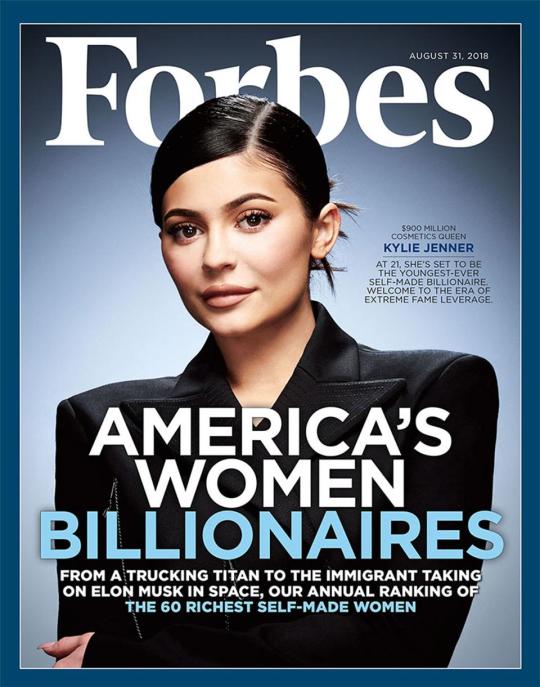
And if the trend line continues, she’ll be the youngest self-made billionaire, ever. Mark Zuckerberg apparently holds that title right now. But he was a classic underachiever and only became a billionaire at age 23.
Most of Kylie’s net worth is derived from Kylie Cosmetics, which launched less than 3 years ago, but did an estimated $330 million in revenue last year. Forbes values the company at almost $800 million. And Kylie owns every bit of it.
The reason I am mentioning this today is because I was fascinated by the above Forbes article. It’s such a powerful example of social media leverage. Forbes put it differently: “Social media has weaponized fame.”
Kylie has 111 million followers on Instagram (plus many more on her other social channels) and that’s really the most important part of this equation. She has the distribution and reach to acquire boat loads of customers. It doesn’t matter what you’re selling if nobody knows you’re selling it.
The rest of her business is pretty much outsourced. Seed Beauty (out of Oxnard, California and Nanjing, China) handles the manufacturing, packaging, and shipping fulfillment. Shopify (headquartered in Ottawa) is her e-commerce platform.
We could of course have a debate about whether a celebrity-fueled business is really all that sustainable. And perhaps there’s risk in relying so heavily on social for customer acquisition. But youngest billionaire is youngest billionaire.
Steven Sinofsky recently tweeted out this thread where he talks about the virtues of writing in business. His argument: writing is thinking.
Writing is difficult. It takes a lot of time. I’ve been writing posts – albeit short ones – on this blog every day for almost 5 years and I can tell you that somedays it is downright painful. Somedays I ask myself: Would I be better served spending this time elsewhere?
It’s much easier to talk, throw down bullet points on a slide, or send out pithy emails. And because, today, we’re all so focused on “agility” and “execution”, it is easy to dismiss writing as being slow and cumbersome.
But the act of writing is indeed thinking. To write about something you have to wade into the details and actually understand what you’re talking about. It’s far more nuanced.
One of Sinofsky’s arguments is that “execution is in a constant state of diverging as more expertise deals with more details that fewer people understand.” Business becomes “I just know.” Writing can fill in those missing parts.
He goes on to argue that agility is also not mutually exclusive with writing. In fact, when you write, clarify, and collaborate early on, overall execution speeds up because now people get the details and better understand the context.
I’ve mentioned this before on the blog, but my Grade 4 English teacher used to make us write a daily journal. He would tell us that it didn’t matter what we wrote or how long it was, but we had to write something every day.
I did it and I enjoyed keeping those journals, but at the time I didn’t really appreciate was he was trying to get us to do. I do now.
Lately I have really gotten into Matt Levine’s daily newsletter about “Wall Street, finance, companies and other stuff.” Maybe that’s how I should describe this blog: Cities, real estate, design, and other stuff.
If you aren’t familiar with Matt’s writing, here is an article that he wrote about Kylie Jenner’s recent tweet concerning Snapchat. You know, the one that wiped out $1.3 billion of market value because she revealed – using only 88 characters, I might add – that she was no longer using the app.
sooo does anyone else not open Snapchat anymore? Or is it just me… ugh this is so sad.
“Would it be insider trading for Kylie Jenner to buy short term out of money put options on Snap and tweet out that she’s no longer using Snap?”
And this is the start of his answer:
Insider trading, as I am constantly saying around here, is not about fairness; it is about theft. It is not illegal to trade on your own nonpublic knowledge of your own intentions. Warren Buffett can buy stocks before he announces that he’s bought them, even though that announcement will predictably make the stocks go up.
If I did describe this daily blog like Matt describes his daily newsletter, this post would clearly fall into the “other stuff” camp. But maybe you too will find it interesting. If you do, you can subscribe here.