Daily insights for city builders, delivered every morning at 6 AM ET. I’m Brandon Donnelly — a Toronto-based real estate developer and founder of Globizen. I’ve been writing here since 2013.

Tag: brutalist architecture

  • A few observations about Salt Lake City

    Utah is beautiful. See here.

    People in SLC are really nice. Strangers greet you on the street. Motorists are also more polite and patient. I had no idea how to respond. I suspect it might have something to do with there being less traffic and, in turn, less frustration. But again, even if you ignore what happens on the road, people are nice.

    You will need a serious utility vehicle to navigate the topography of this region. Venturing into the surrounding canyons requires 4-wheel drive or chains during snowstorms. I was only there for a week and already I have visions of a classic Defender in my mind. Do they come in electric versions?

    The streets are too wide for proper enjoyment as a pedestrian. This is a challenging problem to fix, as I have mentioned before. That said — and this is going to be an unpopular opinion — the city felt void of any sort of real traffic. The distances travelled are great, but the highways actually flow freely. You also never really need to worry about parking.

    Electric scooters are popular in SLC. As is cycling — both for getting around and as a reason to wear tight-fitting bright clothes.

    SLC feels as if it is both under the radar and also rapidly emerging. My new favorite restaurant in SLC is a place called Post Office Place. We walked in without a reservation on a Friday night and they gladly took us. I couldn’t understand why the place wasn’t rammed. I mean, they have Marseille-style panisse on the menu!

    The Granary District is an area to watch. It is a former industrial area to the southwest of downtown. It is already home to breweries, food halls, and creative offices. But it needs some more time to properly fill in. We stayed at the Evo Hotel in Granary (highly recommend). The campus amenities include a rock climbing facility, an indoor skatepark, and plenty of places to work and Zoom.

    Most of the new infill housing appears to be mid-rise in scale and most of it is wood-frame construction on top of concrete.

    By my estimation (and by estimation I mean that I have a spreadsheet for this), the ski and snowboard communities surrounding SLC are some of the most accessible in North America. Land at SLC airport and you’re in the mountains in 20-30 minutes.

    Park City-Canyons is the most well-known ski destination. But if you’re a more aggressive skier — the kind that keeps your gloves together with duct tape and counts the number of ski days per season — you’ll want to head over to the Cottonwood canyons and places like Snowbird and Brighton.

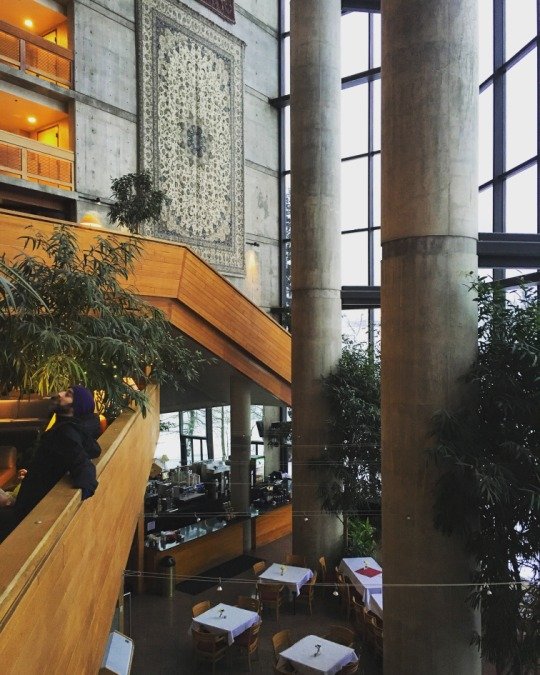
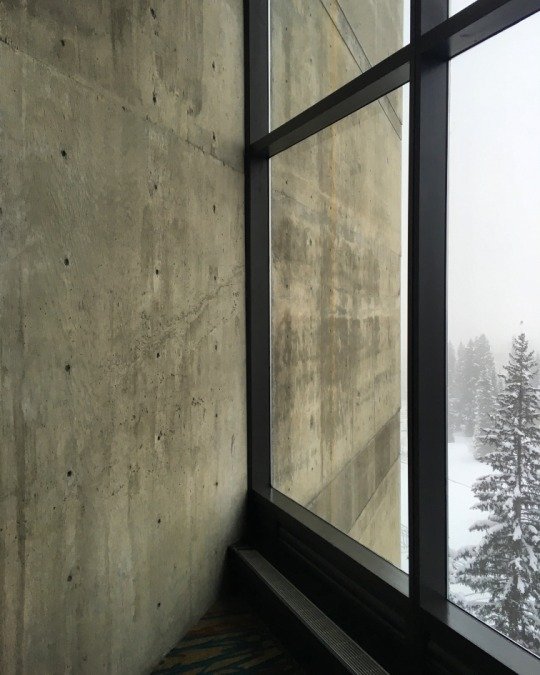
    Snowbird remains one of my all-time favorite ski destinations for two reasons: the mountain itself and the brutalist architecture at the bottom of it. There’s none of that faux alpine crap over here — just exposed and unabashed concrete and wood. And who doesn’t love brutalism, right? (I haven’t been to Brighton yet but one of my local friends told me that it’s a great snowboarders mountain.)

    The Canyons Village at Park City is developing really nicely. As I understand it, it’s only about 30-40% built out at this stage. The Pendry Hotel just recently opened (announcement here) and I can tell you that the restaurants were generally busy every night of the week (summer experience). The project team did a wonderful job creating a place and a new anchor in the village.

    What did I miss in this list?

  • A tale of two different kinds of Brutalism

    This article from the Guardian about two Brutalist housing estates in London is now more than five years old. But the story is perhaps just as interesting. The article is about two “New Brutalism” estates that were designed and built in the 1960s and 1970s.

    The first is the Barbican Estate (which appeared recently on the blog over here) and the second is Robin Hood Gardens (pictured above, partially). Both were designed by notable architects and both have been equally divisive when it comes to their aesthetic appeal. We’re talking about Brutalism. So it’s likely that you either love them or hate them.

    One of the big differences between these two housing complexes is that one is a private estate and the other is (or was) social housing. And perhaps because of this, the Barbican has remained desirable and Robin Hood Gardens was ultimately demolished starting in 2017. This is despite numerous outcries from the architecture and design community that it should be both preserved and listed.

    We could get into questions of funding and maintenance, as well as the design differences between the two complexes (I don’t have any of these details), but even without all of this, I find these two divergent outcomes pretty interesting. Architecture, it would seem, isn’t everything.

  • Brutalist wine warehouse for sale near Bordeaux

    I am sure that many of you have been eagerly waiting for an old Brutalist wine warehouse to come on the market near Bordeaux, and so here is a listing from Espaces Atypiques. The site is over 1 hectare. The ground floor is about 2,000 square meters. And the central atrium space is some 25m tall. It’s listed for €550,000 and I reckon it needs a bit of work.

    I don’t know where exactly it’s located in Saint-Émilion, France (nor have I ever been) and I can’t vouch for the condition of the existing building in any way shape or form, but I do think it would be a lot of fun to turn a Brutalist structure like this into a hotel, restaurant, and creative event space. Public gathering space(s) in the atrium; private rooms along the perimeter.

    Image: Espaces Atypiques

  • Brutalism is fashionable again, kind of

    I think it’s time to make it official: Brutalism is fashionable again. Okay, kind of. According to this WSJ article, the appreciation for this style of architecture remains nowhere near universal, but the renaissance is certainly continuing. Some Brutalist structures are and have been torn down; while others are being repurposed.

    One recent example is the Balfron Tower in East London (pictured above). Designed by the Hungarian-born architect Ernő Goldfinger and completed in the 1960s as social housing, the tower is currently undergoing a £40 million renovation that will convert it to market-rate housing. Apartments start at £365,000 (USD 472,054) for a 450 square foot one bedroom.

    One notable feature are the “streets in the sky” that separate the building’s circulation (elevator core) from the actual suites. It’s a peculiar way to build and most never consider it today, but it’s very much a hallmark of the Brutalist movement. The idea was to express the building’s various functions — vertical circulation being one of them.

    I guess we just don’t build them like we used to.

    Photo: Walter Homann via the WSJ

  • Rethinking Brutalism (in London)

    The Standard recently opened up its first international outpost in London. It’s a 266-room hotel housed in a 1974 Brutalist office building overlooking King’s Cross. London-based Orms (architect) was the lead consultant and they did an incredible job both preserving and modernizing the existing building.

    All of the existing windows were replaced, but otherwise the Brutalist exterior remains more or less intact.

    A tasteful 3 storey addition was placed on top of it, which required threading new steel columns through the existing waffle slabs. There’s a 1st floor transfer slab with concrete columns below it in order to pickup these new loads.

    A dedicated (and red) exterior shuttle elevator was also added to the north elevation of the building. This takes people up to the rooftop, which is a signature feature of all Standard Hotels.

    Brutalist architecture is experiencing a bit of renaissance right now. We are seeing people lament the demise of our concrete blocks from the 60s and 70s. Perhaps it’s because it’s a style/movement that is finally old enough for people to appreciate it. That’s often how these things work.

    The Standard in London is a perfect example of how this history might be both respected and repositioned.

    Images via Orms

  • Equatorial Brutalism

    Generally speaking, architects are the only people I know who like Brutalist architecture. In fact, architect, professor and author Witold Rybczynski once proposed the following litmus test to determine whether a building is indeed an example of Brutalism: “If people don’t hate it, it can’t be Brutalist.”

    But as I have argued before, sometimes architectural styles take a bit of time to settle in and become fully appreciated. Consider how improbable it would seem to demolish a beautiful old Victorian home today. And yet Toronto, and countless other cities, did this on many occasions. Regent Park, Toronto was once Cabbagetown South.

    Brutalism also took on different sensibilities around the world.

    I love this recent piece in T (NY Times Style Magazine) by Michael Snyder called, “The Unexpectedly Tropical History of Brutalism.” In it he uses the term “Equatorial Brutalism” (a new one for me) and discusses the “surprising apotheosis” of Brutalism in equatorial countries (and in particular Brazil). It is a good follow-up to my recent post on Oscar Niemeyer’s work.

    So here’s an excerpt from Michael’s article. If you don’t already like Brutalism, maybe it’ll get you a little bit closer.

    What these buildings shared, beyond an aesthetic — though they shared that, too, with their radical porousness, their blunt geometric forms and their extensive use of raw concrete — was a commitment to architecture as an instigator of progress. But in the tropics, Brutalism reached an unexpected apotheosis: Infiltrated by lush plants and softened by humidity, buildings that looked cold and imposing against London’s constant drizzle or Boston’s icy slush were transformed into fecund, vital spaces. Concrete surfaces bloomed green with moss. The panels of glass necessary for sealing rooms against the northern chill either disappeared or receded from view, encouraging cross-ventilation while also protecting interior spaces from direct sun. The openness and transparency that the Smithsons had pronounced became a practical reality in these humid environments, both theoretically and literally: Built from inexpensive, readily available materials, equatorial Brutalism was as accessible and functional as it was symbolically potent, resulting in buildings that would define new societies growing around them like vines. Here, Brutalism wasn’t only an architecture that shaped the future or confronted the past — it was an architecture of freedom.

    Photo by Samuel Zeller on Unsplash

  • A truly modern ski and snowboard resort

    Today my friends and I spent the day at Snowbird.

    In terms of the skiing and snowboarding, it’s way up there for me alongside Jackson Hole.

    But beyond the mountain, two things really stood out for me. Firstly, I really liked the overall brand and identity of the resort. Everything from the napkins in the cafeteria to the ski run signs were decidedly modern. Secondly, I loved the Brutalist architecture. And both of these elements combined to create what felt to me like a truly modern ski resort.

    Here are two photos that I took today:

    imageimage

    Developed in the mid-1960s by a man named Ted Johnson, the vision had always been to create a new kind of resort. In fact, Ted was insistent that they eschew the typical faux-alpine architecture that had come to characterize ski towns. 

    Here’s a brief summary of the parties involved and Ted’s design direction, via Salt Lake Modern:

    In 1965, the Snowbird Design Group was founded to create the first master plan. The original group was composed of Robert Bliss, Dean of the School of Architecture at the University of Utah, Jim Christopher, principal at Brixen & Christopher Architects, Dan Kiley, renowned landscape architect and site planning consultant based in Vermont, and architect Jack Smith. Johnson was adamant that the new resort not look “alpine lodgey” and based on the steep terrain and available land, the only choice for design would be to make it compact and dense. An aesthetic very unlike Alta, located just above Snowbird.

    For me, it’s the contrast between the rugged exposed concrete and the warm wood that I love. I left today thinking to myself that Snowbird is the most architecturally interesting ski resort I’ve ever visited.

    But as luck would have it and immediately after we left the resort, I discovered a community group called, “Save our Canyons.” And they don’t appear to be as smitten as I am with the Brutalist architecture. Here’s an excerpt from one of their articles talking about a new construction project at Snowbird:

    “Alas, more Snowbird droppings are fouling our Wasatch nest. Snowbird, already renowned for the hideous concrete bunkers at its base, has plopped another wad of architectural guano on top of Hidden Peak.”

    Of course, it is well known that Brutalist architecture isn’t often a crowd favorite. But when done well, it can be quite beautiful. Hopefully there are others who see what my friends and I saw today.

  • For the love of Brutalism

    Brutalism is an architectural movement that most people, other than architecture nerds, hate. Derived from the French words for raw concrete – béton brut – Brutalist architecture is characterized by its use of exposed concrete and its imposing fortress-like qualities.

    Most people find it too cold, sterile, and impersonal. But this 99% Invisible episode perfectly sums of where I think we sit with this era of building:

    “Back in the 1960s, Victorian style buildings were considered hideous and impossible to repair. We were tearing batches of Victorians down to erect big concrete buildings. But some Victorians were saved—and today, some of them are considered treasures.

    Concrete architecture now finds itself at an inflection point: too outdated to be modern, too young to be classic. And a small, but growing band of architects, architecture enthusiasts, and preservationists, would like us to just wait a bit and see.

    Maybe, with a little time, we’ll come around to love these hulking concrete brutes.”

    Concrete can be a wonderful building material all on its own. I mean, just look at the work of Tadao Ando

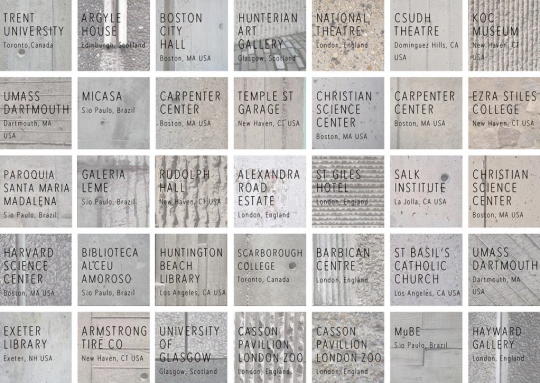
    But all concrete is not created equal. Here is a taxonomy of concrete textures that was also part of that same 99% Invisible episode:

    image

    I say all this because if we believe that Brutalist architecture has no value then we are likely to believe that it doesn’t need to be preserved. And that may very well be the case for some Brutalist architecture. But if history is any indication, some or much of it may also be considered beautiful one day.

    Most cities have a rich history of demolishing (or almost demolishing) buildings and neighborhoods that today we would (or do) treasure. Which tells me that we’re not always very good at figuring out what has value or will have value in the future.

    So maybe some of those brutes are worth a second look.