Daily insights for city builders, delivered every morning at 6 AM ET. I’m Brandon Donnelly — a Toronto-based real estate developer and founder of Globizen. I’ve been writing here since 2013.

Tag: brookings

  • Winner take all, or most, economy

    The world is increasingly spiky. Inequality is growing and it is increasingly geographic in nature. We know that people tend to make more money in urban areas compared to rural areas – even when they possess the exact same level of education. The returns to being smart and educated are simply greater in cities.

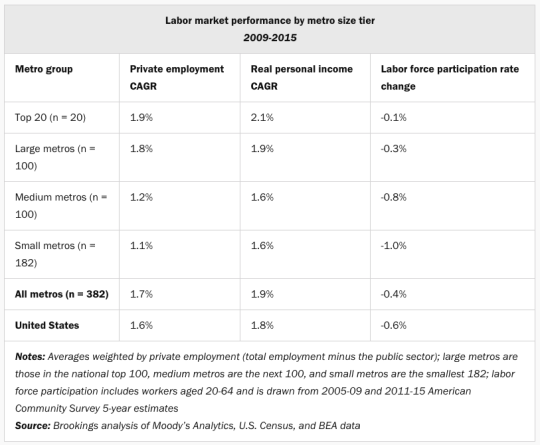
    But they also depend on the size of the city. Mark Muro and Jacob Whiton of Brookings recently published data looking at labor market performance – by metro size – from 2009-2015 (right after the financial crisis). What they found is that larger metropolitan areas simply performed better than smaller ones.
    image

    In summary:

    City size matters because it’s a major influence on city prosperity and adaptability as well as local worker fortunes. Bigger cities are more productive. They are more innovative. They draw better-educated workers by offering higher wages.

    The situation is even more pronounced across the pond. According to the New York Times (quote from Richard Florida), a third of Britain’s gross domestic product comes from London alone.

    What is far less clear is what should be done to address the decline of some of the smaller cities in America – cities that are stagnating and feeling left behind. But perhaps the first step is acknowledging what has happened and what remains feasible in today’s global economy.

    Here is another quote from the above NY Times article:

    Mr. Trump’s promise to relieve the pain by reviving the coal and steel industries, by keeping immigrants out of the country and by raising barriers against manufactured imports is only a rhetorical balm to satisfy an angry base seeking to reclaim a prosperous past that is no longer available.

    That rhetorical balm.
  • International and domestic migration in the US

    In response to President Trump’s proposed immigration bill, Brookings recently analyzed census data from earlier this year to demonstrate the importance of immigration for growth within much of the United States. 

    I’d like to share three tables from their analysis.

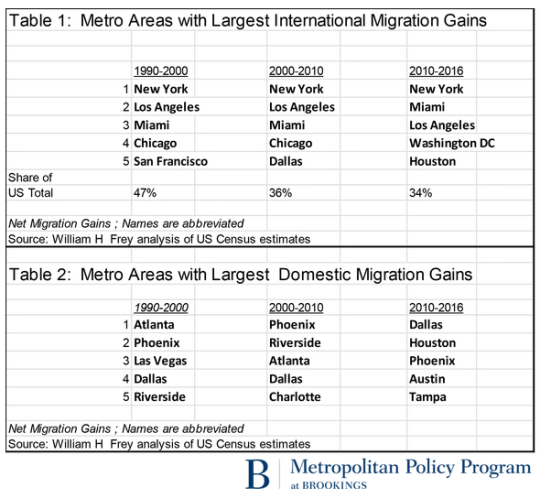
    The first two look at international migration grains and domestic migration gains over the last 3 decades (the last decade isn’t quite a decade).

    Here you can see that New York, Los Angeles, and Miami (all port cities) have dominated international migration to the US since 1990. But at the same time, international migration has become less geographically concentrated. From 1990-2000 the top 5 cities received almost half of all immigrants moving to the US. More recently, that number has dropped to 34%.

    Domestic migration is different in that it’s a zero sum game. When one US city gains, another US city loses. Here there is a very clear migration trend toward cities in the southwest – arguably because of weather, job growth, cheaper housing, and probably a bunch of other factors.

    If we look at actual international and domestic migration numbers over the last 6 years, the 12 largest metropolitan areas look like this:

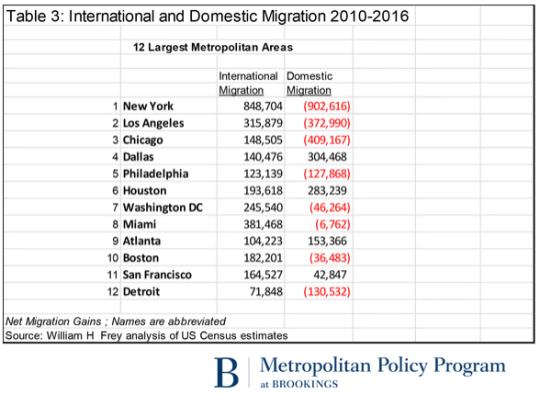
    The key takeaways here are that 8 of these cities are losing people to domestic migration and only 7 of these cities have a positive net migration number – meaning their population is actually growing.

    What is clear is that the international migration column is a pretty important one if you believe that growth is valuable. 

    If you’re Dallas, Houston or Atlanta, maybe you care a little less about that column. But for most of the other cities, international migration is either the only way you’re growing (look at Miami go) or keeping your population losses in check (see Philadelphia).

  • The independent worker

    There’s a lot of discussion about what the “online gig economy” will mean for traditional forms of employment. And seeing how we’re on the topic of Uber right now, I thought it would make for an interesting discussion.

    Should Uber drivers, to use one example, be classified as independent contractors or should they be classified as traditional employees? There are arguments for both sides.

    Seth Harris and Alan Krueger recently published a discussion paper where they argue for a solution somewhere in between the two. They call it “the independent worker.”

    Here’s a snippet that illustrates the tension that currently exists for people working in this new emerging grey area:

    “Independent workers typically work with intermediaries who match workers to customers. The independent worker and the intermediary have some elements of the arms-length independent business relationships that characterize “independent contractor” status, and some elements of a traditional employee-employer relationship. On the one hand, independent workers have the ability to choose when to work, and whether to work at all. They may work with multiple intermediaries simultaneously, or conduct personal tasks while they are working with an intermediary. It is thus impossible in many circumstances to attribute independent workers’ work hours to any employer. In this critical respect, independent workers are similar to independent businesses. On the other hand, the intermediary retains some control over the way independent workers perform their work, such as by setting their fees or fee caps, and they may “fire” workers by prohibiting them from using their service. In these respects, independent workers are similar to traditional employees.”

    I haven’t read the full paper, but I like the idea of remaining adaptable in the face of innovation.