Daily insights for city builders, delivered every morning at 6 AM ET. I’m Brandon Donnelly — a Toronto-based real estate developer and founder of Globizen. I’ve been writing here since 2013.

Tag: book

  • Housing supply is like food supply

    A few months ago I wrote about an upcoming book by Alain Bertaud
    called, Order
    without Design: How Markets Shape Cities.
    Well the book has just come out
    and CityLab just did an interview with him. 

    Bertaud has worked all around the world from Yemen to China and his experiences, particularly in places that were transitioning to market economies, lend an interesting perspective.

    I like this bit on designing in China:

    I quickly realized that if you do not have prices to guide you, you end up relying on arbitrary norms. For example, in China, the central government decided that every home must have one full hour of sunshine each day. So you would plug in the height, latitude, and angle of the sun at winter solstice for your site, and that would formulaically spit out the permitted density of housing.

    And I like the comparison he makes between food and housing supply:

    I compare it to food: You can’t solve a famine by simply mandating that everyone eat 2,000 calories a day. That’s absurd. You have to bring in more food. In the same way, cities like San Francisco have to increase the supply of floor area, and let consumers determine the size of units.

    So I just ordered a copy of his book

    For the rest of his interview with CityLab, click here.
  • Order without Design

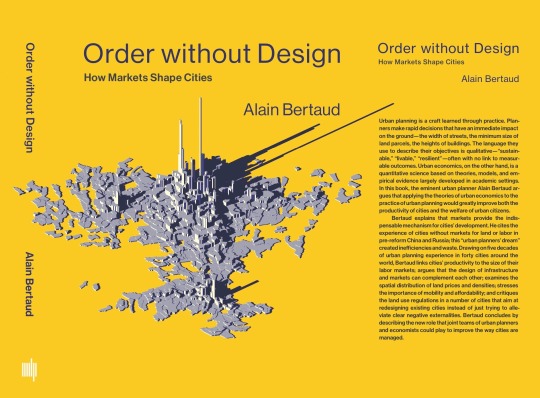
    Alain Bertaud has a new book coming out later this year from MIT Press called, Order without Design: How Markets Shape Cities. If you’re based or happen to be in New York, there’s a book launch on Tuesday, December 11, 2018 at NYU. You can RSVP here

    The book argues that, “operational urban planning can be improved by the application of the tools of urban economics to the design of regulations and infrastructure.” I haven’t read it yet and it’s not available until December, but I’ve just added it to my reading list.

    I am of the opinion that none of us involved in the built environment should be working in insolation, without some understanding of the myriad of other forces shaping our cities. Cities are too complex and important for narrow views.

    From what I’ve read about this book, it subscribes to that philosophy. And so I’m giving it a place in the queue.

    Image: NYU

  • Building a better São Paulo

    São Paulo, and Brazil more broadly, are near the top of my list of places that I want to visit. 

    Starting in the 1930s, Brazil became an early adopter of modern architecture with projects like the Ministry of Education and Health Building. It was one of the first countries outside of Europe to push modernism.

    So I am overdue for a tour of Oscar Niemeyer and Lucio Costa’s work.

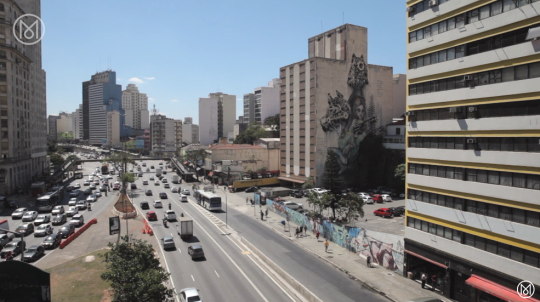
    Here is a short 7 minute video from Monocle about some of the ways in which São Paulo is reinventing its city center.

    It is for the launch of their new book, The Monocle Guide to Building Better Cities, and it got me excited about visiting the city (and country) sometime soon.

  • How we make the decisions that matter most

    I’m listening to the below podcast right now with Sonal Chokshi, Chris Dixon, and Steven Johnson. Steven recently published a new book called, Farsighted: How We Make the Decisions That Matter Most. If you can’t see the embedded podcast below, click here.

    [soundcloud url=”https://api.soundcloud.com/tracks/497128947″ params=”color=#ff5500&auto_play=false&hide_related=false&show_comments=true&show_user=true&show_reposts=false&show_teaser=true&visual=true” width=”100%” height=”300″ iframe=”true” /]

    It is about the big and meaningful decisions that we make as individuals – such as where to live or who to marry – as well as the big and meaningful decisions that we make as a collective – such as how to plan a city or fight climate change. But most importantly, it is about how we can get better at them.

    Supposedly, part of the science (and art) behind deliberative decision making is using tricks to get our minds to see problems and their complexities differently. That could involve scenario planning and even considering the weirdest possible outcomes. In fact, Steven finds a lot of value in fictional storytelling.

    There could also be implications for city building. Tech is allowing us to collect a lot more data about the ways in which our cities operate today. But as we get better at running complex simulations, we should also get a lot better at understanding the long-term implications of our decisions.

    I may just have to get Steven’s new book.

  • The blue (real estate) bible

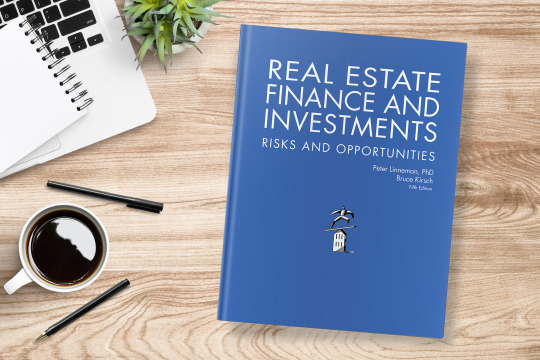
    Back when I was in grad school studying real estate, we used to refer to the below book as the “blue bible.” It is a comprehensive look at real estate finance and investments, and also development. But perhaps more importantly, it is written in a way that is clear, direct, and immensely practical to the actual world of real estate.

    image

    The reason I mention this today is because the fifth edition is out and my friend Bruce Kirsch is now an author, along with Peter Linneman. Thankfully the cover is still blue, otherwise I might be a little sad and this post wouldn’t make a lot of sense.

    Bruce has an MBA in Real Estate from Wharton (at Penn) and is the founder and CEO of Real Estate Financial Modeling, LLC, which I recommend to absolutely everyone who wants to get better at financial modeling and deal underwriting.

    I have a lot of people who reach out to me on a regular basis and want to ask me about getting into real estate, and in particular, development. I try my best to make time because I was once in their shoes. Usually that means an early morning coffee in Toronto’s PATH.

    My advice is fairly consistent. You have two options. Try and get your foot in the door at a shop or, if you’ve got the gall, go out and try and do it on your own. I have friends who have successfully done the latter with very little in the way of formal real estate training.

    Whatever your decision, knowledge of the industry will obviously serve you well. Oftentimes I’m meeting with design and/or planning professionals who bring a lot to the table, but usually lack the finance and investments knowledge. That’s when I remind them of my story: Don’t screw up the numbers.

    This is also when I suggest taking one of Bruce’s classes. I’ve taken a number of them. Because to learn how to model something in Excel you have to understand how it actually works and Bruce helps you do exactly that. Garbage in, garbage out. That’s how models work.

    But the other thing one should consider doing is picking up a copy of the blue bible. I have a copy sitting on my desk right now and will tell you that it’s a “must read”, whether you’re a designer and just want to learn more about the other side of the business, or you’re an experienced real estate professional.

    For more on the book, click here and then on Textbook at the top. Oh, and Bruce, congratulations on the new book!

  • Living on water

    Phaidon has a new architectural book out that surveys 55 homes, all of which have some sort of connection to water, whether that be an ocean, lake, river, or pool. It’s called Living on Water. I don’t (yet) have a copy, but it looks like the perfect coffee table book for a cottage, summer home, or studio apartment with zero connection to water. Monocle on Design recently interviewed the editor of the book (podcast episode here). So if beautiful homes on the water are your thing, maybe check it, and the book, out.

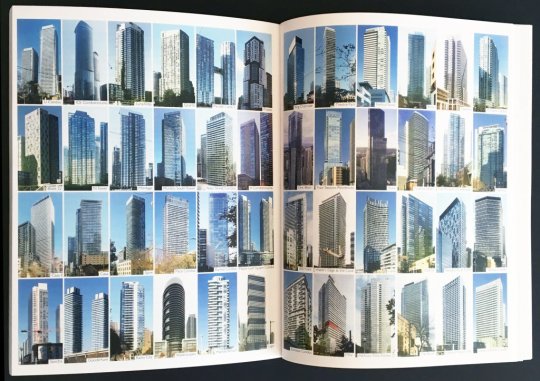
  • Multi-Unit Housing in Urban Cities: From 1800 to Present Day

    I just ordered a copy of Multi-Unit Housing in Urban Cities: From 1800 to Present Day by Katy Chey. I figured this was a book that we should have hanging around our office. I also like to support the Daniels Faculty.

    The book covers the following multi-unit housing typologies:

    • Back-to-backs in Birmingham
    • Tenements in London
    • Haussmann apartments in Paris
    • Tenements in New York
    • Tong lau in Hong Kong
    • Perimeter block, linear block and block-edge in Berlin
    • Perimeter block and solitaire in Amsterdam
    • Space-enclosing structures in Beijing
    • Kyosho jutaku in Tokyo
    • High-rises in Toronto

    In addition to each typology, the book analyzes the connection between the housing type and the city. Why did certain typologies flourish where they did and how have they helped to define their city?

    It reminds me of what I was trying to do with some of my recent posts about Hong Kong’s typical tower plan, albeit with far less rigor than what I am sure has been applied to this book.

    I am also curious to read what has been written about high-rises in Toronto. It goes to show you just how defining the current real estate cycle has been for this city. That’s our multi-unit housing typology.

    Image: Daniels Faculty. My multi-unit home made the book.

  • Third Coast Atlas: Prelude to a Plan

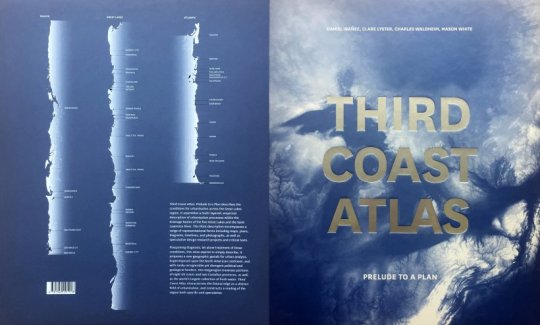
    Daniel Ibañez, Clare Lyster, Charles Waldheim, and Mason White have just published a book analyzing the Great Lakes and the Saint Lawrence River. It’s called, Third Coast Atlas: Prelude to a Plan.

    The Great Lakes represent the world’s largest collection of freshwater; a feature that is likely to become

    only

    more valuable. Their coastline is longer than the Atlantic and the Pacific coastlines of the US, combined. Hence the name “Third Coast.”

    The reason the book is called a “prelude to a plan” is that it doesn’t propose a plan or a path forward. Instead, it is focused on analyzing the current state. Here is an excerpt about the book taken from the Daniels Faculty:

    Third Coast Atlas: Prelude to a Plan describes the conditions for urbanization across the Great Lakes region. It assembles a multi-layered, empirical description of urbanization processes within the drainage basins of the five Great Lakes and the Saint Lawrence River. This thick description encompasses a range of representational forms including maps, plans, diagrams, timelines, and photographs, as well as speculative design research projects and critical texts.

    I find this topic fascinating and I suspect that many of you might as well. It’s also an important one. So I wanted to get it on your radar. If you happen to be in Toronto next week, the launch/book signing is happening this Tuesday, October 24, 2017.

  • The authoritative architectural guide to Toronto

    It’s late. I just got home from the office. And I’m exhausted.

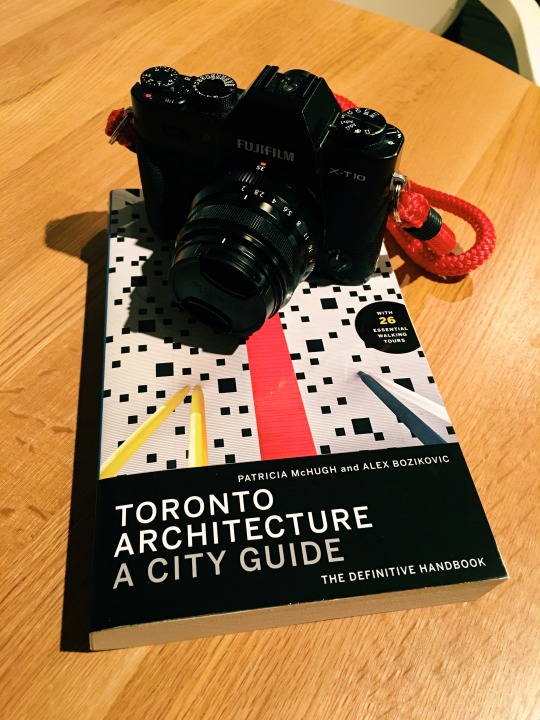
    But I did just receive my copy of Toronto Architecture: A City Guide. The “handbook” was originally written by Patricia McHugh (1934-2008), but it was recently updated by Globe and Mail architecture critic Alex Bozikovic. (Also, shout out to Vik Pahwa for the terrific photos he took for this guide.)

    When I opened the book, one of the first things that stood out for me were these two lines:

    Toronto has in fact rebuilt itself over and over again.

    This book is, in part, a tool to understand that story.

    In my view, this is one of the biggest compliments that you can pay to a city. Cities should not be static entities. Because if they are, then they will inevitably fail. Change must be a constant.

    As I read through the guide, that wonderful spirit of reinvention is abundantly clear. But I think the real way to experience this handbook is on the streets of Toronto – and probably with a good camera. That’s why it’s called a handbook. 

    The book is primarily structured around 26 distinct walking tours, each of which could be covered off in an afternoon. Along each tour, Patricia and Alex point out which buildings you should be focused on and provide pithy, yet insightful, comments for each.

    I believe that the more you know, the more you can appreciate. So if you’re interested in architecture and/or Toronto, I would you encourage you to think about getting a copy. And if you’re interested in going on a walking tour, tweet at me.

  • MOMO TOKYO

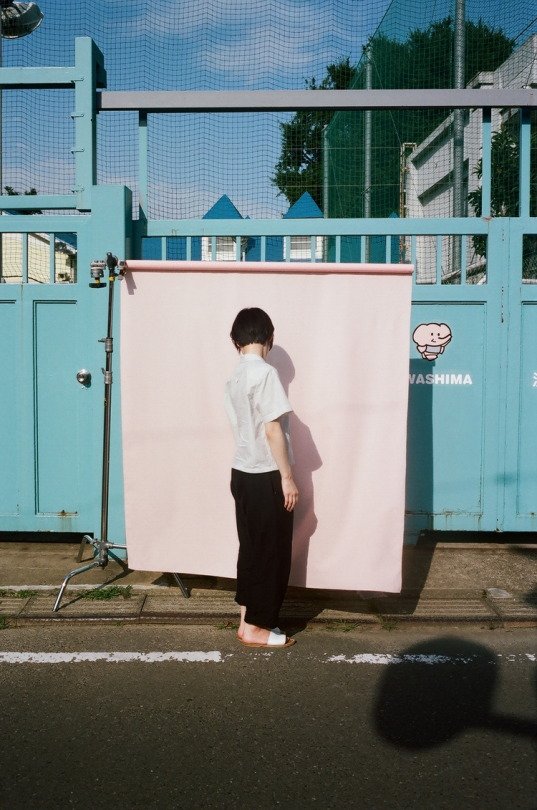
    Last summer, photographer Parker Woods spent two weeks walking over 100 miles in Tokyo with a peach-colored (”momo” in Japanese) backdrop and a metal c-stand. He used this accessory to “contextualize his first encounter with Japanese culture.”

    In some cases, it functions as you would expect: as a backdrop for the new people that he encountered along his walking journey. 

    But in other cases, the backdrop is simply inserted into the urban environment. Sometimes rolled up amongst a pile of metal tubes. And sometimes fully erected in the middle of a busy road.

    This is an interesting photography project based in one of my favorite cities in the world, and so I wanted to share it on the blog. All of his photos were shot on Kodak film. It’s also giving me some ideas for my own photos.

    If you’d like to buy a copy of the book ($40), you can do that here. There’s a limited run of only 250 copies. If you’d like to read a bit more about the project (and see a few additional photos), you can do that here on VSCO.

    Image: Parker Woods