Daily insights for city builders, delivered every morning at 6 AM ET. I’m Brandon Donnelly — a Toronto-based real estate developer and founder of Globizen. I’ve been writing here since 2013.

Tag: bmw

  • How to brand and market a new development

    The typical way to do it looks something like this:

    • Hire a creative agency
    • Come up with a new name and brand identity that speaks to your target market
    • Create a new website and new social media accounts
    • Start marketing the project with this new single-purpose brand and identity in the forefront (the developer’s brand is usually far less prominent)

    Of course, this is the typical way and things do vary. What I would like to discuss today is this last point: the interrelationship between new project-specific brands and developer brands. Because in most other industries, the brand of the company is paramount. It is everything. When BMW releases a new car model, it is BMW and then the something. It is not the something, with BMW hidden at the bottom of the page.

    So why is real estate any different?

    One possible explanation is the entrepreneurial and opportunistic nature of development. New projects are often the result of people and groups coming together to make a specific “deal” happen. And unless you’re an established player with a long history, you may not have a consumer-facing brand with much equity in it. So you rely on a new single-purpose one instead.

    But perhaps the main reason is that, as an industry, we have never really succeeded at making buildings a product (architects sometimes despise when you call buildings this). It is for this reason that every building can feel like a prototype and that prefabrication remains this dream that never seems to become a reality. A product implies something repeatable and producible at scale. And buildings are generally not that. Every market and site are unique.

    All of this said, there are ways that developers are building meaningful brands for themselves.

    The first way is to obviously focus on building your own brand alongside or in lieu of strong project brands. One example of this is Toronto-based Urban Capital. They build a specific kind of condominium building/product and, to the extent that it’s possible, it doesn’t change whether they’re building in Saskatoon or in Halifax. David Wex, one of the partners, describes this as branded vs. opportunistic real estate development.

    Another example is Toronto-based Fitzrovia (which I wrote about, here). They are one of if not the most active rental developers in the city. And if you go into one of their apartment buildings, you’ll find the same No. 10 Dean coffee shop and bar in the lobby; the same rooftop pool (called LIDO); the same gym (called The Temple); and the list goes on. Their goal is to build a consistent and hospitality-like experience for apartments.

    The second way to go about building a brand is to make it so attractive that other developers will pay you to use it. The best example that I can think of is London-based YOO. A partnership between John Hitchcox (a developer) and famed designer Philippe Starck, they have built a business out of creating branded residences for third-party developer clients. And this is in some ways the holy grail of development: you get paid without taking on the risk of building.

    Of course, this same licensing model is also used with hotels. And hotel brands are globally the most common kind of branded residence. What this obviously tells us is that brands matter a great deal in real estate. They matter so much that developers will pay to use the right one, because it will likely command a premium and it will likely increase sales/leasing velocity.

    It is for this reason that I’ve always felt it important to grow the parent brand alongside any project-level brands. And it’s why we never bother creating new social accounts for our individual development projects. Brand building takes time. If you’re going to invest time and money into one, why not take advantage of the compounding at the very top of the house.

  • Global electric vehicle adoption

    This is the current state of global electric vehicle adoption:

    • Last year was the first year that global electric-vehicle sales reached 10% of all car sales — the total was around 7.8 million cars (see above chart)
    • Fully-electric vehicles accounted for about 5.8% of all car sales in the US, 11% of all car sales in Europe, and about 19% of all car sales in China — China is leading in this department
    • The US saw 807,180 fully-electric vehicle sales last year — Tesla remains the biggest EV maker in the world
    • In Germany, electric vehicles accounted for about 25% of all new vehicles produced last year — BMW reported a 5% decline in new-car sales, but saw its EV sales more than 2x
    • Similar story with Volkswagen: 7% decline in new-car sales; 26% increase in EV sales
    • This year, some are predicting that China will see EV sales increase to every third car, and that it will reach its tipping point sometime between 2025-2030

    It is obvious where all of this is heading. It is simply a question of how fast, and who will be the leaders at the end of the day.

    All data sourced from the WSJ

  • Thoughts on electric vehicle adoption

    Nathaniel Bullard’s latest Sparklines article for Bloomberg Green makes some interesting arguments around EV adoption.

    First, he shows that cars in general have been getting a lot more expensive. Looking at new vehicle market share in the US according to price (above), you can see how quickly cars over $40k have become about half of the market. Only some of this is inflation.

    Nathaniel then goes on to show just how many people lease a luxury vehicle (apparently this is called lease penetration). For Infiniti it’s 55.6%, for BMW it’s 49%, and for Mercedes it’s about 40%.

    When you consider that “upfront cost parity” between EV and internal combustion vehicles is supposed to arrive sometime in 2024, there is an argument to be made that people are destined to start buying a lot more EVs in the near future.

    They’re already buying expensive cars and EVs will soon be cost neutral in that regard. At the same time, a lot of people lease their cars and will be in a position to easily switch when it makes sense to do that.

    I think the greater barrier to adoption at this point will be the charging network and “range anxiety.” Too many plug types and not enough charging stations, except maybe if you have a Tesla. But at some point that too will change, I’m sure.

  • The post-combustion era

    Over the winter I visited BMW World, and its neighboring museum, in Munich, Germany.

    I loved seeing how the company got its start and how far it has come since it helped to invent the automobile at the beginning of the 20th century. I think their first product was actually an airplane engine.

    But you and I both know that the paradigm is changing. The internal combustion engine (ICE) is going away and pretty soon we won’t be driving, so much as being driven around by our cars.

    Bloomberg recently published an interesting article about this shift and about BMW. Here is an excerpt:

    The fact that both combustion engines and electric motors find themselves inside the same 18,000-person complex in Dingolfing, BMW’s largest in Europe, makes it a microcosm of a shift overtaking automakers the world over. A visitor can see that 625-horsepower engine—more than twice as powerful as the original from 1985, a luxury product relentlessly branded as “the ultimate driving machine”—then walk around the corner and see its puny electric replacement. You start thinking the better slogan might be “the ultimate combustion engine.” As in: last of its kind.

    Electric motors are a hell of a lot simpler to manufacture (and service) than gasoline engines. BMW estimates that they take about 30% less time to make. So the impacts of this transformation span everything from supply chain to human capital.

    Today, about 10% of the work that goes on in Dingolfing is related to electric vehicles.

  • A visit to BMW World

    Today we visited BMW Welt (World) and the BMW Museum in Munich.

    BMW Welt was designed by COOP HIMMELB(L)AU out of Vienna. It is the result of a design competition that the BMW Group held in 2001. Construction of the ~73,000 square meter facility was completed in 2007.

    The project is centered around a great hall and an elevated vehicle delivery area known as Premiere. It was designed — and this includes the HVAC system — to handle 40 car deliveries per hour, or 250 per day. I guess they don’t work a full 8 hours.

    Below are two photos that I took of the delivery area. The circles you see on the floor in the second picture are rotating platforms. This is where you want to pick up your new car.

    And here is a plan of the entire Welt space via COOP HIMMELB(L)AU:

    I also really enjoyed the BMW Museum, which is housed in a separate building adjacent to the BMW Tower (the one that looks like engine cylinders).

    The “art cars” were a lot of fun. I’m sure that many of you will be able to guess the artist behind this one:

    But what I enjoyed most were the classics like this one here:

    The least interesting cars for me were the ones that weren’t old enough to be “classic”, but also weren’t new and shiny. This can happen with architectural styles as well. Designs sometime need time to settle in.

    For more photos of BMW Welt and the BMW Museum, follow me on Instagram.

    Drawings/Isometrics: COOP HIMMELB(L)AU

  • Are you happy with where you live?

    This past weekend I saw a few people reacting on Twitter to this article by Wendell Cox talking about how Canadian families are being denied their preferred housing choice: the detached single family home.

    The fact that the article is by Wendell Cox should tell you everything you need to know. But essentially the argument is that misguided planning policies are driving up the cost of housing and that we should, instead, be encouraging unfettered sprawl.

    There’s lots to discuss here, but the first thought that actually came to mind was: “How would this article sound if we replaced all of the references to housing with references to cars?” In case you too are wondering that, this is how the first paragraph would read:

    A new poll by Sotheby’s International Realty suggests substantial disappointment among Canada’s young urban families, unable to afford to purchase the types of [cars] that they prefer. The poll determined that young urban households in Canada strongly prefer [Aston Martins], but they are often “motivated by (financial) necessity to purchases [sic] [cars], especially [BMWs], they do not prefer.“

    The article is clearly one-sided. I don’t disagree that there are people who – all things being equal – would prefer to raise a family in a ground-related single family home. Backyards serve a purpose, as do large basements equipped with beer fridges.

    But all things are not equal. And there also people who value walkability, a reasonable commute, and the kind of urban amenities that come along with being in a dense city. I am one of those people.

    Photo by Adrien Olichon on Unsplash

  • Mobility at CES

    CES is underway right now in Las Vegas. About 200,000 people are in attendance. 

    Since tech and mobility are today closely intertwined, the show has become an important platform for the automative industry.

    Here is a video showcasing BMW’s new iNext concept (expected by 2021):

    [youtube https://www.youtube.com/watch?v=x9-f3cALABk&w=560&h=315]

    It is based on level 3 autonomy, which means the car will do mostly everything, but you need to be ready to take over at any time.

    The video is interesting because it begins to show you what becomes possible when you no longer need to pay attention to the road. It is a bit like flying (but hopefully more enjoyable). 

    And here is a video of Bell’s new urban air taxi, which is called Nexus (expected by the mid-2020s):

    [youtube https://www.youtube.com/watch?v=1o4d8N-A1G8&w=560&h=315]

    This is the company’s first concept. But they’ve been working with Uber since 2017 to develop a network of flying taxis for cities.

    Finally, flying cars.

  • My Focals by North fitting

    Over the weekend I went by the new North store on Ossington for the fitting of my new Focals by North glasses. According to Retail Insider, this is the first retail space in Canada that is entirely dedicated to wearable tech (shout-out to Hullmark and CBRE). Full disclosure: I am not being paid by North, but I was asked if I would accept a pair of Focals and provide my thoughts. So I will be doing that over the coming months on the blog.

    Previously known as Thalmic Labs, North is a Waterloo-based company that first attracted attention with the launch of a gesture-control armband known as Myo. What that product did was make digital interactions completely hands-free. It had strong use cases across medicine, music, and business. However, this past October the company announced that it would be moving on from Myo. Enter Focals by North. 

    Focals are custom-built eyewear with an integrated display that only the wearer can see. It is similar to, for example, BMW’s heads up display, and the idea is that it is a way for you to quickly get the information you want, without pulling out your phone and disengaging from the world. The ambition is human-centric technology that integrates seamlessly.

    Here is an example of what that display looks like (it is much better and cooler in person):

    image

    To control the display you use both your voice (the glasses have a microphone) and a 4-directional joystick called a Loop, which sits on your index finger like a ring and that you thumb. You can receive and send texts (voice to text), you can get turn-by-turn directions, you can view your appointments and the weather, and you can ask Alexa things.

    The first step in the ordering process is a fitting. And that’s what I did over the weekend. The glasses are all custom made and so they start by doing a full 3D scan of your head in a room that feels like the future. Once that’s done, you pick what frame you want, the color, and your sun clips (an essential accessory for day drinking in Trinity Bellwoods). Total cost: CAD 1,299.

    While exceptionally cool, it is premature for me to really comment on the tech at this point. I’m expecting my Focals in 8-10 weeks. But is it interesting to opine on the current state of eyewear tech.

    Most people believe that the problem with Google Glass was the fact that you had to be a Silicon Valley nerd in order to want to wear them out in public. They looked and continue to look ridiculous, which is why Snap went fashion first with their Spectacles. I have always found this product really intriguing. I want to use it. But I’ve stopped using Snapchat entirely and I don’t really have a strong use case for them.

    Snap’s Spectacles are about capture and content creation, whereas Focals are about discreetly feeding you information that you would otherwise have to pull out your phone (or watch) to view. There’s no camera on Focals. That’s not what they are about. But they are obviously fashion first.

    The question for me is whether the experience will truly be seamless and integrated, or if I’ll still be disengaged – gazing off into my glasses (space) while I ask Alexa to UberEats me a chicken shawarma wrap. I’ll let you know in about 8-10 weeks. If you’re looking for more on Focals by North, check out their website and this CNBC piece. Go Canadian tech.

  • The world’s best brands — 2018 edition

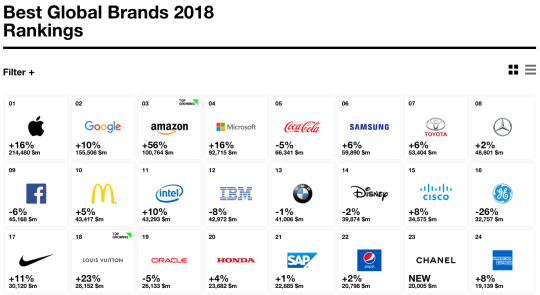
    At the beginning of this month, Interbrand released its annual ranking of the world’s best global brands. This year’s 2018 report marks the 19th year of the study. If you’d like to download a free copy of the report, you can do that here. But below is a snapshot of the first 24 brands:

    Apple and Google are in top position for the 6th year in a row. And Amazon is on a hockey stick trajectory with its brand value jumping by 56%. More than half of the list is comprised of the following five sectors: Automotive (16), Technology (13), Financial Services (12), Luxury (9), and Fast-Moving Consumer Goods (9). Luxury is currently the fastest growing sector.

    In their report, they outline five themes that have emerged and that are helping these brands outperform. They are:

    1. Positive utility – not enough to just make people feel good through storytelling; you need to create real value and a positive impact in the world
    2. Subscription mindset – there’s an increasing amount of brand value in subscription-based businesses (29% in 2018 compared to 18% in 2009); you need to offer your products and services with the least amount of friction as possible
    3. Customer-centricity – bring the voice of your customer into every aspect of your business; be nimble enough to respond quickly
    4. Learning from luxury – the top performing category in this year’s ranking; about exclusivity and authenticity
    5. Role of brand – make your brand part of the decision-making process; build brand equity and trust

    I’ll stop there and let you all dig into the rest of the report if you’re interested. 

    But one thing I found particularly interesting about the study is that they used – insert buzzwords here – “AI-powered social listening” to try and measure the emotion and sentiment floating around on the internet around specific brands. The goal was to pin down the perceived trustworthiness of specific brands.

    Not surprisingly, they found a pretty strong correlation between customer trust and purchasing intent. Makes sense to me.

  • Is Tesla the new iPhone?

    image

    Benedict Evans just published a great post on his blog about “Tesla, software and disruption.” I recommend a full read. In it, he tries to answer whether Tesla is really “the new iPhone” and if it will be as disruptive to the car landscape as some/many people think.

    In his line of thinking, electric (as opposed to an ICE vehicle) feels a lot more like a sustaining innovation, rather than a disruptive innovation. In other words, it something that incumbents will be able to incorporate. So it will not change the “basis of competition.”

    The more critical aspect is instead autonomy. Here are two snippets from the piece:

    All of this takes us to autonomy. Electric is compelling but will probably be a commodity, whereas Tesla’s improvements on top of electric may not be commodities but are not necessarily decisive. Autonomy changes the world in profound ways (I wrote about this here), and it’s a fundamentally new technology that doesn’t look at all like a commodity. And Tesla is doing this, too. Sort of.

    In this competition, Tesla’s thesis is that the data it can collect from its cars will give it a crucial advantage. The only reason that anyone is interested in autonomy today is that the emergence of machine learning (ML) in the last 5 years probably gives us a way to make it work. Machine learning, in turn, is about extracting patterns from large amounts of data, and then matching things against those patterns. So how much data do you have?

    But even if we are to all agree that autonomy is the “disruptive innovation”, it is not yet clear who will get there first. Maybe it is Tesla. Maybe it is Waymo. Regardless, many or most people seem to agree that it will arrive in 202x.

    Image: Tesla