Daily insights for city builders, delivered every morning at 6 AM ET. I’m Brandon Donnelly — a Toronto-based real estate developer and founder of Globizen. I’ve been writing here since 2013.

Tag: bloomberg

  • Affordable housing for all?

    Bloomberg CityLab has a new video out talking about how Vienna has seemingly solved the housing unaffordability problem that is impacting most global cities around the world. Each year Vienna builds about 14,000 new housing units and about half of this is supply is “affordable.” Already over 60% of Viennese live in an affordable home. The title of the video suggests that their approach is radical, but is that really the case?

    What was clear to me when I watched the video is that there are perhaps two key differences in terms of how Vienna approaches this problem. One, they quite simply care about delivering high-quality affordable housing to the middle class. They think it’s culturally important and they believe that architecture and design matters. Two, they are willing to invest in it, both up front and over time (maintenance).

    In the video, the former Vice Mayor of Vienna talks about how the City will go out and buy land (or use already owned land) and then make it available (sale or lease) at discounted rates so that it makes economic sense for non-profit housing developers. If the math still doesn’t work for the private sector, then there are other subsidies available.

    I’m certainly not an expert on Vienna’s approach to housing delivery. And I’m not suggesting it’s perfect. My knowledge base comes largely from one 13 minute episode by CityLab. But I think it’s notable that I didn’t pickup anything in the video about inclusionary zoning leading the way (which I have argued before tends to shift the burden to the remaining market rate housing units). Instead, they value it and they invest in it. There’s no such thing as a free lunch.

    Image: CityLab

  • Project Titan

    Apple’s self-driving system and/or car project has been in the news again recently. Last month, Bloomberg reported that the company was hoping to start production by as early as 2024. But this week, projections were revised and we’re probably looking at least 5 years. The details are pretty limited at this stage, as is typical of Apple (although Hyundai has been saying things). It’s also not clear whether the company is set on developing both an electric vehicle and a self-driving system, or just the latter. But the company has been hiring lots of engineers to work on the project, including a bunch of ex-Tesla employees. Supposedly, Apple now has “several hundred engineers” working on this initiative, most of whom are focused on the self-driving system part. Who really knows how and when this all unfolds, but I would bet that software is going to continue eating the world.

  • La ville du quart d’heure, but also the value of centralization

    These days, everybody seems to be talking about the 15-minute city — Bloomberg, Treehugger, the Financial Times, as well as countless others. While not a new concept, it is a moniker that is easier for most people to digest. COVID-19 has also created the right backdrop for the moment that it is currently enjoying.

    The 15-minute city is a polycentric and somewhat decentralized approach to urbanism. It is about encouraging and creating multiple centers of urban activity near where people live. The idea being that everybody should have most of their essential services within a 15-minute walk of their home. Put even more simply, it’s about creating an urban environment where people can live locally.

    The benefits to this are numerous. It encourages more compact forms of development, which in turn encourages people to rely more heavily on active modes of transportation such as walking and cycling. The result is less commuting, less carbon emissions, more time, and likely better health outcomes given the reliance on active mobility.

    Indeed, living in a walkable urban community is something that I personally put a huge value on. If I can’t walk out of my home to go grab a coffee and something to eat, it’s probably not the neighborhood for me. But at the same time, I don’t think we can ignore the fact that there are powerful centralizing forces present within our cities.

    As Natalie Whittle points out in this FT article from the summer, new technologies — from the telegraph to the internet — have always elicited predictions that humans would now flee cities and move to the countryside. While it is true that there are other technologies — everything from the streetcar to the automobile — that have allowed us to decentralize to a greater extent, most of us are all still bound to cities.

    In fact, you could argue that the opposite of decentralization has played out. As we have transitioned to a knowledge and information economy, the returns to being embedded within cities and within a particular place have only become greater.

    Take for example the phenomenon of “collab houses” that has been playing out in Los Angeles for some time now, including during this pandemic. Collab houses are typically LA mansions where clusters of young people come and live together in order to create content for platforms like YouTube and TikTok. It’s like a big dorm for creators. And supposedly the biggest one is Hype House.

    What’s fascinating to me about this phenomenon is that it reinforces two things. One, if you want to be rich and famous (emphasis on famous), Los Angeles is seemingly still an important place to be. And two, if you really want to be at the top of your game, it’s apparently not enough to be in the same city as other likeminded individuals; you also need to be under the same roof, bouncing ideas around and pushing one another.

    So what does this all mean? Well, maybe this time is different and we are all currently living through a reorganization of how we will live, work and play. Or, maybe this time isn’t all that different. And the 15-minute city, while an important goal, won’t be the be-all and end-all of modern city building.

    Photo by Lukas Geck on Unsplash

  • The many forces shaping our cities

    Richard Florida has a three-part essay over on Bloomberg CityLab about the forces that are currently shaping American cities. In part three, he argues that this pandemic will likely accelerate many of the trends that were already underway — families will continue to like the suburbs and young people and businesses will continue to cluster in dominant global cities. At the same time, he argues that we will see a kind of “urban reset.” A window of opportunity where we just might be able to rebuild our cities to be more affordable, more inclusive, and more productive. Could this be the moment where we commit to transforming our suburbs into more walkable mixed-use communities? Could this crisis actually strengthen our cities, as I have argued before on the blog? At this point in time, the only thing I really know for sure is that most of our predictions will be wrong.

  • EV and ICE vehicles expected to reach price parity by mid-2020s

    Each year, Bloomberg NEF (New Energy Finance) publishes a long-term forecast of how electric vehicles and shared mobility will/might impact our cities. Predicting the future is never easy. And forecasts are never right. But they’re valuable to do.

    By 2040, BNEF believes that 57% of global passenger vehicle sales and 30% of the global passenger vehicle fleet will have some form of an electric drivetrain. Either full battery electric (BEV) or plug-in-hybrid electric (PHEV). Looking at this another way, we have about 17 years (2037) until ICE and electric vehicles are expected to intersect and hit 50/50 in terms of global sales.

    A big part of what is driving the adoption of electric vehicles is that the price of lithium-ion batteries keeps coming down. Assuming this trend continues, the price of EVs and ICE vehicles (in most segments) should reach parity sometime in the mid-2020s. Meaning, yes, it’s more expensive to produce an EV today.

    All of this will also impact mobility services (ride-hailing and ride-sharing). Today, less than 5% of annual kilometers traveled by passenger vehicles around the world is thought to be done through some form of a ride-hailing app. That’s still a pretty significant number, actually. Though only about 1.8% of this fleet is electric.

    By 2040, shared mobility services are expected to rise to 19% (see above) and — because their costs are coming down — 80% of this fleet is expected to be electric. Autonomous vehicles are not expected to meaningfully impact global mobility until the 2030s. But the growth in shared mobility services is still expected to reduce the demand for car ownership, and likely parking.

    Other high-level findings from BNEF’s 2019 Electric Vehicle Outlook can be found here. If you want to access the full report, you’ll need to be a BNEF client.

    Images: Electric Vehicle Outlook 2019 (BNEF)

  • The global average fertility rate is decreasing

    According to this recent Bloomberg article, the world is expected to add more than 3 billion people by 2100. At the same time, the global average fertility rate is dropping. In 1960, it was five live births per woman. As of 2017, it had dropped to 2.43.

    About half of all countries are now below the rate of replacement, which means they’re relying on immigration (places like Canada) and/or they’re relying on labor productivity gains to keep their economy growing (places like China).

    The article is also fascinating in that it begins to consider the economic and cultural forces that shape the above fertility rates. Women in Saudi Arabia, for example, have one of the lowest labor force participation rates in the world. Only about 25% are in the workforce.

    If you’d like to read the full article, you can do that here.

    Image: Bloomberg

  • Qantas pilots new 20 hour ultra long haul flight from New York to Sydney

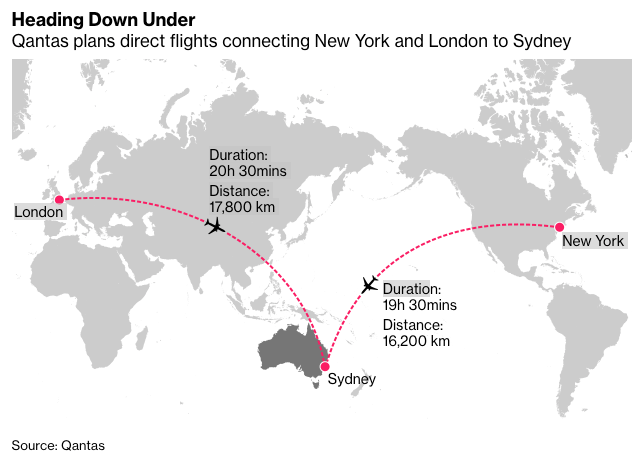
    Over the weekend, Qantas Airways set a new record with a nonstop ultra long haul flight from New York to Sydney. At a distance of 16,200 kilometers and a duration of 19 and a half hours, this is now the world’s longest flight. Though, this was still a test voyage. It remains to be seen whether this will be a commercially viable route. The company also plans to offer a similar ultra long haul from London.

    It’s fascinating to think about the logistics that go into a flight like this. The flight took off with its fuel tanks maxed out at 101 tons. But according to Wired, the loss factor on each additional ton of fuel is about 60% simply because of the additional weight. In other words, most of the incremental fuel to get all the way to Sydney just gets cannibalized by the heavier load. Wow. That doesn’t feel all that sustainable.

    Similarly, every ten passengers roughly equates to one ton (200 pounds per person). So there’s a balancing act between reducing weight (optimizing fuel consumption) and maximizing revenue (adding lots of people). There’s also a question of how best to price discriminate across economy, premium economy, and first class.

    Initially these ultra long haul flights were imagined to be flying hotels, where people could sleep, workout, and do all sorts of other things while they traveled halfway around the world. But the economics didn’t work. Too much wasted space on non-revenue generating items.

    The other interesting thing about these ultra long haul flights is how much work goes into passenger comfort, specifically around our body’s natural rhythms. Angus Whitley of Bloomberg was onboard this maiden voyage and he talks about how the food they served — spiced with things like chili and lime — was designed to fire up your clock when you shouldn’t be sleeping.

    And this isn’t new a feature of ultra long hauls. Qantas already employs things like hot chocolate laced with tryptophan in order to help people sleep onboard. I’m not great at sleeping on planes, generally because I don’t fit in the seats very well. But maybe it’s because I’ve been passing on the hot chocolate.

    Image: Qantas via Bloomberg

  • Global distribution of wealth

    Bloomberg recently came up with a new index to define the distribution of wealth across adults in the world. They’re calling it your “net worth number” and the scale ranges from -2 to 11. Sadly, because the gap is so significant between the rich and the poor, it is based on a logarithmic or non-linear scale. Here’s how they break it down:

    Logarithms of negative numbers aren’t a thing, and so, technically, if your liabilities exceed your assets (i.e. you have a negative net worth) you shouldn’t appear on this index. But Bloomberg has added those people — which could be students with debt, after all — into the -2 category of their scale. These are people with a penny to their name.

    Now, the number of adults in each bracket is purely an estimate. If you look at different sources, you will end up with different numbers. Bloomberg believes that there are 2,800 adult billionaires in the world (numbers 9 to 11); whereas Credit Suisse’s estimate is about 1,600. (I wonder if it’s easier to estimate the number of billionaires or the number of -2’s.)

    Still, it is eye-opening to see where most adults sit (at number 3) and how bottom heavy this index is.

  • Fees on homes

    A colleague of mine sent me this Bloomberg article today and said, “Here’s an article about things you already know.” The article cites a recent report by Altus Group that compared government-related fees on new housing across Canada and the U.S. What they discovered will not surprise any of you who are in the industry: Toronto has some of the highest government-imposed charges on new homes.

    For new condo apartments, the report found that government charges can add up to as much as C$124,582 per unit. That’s about 50% higher than the average unit in the U.S. and about 30% higher than the average unit in Canada (see above chart for the list of cities). While all of us in the industry can appreciate this, I don’t think most homeowners and tenants understand this. Hopefully they’re reading this post.

    Chart: Bloomberg

  • Hong Kong vs. Singapore

    There’s now evidence to suggest that the political crisis in Hong Kong may be having an impact on capital flows. Bloomberg, as well as others, reported today that wealth managers in Asia have been receiving a heightened number of requests to transfer assets out of the country — to places like Singapore — and to setup new overseas bank accounts so that they can be ready to transfer, should the situation gets worse.

    In fact, the Monetary Authority of Singapore (MAS) even asked the country’s financial institutions not to prey on the wealthy in Hong Kong during this period of uncertainty. They want to avoid the perception that Singapore is trying to capitalize on the situation. Of course, it remains to be seen how much all of this is here-say and how much of it will actually translate into a meaningful transfer of wealth.

    Hong Kong has a significantly larger private wealth base, with about 853 individuals worth more than $100 million. This is more than double the number in Singapore (figure from Credit Suisse). But the current demonstrations have people questioning what will happen to Hong Kong in 2047 when the constitutional article committing Hong Kong to a capitalist way of life is set to expire.

    The flows of capital can be fickle.

    Photo by Florian Wehde on Unsplash