
Daily insights for city builders, delivered every morning at 6 AM ET. I’m Brandon Donnelly — a Toronto-based real estate developer and founder of Globizen. I’ve been writing here since 2013.

Tag: bloomberg

  • Who owns single-family houses in the US

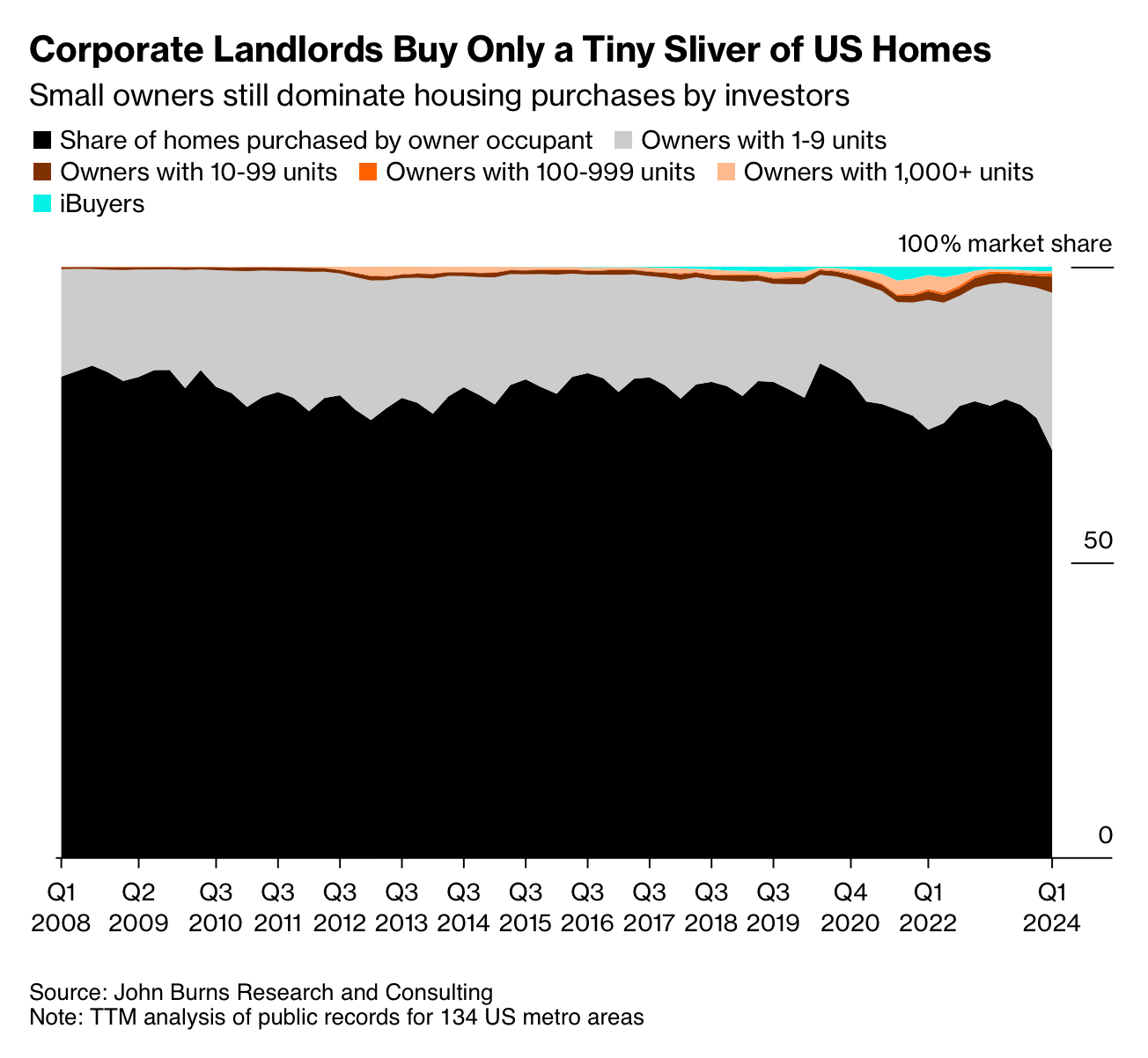
    Here is a chart from a recent Bloomberg article summarizing who owns single-family houses in the US.

    As of Q1-2024, about 69% were owner-occupied, about 26.6% were owned by small landlords (1-9 homes), and the rest were owned by what many are now calling “corporate landlords.”

    The point of this graph was to show that, despite getting a lot of political attention, corporate landlords still own very little. Let’s call it sub 4%, excluding iBuying companies like OpenDoor. So how much of a problem is this, really?

    Smaller landlords control much more of the US market. And at the end of the day, a house owned by a small landlord versus a corporate landlord doesn’t change the supply-demand balance of a market. It still represents an available home.

    The first and more important problem to solve is overall housing supply. Because that does change the supply-demand balance of a market. And once again, there’s no shortage of data to support the finding that increased supply tends to moderate rental growth.

    For the record, I also dislike using the term home to refer to single-family houses. Home is not a housing type. It is simply a place where people live permanently. So whenever I see a title like “US homes,” I get confused, because I don’t actually know what they’re referring to.

    If you read the article, it would appear they’re only talking about single-family houses. But implying that these are the only kind of home feels to me like an anachronism.

  • 41 million

    It seems like just yesterday that I wrote about Canada’s population surpassing 40 million people. Because today, some 9 months later, we’re already over 41 million.

    Since 2000, we are the fastest growing country in the G-7:

    This is, in many ways, a positive thing. But it’s also a serious problem if, among other things, we don’t build enough new housing (source):

    In 2013, Canada ranked 13th out of 170 countries in meeting the basic needs of citizens, according to data tracked by Social Progress Imperative. By 2023, it had fallen to 39th, in large part because of a lack of affordable housing.

    For more on this topic, here is a recent article from Bloomberg talking broadly about Canada’s declining social safety net.

    Chart: Bloomberg

  • Car washes are hot right now

    We talk a lot about walkable urban communities on this blog, and I’ll be the first to admit that this is my own bias. It’s my preference. But at the same time, we can’t ignore that, as of 2022, there were nearly 280 million registered personal and commercial vehicles in the United States. And that only about 8.3% of households do not have a vehicle. Most households drive in this part of the world.

    The result is that lots of people want to regularly wash their car(s). According to Bloomberg, there are some 60,000 car washes across the US, and the overall sector has been growing at roughly 5% per year (I’m not sure over what time period). More thrilling, though, are the stats that the car wash market is expected to double by 2030 and that there were more car washes built in the last decade compared to all prior years combined.

    The obvious reason for this is that there are a lot of drivers. But why right now? Apparently, there are other more specific reasons for the recent boom in car washes:

    Now, washes can take just 90 seconds, labor costs have been automated down, and recurring revenue from memberships has eliminated weather risks. Plus, the tax reforms enacted in 2017 by former president Donald Trump allowed car wash owners to claim 100% depreciation on new equipment — a generous subsidy to further investment. While that incentive was written to shrink over time, the tax proposal currently in Congress would restore the 100% depreciation allowance.

    This has the PE and real estate industries interested:

    “If private equity thinks it’s sexy, they’re gonna throw money at it, right?” said Emil Khodorkovsky, founder and CEO of Forbix, a real estate firm that just acquired a car wash in Santa Monica, California. “It’s a basic business. It isn’t complicated finance. Certain actors are getting squeezed but this one still has a much higher-yielding return than an apartment building or a retail center.”

    It’s hard to think of a retail use that is more antithetical to walkable urban communities. Even most drive-through places have the ability to service things that aren’t cars. It is also possible to go through a drive-through on a bicycle or other micro-mobility device. I have done this before and it was fun. But going through a car wash on a bicycle is probably a lot less fun.

    Intuitively, as long as there are lots of cars, there will be lots of people who want car washes. At the same time, there may even be a more urban use case, here. If you happen to have a garage and a driveway, there is always the possibility that you could wash your own car. But if you live in a walkable urban center and you park your car in a stacker accessed via an elevator, it’s probably a lot harder for you to do that.

    In this case, there’s a subscription for that.

  • Billionaire minimum tax

    If you’re looking for a rough overview of how US business income taxation works — and who isn’t really — this is an interesting article by Matt Levine. He has a knack for making this stuff a lot more interesting. The real purpose of the article, though, is as a lead up to talking about Biden’s proposed “billionaire minimum tax”. At the highest level, here’s the idea:

    His most recent budget would require taxpayers worth more than $100 million to pay a minimum of 25% on their capital gains each year, whether they sold assets for a profit or continue to hold them.

    The way things work today is that unrealized capital gains are not taxed. Meaning you can own something like a stock for a really long time and not pay any capital gains on it, until of course you sell or realize the gains. So this is a philosophical kind of change. And in Matt’s words, it is both “jarring” and “possibly unconstitutional”.

    But I guess it doesn’t affect that many people. There are, according to CNBC, somewhere around 10,660 centi-millionaires in the US. I wonder why it’s not called a centi-millionaire minimum tax, though. (I know why.)

  • Don’t screw it up, New York

    New York City is set to become the first in the US to implement a congestion charge (a form of road pricing). I first wrote about this back in 2018, and then again in 2019, but now it is looking more and more like it may actually happen sometime next year.

    I think all urbanists agree that this is an important step in the right direction. But some are now worried that New York isn’t going about it in the right way. Here is an excerpt from a recent Vice article by Aaron Gordon:

    With all these plans, you could be excused for thinking New York is doing congestion pricing—a potentially transformative policy that would be a first in the nation—right by not only charging drivers to access some of the densest, most valuable land in the world, but also giving them alternatives. Unfortunately, New York isn’t doing that, and in fact looks set to completely screw up congestion pricing so badly it may discredit the policy in a way that makes it harder for other cities to adopt it. Rather than approaching it as a lynchpin to a wide-ranging effort to reshape Manhattan’s relationship to the private car, congestion pricing has become solely about money—specifically, paying off enough of the credit-card bill New York has run up with a variety of ill-conceived and poorly-executed projects that it can get more credit cards.

    You can rightly say that this is decades in the making. Mayor Bloomberg first proposed the idea back in 2007, and I’m sure there were others before him with a similar idea.

    So Gordon raises a valid point: It’s important that NYC gets this right. Otherwise, it’s going to be that much more difficult for other North American cities to even think about implementing road pricing.

    For the full Vice article, click here.

  • A worsening housing shortage is expected

    Last month we spoke about how our current economic environment is going to negatively impact housing supply in the short-term. Now here’s some further evidence for this argument (via Bloomberg):

    “As rates started ticking up, the faucet started to turn off,” says Jonathan Gertman, senior vice president for development at the NRP Group, one of the largest multifamily housing developers in the country. “The number of projects starting this year already has been cut significantly. Anything that started in 2022, in most of the country, comes online 18 to 24 months later. So by the middle of 2025, you see that new supply start to go down significantly.”

    This is also being reflected in Federal Housing Administration (FHA) loan applications for new multi-family housing:

    Or put another way: FHA multifamily loan applications are on track to total as much as $18 billion for FY 2023, compared with $29 billion for FY 2022, $51 billion for FY 2021 and $45 billion for FY 2020.

    The above article is specifically talking about a looming affordable housing shortage. But these exact same headwinds are also impacting new market-rate housing. Of course, there’s always a lag when it comes to development. So it’ll likely be a few years until we really feel the impacts.

  • America’s most affluent cities

    This is an interesting chart from Bloomberg showing the most affluent metropolitan areas in the US in 1949. As you can see, at the top of this list is Detroit, followed by mostly older industrial centers.

    Now here’s the list today:

    It’s largely a different list; but importantly, it’s not an entirely new list. San Francisco was a wealthy city in 1949 and it remains one of the wealthiest today. But could that be changing? Given the city’s current challenges, some are questioning whether it might end up as another Detroit.

    I don’t see that happening. And for what it’s worth, here’s evidence of nearly 75 years of resiliency.

    Images: Bloomberg


  • Wealthiest cities in the world

    According to this annual survey by Henley & Partners (first chart from Bloomberg), these are the top 10 wealthiest cities in the world when you count the number of high-net-worth individuals (i.e. people with investable wealth greater than US$1 million):

    However, if you instead count billionaires, the top city flips from New York City to the Bay Area (which includes San Francisco and all of Silicon Valley). This isn’t all that surprising.

    Also not surprising is the precipitous decline in the number of HNWIs residing in Hong Kong. From 2012 to 2022, the number declined by 27%. That said, a bunch of other cities fared even worse. The city that lost the most millionaires over this same decade was Moscow. It declined by 44%.

    For those of you wondering about Toronto, we placed 12th, just after Chicago, with 105,200 millionaires, 193 centi-millionaires, and 18 billionaires:

    The next city in Canada on the list is Vancouver, and following that is Montreal:

    It is interesting to see how much further behind Montreal places with these metrics given that it is an urban region with about 1.6x the population of that of Vancouver’s.

    Also interesting — given its size and global importance — is Paris (18th when it comes to HNWIs):

    However, when it comes to seasonal draw, Paris is second only to Miami, which appears to be the undisputed global destination for rich people in the winter. Paris has 126 centi-millionaire residents, but during its peak holiday month (presumably summer), this number is believed to increase to over 300:

    Finally, looking at Park City, Utah, it has 8 permanent centi-millionaires and this number is thought to increase to over 100 during the winter snowboarding season. And to be clear, this transient population figure only includes people who own a second home there. It does not include rich people paying US$3,700 per night to stay at Deer Valley. That’s pretty good for a small town of only 8,500 permanent residents.

    To check out the full list of 97 cities, click here.

  • Dubai is now the capital of branded residences

    One way to define “brand” is that it is “the sum of how a product or business is perceived by those who experience it.” And it’s a pretty awesome construct when you stop to think about it. Because if I perceive one brand to be superior to another — which might just mean that it better matches my sense of self — then there’s a good chance I’d be willing to pay more for that brand.

    And if I happen to own a brand that people perceive to be valuable, then I can also monetize this brand by lending it out to other people for money.

    It is for this reason that in the world of real estate development there is something known as branded residences. Broadly speaking, it involves a pretty simple trade. Person 1 has a brand that lots of people perceive to be desirable. Person 2 has real estate that it is looking to sell, but it doesn’t have a brand with the same kind of cachet as person 1.

    So what happens is that person 1 offers the following trade to person 2: pay me $X (upfront and/or over time) and then I will let you use my highly coveted brand to sell your real estate. And hopefully you won’t screw it up by doing weird things with it. (But other than this, person 1 isn’t really taking on much risk with this trade.)

    Because person 2 believes that they’ll be able to sell their real estate for more money and/or faster than without the brand, it gladly accepts the trade. And as long as the benefit it gains is, in fact, greater than the cost of using the brand, it should be a good trade and both person 1 and person 2 should be happy with the outcome.

    Now here’s an actual example. Earlier this month, the proposed Baccarat Hotel and Residences in Dubai set a new pre-construction pricing record when it sold a ~14,507 square foot apartment for 203.1 million dirhams (or US$55.3 million). For those of you who are wondering, this works out to be about US$3,812 psf.

    Supposedly this is the most that anyone has ever paid for a new place in Dubai, and there’s a strong argument to be made that the developer got this pricing because it was a branded residence.

    Image: Bloomberg

  • Walkable archipelagos are emerging across the US

    We have spoken before about how walkable urban communities punch above their weight. In the US, only about 1.2% of land is, on average, designed and built for walkability. And yet, walkable neighborhoods in the top 35 metro areas account for about 19.1% of total US real GDP.

    At the same time, because walkable communities are a rarified commodity, they usually come at a premium. According to some sources, it’s to the tune of 30-40% when you look at home prices and rental rates. This again suggests that humans actually like and want this type of urbanism.

    Which is probably why there’s a growing interest in building more of it. Here’s a recent article from Bloomberg CityLab and here’s a photo of Culdesac’s new completely car-free community under construction in Tempe, Arizona (this doesn’t look like the Arizona I know):

    But in addition to just giving people more of what they want, there are also real economic benefits to stripping out parking and to overall more compact development. Charlotte-based Space Craft is another developer focused on car-light and transit-oriented apartments, and they have seemingly managed to make their projects more affordable as a result:

    “Our product offered lower rents to residents, $100 to $200 below our competitors, and was the best product in the market because we were able to reinvest some of the savings from parking,” said [Harrison] Tucker, who sees walkable urban neighborhoods becoming their own real estate investment class. “The economic case was just very strong.”

    This also flies in the face of the common argument that developers will always profit maximize and charge whatever the market will bear for their spaces. So why even bother trying to make it easier and cheaper to build? But this is not true! Lower development costs, as we see here, can and will translate into lower rents and higher quality buildings.

    I also agree with Tucker that we will see walkable urban neighborhoods, and their associated building typologies, become an important real estate asset class. For all of the reasons that we talk about on this blog, this is where our cities are headed.

    However, it’s going to take some time. I like the metaphor (mentioned in the above article) that, right now, we are creating “walkable archipelagos” or walkable islands in seas of cars. With the right connectivity (transit, micromobility, and so on), these islands can do just fine. But over time, I suspect we’ll see a lot more land reclamation. Good.