
Daily insights for city builders, delivered every morning at 6 AM ET. I’m Brandon Donnelly — a Toronto-based real estate developer and founder of Globizen. I’ve been writing here since 2013.

Tag: blogging

  • Toronto Community Council voted unanimously in favor of laneway suites

    It happened.

    Today, Toronto and East York Community Council voted unanimously in favor of adopting a planning framework that would allow laneway suites on lands within the Toronto and East York District that are designated as “Neighbourhoods.” 

    If you’d like to see the actual vote (and the clapping that ensued), check out this YouTube video at the 41 minute mark. There are also some great speeches prior to the vote by Councillor Bailão, Councillor Perks, and others.

    Now, it still needs to go through City Council, but today remains an important milestone and a positive step forward. So kudos to everyone who has been working tirelessly to push this initiative forward.

    I would also like to take this opportunity to address some of the comments that I recently received about this blog, one of which is that I continue to offer a one-sided perspective on this issue of laneway housing in Toronto.

    Think of this blog – and I’m stealing this analogy from another blogger – as a bar. I am the bartender and I show up here pretty much every day. I’ve been doing that consistently for almost 5 years now.

    At this bar I sip on negronis – okay, it’s probably beer – and I talk about topics and issues that excite me and that are usually related to city building. If it doesn’t excite me, I don’t talk/write about it. And I get lots of emails every day asking me to write about things that do not excite me.

    If you would like to take a seat at the bar, have a drink, and join the conversation, you are more than welcome to do that in the comment section at the bottom of every post. In fact, it’s encouraged. I make a mean vodka soda.

    So maybe I’ll see you at the bar. The bartender is a fairly open-minded guy who enjoys good conversation.

  • Why confidence is so important in ______

    Those of you who are regular readers of this blog know that I like to incorporate tech into the topics I cover here and that I follow a lot of venture capitalists. 

    Well, I was reading Mark Suster’s recent post on why confidence is so important in (venture capital) fund raising and immediately thought that this audience may also find it interesting.

    Maybe you’re trying to raise money for a real estate development project. Maybe you’re trying to start a small business. Or maybe you’re just interested in human psychology.

    Here’s an excerpt from the post:

    But confidence is CRITICAL in fund raising. Investors are human and humans want what they can’t have and what they perceive other people want. It’s human nature — just read Cialdini and others on this topic. We don’t think we work that way, we do. If you don’t act in demand, people will subconsciously know you’re not in demand.

    It reminds me of one of my favorite lines from one of my favorite movies (which I have posted before on this blog):

    “Now the trick is that we gotta look like we don’t need this shit and they give us the shit for free.“ –Mike Peters

    There’s a lot of truth to that.

  • Writing is thinking

    Steven Sinofsky recently tweeted out this thread where he talks about the virtues of writing in business. His argument: writing is thinking.

    Writing is difficult. It takes a lot of time. I’ve been writing posts – albeit short ones – on this blog every day for almost 5 years and I can tell you that somedays it is downright painful. Somedays I ask myself: Would I be better served spending this time elsewhere?

    It’s much easier to talk, throw down bullet points on a slide, or send out pithy emails. And because, today, we’re all so focused on “agility” and “execution”, it is easy to dismiss writing as being slow and cumbersome. 

    But the act of writing is indeed thinking. To write about something you have to wade into the details and actually understand what you’re talking about. It’s far more nuanced.

    One of Sinofsky’s arguments is that “execution is in a constant state of diverging as more expertise deals with more details that fewer people understand.” Business becomes “I just know.” Writing can fill in those missing parts.

    He goes on to argue that agility is also not mutually exclusive with writing. In fact, when you write, clarify, and collaborate early on, overall execution speeds up because now people get the details and better understand the context.

    I’ve mentioned this before on the blog, but my Grade 4 English teacher used to make us write a daily journal. He would tell us that it didn’t matter what we wrote or how long it was, but we had to write something every day.

    I did it and I enjoyed keeping those journals, but at the time I didn’t really appreciate was he was trying to get us to do. I do now.

  • How to act like an entrepreneur

    I really like the post that Seth Godin wrote on his blog today called: The four elements of entrepreneurship.

    He defines entrepreneurs through their actions and behaviors. In his view, this is what they do:

    1. They make decisions.

    2. They invest in activities and assets that aren’t a sure thing.

    3. They persuade others to support a mission with a non-guaranteed outcome.

    4. This one is the most amorphous, the most difficult to pin down and thus the juiciest: They embrace (instead of run from) the work of doing things that might not work.

    As far as I can tell, that’s it. Everything else you can hire.

    He then goes on to say:

    All four of these elements are unnatural to most folks. Particularly if you were good at school, you’re not good at this. No right answers, no multiple choice, no findable bounds.

    Perhaps this is why many VCs seem to favor young founders. They’re not old enough to think they know what will work and what will not work.

  • The Christmas slowdown

    It has been a busy year end. No slowdown whatsoever on my end as I make my way through the last week of the year in the office. Because I love what I do so much (I’m grateful for that), I have a habit of getting completely absorbed in my work. That’s a good thing, but it also means I probably neglect other things, like I have with my Christmas shopping this year.

    So I’m looking forward to the holiday slowdown so that I can spend more time with family and friends, workout more, and dedicate more time to this blog and photography. 

    I’m also going to be traveling after Christmas. And since I’ve been feeling lately that I need to challenge myself more with this blog, expect it to skew toward a travel/photoblog for about a week. I am sure it will still relate to many of the topics that we regularly discuss on this blog. Or maybe it won’t.

    What are your plans for the holidays?

  • Attention = money; why the attention economy is broken

    “…the path to profit is to manufacture attention more cheaply than what you get paid for it.” Ev Williams

    A big part of our economy is centered around attention. Some would argue we are living in a de facto attention economy. That is now our scarce resource. There are only so many waking hours in a day and every company and social media platform is fighting for their sliver of your attention.

    However, the irony of the attention economy is that, while it has gotten easier to make and share “content” with the world, the quality of that content matters less than the attention it garners. Because that’s what the system rewards. Whatever you may think about Trump, he has mastered the art of attracting attention.

    Ev Williams – co-founder of Twitter and CEO of Medium – recently wrote a piece on this topic called: Words still matter. It is very much about the mission driving his publishing platform, Medium. Here is an excerpt:

    It’s not that there aren’t journalists, publishers, and thinkers doing great work and putting it out there. But the realities of the attention economy are very tough for those who create things designed for anything but the widest possible (i.e., lowest-common-denominator) audience. For ad-driven sites, the revenue per reader has been dropping for years (while the experience worsens and privacy disintegrates), leaving little room for research, fact checking, or polish… let alone nuance or complexity. The system demands quantity. It demands speed. And it demands little else — except our clicks.

    Their solution is the Medium Partner Program. It is an “open paywall” that allows publishers of great content to lock some of their best content behind a paywall. Their view is that to fix the attention economy, we need to move beyond ad-supported lowest-common-denominator content. 

    This not entirely novel, but they are calling themselves the first “open paywall” platform. I would be curious to hear your thoughts about this in the comment section below. I’ve had a few people suggest to me that I employ a similar approach for this blog. I’m not convinced.

  • Random thoughts about climate change

    One of the things that I have been wondering lately with all of the devastation caused by hurricanes Harvey and Irma is if we need to be viewing these catastrophic incidents as the result of climate change or if we’re being too quick to apply the availability heuristic.

    The latter being: “Look at all of these horrible hurricanes. Climate change must really be here and happening right now.”

    Albert Wenger is covering this topic on his blog right now through his “Uncertainty Wednesday” series and has also written similar posts in the past. The current series is still ongoing, but a few things stood out to me as I was going through the archives. I’ll mention 3 of them today.

    Firstly, it’s important to understand the difference between weather and climate. Weather is what’s happening at any given moment. Climate, on the other hand, is the statistics of weather. Albert proposes the following definition for climate, which I like:

    “Climate is the probability distribution of possible weather events.”

    Secondly, the data is clear: We have gotten far better at forecasting weather over the years. Accuracy has greatly improved. 

    But we’re still pretty bad at it, particularly over longer periods of time. According this graph, we’re about 97.5% accurate for 3 day forecasts, but only about 40% accurate for 10 day forecasts. So by “longer periods of time”, I’m really talking about forecasts that go out beyond one week. That’s not very far into the future.

    Thirdly, Albert has this post from last year where he talks about the flooding we saw on the U.S. east coast and also the slowing down of the Gulf Stream

    This is fascinating, and also frightening, because the Gulf Stream is a vital ocean current. Among other things, it warms western and northern Europe – likely making it warmer than it otherwise would be – and, according to some models, it lowers the sea level along the U.S. east coast by as much as 3 feet

    The frightening part is that as the Gulf Stream slows it also stops pulling away the same amount of water from the coast, which is arguably why mean sea level is increasing.

    I say “arguably”, but the data clearly suggests an acceleration in the rate of rise. Here are two charts that Albert prepared. And there’s more: The U.S. east coast may also have it worse in terms of sea level rise precisely because of this phenomenon.

    This is an interesting and, of course, important topic. This post obviously doesn’t do it justice, but I am trying to learn as much as I can. Writing always helps with that.

    Photo by Joseph Barrientos on Unsplash

  • 4 years

    Today is the 4 year anniversary of this daily blog.

    Sure, I’ve missed a few days over the years (my estimate is 4-5 days), but for the most part I have shown up here every day and written something. 

    Sometimes that something is very short and/or bad. I’ve had a few people say to me: “I can tell when you’re super busy. Your posts are shorter.” I’m okay with that. Part of this exercise for me is simply about the discipline. 80% of success is showing up, right?

    In some ways, what I do here is an anachronism. Here is a good vintage article (2011) that talks about two different schools of thought when it comes to blogging.

    The reality is that it’s painfully slow and difficult to build an online audience via a personal blog using your own domain. It takes years, unless you’re a celebrity, which I am most certainly not. That’s why many people give up.

    Instead, many people/influencers choose to build their audience on top of an existing network, such as YouTube, Instagram, or Medium. Medium is pretty tempting and I’ve seen lots of bloggers port over their personal blogs.

    The idea here is that you simply bring your content to where your/an audience already lives, instead of trying to get them to come to you. 

    Of course, one of the risks of this approach is that you don’t own/control the platform. What if people one day decided to stop using MySpace? I like the idea of owning (at least part of) my online presence.

    So here’s to another year on the blog. Thanks for reading! I really do appreciate it. Regular scheduled programming will resume tomorrow.

  • Value creation gap

    Here is a good follow-up to yesterday’s post about Ian Schrager and Edition Hotels. It’s a short post by Seth Godin that I’m going to reblog here in full:

    The gulf between “risky” and “feels risky” is huge. And it’s getting bigger.

    It turns out that value creation lives in this gap. The things that most people won’t do (because it feels risky) that are in fact not risky at all.

    If your compass for forward motion involves avoiding things that feel risky, it pays to get significantly better informed about what actually is risky.

    I like this distinction, a lot.

    I’m traveling for work right now, which is why you may be noticing shorter than usual posts. But stay tuned because I’ll be making a big announcement later this week on the blog.

  • The emotional journey of creating anything great

    Welcome to 2017. (We better have flying cars by 2020 or I’m going to be pissed.)

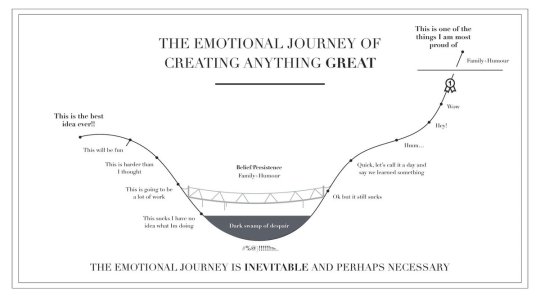
    I found the following chart on Howard Lindzon’s blog. It’s called “The Emotional Journey Of Creating Anything Great" and it’s getting shared around town right now.

    I’m sure that you’ve seen other similar charts before, but it doesn’t hurt to drive home this point, particularly as all of us kickstart the new year and promise ourselves that we’re going to be better, faster, stronger.

    The point of this chart is that when you’re creating anything new and great, there will always be the period of time that this diagram refers to as the “dark swamp of despair.” This is where you question your life decisions and wonder if you’re wasting your time trying to create this new and great thing.

    I never fully appreciated this phenomenon until I worked on a startup. Though for me, it felt more like a manic depressive rollercoaster. One week I was killing it and the next week I was in a dark swamp of despair searching for a way out. 

    And it’s because when you’re creating something new, you have few, if any, points of reference to reassure yourself that you’re on the right path. If it is truly great, then it’s probably something novel. And if it’s new, then by definition it hasn’t been done before. So it is unknown whether it’s truly a dark swamp of despair or if it just feels that way right now because things are tough.

    Because of the emotional nature of this journey, I have found myself really questioning the worth of things like caffeine and alcohol. I used to think the former made me more productive – the latter certainly doesn’t – but I’m not so sure that is the case. So as an experiment, I cut out coffee last month.

    I don’t believe in new year’s resolutions, so that’s not what all of this is about. It’s far better to talk about the things you’ve remained committed to, than to talk about the things you’re planning to do.

    This is simply a reminder that there will always be ups and there will always be dark swamps of despair. The key is to have the confidence and conviction to charge through those swamps any way you can. Onward my friends. I’m really looking forward to 2017 and I hope you all are as well.