
Daily insights for city builders, delivered every morning at 6 AM ET. I’m Brandon Donnelly — a Toronto-based real estate developer and founder of Globizen. I’ve been writing here since 2013.

Tag: blair welch

  • My last day at Slate

    As some of you may have gleaned from this recent RENX article, I have moved on from my development position at Slate Asset Management to focus exclusively on Globizen. After 8 very productive and exciting years at the company, it was time.

    I joined Slate in 2016 to help start the development group. Here is the post that I wrote back then. And it all came about because of a coffee meeting at Starbucks at the corner of Yonge & King.

    At the time, Lucas Manuel was looking to hire someone, and so our mutual friend, Kieran Boyd, connected us with the expectation that I would make some industry introductions. But at the end of our meeting, Lucas was quick to say, “actually, I think you should come join Slate.”

    And obviously, that’s what I did.

    Fast forward to today, and Slate has grown into a global investment and asset management company with $13 billion of assets under management across Canada, the US, and Europe. And within this platform is a supremely talented development group with an awesome portfolio of sites and projects.

    Thankfully though, this is not a goodbye. Myself and the Globizen team will still be working very closely with Slate on a handful of development projects, including One Delisle and Corktown. And the intent is that we will continue to work on new projects together in the future.

    I learned a lot during my time at Slate, and I have so much respect for Blair and Brady Welch and the rest of the partners. They have built an incredible global company and assembled some of the most creative, entrepreneurial, and smartest people I have ever worked with.

    Thank you for everything over the last 8 years.

    So what’s the plan for Globizen? This will be the topic of a follow-up post.

  • Grocery-anchored real estate as food logistics

    Blair Welch, co-founder of Slate Asset Management, was recently on Institutional Real Estate’s podcast talking about grocery-anchored real estate. In it, he talks about the role that this asset class plays in last-mile food logistics, why ecommerce might actually be strengthening its importance, and why it needs to be considered as being distinct from other kinds of retailing. This is a topic that we have covered a few times before on the blog and I think many of you might find it interesting. To have a listen, click here.

  • Delivery > mobility

    I was picking up food the other night on Bloor Street (via Uber Eats) and the lineup of delivery drivers outside of the restaurant was at least ten people deep when we arrived. While we were waiting, another handful of drivers pulled over to quickly pickup their deliveries. This is what is happening in our cities right now, especially here in Toronto while we live through another stay-at-home order. And the numbers certainly reflect it.

    Last month in March, Uber’s delivery business (which is separate from the company’s mobility business) recorded a 150% year-over-year increase in annualized gross bookings. The company’s run-rate as of March is now $52 billion. To put this number into perspective, the company’s mobility business also had its best ever month in March with an annualized gross bookings run-rate of $30 billion.

    Delivery > mobility right now. Makes sense.

    To further put this into perspective, total restaurant spending across the entirety of the United States was $670 billion in 2019 (figure from Benedict Evans). So Uber Eats has quickly become a meaningful part of how we eat. I obviously believe that people are dying to get out and eat at restaurants again, but these figures are still interesting nonetheless.

    It’s also interesting to think about the above trendline from a broader logistics perspective. Alongside the rise in Uber Eats, we are seeing a wave of capital move toward “rapid delivery apps.” These are platforms that allow meals, groceries, and other stuff to be delivered, in some cases, almost right away, which aligns with where I think consumers are moving. Rather than making lists and doing weekly shops, it’s now about just-in-time delivery.

    It’s arguably a lazier way of going about things, but water will always find the path of least resistance.

    Many, or perhaps most, of these platforms have adopted an asset light approach. Instacart, which partners with existing grocers, would fall into this category. Their model revolves around gig workers going into existing stores, picking orders directly from the shelves, and then delivering those orders. And it is what Blair Welch was getting at in his recent RENX interview when he reasoned that grocery shopping is still being done, almost exclusively, at local stores.

    This approach is enough for Instacart to be valued at nearly $40 billion, according to the Financial Times. So something seems to be working.

  • Essential food logistics

    Blair Welch, co-founding partner of Slate Asset Management, was recently interviewed by Don Wilcox of RENX about the company’s recent acquisition of the Commercial Real Estate Business of New York-based Annaly Capital Management. As part of the deal, we also acquired $0.4 billion of grocery-anchored real estate assets across the US. These were purchased by Slate Grocery REIT (TSX: SGR.UN). What some of you maybe don’t know, though, is how we as a company view these kinds of assets as being essential food infrastructure, more so than as being retail assets. So here are a few excerpts from the article and quotes from Blair that explain why, in our view, this distinction matters.

    “We started buying grocery-anchored real estate in a big way in the financial crisis and I think we always looked at grocery-anchored real estate as food logistics, rather than a retail play,” Welch explained. “In the pandemic it’s really proven the local food store, or the spoke in the hub, is just as valuable as the hub itself.”

    Despite an increase in online grocery shopping (to about 10 per cent in the U.S.), people are still going to the stores. Or, at least, (are) getting their products from the local stores. Again, think “food logistics.”

    “That (10 per cent bought online) means 90 per cent is done in store,” Welch observed. “Now, here’s the interesting thing. Over 90 per cent – probably closer to 95 per cent – of the online sales are done at the local store.

    “So what we are saying is over 99 per cent of all the sales are done at the local stores, whether it is click and collect, or someone delivers. You are not changing the distribution pattern.”

    Here are a few more words and a comparison to what Amazon is and has been doing when it comes to food logistics:

    “If I’m Kroger or Walmart if I have to pay $10 (per square foot) for my warehouse what’s the difference if I’m paying $10 for my store? It’s the same cost, they just look at it as a distribution cost,” he said.

    However, those stores are in the middle of most neighbourhoods. Exactly where Amazon wants to be.

    “I think Amazon is an amazing company. I think their acquisition of Whole Foods and others is actually to get closer to the consumer. And the Whole Foods (acquisition) was just under 400 grocery stores in a market of 35,000 stores.

    “If I am Walmart with 5,000 stores or Kroger with about the same under different banners, that infrastructure is extremely valuable.”

    Slate will soon own more of it.

    For the full article, click here.

  • What I’m doing next

    image

    A number of you have asked if I’m moving to New York. I can see why that was inferred from some of my posts, but that was actually not my intention. I am not moving to New York. (Sorry New York friends. I’ll visit soon.)

    Toronto is home base. I hope it’s clear how much I love this city. Sure, I’m a big fan of New York and Miami and Vancouver and Berlin and Tokyo and Jackson (to name some of the places I have on my phone’s weather app), but I made a deliberate choice to station myself here.

    Because unlike some of the other industries I write about on this blog, city building is hyper local. What I do involves the built environment. And that doesn’t generally happen via a laptop on a beach in Bali (at least not for extended periods of time).

    It happens by being on the ground, interfacing with local communities, meeting face-to-face with the city, and poring over drawings with smart people who know far more about their respective disciplines than I ever will. It is a collaborative and local effort. It’s about getting into the details.

    And so to be successful in this business, I think it helps to find a home and take long bets. I’m not saying that I will never work on projects in other cities (I have and I would), but I am saying that I’m not moving to New York right now and that home remains Toronto.

    On that note, here’s what I have to tell you. Later this year I’ll be joining Slate Asset Management as VP of Development.

    A bit about Slate:

    Slate is one of the most active acquirers, owners, and managers of real estate in Canada right now. Founded in 2005 by two brothers (Blair and Brady), Slate has over $3 billion of assets under management across over 16 million square feet and over 130 properties.

    All of this is done through four main investment vehicles: 

    1) The first is Slate Advisors. It acts on behalf of and alongside private institutional investors — such as Greystone.

    2) The second is Slate Office REIT (TSE:SOT.UN). It is a pure play Canadian office REIT focused on downtown and suburban properties all across the country.

    3) The third is Slate Retail REIT (TSX:SRT.U). It is a pure play REIT entirely focused on grocery-anchored U.S. retail properties. (Remember how many times I’ve written on this blog about how grocery has one of the lowest online shopping penetrations?)

    4) And the fourth: Slate is also starting a grocery-anchored retail platform in Germany. It is similar to #3, except that it’s in Germany.

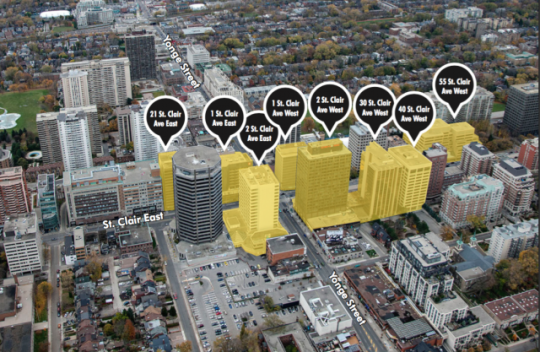
    Most recently, Slate has been in the news because of the position it has taken at Yonge + St Clair in midtown Toronto — a perfect example of “finding a home and taking long bets.” Slate, in partnership with Greystone, owns all 4 corners of the intersection and about 60% of the properties along the St. Clair corridor.

    Here’s a diagram of those Slate buildings:
    image

    In case you didn’t put two and two together, the 8-storey mural I wrote about two weeks ago is going up (right now) on the side of a Slate building (1 St Clair Avenue West — shown above). The British street artist known as Phlegm is doing it.

    Up until today, the focus of Slate has largely been on acquiring undervalued / overlooked real estate and creating value through re-leasing and overall repositioning. That will certainly continue. But given what I do, I am sure you can posit what’s also next.

    I’m genuinely excited to be joining such a talented group of real estate professionals. As I mentioned last week, I wasn’t in the market for anything new. I was heads down working on cool projects. But life happens. And Slate quickly demonstrated to me that the incredible success they have seen to date is precisely because of how progressive, nimble, and entrepreneurial they are.

    On that note, I have “one more thing” to share today.

    In parallel to all of this, and with the support of Slate, I am also starting a boutique city building company called Globizen. The name is derived from Global + Citizen.

    The objective is to build a company that embodies everything I write about on this blog. I want it to be lifestyle and design-driven. I want it to leverage technology to improve the way that cities and the building industry operate. And I want it to function as a vertically integrated real state + design firm, focused on sustainable urban infill development. Think of it as city building by and for the responsible global citizen.

    It’s still early days, but the thinking is that this new platform could compliment the larger Slate platform in some way. It’s too early to say how exactly, but everyone is open to having those discussions. And that’s what matters at this stage.

    I am going to end with a quote. It’s by Partner and Co-Founder, Blair Welch:

    “On all of our deals we have had people say ‘can’t’ to us. They say ‘Can’t be done, can’t do that, can’t raise money, etcetera.’ At Slate, we don’t do ‘can’t’ well.”

    I like that a lot. So here’s to finding a home, taking long bets, and not saying can’t. Onward my friends.
