Daily insights for city builders, delivered every morning at 6 AM ET. I’m Brandon Donnelly — a Toronto-based real estate developer and founder of Globizen. I’ve been writing here since 2013.

Tag: bike

  • May we have a bike lane?

    Today, the government of Ontario announced legislation that, if passed, would require municipalities to receive approval from the province before installing any bike lane that would result in the removal of lanes for traffic. And in order to receive such an approval, municipalities would need to demonstrate that the proposed bike lane(s) won’t have a negative impact on vehicle traffic. To be clear, municipalities should still be free to remove lanes for other purposes — such as on-street parking — but not for bike lanes.

    There’s a lot that can and will be said about this announcement. I’m also aware that I have my biases. I’m an urbanist. I live in a walkable neighborhood. And I enjoy biking, a lot — both to get around and for fun. So I think it’s clear that this announcement was designed to appeal to a specific audience: those that drive in from the suburbs and who are deeply frustrated. This is somebody doing something. Never mind that the new Eglinton LRT line isn’t open yet and nobody knows when it will actually open, look over here at these annoying cyclists.

    The problem with this line of thinking is that it’s not going to fix our traffic. The way you make things better in a big global city with lots of demand for road space is to reduce car dependency. This is not a popular thing to say, but it’s the reality. And broadly speaking, this is done in two ways. One, you provide great alternatives. And two, you price roads accordingly, through things like congestion charges. Incidentally, this also creates a virtuous cycle, because the latter raises money for the former.

    In many ways, we’ve been getting better at number one. In 2015, Bike Share Toronto recorded 665,000 trips. Since then, ridership has increased every year. In 2023, the network recorded 5.7 million trips. And this year, the number is expected to exceed 6 million. This is not nothing. This is a lot of people riding around on bikes, some of whom may have instead opted to drive or take an Uber. And I think there’s no question that this continual increase in ridership is at least partially supported by the fact that we’ve been creating more bike lanes.

    That said, I think it’s clear that to continue to move forward as a city we’re going to need to start collecting far better urban data. We need to know things like how many cars and bikes are on every street and how fast they’re moving. (AI can do this, right? ) This way we can continually optimize for moving the most number of people as efficiently possible. And if it turns out that I’m wrong, and clamping down on bike lanes and having more people drive is the most efficient, I’ll of course accept that. Just show me the data.
  • More people are cycling in Chicago

    One of the common criticisms of bike lanes is that most people don’t want to cycle in the winter. I mean, just look at Montreal’s winter cycling retention ratio.

    But that doesn’t mean that you shouldn’t invest in cycling infrastructure. Chicago, for instance, has been building out cycling infrastructure over the last few years (2020-2023) at an average rate of approximately 30 miles per year. This is double its rate from 2011-2019. And the results show.

    According to recent data from Replica and the Chicago Department of Transportation (CDOT), Chicago saw the highest growth in cycling among the 10 largest cities in the US between fall 2019 and spring 2023.

    Biking overall was up 119%. Crosstown trips were up 180% (bike trips that spanned across four or more neighborhoods). Trips related to shopping were up 117%. And notably, zero-car households were up 207%.

    Remember, this is a city that basically has the same weather as Toronto. It gets cold in the winter. And sometimes it snows. But clearly if you build good cycling infrastructure, people will use it.

  • What tribe are you part of?

    This satirical piece in the Beaverton about “biking everywhere” is hilarious because it touches on so many cycling stereotypes:

    “It’s a great way to get around while also staying in shape,” said McFarlen as he biked through a red light. “From tattoo shops to my job at VICE to even the best Banh Mi in the city – I just hop on my bike and I’m there. Why does anyone drive ever? Gross!”

    But the other thing it does is speak to the trade-off between location and transportation costs. Brian McFarlen, the fictional protagonist from the article, is able to bike everywhere (low cost) because he allegedly lives in a central neighborhood (high cost):

    McFarlen, whose parents paid for him to go to film school and has no mortgage, kids, or debt, condemns people who drive in the city. “I hate cars – we should just get rid of all roads and replace them with bike lanes. Isn’t everyone able to live downtown and spend hours of their day biking around the city hitting up all the best micro breweries?”

    I think it’s natural for us humans to form tribes with others that are similar to ourselves. We have two wheels and you all have four wheels. We live in the city and you all don’t. All of these things make us different.

    But there’s certainly something to be said for having a bit of empathy for those outside of our particular tribes.

  • A cycling mecca in northeast Spain

    Today I learned that Girona in northeast Spain is a mecca for cycling. Bike enthusiasts like it because the climate is mild; the roads are well maintained; the lifestyle is relaxed; and there’s easy access to the European Grand Tours in Spain, France, and Italy. Apparently Lance Armstrong bought an apartment there in 2001. Though there were other pro cyclists who had come before him.

    Interestingly enough, all of this is allegedly having an impact on the real estate market. According to the WSJ, there has been a surge in the tourist licenses required to operate a short-term rental in the city. Ten years ago, the city had only issued 10 of them. But today, more than 700 have been issued. And as of the end of 2019, residential sale prices had increased about 15% year-over-year.

    I’m not sure how much of this is a result of cycling tourism, Airbnb, Spain’s overall housing market recovery, or other factors. But it certainly sounds like a nice place to go for a bike ride.

  • Minimalist smart biking device

    I just came across this smart biking device on Kickstarter. It is the next generation of their original SmartHalo, which did very well and is now sold in Apple Stores. The company is based in Montréal.

    Here’s how it works:

    https://www.kickstarter.com/projects/smarthalo/smarthalo-2-make-your-bike-smarter

    I know that a lot of you are cyclists, so I figured some of you might appreciate this. It looks pretty awesome. Delivery of SmartHalo 2 is expected by December 2019.

    Their Kickstarter campaign ended on July 2. The project got funded with about CAD 1.7 million from over 10,000 backers. But you can still pre-order a device, here.

  • New Toronto architecture bike tour

    I have a friend visiting from Detroit this weekend. We went to architecture school together at Penn. But unlike me, he decided to become a full fledged architect.

    Not surprisingly, he wants to see some new Toronto architecture while he’s here. I say new because he has seen the classics. So I mapped out a short bike route this morning. It’s more or less a downtown loop that starts in the St. Lawrence.

    First we head west to the Queen Richmond Centre West by Allied Properties REIT (developer) and Sweeny&Co (architect). After that I’d like to show him the main drag of King West and point out two buildings by Saucier + Perrotte Architects and CORE Architects. I don’t think Unzipped Toronto is open yet.

    Next it is north to One Spadina Crescent – home of the Daniels Faculty of Architecture, Landscape, and Design. This is one of if not my favorite new building in the city right now.

    After that I figure we’ll cruise east along the Bloor bike lanes and look up at 1 Bloor East. Then it is back south to check out the River City collection by Urban Capital (developer) and Saucier + Perrotte Architects (they are getting good face time on this tour).

    Then we’ll do what every good new Toronto architecture bike tour should do and end with a drink on a rooftop patio somewhere. Maybe we’ll check out the Broadview Hotel. I like the neon in the lobby bar.

    If I missed anything critical, let me know.

    Photo by Tiffany Nutt on Unsplash

  • Toronto’s great streets

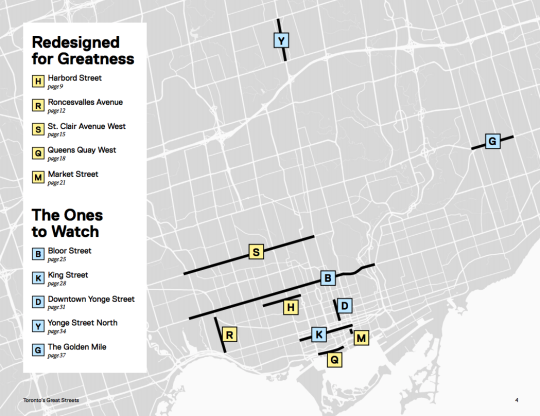
    Last week the Ryerson City Building Institute published a terrific report on Toronto’s Great Streets. It profiles five streets in the city that have been “redesigned for greatness.” They are:

    • Harbord Street (continuous bike lanes)
    • Roncesvalles Avenue (placemaking and people)
    • St. Clair Avenue West (dedicated streetcar lane)
    • Queens Quay West (public waterfront promenade)
    • Market Street (prioritized for people and patios)

    But what exactly makes a street a great one? The report describes it in this way: “They all play a key role in making the surrounding neighborhood a great place to live, work, and visit.”

    This relates closely to what the City of Toronto calls a “complete street”, which is an approach to accommodating multiple kinds of users, enhancing the local context, and determining which trade-offs to make.

    And there will always be trade-offs. I am fairly certain that all of these street redesigns were contentious at the time when they were proposed. Because at the end of the day they will never be all things to everyone.

    I remember the St. Clair West fight vividly because I moved to the neighborhood in 2009 and the dedicated streetcar lane didn’t fully open until 2010. From 2005 to 2017, streetcar ridership grew 23%. But drivers have remained grouchy.

    I now walk Market Street every single day and I agree that it’s one of the most beautiful and functional streets in the city. But the bollards are constantly getting beat up by drivers attempting to parallel park and the retail vacancy rate has not been 0% like is suggested in the report.

    Queens Quay West is also a magnificent street. It was a giant step forward in terms of the quality of the public realm in this region and I spend a lot of time there. But it’s of course not perfect. All of us have seen the reports of cars ending up in odd locations, including underground, along the waterfront.

    Riding your bike there can also feel like a challenging game of Frogger with all of the pedestrians that now obliviously meander back and forth across the cycling trail. I suggest riding with a good blow horn. The report rightly mentions the lack of delineation between these users.

    But cities are a living laboratory and none of these streets should now be considered static. We are fortunate to be in a position to critique levels of greatness. If anything, the map at the top of this post tells me that we need to create more greatness across the other areas of this city.

  • Adelaide cycle tracks

    Earlier this week I was on Adelaide Street (Toronto) for a morning meeting. This is further north than my typical routine.

    For those of you not familiar with Toronto, Adelaide is a one-way street with separated bikes lanes. These “cycle tracks” were installed as part of a pilot project that launched back in summer 2014. As I’m sure you can imagine, they were highly controversial at the time. Many heated debates.

    But if you stand on Adelaide Street during the morning rush, as I did earlier this week, I think you would be amazed to see just how widely used these lanes actually are. Here’s a video of Adelaide (just east of Spadina) in action. It is by Gil Meslin and was filmed sometime between 840 and 855am on a weekday.

    However, I will say that I was far more impressed by the volume of bikes I saw in person. I wish I took a picture. They easily outnumbered the cars when I was there, which speaks to the latent demand for this sort of infrastructure. I can’t imagine a faster way to get across downtown in the morning.

    So if you haven’t already, check out Adelaide (or Richmond Street, which is also part of the cycle tracks program).

  • Inviting behaviors

    The following paragraph is a great way to describe urban cycling and to explain how our built environment can explicitly invite certain behaviors:

    “If you want people to drive, build more automobile infrastructure. If you want people to bike, build better bike infrastructure. In San Francisco, as in most US cities, we’ve treated the idea of bike infrastructure as secondary to optimizing traffic flow, and have wound up protecting parked cars with bike lanes instead of the opposite. Because of this our bike lanes are plagued with double-parking. While enforcement is an important piece of the puzzle, we usually fail to admit how inviting a striped space between parked cars and traffic appears to an Uber driver. Our built environment invites a driving behavior that causes cyclists to spend much of their commute pushed into traffic, encouraging a culture of every-man-for-himself cycling behavior, adding to the discouraging perception that bikes are for the young and fearless only. This perception is elevated by the fact that bicycling deaths in San Francisco are hovering at least four times higher than the average rate in Copenhagen, a city with ten times as many cyclists.”

    This snippet is from a blog post written by Alex Schuknecht (urban designer with Gehl). In the posts he also contrasts the cycling cultures of San Francisco and Copenhagen – two cities of similar size and density, but with fundamental differences. It’s a good read.

    Many of us probably assume that we are agents of our own lives. We decide what we do and when we do it. We’re our own boss. That’s at least how I want to feel.

    But the built environment is distinct from the natural environment in that we design it. It is not a given. And the environments we collectively choose to fund and build will ultimately have a significant impact on the way we “choose” to live our lives. 

    This gets back to the first line of the above quote: build more of this; get more of that. It’s also related to the startup mantra: “you make what you measure.” If all we’re measuring is traffic flow, then that’s the kind of city we will make. And that’s certainly be done.

    I don’t think a lot of us think in these terms. But we should.

  • Crowdsourcing unsafe cycling conditions with a small yellow handlebar button

    Hövding – a Swedish company best known for its radical airbag cycling helmets (definitely check these out) – is currently crowdsourcing unsafe conditions and cyclist frustration in London.

    Working with the London Cyclist Campaign, they distributed 500 yellow handlebar buttons. Cyclists were then instructed to tap these buttons whenever they felt unsafe or frustrated with current cycling conditions. 

    Here’s what the button looks like:

    Every time the button is hit, the data point gets logged to a public map and an email gets sent to the Mayor of London reminding him of his promises around cycling. Both of these things happen via the rider’s smartphone.

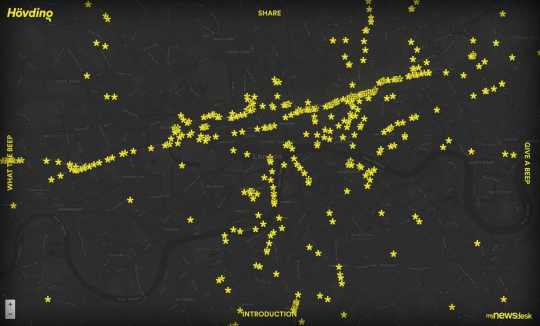
    Here’s what the public map looks like at the time of writing this post:

    Not only does it tell you pain point locations, but it also seems to suggest the primary cycling routes. I think this is a brilliant initiative because, it’s entirely user-centric. It’s telling you how people feel on the ground.

    Supposedly, Hövding is actively looking for other cyclist groups around the world to help them distribute their buttons. So if you’re a group in Toronto or in another city, I would encourage you to reach out to them. The more data the better.