Daily insights for city builders, delivered every morning at 6 AM ET. I’m Brandon Donnelly — a Toronto-based real estate developer and founder of Globizen. I’ve been writing here since 2013.
The topics covered would have been familiar to anyone who is a regular reader of this blog (the power of open data, the knowledge economy, etc…), so I’m not going to repeat it all here. But I did want to touch on one of his impressions of Toronto, which is that this is a city that is “never finished.”
What does that mean?
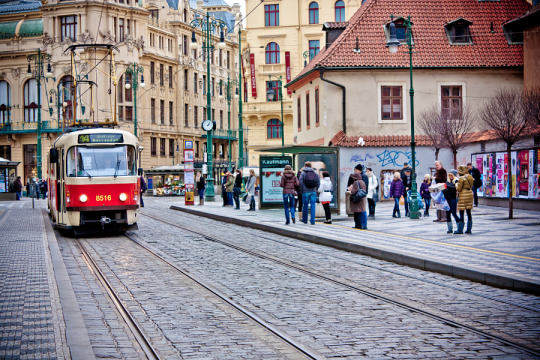
The opposite of a city that is never finished would be a city like Paris that feels a bit like a monument that is now done and shouldn’t be touched anymore. It’s a city that almost feels too precious to intervene in. This is obviously not the case for all of Paris, but I think you get the point.
Toronto, on the other hand, is a city that is constantly building, changing, and renewing itself. There are often layers upon layers of new interventions being applied, which gives you the impression that the city will never be done. It’s constantly in flux.
Some of you may not appreciate this kind of “messy” urbanism, but I think it gives cities a kind of entrepreneurial resiliency (resiliency is a hot topic right now in urbanist circles). Cities are an ecological system. And the most resilient ecological systems in the world are the ones that are able to adapt to constant change.
So in my view I look at this as a feature, not a bug. The only constant is change.
Last Tuesday the app launched in 10 cities across North America. So if you’re in Boston, Chicago, Los Angeles, New York, Portland, Seattle, San Francisco, Toronto, Vancouver, or Washington D.C., you can go ahead and download it right now.
The biggest “wow factor” is probably the augmented reality feature that allows you to hold your phone up and see transit information overlaid on top of the street in front of you.
But more fundamentally, the real potential lies in the platform’s ability to collect data on the way people move in cities and on how transit lines are performing, so that it can be fed back to improve overall efficiency.
That’s why the company is also working with cities to give them 24/7 analytics and reporting on how every bus, car, and train is performing in their networks.
My hope is that with better data at our disposal, we’ll be able to elevate the discussions around transit and transit planning. Without great data, it’s too easy for these discussion to become political.
For Alex’s article, the Globe asked “prominent urbanists, architects, and scholars” from around the world to comment on what Canadian mayors should be focused on right now as we build the cities of tomorrow.
Here’s a list of what they said:
Make people, not cars, happy
Decrease speed limits
Empower city governments
Leverage density
Embrace the science of big data
Mix residences and workspace
Turn streets into destinations
Redevelop the inner suburbs
It’s a great set of recommendations. So I would encourage you to check out the full Globe and Mail article.
To start off the year, I thought I would talk about something pretty geeky, but very forward looking: Bitcoin.
I wrote about Bitcoin just over a year ago when I was first starting to wrap my head around it, but a lot has happened since then. Many of you might know that 2014 was a terrible year for Bitcoin and that its price has declined significantly (chart from Coinbase):
But does that mean Bitcoin is a flop, or that the hype has just died down a bit?
If you follow what’s being discussed within the tech community, you’ll know that there are still lots of people who are bullish on Bitcoin. But more precisely, they are bullish on the underlying architecture behind Bitcoin and something that is called the Blockchain.
I’m not going to get too technical in this post (if you want that, go here), but I do want to talk about three things (that I’ve mostly learned from the folks over at Union Square Ventures): the Blockchain, why it matters, and what it could mean for specific industries such as transportation and real estate. I promise to make it relevant at the end.
The way to think about all of this is in layers.
The Blockchain is the foundation or base of Bitcoin. It’s essentially a decentralized public ledger that keeps track of all the Bitcoin transactions. Decentralized means that not one single person or company owns the database. It’s free for anyone and everyone to see. This structure is important because it enables peer-to-peer transactions across the internet, as opposed to going through a bank or other intermediary.
But the key takeaway is that Bitcoin is simply one example of a “protocol” built on top of the Blockchain. And there are many others in the works, including a protocol for realtime ride sharing (Lazooz) and a protocol for a decentralized peer-to-peer marketplace (OpenBazaar). And so the real innovation is the Blockchain, not Bitcoin itself.
Why does this matter?
It matters because these protocols are, again, not owned by a single entity, which is remarkably different than the way most things work today. Take for example the residential real estate industry. In the Greater Toronto Area, the data that emerges from home listings and sales is owned by the Toronto Real Estate Board.
And since this data is privately owned, a lot of it remains only accessible to “members” or real estate agents. The Competition Bureau has been fighting for more openness, but the Toronto Real Estate Board obviously wants to keep as much of this data as it can to itself. Who can blame them.
But what if somebody came along and created a new protocol for a decentralized peer-to-peer home marketplace? In that case no one would own the data, which means everyone would have access to it. And that would completely change the landscape. I’m fuzzy on what this protocol would even look like, but it seems entirely possible given what else is in the works.
And if this Bitcoin Blockchain revolution does actually take place, it wouldn’t be restricted to only non-tech legacy industries. Joel Monegro of Union Square Ventures believes that “decentralized protocols” such as Lazooz and OpenBazaar (mentioned above) could even have a big impact on companies such as Uber and eBay, respectively.
I’m still trying to wrap my head around all of this, but I want to understand it and I thought you all might as well. Because even though it seems very tech right now, the implications would also be very non-tech if it turns out to be true.
Here’s further evidence that technology is starting to infiltrate into many other industries, including architecture. London-based architect and designer Pernilla Ohrstedt is currently working on an exhibition for Dezeen and MINI Frontiers that will architecturally visualize the 3D data that driverless cars collect in order to navigate around.
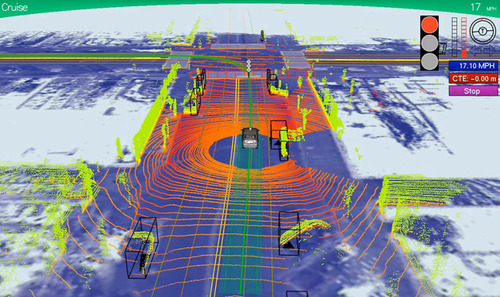
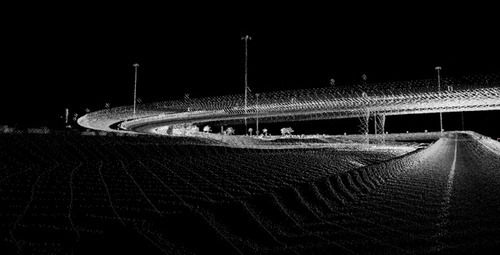
I had never thought of this before, but as a byproduct of driverless cars, we’re about to start collecting detailed replicas of all of our cities – well beyond the static images we currently have with Google Streetview. In order to navigate by themselves, driverless cars are constantly scanning their surroundings to create a “point cloud” replica of the built environment. This point cloud basically tells the car where they are, where they should drive, and what obstacles might be around.
It could look something like this:
Already there are firms like ScanLAB emerging to provide 3D scanning, publishing, and visualization services. But this is obviously just the tip of the iceberg. I can only imagine what innovation will emerge from the passive collection of all this data once driverless cars become commonplace in our cities.
As one example, it could be a way for us to systematically measure the correlation between the qualities of a street and the vibrancy of its street life. Is there a perfect width? An ideal traffic volume? A right scale? All of this data could make city building more of a science (and perhaps less political).
My hope though is that this data would be open and accessible to all, so that clever entrepreneurs could build on top of it.
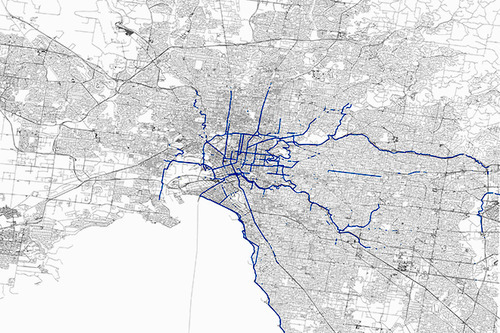
Some of you might know that I’ve recently started using a mobile app called Strava. It’s a platform that allows you to track your runs and bike rides, as well as those of your friends. It tells you your speed, elevation changes, and it also maps your trips–among many other things. Here’s what my 50 km ‘Ride for Heart’ looks like from last Sunday.
For $20,000 a year, transportation planners and others can access Strava Metro, which provides an unprecedented look at where and how people are biking. It can tell them where they speed up and slow down, for example, or where they might stay in the street or ride on a crosswalk. That information can reveal where bike lanes or traffic calming measures would be useful, and if those already installed are effective.
It’s a perfect example of how “tech” is infiltrating so many other sectors. Mobile technology and networks are generating huge amounts of data and it’s happening at an increasing rate. We’re gaining insights into the way people live that simply wasn’t possible before. Some of this information will inevitably be misused, but a lot of it will be used to improve the way we live our lives.
I know that the City of Toronto also has its own proprietary cycling app and is hoping to collect similar sorts of data from it. But intuitively, I don’t think they’ll be able to compete with the scale of a platform like Strava. Though I certainly applaud the initiative.
The reason I call the real estate industry imperfect is because of 2 main reasons: first, there’s a lot of friction when it comes to buying and selling as a result of high transaction costs (amongst other things); and, second, there are massive information asymmetries between marketplace participants. This could be buyers and sellers, purchasers and developers, clients and real estate agents, and so on.
But it’s only a matter of time before these issues get resolved. And I think it’ll happen through better access to data and more transparency in the marketplace. The question, however, is: Where is this big data going to come from?
“The question is who will control the input of the patient data, the aggregated data sets, and the results the data science produces. If the answer is the current healthcare system; the insurance companies, the hospitals, and the doctors, then we will have missed a big opportunity to reshape healthcare. If, on the other hand, the data is entered by patients, controlled by patients, and benefits patients, then we would have something new, different, and disruptive.”
In both healthcare and real estate, we have large bureaucratic institutions and bodies that control the industry. And in both instances, we’ve seen that they’ve been slow to adapt to the changing times. Therefore, I think the billion dollar opportunity is the same in both: the data is going to have to come from the ground up via patients and real estate consumers. Only then will we have something truly innovative.
Dirt was founded to correct the problem of information in the real estate industry: too much of it is either fragmented, restricted or entirely unavailable. We believe that real estate consumers should be able to easily and freely access all the information they need through one consolidated source.