Daily insights for city builders, delivered every morning at 6 AM ET. I’m Brandon Donnelly — a Toronto-based real estate developer and founder of Globizen. I’ve been writing here since 2013.

Tag: benedict evans

  • Is Tesla the new iPhone?

    image

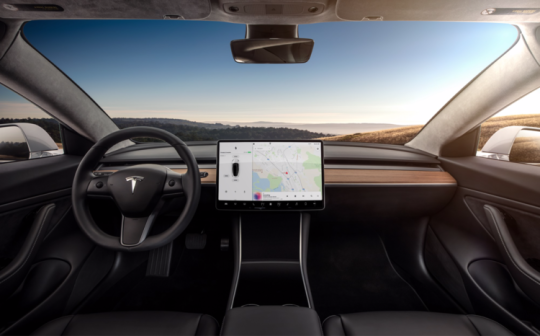
    Benedict Evans just published a great post on his blog about “Tesla, software and disruption.” I recommend a full read. In it, he tries to answer whether Tesla is really “the new iPhone” and if it will be as disruptive to the car landscape as some/many people think.

    In his line of thinking, electric (as opposed to an ICE vehicle) feels a lot more like a sustaining innovation, rather than a disruptive innovation. In other words, it something that incumbents will be able to incorporate. So it will not change the “basis of competition.”

    The more critical aspect is instead autonomy. Here are two snippets from the piece:

    All of this takes us to autonomy. Electric is compelling but will probably be a commodity, whereas Tesla’s improvements on top of electric may not be commodities but are not necessarily decisive. Autonomy changes the world in profound ways (I wrote about this here), and it’s a fundamentally new technology that doesn’t look at all like a commodity. And Tesla is doing this, too. Sort of.

    In this competition, Tesla’s thesis is that the data it can collect from its cars will give it a crucial advantage. The only reason that anyone is interested in autonomy today is that the emergence of machine learning (ML) in the last 5 years probably gives us a way to make it work. Machine learning, in turn, is about extracting patterns from large amounts of data, and then matching things against those patterns. So how much data do you have?

    But even if we are to all agree that autonomy is the “disruptive innovation”, it is not yet clear who will get there first. Maybe it is Tesla. Maybe it is Waymo. Regardless, many or most people seem to agree that it will arrive in 202x.

    Image: Tesla

  • Autonomy, sometimes

    Benedict Evans raises a number of good points and asks a bunch of good questions about the “steps to autonomy” in his recent blog post.

    Right now we’re all talking about autonomous vehicles in terms of their level of autonomy – namely 1 through 5. L1 is some degree of autonomy, but in almost all situations, you still need a human driver. L5 is no human driver needed, ever.

    But as Evans points out, the level of autonomy depends on the place, and it is unlikely – at least initially – that L4 or L5 will mean L4 or L5 in all environments. Here is an excerpt from his post:

    It naturally follows that we will have vehicles that will reliably reach a given level of autonomous capability in some (‘easy’) places before they can do it everywhere. These will have huge safety and economic benefits, so we’ll deploy them – we won’t wait and do nothing at all until we have a perfect L5 car that can drive itself around anywhere from Kathmandu to South Boston. And so, if we call a car even L4, we have to say, well, where are we talking about? We might mean ‘most of this country’. But more probably, it will be L4 in one neighborhood, L3 in another and only L2 in a third – and a car might encounter all three of those on one journey. Put your route into the map and it will tell you if today is an L5 day or not.

    Thinking about the Gartner Hype Cycle, there’s often (always?) a “peak of inflated expectations”, as well as a chasm that new technologies need to cross as they are being adopted.

    Benedict’s article reminded me that we’re probably coming off that peak with autonomous vehicles and about to enter the so-called “trough of disillusionment.” 

    Autonomous vehicles represent a monumental shift in mobility, which will in turn impact our cities. That’s going to seem like an insurmountable challenge – until it doesn’t.

  • So the tech works. What’s next?

    Below is a keynote talk by Benedict Evans about what’s going on in tech today and what may happen in the next ten years. It covers: the growth of mobile; S-curves; Google / Apple / Facebook / Amazon (who knew Amazon had so many employees?); machine learning; autonomous vehicles/impact to cities; mixed reality; crypto-currencies; and so on.

    For those of you interested in crypto-currencies – and that appears to be everyone these days – it’s interesting to hear how Evans describes their current position at the beginning of the curve: “The tech works, but what’s the use case?” This is not to say the potential isn’t huge. It is. Automated trust. Distributed and programmable money. But the future is still unclear.

    If you can’t see the video below, click here.

    [youtube https://www.youtube.com/watch?v=cVYDkPidXrU&w=560&h=315]

  • Network effects for autonomous vehicles

    In my recent post about why I write about tech on this city building blog, I made a pithy comment about autonomous vehicles and why it is “largely a software challenge.” 

    The argument I was trying to make was that the hardware, similar to smartphones today, will likely become a commodity. More of the value will end up flowing to the firms that control the software.

    Benedict Evans has an excellent deep dive into this topic on his blog. The post is called: Winner-takes all effects in autonomous cars.

    Here’s an excerpt about hardware:

    To begin with, it seems pretty clear that the hardware and sensors for autonomy – and, probably, for electric – will be commodities. There is plenty of science and engineering in these (and a lot more work to do), just as there is in, say, LCD screens, but there is no reason why you have to use one rather than another just because everyone else is. There are strong manufacturing scale effects, but no network effect. [My link, not his.]

    And here’s his conclusion:

    So, the network effects – the winner-takes-all effects – are in data: in driving data and in maps.

    That said, it is still early days for autonomous vehicles. Who knows if these network effects will end up being highly defensible or weak. There are still lots of assumptions and questions at this stage.

    From a city building perspective, one of the major concerns with autonomous vehicles is that they could tempt us back to car-centric city planning. That would be a shame.

    Photo by Zachary Staines on Unsplash

  • Retail tipping point

    Venture capitalist Benedict Evans recently published a post on his blog called, Ten Year Futures. If you haven’t already noticed, I really enjoy this sort of curiosity and line of thinking. Here is an excerpt where he talks about retail being at a tipping point:

    “First, ecommerce, having grown more or less in a straight line for the past twenty years, is starting to reach the point that broad classes of retailer have real trouble. It’s useful to compare physical retail with newspapers, which face many of the same problems: a fixed cost base with falling revenues, the near-disappearance of a physical distribution advantage, and above all, unbundling and disaggregation. Everything bad that the internet did to media is probably going to happen to retailers. The tipping point might now be approaching, particularly in the US, where the situation is worsened by the fact that there is far more retail square footage per capita than in any other developed market. And when the store closes and you turn to shopping online (or are simply forced to, if enough physical retail goes away), you don’t buy all the same things, any more than you read all the same things when you took your media consumption online. When we went from a corner store to a department store, and then from a department store to big box retail, we didn’t all buy exactly the same things but in different places – we bought different things. If you go from buying soap powder in Wal-Mart based on brand and eye-level placement to telling Alexa ‘I need more soap’, some of your buying will look different.”

    I’ve said this many times before, but the way the above excerpt ends is yet another remind that one has to look deeper beyond the obvious change(s). Yes, ecommerce is growing and impacting physical retail. But what other changes might ensue because of this shift?

  • Downstream effects of electric and autonomous vehicles

    I speculate a lot on this blog about what electric and autonomous vehicles will mean for the future of our cities. The reason it’s speculation is because it’s phenomenally difficult to know with any sort of certainty what the downstream effects of these technologies will be.

    I’ve seen some people claim that a car is still a car. That is, all of the same rules will apply even if they’re powered completely by renewals and we manage to make drivers obsolete (5-10 years?). But I fundamentally disagree with this line of thinking. There will be both positive and negative consequences. They are just yet to be seen.

    Benedict Evans recently wrote a post where he started to think about where some of these changes might happen. And so I thought it might be valuable to throw a few of these into the discussion mix. Here are some of his ideas:

    • About half of car maintenance spending in the US goes to things directly related to the internal combustion engine. Electric takes that away.
    • There are about 150,000 gas stations in the US. They go, along with their associated convenience stores, which is where the margins are made. Interestingly enough, more than half of all US tobacco sales happen at gas stations. Where does that go?
    • It is estimated that electric vehicles will increase overall electricity demand by 10-20%. But this could disappear with the battery storage and off-peak power.
    • Globally, about 1 million people die every year from car accidents. In the US, something like 90% of all accidents are thought to be caused by human error and about 1/3 of fatal accidents involve alcohol. Autonomy has the potential to take most of this away. Personally, I think we’ll look back and think about how dangerous driving used to be and wonder how/why we all did it.
    • A complete rethink of parking. This obviously gets talked about a lot. ~14% of LA’s land is thought to be used for parking. My guess is that parking ratios/requirements go way down (we’re already in the 0 to 0.3 per residential unit territory here in Toronto) and parking garages transform into yards for AVs.
    • Autonomous vehicles once again rewrite the retail real estate landscape. Benedict believes they will create more billionaires in real estate and retail than in tech or manufacturing. I like how he describes big box retailing as an arbitrage of land costs, transportation costs, and people’s willingness to drive and park. This point is likely about AVs + e-commerce. See yesterday’s post about Amazon.
    • Finally, his last point is that autonomous vehicles could become a kind of mobile Panopticon. The Panopticon was an institutional building typology conceived of by Jeremy Bentham in the late 18th century. It was based on the idea that inmates could all be monitored by a single watchman, without any of the inmates knowing if they were, in fact, being watched. It was a way of trying to impose strict obedience in prisons, and so on. Since virtually all autonomous vehicles require some sort of computer vision, Benedict argues that they could become the 21st century watchmen. Move over CCTV.

    The other big question is about decentralization. New transportation technologies have consistently promoted greater suburbanization – think streetcar suburbs to car suburbs. The fact that you’ll be able to use your time more productively in an autonomous vehicle is continually floated as an argument for this trend to continue. But I haven’t made up my mind about this one.

    Do you have any other thoughts on the downstream effects of electric and autonomous vehicles?

  • 16 mobile theses and how tech might change the built environment

    Caucasian woman standing near passing subway in train station by Gable Denims on 500px.com

    https://500px.com/embed.js

    One of the things that I try and do here on this blog is examine the intersection of design, real estate, and technology. I didn’t explicitly set out to do that, but more and more I find myself thinking that way when I’m writing and when I’m giving talks.

    Part of that is because of my passions, but part of it is because there is a big and important overlap. One example of that is autonomous, self-driving cars. The tech community is enamoured with driverless cars, but everyone involved in the built environment should also be thinking about their impacts. Because it’ll be significant.

    Benedict Evans – who is a venture capitalist with Andreessen Horowitz in the Valley – recently published a post called, 16 mobile theses. It’s a look at 16 topics, trends, and shifts that are happening in the tech space. (There’s also a related podcast discussion.)

    If you’re involved in internet products, you absolutely need to give it a read. But I also think it’s interesting to read it through the lens of a designer or real estate person. Productivity is changing. Notions around the living room are changing. And yes, autonomous vehicles are going to have a profound impact on the urban landscape of our cities – just as cars did initially.

    Below are 3 excerpts from Benedict’s post that I really enjoyed.

    The first is about mobile and just how massive it is:

    “The mobile ecosystem, now, is heading towards perhaps 10x the scale of the PC industry, and mobile is not just a new thing or a big thing, but that new generation, whose scale makes it the new centre of gravity of the tech industry. Almost everything else will orbit around it.”

    The second is about how “networked” is quickly becoming a given:

    “Our grandparents could have told you how many electric motors they owned – there was one in the car, one in the fridge and so on, and they owned maybe a dozen. In the same way, we know roughly how many devices we own with a network connection, and, again, our children won’t. Many of those uses cases will seem silly to us, just as our grandparents would laugh at the idea of a button to lower a car window, but the sheer range and cheapness of sensors and components, mostly coming out of the smartphone supply chain, will make them ubiquitous and invisible – we’ll forget about them just as we’ve forgotten about electric motors.”

    And the third is about those self-driving cars:

    “The move to electric and the move (if and when) to autonomous, self-driving cars fundamentally change what a car is, but also what the whole automotive system might look like. Electricity changes the mechanical complexity of cars and hence changes who might build them and what they might look like. Autonomy and on-demand services change who buys them, meaning the buying criteria will be different. But they could also change the urban landscape just as much as cars themselves did – what do mass-market retail or restaurants look like if no-one needs to park?”

    Can you think of other ways in which tech will impact cities and the spaces we occupy?

  • The threat to big box retailing

    image

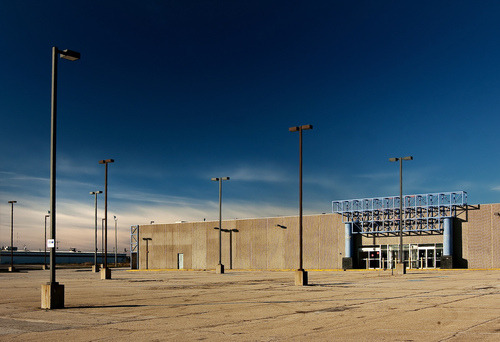
    Earlier this week, I was having a conversation with a number of smart real estate people about the future of retail in today’s internet and smartphone world. This, of course, isn’t a new topic. The industry has been discussing it for years. And while internet retailing still accounts for a relatively small percentage of overall retail sales (~10%), we all know that change is coming.

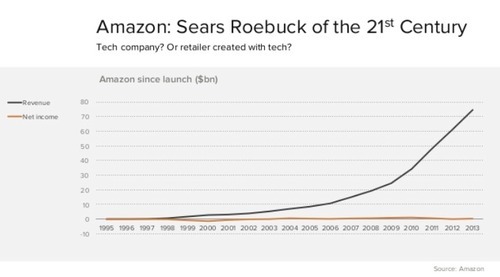
    One company that came up during our discussion was not surprisingly Amazon.com. But the initial comment was that they don’t make any money. Fortunately for me I had just gone through a presentation by venture capitalist Benedict Evans the night before called: Mobile is eating the world. And so I pulled out my phone and presented this slide:

    image

    The fact that Amazon operates with basically no net income is on purpose. Look at their revenue growth! So I wouldn’t dismiss them as being a fad. They may only account for 1% of all US retail sales today, but I’d put money on that percentage growing.

    The other reason I bring up Amazon is because, in some ways, I think of them as the online equivalent of a big box store. Just like a Walmart or Costco, where you can buy everything from tires to groceries to prescription drugs, I buy a lot of different things, besides just books, off of Amazon.com. You might do the same as well. And this is where I see the immediate threat to offline retailing and retail real estate: big box stores.

    In the second half of the 20th century, big box stores were incredibly disruptive to the retail landscape (and to cities). They used cheap land on the outskirts of cities, cheap buildings, and economies of scale to offer rock bottom prices to consumers. The value proposition was about cheap, not about differentiation. But as cheap as they may be, the internet can still do it cheaper.

    And retailers know this, which is why I think they all now sell groceries. Groceries have a very low online penetration. Basically everybody still buys groceries in-person. So if you offer that, you have a reason to draw people inside your store, where they will hopefully buy all the other stuff that they need. But as the online value proposition continues to get stronger, I think we’ll see many other, more significant, changes.

    Image: Flickr

  • How smartwatches will augment location

    image

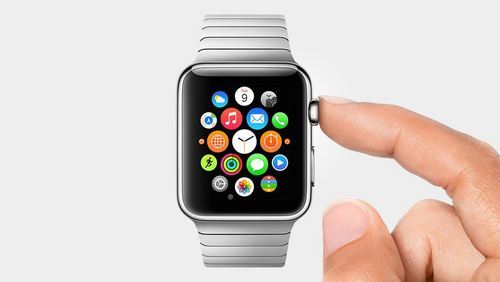
    So the rumors were right. Apple released a watch today. There will be 3 different “collections”, but lots of flexibility in terms of how each can be customized. There’s a big emphasis on health and fitness monitoring. Prices start at $350. And you’ll need an iPhone. Though you won’t be able to get one on your wrist until next year.

    Who knows whether or not it’ll catch on in the same way that iPod and iPhone did, but I think it has a damn good shot (more on this below). They’ve clearly put a lot of thought into both usability and the whole fashion side of the equation, which obviously needed to be done. Given that most people today use their phone for the time, the watch market strikes me as being heavily about style.

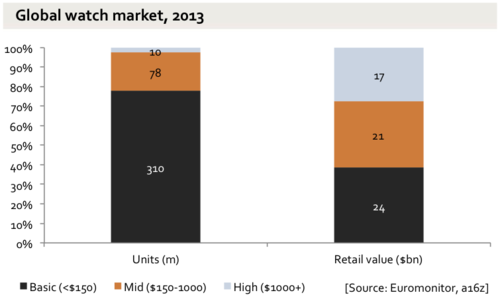
    In case you were wondering, here’s the watch market size as of 2013 (courtesy of Benedict Evans):

    image

    A lot of you might be skeptical about the need for a computer on your wrist (remember those watch calculators from the 80s?). But I think this time is different. Consider the number of people that now walk around with their phone in their hand and/or immediately pull it out whenever they have a free moment. We’ve become reliant (okay, addicted), to notifications and information.

    But in many of those cases, the smartphone isn’t the most efficient medium to be delivering those messages. Just like it’s not ideal to have to reach into your pocket to figure out what time it is, I think the watch could emerge as a new and better medium for a bunch of other pieces of information. And the big one could be location-aware or contextually-aware notifications.

    Here’s a tweet from Dennis Crowley – founder of Foursquare (Swarm) – talking about that exact thing:

    So what does this even mean?

    It means walking into a restaurant and having a tip pop up on your watch telling you what the best dish is (as shown in the tweet above). It’s driving down the street and having your watch notify you that there’s an open house 3 blocks away (and then giving you directions). It’s walking into a condo building and having your watch tell you that one of your friends is having a party on the 23rd floor. And so on.

    All of these notifications are currently already possible on your phone, but it’s not the ideal place for many of them. Which is why we’re all walking through life looking down at our phones. So while a computer strapped to your wrist may feel like we’re going further down that rabbit hole, it may actually free up more of our hands and our attention.

    And I’m sure there are many other possibilities that nobody has even thought of yet. Location just feels like a big one to me.

    //platform.twitter.com/widgets.js