Daily insights for city builders, delivered every morning at 6 AM ET. I’m Brandon Donnelly — a Toronto-based real estate developer and founder of Globizen. I’ve been writing here since 2013.
The United States and the United Kingdom recently published some official statistics on the impacts that this pandemic has had on ecommerce. The above chart is from Benedict Evans and he has some more over here. It’s worth a click through. What is clear is that lockdown forced a whole bunch of adoption and accelerated trends that were already underway. More people turned to shopping online. The UK went from 20% ecommerce penetration to over 30%. And the US went from 17% to about 22%. What is also clear is that grocery has demonstrated to be exceptionally resilient. Most physical retailers saw a decline in sales during lockdown. Grocery proved to be a notable exception. But what is unclear is how much of this adoption will actually stick. The UK is reporting monthly (as opposed to quarterly for the US) and already you can see signs of a possible reversion. My guess is that — provided we don’t see another major lockdown — there will be a meaningful reversion before the trend line resumes its march.
Back in February, I shared a presentation by Benedict Evans about the macro and strategic trends that have been playing out in the tech industry. (Of course, the potential impacts go well beyond tech.) Well that was February and lot has happened since then. So he has updated a bunch of his slides and it is now called, “Tech and the new normal.” We know that things have changed, but we don’t know what things will really look like when this is all over — and which changes will have durability. Benedict doesn’t necessarily prognosticate in his presentation, but he does provide valuable historical context and some great data. So there are a lot of conclusions that you might be able to draw from it on your own. It’s also my kind of slide deck. Not a lot of text. Lots of graphics/diagrams. And really only one key takeaway per slide. Here you are.
Joining a Zoom (or other video) meeting is as frictionless as opening up the calendar invite and clicking the link. No need to login or do much else, except maybe fiddle with the audio for a bit. “Can you hear me now?” The benefits to this are obvious. But if you’re Zoom (or another video conferencing company) there could be a slight problem: I don’t really care where that link is taking me, as long as it’s taking me to the meeting I was supposed to join 4 minutes ago. In other words, there aren’t really any network effects. The service doesn’t get any better for me as more people use it, because anybody can join the link that I send them. Benedict Evans recently made this argument, here, and he goes on to posit that video calls, like voice calls, are destined to become a commodity. All that will matter is how you package them up. Makes sense.
There’s an argument out that there this pandemic isn’t necessarily going to precipitate new changes, it’s simply going to accelerate changes that were already underway. Benedict Evans begins to illustrate this point in a recent blog post called, COVID and cascading collapses.
In it, he starts by looking at US print advertising revenue. In the first decade or so of the consumer internet, newspapers and magazines actually managed to hold their own. It’s not until after 2008 that they really start to fall off and lose significant market share to internet advertising (most of which belongs to Google and Facebook).
Intuitively this makes sense. During a crisis, budgets invariably get cut. And then when the market comes back, as it always does, you have people actually thinking about where those dollars should be spent: “Hey, maybe we should put some more money toward that Facebook thing.” It’s a reset moment.
The other interesting thing about the decline of print advertising is that if look at a longer time horizon — say 85 years, as Benedict did — you can see that its share has been declining for a very long time thanks to television. Of course, now television is changing. US consumers are “cord-cutting” faster than they’re moving to buy things online.
Wired recently published a long read called, “I stumbled across a huge Airbnb scam that’s taking over London.” Apparently the people who do these sorts of things on the platform (things that are both illegal and questionable) call it “systemizing.” This is the process of trying to create scale. Secure lots of units. Create a bunch of fake/duplicate accounts. And try and maximize revenue.
This obviously runs counter to Airbnb’s mission of “authentic places”, “community”, and “local hosts.” But as Benedict Evans points out in his latest newsletter, “where there is money and people, there will be scams.” And Airbnb is obviously doing everything it can to quash this kind of activity, especially as it prepares for a possible IPO this year. The company has a policy of zero tolerance.
Fraud and government regulation are likely to be the two biggest kinks to work out as the company gets ready for public consumption. I am sure an equilibrium will be found; it’s just going to take some time and a few lawyers. It goes to show you just how challenging startups can be when you combine digital (tech) and physical (real estate).
Every year, Benedict Evans publishes a “big presentation” on the current trends in tech. They are always excellent and they help to put a lot of things into perspective. This year he covers everything from TV subscriptions to online mattress companies (there were 175 of them as of last year), and asks: What’s next in tech?
New technologies have typically come in S-Curves (see above). They start out slow, see rapid growth, and then taper off. To use Benedict’s wording, they go from stupid to exciting and then to boring. Smartphones are currently in the boring phase. Each new year sees only incremental change. So, what’s next? That is still TBD.
To download a full copy of the presentation, click here.
Benedict Evan’s latest post on Microsoft, IBM, and anti-trust is excellent. In it he argues (reminds us) that market power during one generation of tech, doesn’t necessarily guarantee market power in the next. And that anti-trust intervention isn’t actually responsible for Microsoft missing out on, among other things, mobile. The rules of engagement simply changed. The PC is now a smartphone accessory.
Here is an excerpt:
The tech industry loves to talk about ‘moats’ around a business – some mechanic of the product or market that forms a fundamental structural barrier to competition, so that just having a better product isn‘t enough to break in. But there are several ways that a moat can stop working. Sometimes the King orders you to fill in the moat and knock down the walls. This is the deus ex machina of state intervention – of anti-trust investigations and trials. But sometimes the river changes course, or the harbour silts up, or someone opens a new pass over the mountains, or the trade routes move, and the castle is still there and still impregnable but slowly stops being important. This is what happened to IBM and Microsoft. The competition isn’t another mainframe company or another PC operating system – it’s something that solves the same underlying user needs in very different ways, or creates new ones that matter more. The web didn’t bridge Microsoft’s moat – it went around, and made it irrelevant. Of course, this isn’t limited to tech – railway and ocean liner companies didn’t make the jump into airlines either. But those companies had a run of a century – IBM and Microsoft each only got 20 years.
Benedict Evan’s most recent blog post, called “Amazon as experiment,” draws some interesting parallels between what Amazon is doing today (and experimenting with) and the beginning of mass retail, namely the invention of the department store. He also talks about some of the shortcomings of Amazon’s model, which isn’t at all focused on (or good at) things such as “pleasure” and product discovery. Here are a couple of excerpts:
On the other hand, it’s interesting that Amazon seems to be doing as much experimentation as possible around the logistics model—from stores to drones to warehouse robots of every kind—but much less around the buying experience, other than small-scale tests of the Four-Star stores. After all, historically, department stores were about pleasure as much as they were about convenience or price. They changed what it meant to “go shopping” and helped turn retail into a leisure activity.
This has always been the gap in the Amazon model. It’s ever more efficient at finding what you already know you want and shipping it to you, but bad at suggesting things you don’t already know about, and terrible whenever a product needs something specific—just try finding children’s shoes by size.
This is probably inherent in the model. For Amazon to scale indefinitely to unlimited kinds of products, it needs to have more or less the same commodity logistics model for all of them. That’s the line it’s never been willing to cross. Amazon doesn’t do “unscalable.” And yet, while we now know there is nothing that people won’t happily buy online, not everything will fit that commodity model. So maybe that’s the real test of Amazon’s pride: can it work out how to let us shop, rather than just buy?
Machine learning is one of the most important trends in tech right now. But like anything new, it naturally raises a number of important questions and concerns. Benedict Evan’s most recent blog post provides a good explanation of what he refers to as the artificial intelligence bias. Here are a couple of excerpts that I found interesting.
What machine learning does:
With machine learning, we don’t use hand-written rules to recognise X or Y. Instead, we take a thousand examples of X and a thousand examples of Y, and we get the computer to build a model based on statistical analysis of those examples. Then we can give that model a new data point and it says, with a given degree of accuracy, whether it fits example set X or example set Y. Machine learning uses data to generate a model, rather than a human being writing the model. This produces startlingly good results, particularly for recognition or pattern-finding problems, and this is the reason why the whole tech industry is being remade around machine learning.
The rub:
However, there’s a catch. In the real world, your thousand (or hundred thousand, or million) examples of X and Y also contain A, B, J, L, O, R, and P. Those may not be evenly distributed, and they may be prominent enough that the system pays more attention to L and R than it does to X.
What AI isn’t:
I often think that the term ‘artificial intelligence’ is deeply unhelpful in conversations like this. It creates the largely false impression that we have actually created, well, intelligence – that we are somehow on a path to HAL 9000 or Skynet – towards something that actually understands. We aren’t.
The conclusion:
Hence, it is completely false to say that ‘AI is maths, so it cannot be biased’. But it is equally false to say that ML is ‘inherently biased’. ML finds patterns in data – what patterns depends on the data, and the data is up to us, and what we do with it is up to us. Machine learning is much better at doing certain things than people, just as a dog is much better at finding drugs than people, but you wouldn’t convict someone on a dog’s evidence. And dogs are much more intelligent than any machine learning.
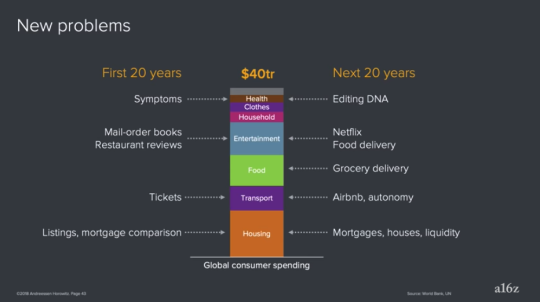
Above is a screenshot from a presentation about the future of tech that Benedict Evans gave last week at venture capital firm a16z’s annual conference. And below is a video of the talk. If you can’t see it, click here.
The talk is positioned as “the end of the beginning.” In other words, here is where the internet and smartphones have taken us, but that’s just the beginning. Quote: “We used to do apartment listings [online] and now Opendoor will buy your home.”