Daily insights for city builders, delivered every morning at 6 AM ET. I’m Brandon Donnelly — a Toronto-based real estate developer and founder of Globizen. I’ve been writing here since 2013.

Tag: bay area

  • Geography is no longer destiny

    image

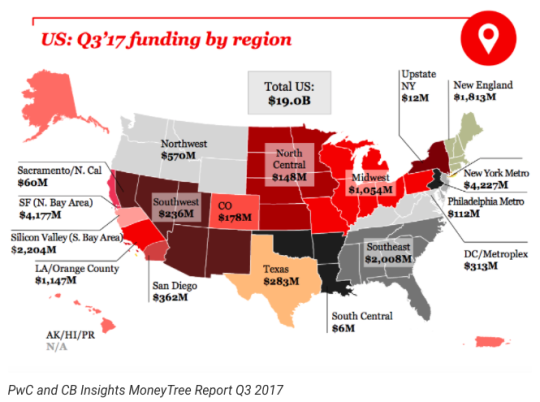
    The Q3 2017 Moneytree Report from PwC and CB Insights was recently released. It tracks venture capital trends in the US and globally. 

    Last quarter, US venture capital-backed companies saw $19 billion in total funding across 1,207 deals. Perhaps most notably for the US, funding in the NY metro area rose 57% to $4.227 billion and inched out the San Francisco Bay Area ($4.177 billion).

    But this was really because of two epic rounds to WeWork (NYC HQ) totalling around $2.5 billion. Also, Silicon Valley ($2.2 billion) is tracked separately to the San Francisco Bay Area in the report.

    Still, there’s a real sense that the New York tech ecosystem is on the rise and that it is probably furthest ahead in the US in terms of being able to catch up to California.

    Last week, MongoDB (NASDAQ: MDB) went public. Albert Wenger, who is an investor in the company, argued on his blog that this is an important milestone for technology companies based in New York. 

    It’s the first core technology company (instead of applied technology company) to go public in the city and it’s a big step forward in terms of demonstrating that “geography is no longer destiny.” 

    You don’t have to move to the Bay Area to win in tech.

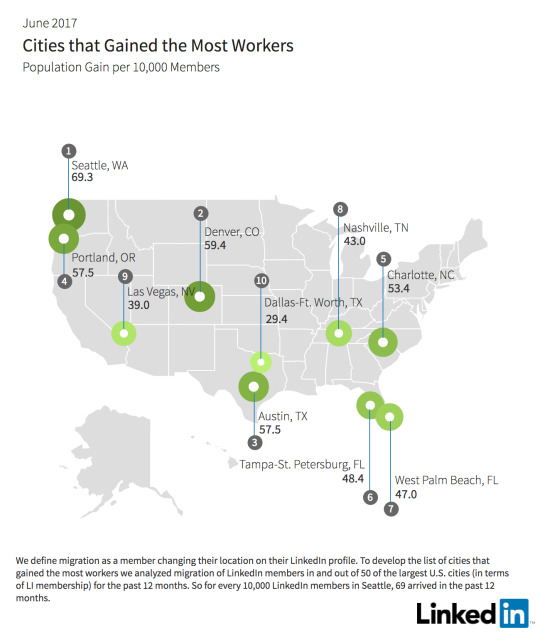
  • The U.S. cities that gained the most workers over the last 12 months

    One of the great things about social media is that it gives us access to data that previously didn’t exist or was difficult to collect.

    Take, for example, LinkedIn’s monthly report on employment trends called the Workforce Report. They look at which industries are hiring, where people are moving for jobs, and so on. Click here for the June 2017 edition. 

    Note that architecture/engineering hiring appears to be up nationally, which is usually a positive leading indicator.

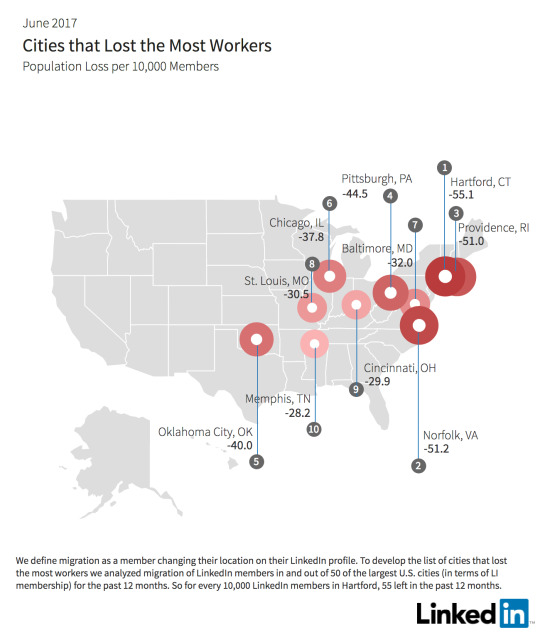
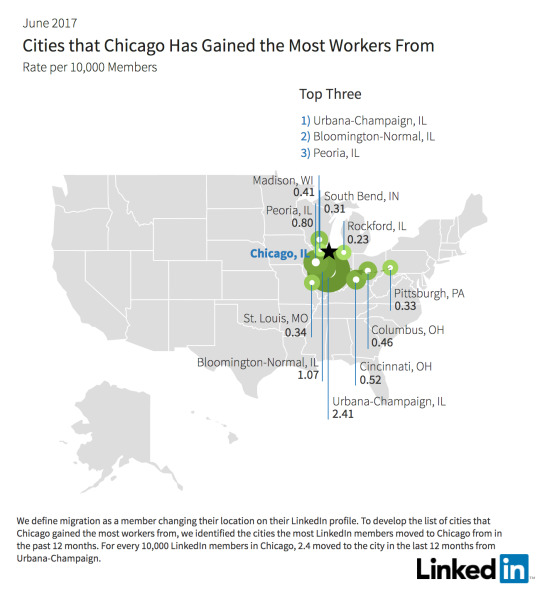
    I’ll leave you all to go through the report, but I did want to pull out a few of their maps and one of their takeaways. Below are maps of the cities that lost the most workers and gained the most workers over the last 12 months.

    The established trend of people moving from colder northern cities to warmer amenity-rich cities seem to play out here.

    That said, one of their “key insights” is that fewer workers today are moving to the San Francisco Bay Area. Since February 2017, there has been a 17% decline in the net number of workers.

    They blame housing affordability (ahem, lack of supply). People are simply turning to other great cities like Seattle, Portland, Denver, and Austin. They’re growing and cheaper.

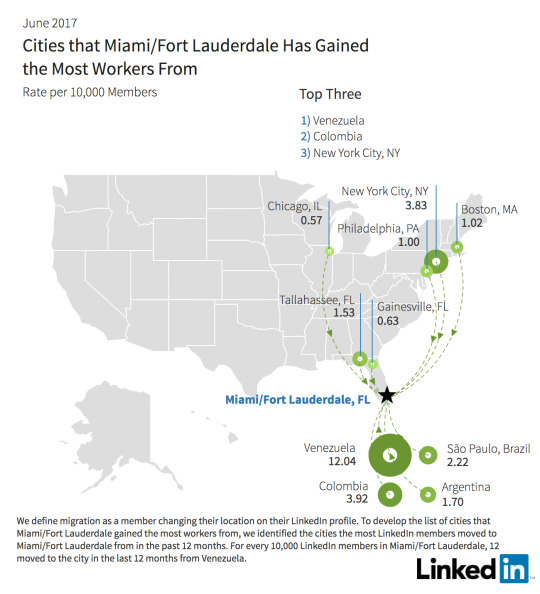
    One of the other cool things about the report is that you can drill down into individual cities to see where people are moving from. I looked up Miami and Chicago just to do a quick comparison. 

    Not surprisingly, Miami is seeing a significant contingent from South America. What’s interesting about this random comparison is how international Miami is and how regional Chicago is in terms of their draws.

    I would love to see similar data for Canada. This is valuable stuff.

  • Transit Flow

    This is a map of the Bay Area Rapid Transit network:

    And this is an elegant visualization by Ray Luong of ridership levels over the course of one day: February 4, 2016. If you can’t see the embedded video below, click here.

    [youtube https://www.youtube.com/watch?v=owGgbAS7Wq8?rel=0&w=560&h=315]

    Note how the lines speed up as they go through the Transbay Tube connecting San Francisco and Oakland. That’s actually what happens. Within the 10 km-long tube, the trains reach ~130 km/h, which is more than twice as fast as the average speed throughout the rest of the network.

  • The rise of tech outposts

    What happens when wages and real estate prices become too high in a city? Companies start growing in lower cost locations. We’ve all seen this before. 

    Fred Wilson recently blogged about this “spillover effect”, citing a New York Times article talking about the growth of tech offices in Phoenix. As someone who sits on the board of many technology companies, he was noticing a thematic trend:

    “A big theme of board meetings I’ve been in over the past year is the crazy high cost of talent in the big tech centers (SF, NYC, LA, Boston, Seattle) and the need to grow headcount in lower cost locations.”

    We talk a lot about housing prices on this blog, and so I think it’s useful to see how this, along with high wages, also impacts companies. The two are interrelated.

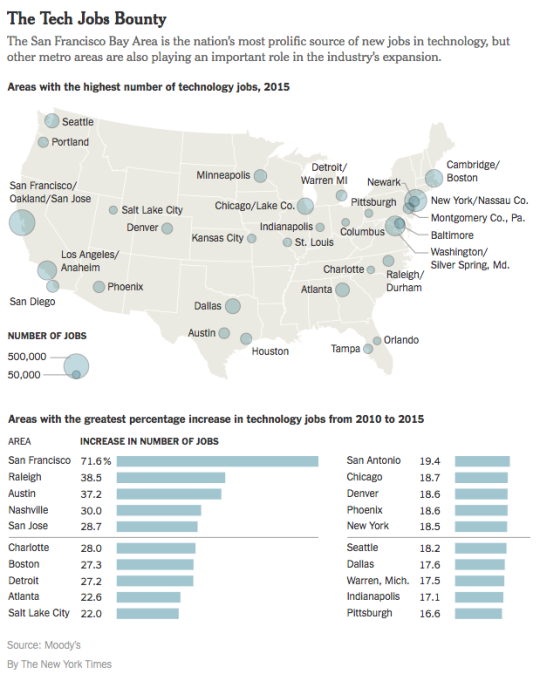
    Below is a chart from the NY Times article showing the US cities with the highest number of technology jobs and the most growth from 2010 to 2015. 

    San Francisco is in a league of its own. But overall, the growth is in tech and many cities are adding lots of technology jobs. Look at Detroit and Boston right beside each other (Detroit obviously has a smaller starting base). And look at how Miami is nowhere to be found.

    Of course, one interesting question is whether these new outposts – such as Phoenix – can truly come into their own and carve out a niche:

    “We don’t want to be San Francisco’s back office — we need more creators here,” said Scott Salkin, a founder and the chief executive of Allbound, which is based in Phoenix, makes sales software and has offices down the hall from Gainsight’s.

    Even with the high cost of living, it’s hard to supplant the coastal hegemony. That’s where people go to chase riches. As comedian Daniel Tosh likes to say, “the middle of the country is for people who gave up on their dreams.”

    Though for some, living in a place like Denver or Salt Lake City and snowboarding every weekend is a better outcome than living in a studio apartment and commuting an hour to work.

  • Dear City Council

    Kate Downing was formerly a planning commissioner in the City of Palo Alto. She recently resigned from her position and, about about a day ago, she posted her resignation letter on Medium. It has since gone viral.

    The reason it has spread so quickly, I think, is because it addresses the very same issues that so many cities around the world are facing: a lack of housing supply and eroding affordability.

    As a developer, I obviously have a vested interest in this matter. But to the extent that I can put that aside, I really do believe that our goal should be to build inclusive, rather than exclusive, cities.

    For instance, when I think of great cities such as New York and Toronto, I think of their history of taking in a large number of immigrants and then empowering them to climb the socioeconomic ladder. There’s something magical about that. One of my best friends likes to talk about this potential as “immigrant hustle.”

    But when we sterilize our cities by allowing only the incumbents to survive, I believe we place that socioeconomic potential in jeopardy. So for that reason, I am reposting Kate’s entire letter. I have bolded the points that stood out for me. Let me know what you think in the comments.

    ———————————————————

    Dear City Council Members and Palo Alto Residents,

    This letter serves as my official resignation from the Planning and Transportation Commission. My family has decided to move to Santa Cruz. After many years of trying to make it work in Palo Alto, my husband and I cannot see a way to stay in Palo Alto and raise a family here. We rent our current home with another couple for $6200 a month; if we wanted to buy the same home and share it with children and not roommates, it would cost $2.7M and our monthly payment would be $12,177 a month in mortgage, taxes, and insurance. That’s $146,127 per year — an entire professional’s income before taxes. This is unaffordable even for an attorney and a software engineer.

    It’s clear that if professionals like me cannot raise a family here, then all of our teachers, first responders, and service workers are in dire straits. We already see openings at our police department that we can’t fill and numerous teacher contracts that we can’t renew because the cost of housing is astronomical not just in Palo Alto but many miles in each direction. I have repeatedly made recommendations to the Council to expand the housing supply in Palo Alto so that together with our neighboring cities who are already adding housing, we can start to make a dent in the jobs-housing imbalance that causes housing prices throughout the Bay Area to spiral out of control. Small steps like allowing 2 floors of housing instead of 1 in mixed use developments, enforcing minimum density requirements so that developers build apartments instead of penthouses, legalizing duplexes, easing restrictions on granny units, leveraging the residential parking permit program to experiment with housing for people who don’t want or need two cars, and allowing single-use areas like the Stanford shopping center to add housing on top of shops (or offices), would go a long way in adding desperately needed housing units while maintaining the character of our neighborhoods and preserving historic structures throughout.

    Time and again, I’ve seen dozens of people come to both Commission meetings and Council meetings asking Council to make housing its top priority. The City Council received over 1000 signatures from Palo Alto residents asking for the same. In the annual Our Palo Alto survey, it is the top issue cited by residents. This Council has ignored the majority of residents and has chartered a course for the next 15 years of this city’s development which substantially continues the same job-housing imbalance this community has been suffering from for some time now: more offices, a nominal amount of housing which the Council is already laying the groundwork to tax out of existence, lip service to preserving retail that simply has no reason to keep serving the average Joe when the city is only affordable to Joe Millionaires.

    Over the last 5 years I’ve seen dozens of my friends leave Palo Alto and often leave the Bay Area entirely. I’ve seen friends from other states get job offers here and then turn them down when they started to look at the price of housing. I struggle to think what Palo Alto will become and what it will represent when young families have no hope of ever putting down roots here, and meanwhile the community is engulfed with middle-aged jet-setting executives and investors who are hardly the sort to be personally volunteering for neighborhood block parties, earthquake preparedness responsibilities, or neighborhood watch. If things keep going as they are, yes, Palo Alto’s streets will look just as they did decades ago, but its inhabitants, spirit, and sense of community will be unrecognizable. A once thriving city will turn into a hollowed out museum. We should take care to remember that Palo Alto is famous the world over for its residents’ accomplishments, but none of those people would be able to live in Palo Alto were they starting out today.

    Sincerely,

    Kate Downing

  • Market vs. subsidized

    Miriam Zuk and Karen Chapple of the University of California, Berkeley, recently published a research brief called Housing Production, Filtering and Displacement: Untangling the Relationships

    It’s a nuanced look at the impact of both market-rate and subsidized housing production on affordability and displacement within the San Francisco Bay Area.

    The report is essentially a response to the debate around whether increasing market-rate housing production alone can address affordability and displacement concerns, or whether the only way to do it is through subsidized housing. What they found was that both matter, but…

    “What we find largely supports the argument that building
    more housing, both market-rate and subsidized, will
    reduce displacement. However, we find that subsidized
    housing will have a much greater impact on reducing displacement
    than market-rate housing. We agree that market-rate
    development is important for many reasons, including
    reducing housing pressures at the regional scale and housing
    large segments of the population. However, our analysis
    strongly suggests that subsidized housing production is even
    more important when it comes to reducing displacement of
    low-income households.”

    If you’re interested in this topic, I recommend reading the full brief. It’s only 12 pages. I particularly liked the information around filtering and how new housing steps down over time to ultimately serve lower-income households.

  • Rentberry brings open bidding to rental market in San Francisco

    A new startup out of San Francisco, called Rentberry, has just launched, allowing tenants to openly bid on rentals in the city. Think of it like a rental auction. Landlord lists property. And then tenants compete for it by submitting offers. 

    Not surprisingly – especially since we’re talking about San Francisco – there’s concern that this will do nothing but drive up the city’s already high rents.

    But I think the key detail is that the platform will make public the total number of applicants. As a tenant, it’ll even tell you how your credit score compares to those of the other bidders (presumably, so you can gauge how aggressive you might need to be on your bid).

    The real estate industry is rife with information asymmetries. So anything that improves transparency is something that catches my attention. If you’ve ever bought or rented a place in a competitive market, you know that one of the worst things you can hear from the broker is: “We have another offer.” (Even worse: “We have 12 other offers.”)

    It’s frustrating because it now means you’re competing. But even more frustrating is the fact that you have no way of assessing whether or not that statement is fact or fiction. Yes, I realize that there’s a code of ethics that’s supposed be followed, but you and I both know that games are played all the time.

    In fact, I think someone could easily make a full career out of just trying to correct the information asymmetries inherent in the real estate industry. Who knows what sort of impact they might be having on the market. So I’m excited to see how things pan out for Rentberry.

  • John Maeda’s #DesignInTech Report from SXSW

    One of the most interesting talks that I attended while I was in graduate school at Penn was by John Maeda

    John operates at the intersection of design, technology, and business, and I find his work fascinating. He’s probably best described as a graphic designer, visual artist, computer scientist, academic, and author. And when I heard him speak in 2008, he was also President of the Rhode Island School of Design.

    More recently though, John has entered the world of venture capital by becoming a “Design Partner” at Kleiner Perkins Caufield & Byers (KPCB) in Silicon Valley. But what’s really interesting about this move is that when he joined KPCB in January 2014, he was the first designer to arrive on Silicon Valley’s legendary Sand Hill Road. No other VC firm had a designer in-house.

    And that’s because design hasn’t, at least historically, been considered that important. In fact, in some cases it was seen as being detrimental. Brian Chesky – cofounder of Airbnb – has gone on record saying that when they were first starting out, Silicon Valley didn’t think that a bunch of designers from RISD could build and run a company. Boy were they wrong.

    So that’s changing. As of this month (March 2015), there are now 6 other designers on Sand Hill Road. The venture capital community has seemingly woken up to the value of great design.

    John Maeda has branded this shift, #DesignInTech. And he recently gave a presentation on the topic at SXSW. It’s a great read, particularly if you’re somebody who cares about design. Click here if you can’t see it below.

    //www.slideshare.net/fullscreen/kleinerperkins/design-in-tech-report-2015

  • What should San Francisco do with the Tenderloin?

    image

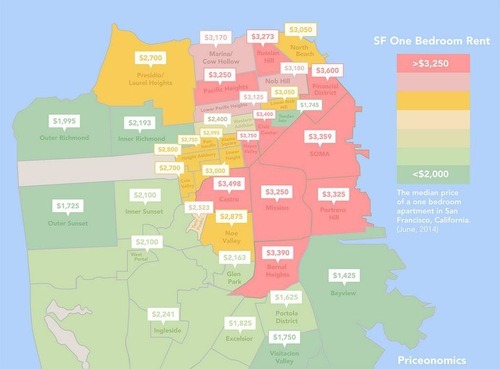
    Recently Priceonomics posted a piece on San Francisco’s “rent explosion.” In it, was the infographic above showing the median rental rate for a 1 bedroom apartment in the city. The most obvious takeaway is that San Francisco is real expensive. In the core of the city, you’re easily looking at $3,000 per month.

    That is with one exception: the Tenderloin (the green area just northwest of SOMA in downtown). The first time I ever visited San Francisco, I actually stayed on the outskirts of this area, which is a neighborhood well known for seediness, homelessness, crime, drug trade, strip clubs, and so on. And it was actually named after a similar neighborhood in New York that was also a center of vice in the late 19th and early 20th centuries.

    But when I saw this diagram, I immediately asked myself: How could it be that the Tenderloin was holding out so well against the forces of gentrification? How is this island of seediness being preserved in the center of downtown? Particularly in a city like San Francisco where there’s a perpetual housing supply shortage and lots of wealth. The Tenderloin has some of the lowest rents in the city.

    So I tweeted the good folks at Priceonomics and they responded with this article. It’s a few pages long, but the reasoning seems to come down to the following: active community groups that fought to keep developers out of the area (and that also own many of the buildings), downzoning, and a high percentage of rooming houses. According to that same article, the Tenderloin contains approximately 100 single room occupancy residential hotels (or SRO’s as they’re called). These were initially built to house the city’s transient and seasonal population after the great fire of 1906.

    So it would appear that there are some significant barriers to entry.

    But at the same time, it generally seems like a bad idea to concentrate poverty, homelessness, drug users, and so on. Interestingly enough, the article talks about how when the Bay Area’s transit system went on strike for a period of time, the supply of drugs actually dried up in the Tenderloin. This underscores how regional the drug business is, but also makes me think that dealers are almost surely benefiting from the clustering of their client base.

    In any event, this is a much larger problem than just a real estate development one. I don’t know what the solution should be, but I’m pretty sure that things are being made worse by concentrating everything in one neighborhood and by rising income inequality in the city. Inequality seems to lead to all kinds of negative externalities and, from my experience, mixed-income neighborhoods perform better than 100% poor ones.

  • Further evidence that laneway housing is going to happen

    image

    Earlier this week Fast Company ran a piece talking about “the next big thing in urban planning” – backyard cottages. As the name suggests, backyard cottages are basically accessory dwellings built in the backyards of existing single family homes. And the idea is that they’ll provide new affordable housing options in competitive and supply constrained markets such as the Bay Area in California.

    While somewhat different than laneway housing–which you probably know I support here in Toronto–they do share many similarities. We’re talking about the intensification of our residential neighborhoods at the scale of the single family home. And the potential benefits go beyond just affordability. It would also make our communities more sustainable, more walkable, and more conducive to transit.

    But there are challenges. I don’t know about the Bay Area, but many municipalities don’t allow a “house behind a house” and many communities don’t want to see their neighborhood itensify. However, we are seeing companies, like New Avenue, emerge to help homeowners navigate the process of building a backyard cottage. This company in particular claims to have worked with over 90 homeowners. 

    So I think we’re going to see more, not less, of these types of housing solutions. Vancouver is already doing it. And so is Portland

    Now here’s a question for you. If you owned a house in a single family neighborhood, would you be fussed if your neighbor erected a backyard cottage or laneway house? I’d love to get your opinion. Let me know in the comment section below.

    Image: New Avenue